50 centavos 1916
Market Prices
4 salesAbout This Note
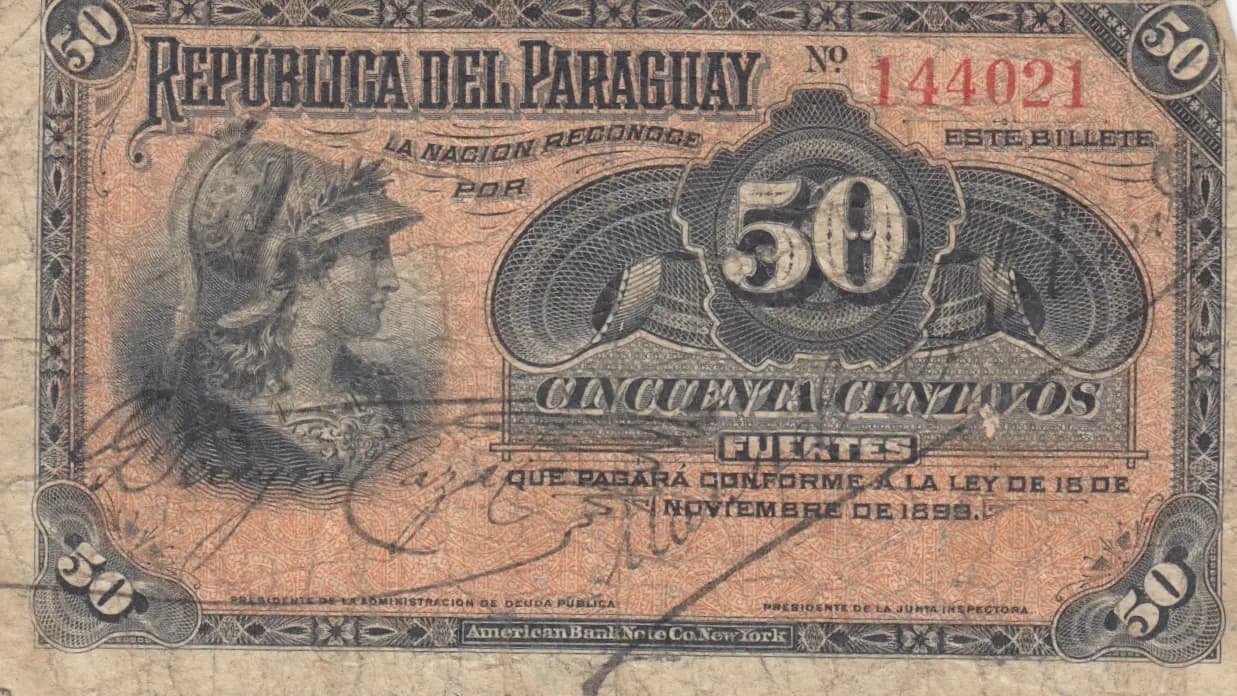
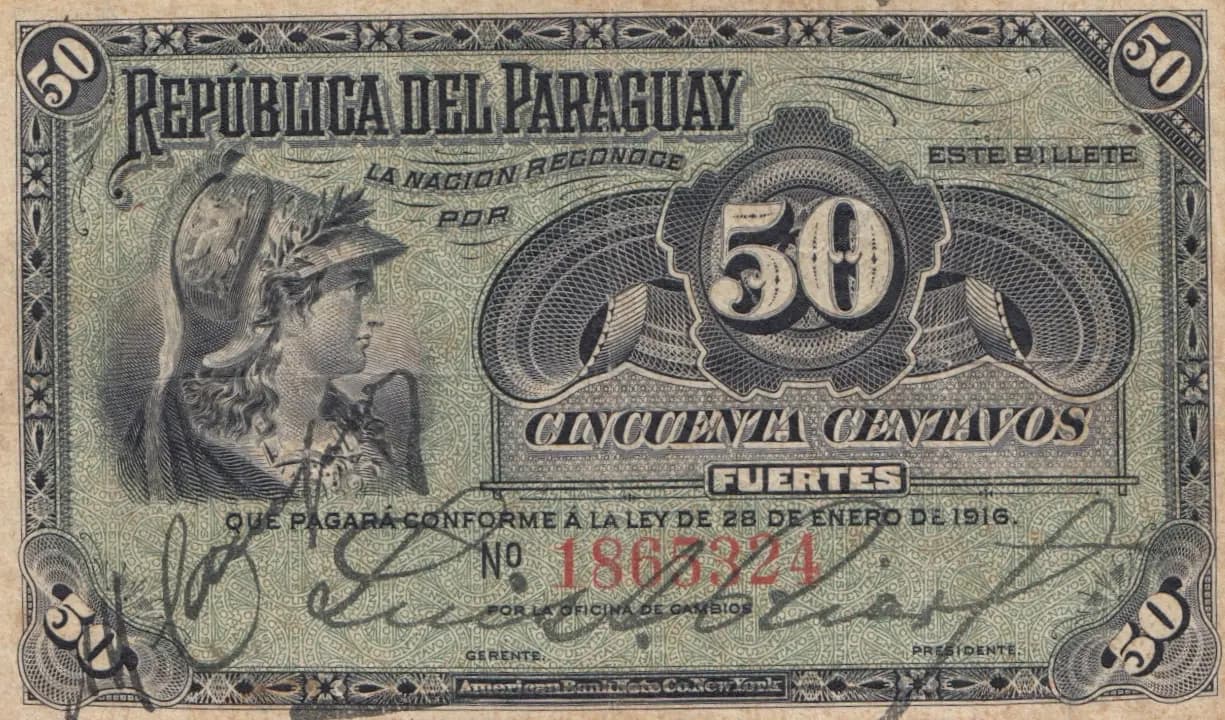
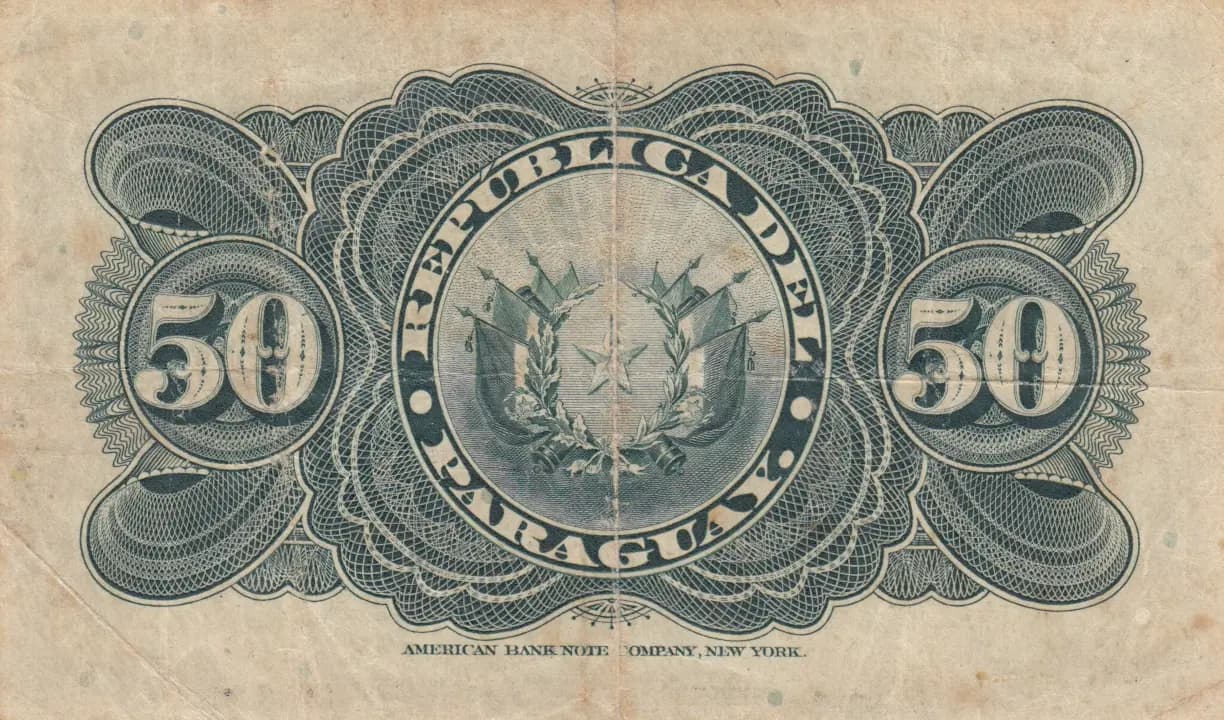
This Paraguay 50 Centavos Fuertes from 1916 (Pick P-137) is a classical early 20th-century banknote issued by the Oficina de Cambios, featuring a striking allegorical Liberty figure on the obverse and the national coat of arms on the reverse. The note exhibits typical F (Fine) condition wear including visible creasing, fold marks, and age-related patina consistent with a note that has seen moderate circulation over more than a century. The fine engraved work by American Bank Note Company and the note's historical significance as legal tender under the Law of January 28, 1916, make it an attractive example for collectors of Paraguayan currency.
Common. This note trades regularly on the numismatic market, with eBay sales data showing examples in F-VF condition selling for $10-$31, and catalog values from 2016 placing Fine condition at approximately $4. The regular issue status, substantial print run implied by the high serial number (1,807,224), and continuous availability in the secondary market all indicate this is a common banknote despite its historical age. The Oficina de Cambios issued this denomination in significant quantities during 1916.
This note was issued following Paraguay's enactment of legislation on January 28, 1916, establishing the Oficina de Cambios (Exchange Office) as the issuing authority for currency. The design reflects liberal political symbolism of the era, with Liberty (depicted as Minerva/Athena wearing a Phrygian cap and laurel wreath) representing democratic ideals, while the reverse displays Paraguay's national coat of arms with crossed arrows and palm/olive branches, symbolizing the nation's sovereignty and natural wealth. The note represents a transitional period in Paraguayan monetary history following the economic recovery from the devastating War of the Triple Alliance.
The obverse features Minerva (the Roman goddess of wisdom, here representing Liberty) depicted in profile facing right, wearing a Phrygian cap (symbol of liberty and revolutionary ideals) and a laurel wreath, positioned at the left side of the note. The center of the obverse contains a large ornamental oval frame enclosing the denomination '50' with the text 'CINCUENTA CENTAVOS FUERTES' below. Elaborate decorative borders with geometric and floral patterns frame the entire composition. The reverse displays Paraguay's national coat of arms—a shield containing crossed arrows flanked by olive or palm branch wreaths—centered within a circular inscription reading 'REPÚBLICA DEL PARAGUAY.' Large denomination numerals '50' appear on both the left and right sides of the shield. Both sides feature intricate engraved decorative borders with fine line work throughout, typical of prestigious bank note engraving of the period.
FRONT SIDE: 'REPÚBLICA DEL PARAGUAY' (Republic of Paraguay) | 'LA NACION RECONOCE POR ESTE BILLETE' (The Nation Recognizes By This Banknote) | '50' / 'CINCUENTA CENTAVOS FUERTES' (Fifty Strong Centavos) | 'QUE PAGARÁ CONFORME A LA LEY DE 28 DE ENERO DE 1916' (Which will be paid in accordance with the Law of January 28, 1916) | 'LA OFICINA DE CAMBIOS' (The Exchange Office) | 'GERENTE' (Manager) | 'PRESIDENTE' (President) | Serial number 'NO 1807224'. BACK SIDE: 'REPÚBLICA DEL PARAGUAY' (Republic of Paraguay) | Large denomination numerals '50' | 'AMERICAN BANK NOTE COMPANY, NEW YORK' (printer attribution).
Intaglio (engraved) printing executed by the American Bank Note Company of New York, one of the world's premier currency printers of the era. The technique is evident from the fine, precise line work, detailed hatching patterns in the ornamental frames, and the complex heraldic rendering of the coat of arms. The two-color printing (black and green underprint) was applied in separate passes. Security features rely on the complexity and difficulty of reproducing the intricate engraved designs rather than on modern security threads or watermarks.
The note displays four known signature varieties for this issue. The observed example (serial NO 1807224) appears to be from the main printing run. No overprints, date variations, or other distinguishing characteristics are evident in the visual analysis. The serial number in red ink and the presence of signature blocks for both 'GERENTE' (Manager) and 'PRESIDENTE' (President) are consistent with standard production characteristics of the 1916 issue.