5 pesos 1920
Market Prices
2 salesAbout This Note
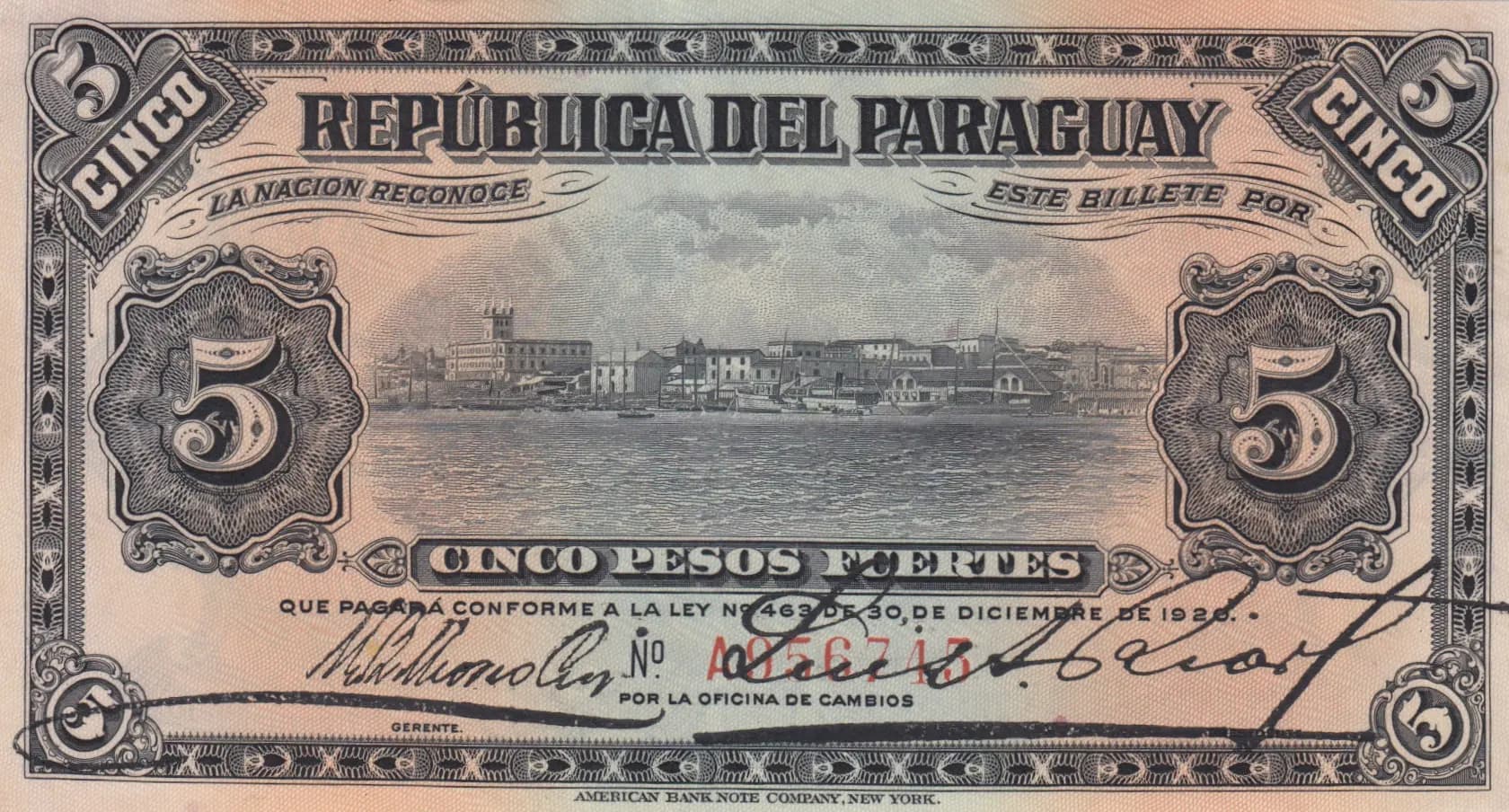
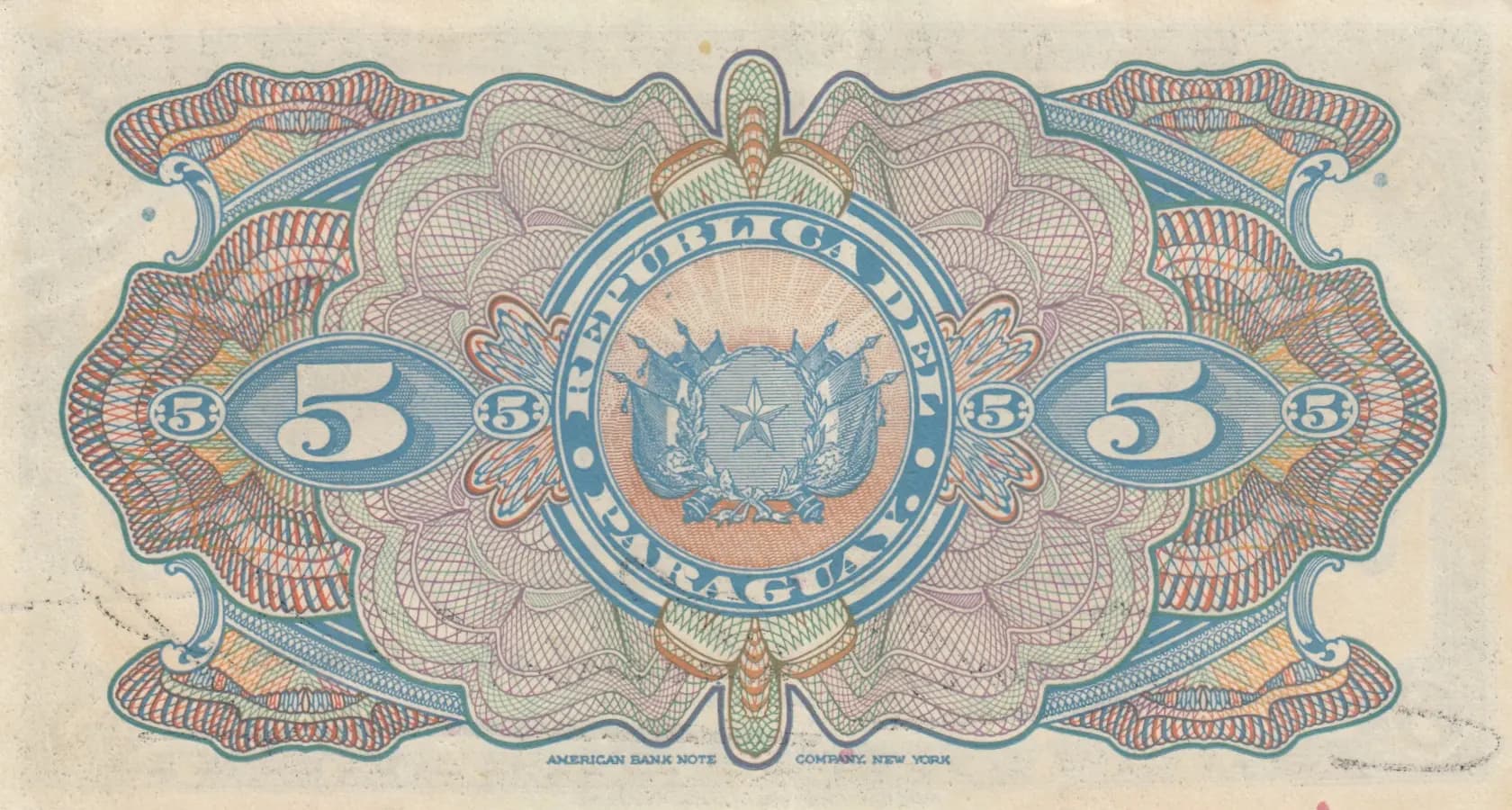
This is a well-preserved example of Paraguay's 5 Pesos Fuertes from 1920, issued by Banco de la República del Paraguay and printed by the American Bank Note Company. The note features an exceptional engraved design with a detailed waterfront cityscape of Asunción on the obverse and the Paraguayan coat of arms on the reverse, rendered in multiple colors with fine security line work. Despite visible age-related foxing and some handwritten overlay marks from handling, the note retains excellent clarity in its intricate engraving and remains in EF condition, representing a desirable example of early 20th-century Paraguayan currency design.
Common. Catalog data shows eBay market prices for this note in lower grades (VG at $18.13, F at $15.50) and 2016 catalog valuations placing EF at $12.50 and UNC at $35, indicating this is a regularly traded note with steady but modest collector demand. The PMG population report shows at least one graded variant, suggesting multiple examples have entered the professional grading market. The note's production by a major security printer and its survival in quantities sufficient to appear frequently in the numismatic market indicate a substantial original print run.
This 1920 note was issued during Paraguay's post-war recovery period following the Chaco conflicts, when the Banco de la República del Paraguay sought to establish monetary stability through well-designed, difficult-to-counterfeit currency. The prominent depiction of Asunción's waterfront—complete with cathedral tower and commercial architecture—reflects national pride in the capital city's development and importance as the economic heart of the nation. The elaborate security features and use of the American Bank Note Company (the era's premier security printer) underscore Paraguay's commitment to modern banking infrastructure and preventing counterfeiting during a period of financial reorganization.
The obverse features a panoramic engraved scene of Asunción as viewed from the Río Paraguay, with a prominent cathedral or church tower bearing a cross at its apex serving as the focal point, surrounded by multi-story colonial and early 20th-century commercial buildings along the waterfront. The cityscape is framed by an ornate Baroque-style decorative border with elaborate scroll and floral motifs. Denomination cartouches in the form of ornamental ovals containing the numeral '5' and word 'CINCO' appear on both left and right margins. The reverse displays the coat of arms of Paraguay—featuring a star surrounded by a wreath—within a circular medallion and the text 'REPÚBLICA DEL PARAGUAY' arranged circularly around it. The reverse background employs sophisticated geometric mesh patterns in blue, orange, and green as anti-counterfeiting measures, with matching ornamental corner pieces. Both sides employ fine-line engraving throughout, typical of American Bank Note Company's premium security work.
Front Side: 'REPÚBLICA DEL PARAGUAY' (Republic of Paraguay), 'LA NACION RECONOCE' (The Nation Recognizes), 'ESTE BILLETE POR' (This Note For), 'CINCO' (Five), 'CINCO PESOS FUERTES' (Five Strong Pesos), 'QUE PAGARÁ CONFORME A LA LEY Nº 463 DE 30 DE DICIEMBRE DE 1928' (Which will be paid in accordance with Law No. 463 of December 30, 1928), 'POR LA OFICINA DE CAMBIOS' (By the Exchange Office), 'GERENTE' (Manager), 'AMERICAN BANK NOTE COMPANY, NEW YORK' (American Bank Note Company, New York). Back Side: 'REPÚBLICA DEL PARAGUAY' (Republic of Paraguay), denomination numeral '5' (Five), 'AMERICAN BANK NOTE COMPANY, NEW YORK' (American Bank Note Company, New York).
Steel-die engraving combined with color lithography. The note was produced by the American Bank Note Company, New York, one of the world's leading security printers of the era. The obverse employs primarily brown and black intaglio engraving with subtle green coloration in the water elements. The reverse utilizes multicolor lithography with geometric safety meshwork in blue, orange/coral, and green to create anti-counterfeiting barriers. The fine line work, intricate border designs, and complex interlocking geometric patterns throughout represent the state-of-the-art security printing technology of the 1920s.
Pick P-163 records a single cataloged variant. The note's date inscription references 'LAW Nº 463 DE 30 DE DICIEMBRE DE 1928' on the face, which is the legal authority under which the note was issued. The catalog data notes related P-149 notes with identical law dates but issued by 'Oficina de Cambios' rather than 'Banco de la Republica del Paraguay'—representing a distinct issuing authority variety. The observed example displays typical signature lines marked 'GERENTE' (Manager) but specific signatures or serial number characteristics are not clearly legible in the provided images due to overlay marks and age-related discoloration.