100 pesos 1907
Market Prices
33 salesAbout This Note
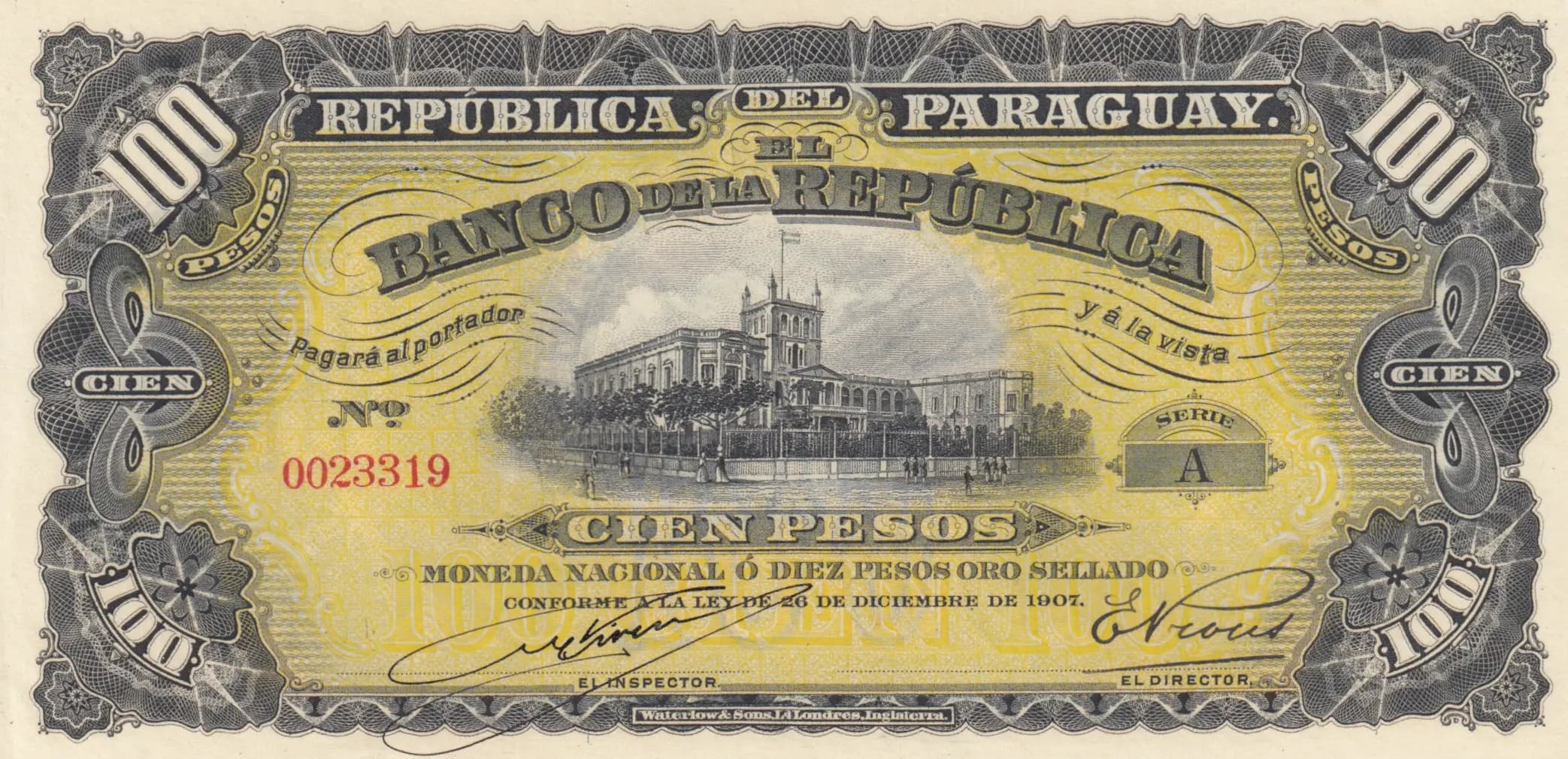
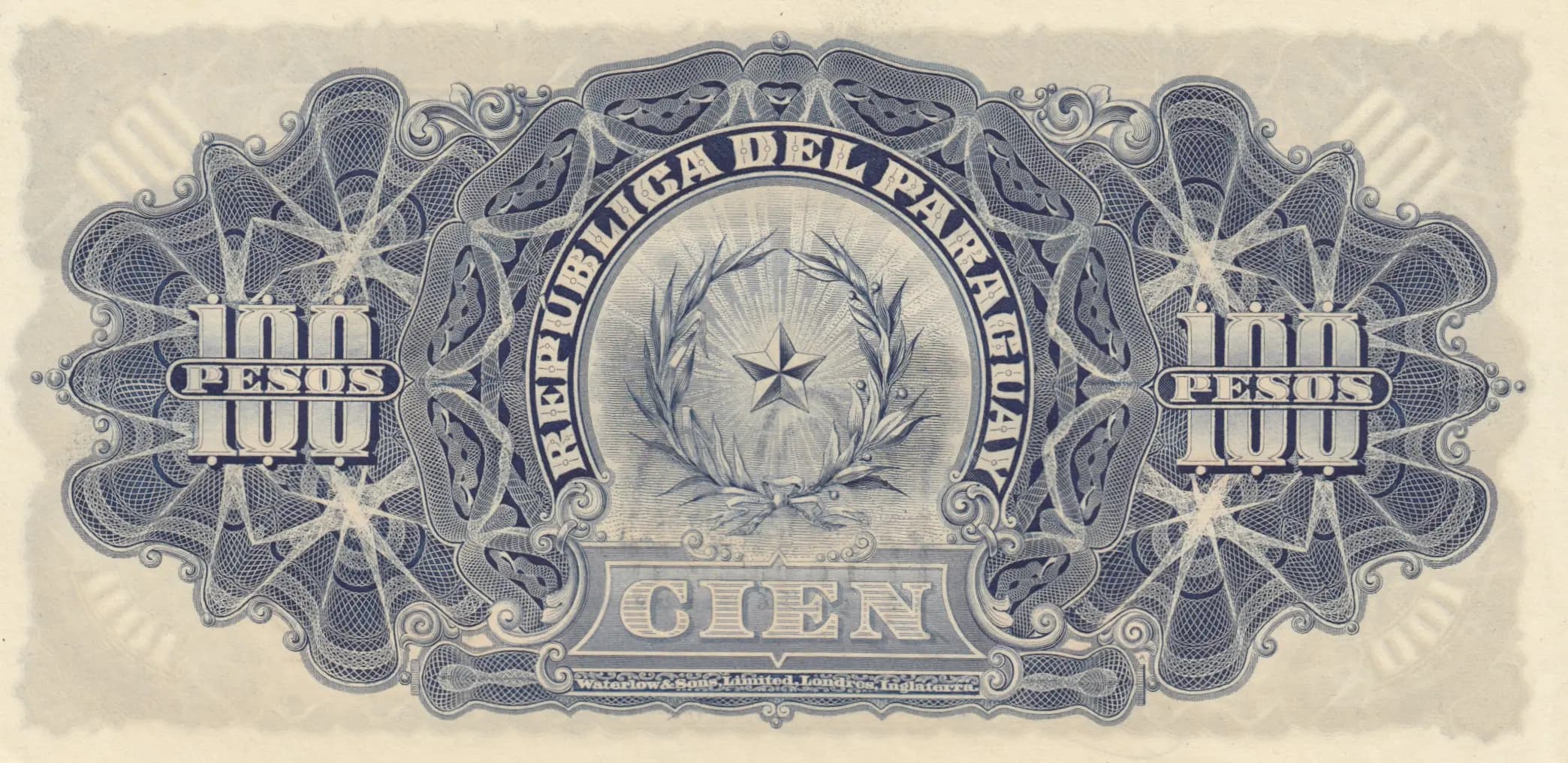
This is an exceptional uncirculated example of Paraguay's 1907 100 Pesos banknote (Pick P-159), issued by Banco de la Republica del Paraguay and printed by the prestigious London security printer Waterlow & Sons. The note displays pristine condition with no wear, creases, or folds, featuring a striking yellow/gold obverse with an architectural vignette at center and a blue-toned reverse showcasing the national arms within an ornate circular medallion. The intricate engraved baroque ornamentation and fine-line security work throughout exemplify the high-quality banknote production standards of the early 20th century.
Common. While this note is over 115 years old and represents an interesting piece of Paraguayan monetary history, the robust eBay sales data spanning from 2014 to 2025 indicates consistent availability in the collector market. UNC examples have sold regularly between $11.50 and $57.60, with PMG-graded examples commanding higher prices ($36–$231.50 depending on grade). The catalog value for UNC specimens stands at $12.50 as of 2016, and the consistent supply of multiple examples at auction auctions suggests a substantial original print run. No evidence of scarcity, recall, or short-lived issuance exists.
This note commemorates Paraguay's monetary reform of December 26, 1907, establishing the Banco de la Republica del Paraguay as the nation's central issuing authority. The De Los López Palace depicted on the obverse represents Paraguay's institutional heritage and governmental authority, while the central star and laurel wreaths on the reverse symbolize national pride and civic virtue. The denomination notation—'100 Pesos M.N. = 10 Pesos Oro'—reflects Paraguay's currency system of the period, which maintained a fixed relationship between national currency and gold.
The obverse features a grand institutional building identified as the De Los López Palace in Asunción, rendered as the central vignette with detailed architectural perspective showing a tower with spire, surrounding fencing, and landscaping elements. The composition is richly framed by baroque-style ornamental scrollwork, oval medallions in the corners, and heraldic decorative elements with floral motifs. The yellow/gold background contrasts dramatically with dark gray and black engraved lines, creating visual depth and security complexity. The reverse presents a more symbolic design, centering on Paraguay's national arms depicted within an ornate circular medallion—a five-pointed star surrounded by laurel or palm branches, contained within an oval banner frame. Large denomination numerals (100) appear in ornate boxes flanking the central design, with symmetrical baroque scrollwork extending to all margins. The blue engraved design on white/cream paper creates a formal, official appearance befitting a central bank issue.
{"front":{"header":"REPUBLICA DEL PARAGUAY / BANCO DE LA REPUBLICA (Republic of Paraguay / Bank of the Republic)","denomination":"CIEN PESOS (One Hundred Pesos)","legalBasis":"CONFORME A LA LEY DE 26 DE DICIEMBRE DE 1907 (In accordance with the Law of December 26, 1907)","paymentClause":"Pagará al portador y a la vista (Will pay to bearer on sight)","currencyNote":"MONEDA NACIONAL O DIEZ PESOS ORO SELLADO (National Currency or Ten Sealed Gold Pesos)","series":"SERIE A (Series A)","denomValue":"CIEN (One Hundred)","officials":"EL INSPECTOR / EL DIRECTOR (The Inspector / The Director)","serialNumber":"0023319","printer":"Waterlow & Sons Limited"},"back":{"header":"REPUBLICA DEL PARAGUAY (Republic of Paraguay)","denomination":"100 PESOS / CIEN (One Hundred Pesos)","printer":"Waterlow & Sons Limited, London"}}
Steel engraving and intaglio printing, executed by Waterlow & Sons Limited of London, one of the world's premier security printers of the era. The security features include intricate fine-line engraved work throughout both sides, complex geometric cross-hatching in background areas, elaborate baroque ornamental patterns serving as anti-counterfeiting deterrents, and finely detailed engraved official signatures. The multi-color approach (yellow/gold with dark gray on obverse; blue on reverse) required separate engraved plates and multiple impressions, a standard practice for high-security currency of the period.
This note exists in four documented signature varieties. The serial number 0023319 observed on this example, combined with the Series A designation and the fully intaglio-printed format without notable overprints, indicates this is a standard regular-issue variety from the initial 1907 release. The Waterlow & Sons imprint (abbreviated W&S in some references) confirms production by the London printer as stated in catalog data. No additional overprints, date variations, or emergency-issue markings are present on this specimen.