1 guarini 1963
Market Prices
17 salesAbout This Note
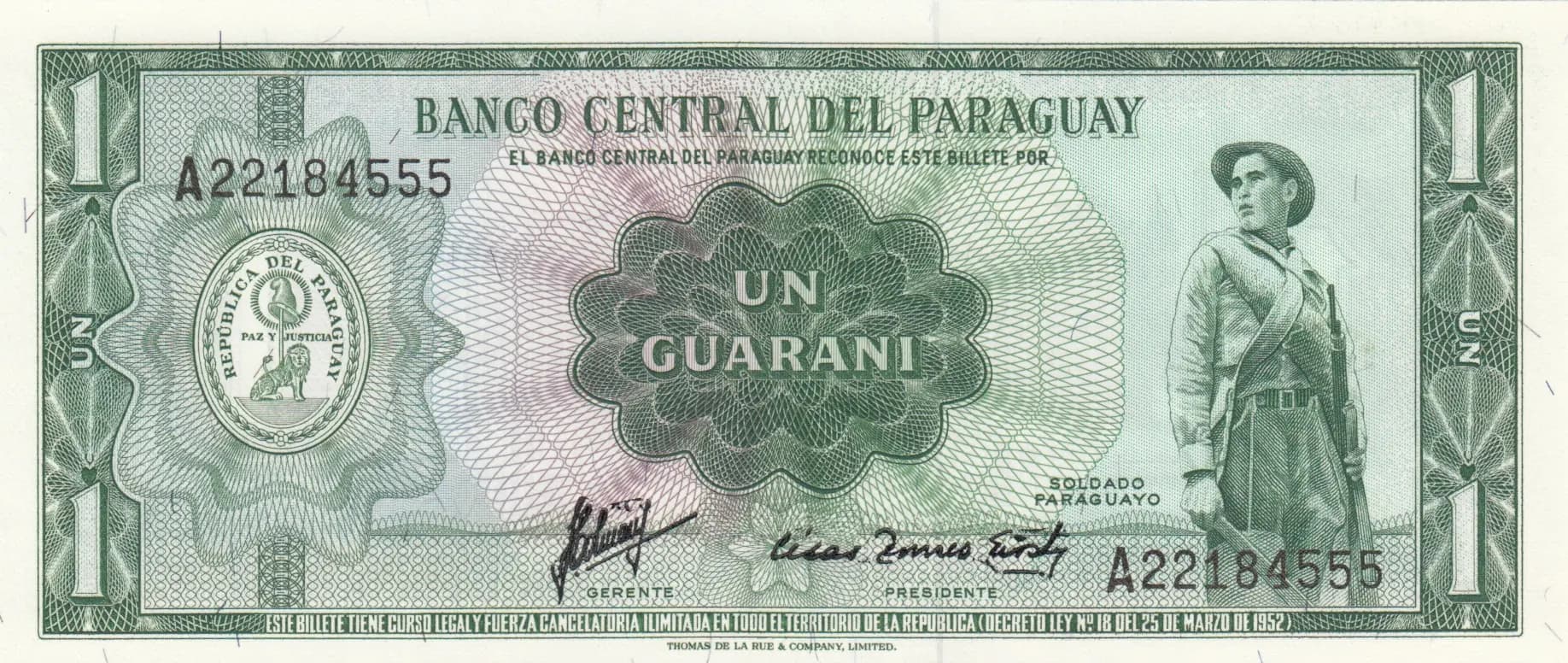
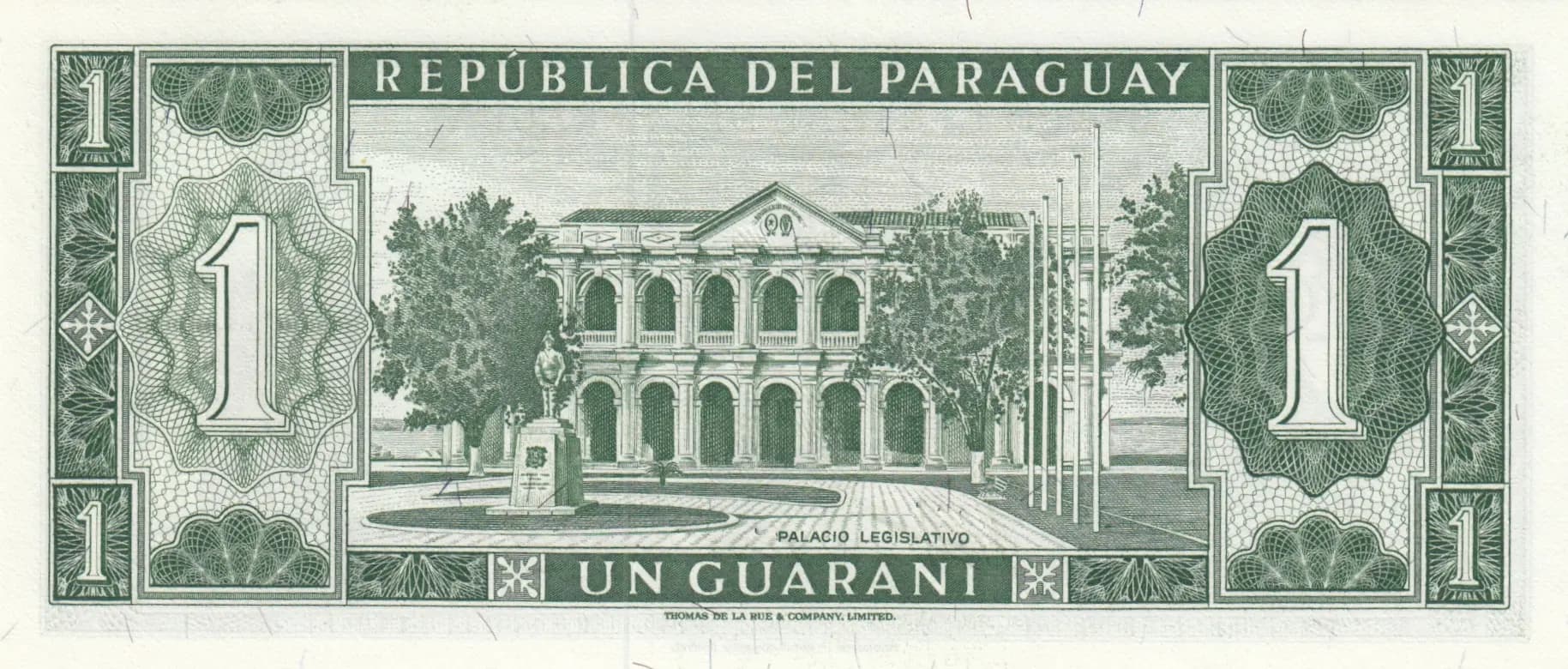
This 1 Guaraní note from Paraguay (Pick P-193b, 1963) presents a well-executed example of mid-20th century currency design by Thomas de la Rue. The obverse features a standing Paraguayan soldier in military dress uniform positioned opposite the national coat of arms, while the reverse displays the neoclassical Palacio Legislativo rendered in fine engraved detail. Despite evidence of circulation including creasing and spotting, the note retains good color saturation and readable serial numbering, making it a representative example of this regular issue from the early Central Bank of Paraguay era.
Common. This regular issue 1 Guaraní note exhibits high catalog frequency and consistent availability in the secondary market. eBay transaction history demonstrates regular sales in UNC condition ranging from $0.99 to $2.50 USD across a 9-year period (2012-2021), with numerous UNC sales documented. A PMG 65 specimen sold for $16.50 in 2020, suggesting a modest premium for high certification grades but no scarcity premium at the UNC level. The straightforward catalog designation (P-193b variant) and stable pricing indicate this is a standard circulation note with no special collector demand.
Issued under Law No. 19 of March 25, 1952, this banknote represents Paraguay's early post-war currency modernization under the Central Bank of Paraguay. The depicted Paraguayan soldier symbolizes national identity and sovereignty during the period following the Chaco War, while the Palacio Legislativo (now Museo Cabildo in Asunción) represented democratic governance and civic institutions. This 1963 printing reflects the broader Latin American trend of commissioning international security printers like Thomas de la Rue to establish credible, secure currency designs during the Cold War era.
The obverse features a formal composition with the Paraguayan national coat of arms (featuring a lion rampant, shield, and the national motto 'PAZ Y JUSTICIA') positioned in an oval seal on the left side, balanced by a standing male figure in full military dress uniform labeled 'SOLDADO PARAGUAYO' on the right. A large rosette-shaped ornamental frame containing the denomination 'UN GUARANI' anchors the center. The reverse presents the Palacio Legislativo, a two-story neoclassical building characterized by multiple arched windows, classical columns, a central dome, and surrounding landscaping with trees and a central monument or fountain. Large ornamental numeral '1' designs appear in decorative rectangular frames flanking both left and right margins. The entire design is framed by elaborate decorative borders featuring floral motifs, geometric patterns, and rosette ornaments typical of high-security currency design.
FRONT SIDE: 'BANCO CENTRAL DEL PARAGUAY' (Central Bank of Paraguay); 'EL BANCO CENTRAL DEL PARAGUAY RECONOCE ESTE BILLETE POR UN GUARANI' (The Central Bank of Paraguay recognizes this banknote for One Guarani); 'REPÚBLICA DEL PARAGUAY' / 'PAZ Y JUSTICIA' (Republic of Paraguay / Peace and Justice - from coat of arms); 'SOLDADO PARAGUAYO' (Paraguayan Soldier); signature lines for 'PRESIDENTE' (President) and 'GERENTE' (Manager); 'ESTE BILLETE TIENE CURSO LEGAL Y FUERZA CANCELATORIA ILIMITADA EN TODO EL TERRITORIO DE LA REPÚBLICA CONFORME A LEY Nº 19 DEL 25 DE MARZO DE 1952' (This banknote has unlimited legal tender and cancellation power throughout the territory of the Republic in accordance with Law No. 19 of March 25, 1952); 'THOMAS DE LA RUE & COMPANY, LIMITED' (printer attribution); Serial number: A22184555. BACK SIDE: 'REPÚBLICA DEL PARAGUAY' (Republic of Paraguay); 'UN GUARANI' (One Guarani); 'PALACIO LEGISLATIVO' (Legislative Palace); 'THOMAS DE LA RUE & COMPANY, LIMITED' (printer attribution); Serial number: A22184555 (repeated).
Intaglio (steel engraving) printing by Thomas de la Rue & Company, Limited, London. The visual analysis reveals characteristic fine line work, extensive cross-hatching patterns, detailed guilloché backgrounds, and intricate decorative borders—all hallmark techniques of intaglio currency production. The fine resolution of architectural detail in the Palacio Legislativo and the precision of the soldier's uniform rendering confirm professional security printing standards of the period.
Pick P-193b represents a variant within the 1 Guaraní 1963 issue. According to reference data, the obverse shows 'L.1952' (Law date) and is printed in green on multicolor underprint. The catalog notes two signature varieties for this denomination. Replacement notes were marked with serial number prefix 'Z,' which would constitute a distinct variety not present in this specimen bearing serial number 'A22184555.' This example appears to be a standard regular-issue variety without replacement designation. PMG has catalogued at least one variant (P-193a) for this Pick base number, suggesting print run variations or signature variety distinctions exist within this issue.