500 cordobas 1979 specimen
Market Prices
About This Note
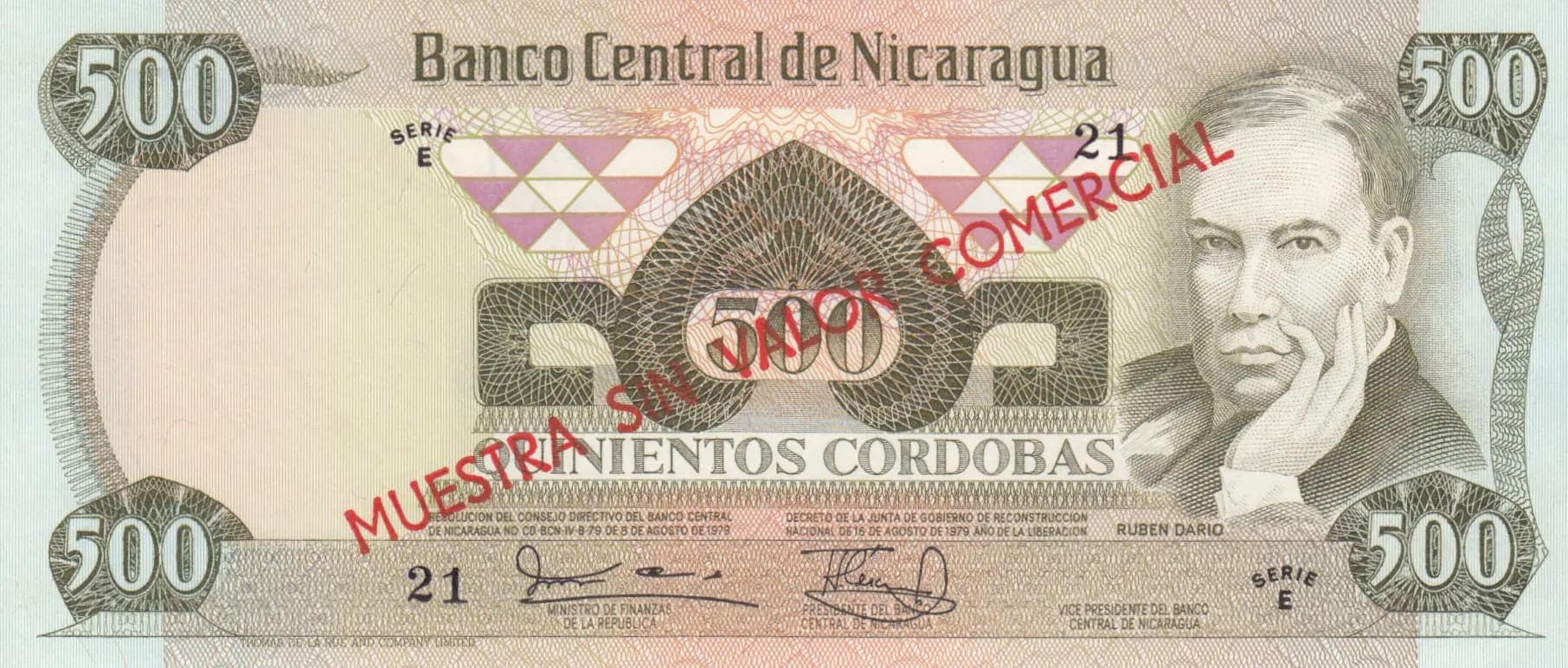
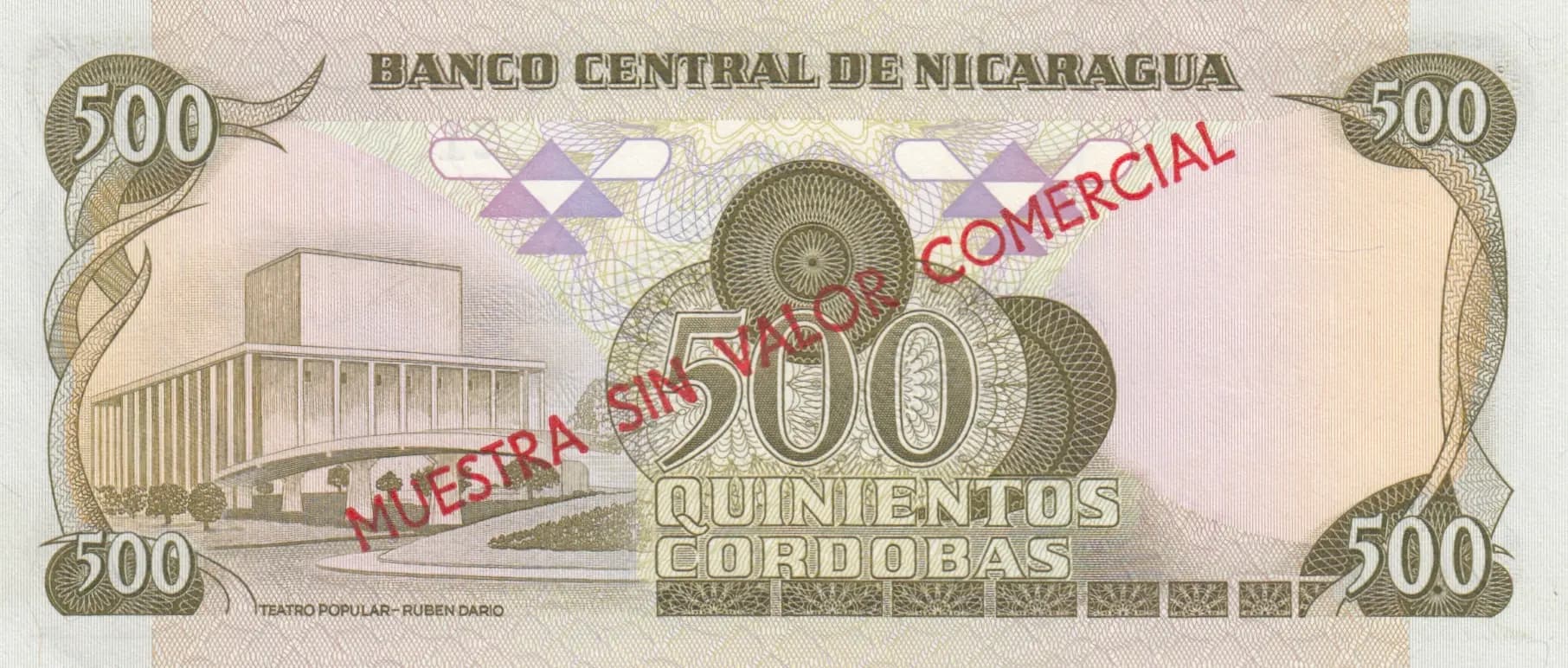
This is a 500 Cordobas specimen note from Nicaragua dated August 16, 1979, issued by the Banco Central de Nicaragua during the revolutionary period following the Sandinista victory. The note is presented in uncirculated condition with sharp, crisp printing and features a portrait of the celebrated Nicaraguan poet Rubén Darío on the obverse and the Teatro Popular-Rubén Darío in Managua on the reverse. The prominent red 'MUESTRA COMERCIAL' (Commercial Sample) overprint and 'SIN VALOR COMERCIAL' (Without Commercial Value) markings clearly identify this as a specimen note produced for distribution and reference purposes rather than for circulation.
Common. While this is a specimen note (which are sometimes sought by collectors), the eBay market data provided shows a wide range of prices ($2.75 to $285.00 USD) with most specimen examples trading in the $3–$50 range, indicating substantial supply. The average market price for UNC specimens appears to be approximately $35–$40 USD, consistent with typical specimen banknote pricing. Specimen notes from major security printers like Thomas de la Rue were often produced in significant quantities for distribution to banks, government agencies, and reference collections, making them relatively common in the collector market despite their non-circulating status. No evidence suggests an exceptionally small print run or scarcity premium for this specific Pick number in specimen form.
This note was issued on August 16, 1979, just weeks after the Sandinista triumph over the Somoza regime in July 1979, during the period officially designated 'Año de la Liberación' (Year of Liberation). The choice to honor Rubén Darío, one of Nicaragua's most celebrated literary figures and a symbol of national cultural identity, reflects the revolutionary government's effort to rebuild and legitimize its authority through cultural nationalism. The decreto references the 'Junta de Gobierno de Reconstrucción' (Government Reconstruction Board), the provisional governing body that led Nicaragua during this transitional period before the Sandinista consolidation of power.
The obverse features a three-quarter portrait of Rubén Darío (1867-1916), Nicaragua's most celebrated poet and founding figure of the Modernist literary movement, rendered in fine engraving style on the right side of the note. His contemplative pose with hand near face emphasizes his intellectual stature. The dominant design element is an elaborate oval medallion in the center featuring intricate geometric patterns in black and white, serving both as an ornamental frame and security feature. The reverse depicts the Teatro Popular-Rubén Darío in Managua, a modernist building with distinctive vertical architectural features representing the cultural infrastructure of post-revolutionary Nicaragua. Both sides employ sophisticated fine-line engraving patterns throughout the background and borders, with decorative geometric elements in purple and white at the top center. The color palette—dominated by beige, cream, brown, and tan with pink/mauve tones and purple accents—creates a dignified appearance appropriate for a commemorative specimen note of this period.
FRONT SIDE: '500' and 'QUINIENTOS CORDOBAS' (Five Hundred Cordobas - denomination); 'BANCO CENTRAL DE NICARAGUA' (Central Bank of Nicaragua); 'RUBEN DARIO' (the depicted historical figure); 'MUESTRA COMERCIAL' (Commercial Sample - specimen overprint); 'SERIE E' and '21' (series and sequence identifiers); 'DECRETO DE LA JUNTA DE GOBIERNO DE RECONSTRUCCION NACIONAL DE 16 DE AGOSTO DE 1979 AÑO DE LA LIBERACION' (Decree of the Government Reconstruction Board of August 16, 1979 Year of Liberation); signature line references for 'MINISTRO DE FINANZAS DE LA REPUBLICA' (Minister of Finance of the Republic), 'PRESIDENTE DEL BANCO CENTRAL DE NICARAGUA' (President of the Central Bank of Nicaragua), and 'VICE PRESIDENTE DEL BANCO CENTRAL DE NICARAGUA' (Vice President of the Central Bank of Nicaragua). BACK SIDE: '500' and 'QUINIENTOS CORDOBAS' (denomination); 'TEATRO POPULAR-RUBEN DARIO' (Popular Theater-Rubén Darío - the depicted landmark in Managua); 'BANCO CENTRAL DE NICARAGUA' (Central Bank of Nicaragua); 'MUESTRA COMERCIAL' and 'SIN VALOR COMERCIAL' (Commercial Sample and Without Commercial Value - specimen markings indicating no legal tender status).
This note was produced by Thomas de la Rue, London (TDLR), one of the world's premier security printers. The printing technique is intaglio engraving, evidenced by the crisp, sharp detail visible in the fine-line patterns, the intricate geometric designs, and the dimensional quality of the portraits and architectural rendering. The multicolor underprint and the precise registration of colors visible in the geometric elements suggest a multi-pass engraving and printing process. Security features include the engraved watermark area (featuring Augusto César Sandino) within the central oval design, fine-line guilloche patterns throughout the background, and complex geometric motifs that serve as anti-counterfeiting measures. The specimen overprints were applied separately in red ink after the primary printing.
This is identified as Pick-138s, the 's' suffix denoting specimen status. The note is overprinted 'MUESTRA COMERCIAL' in red, which is standard for Nicaraguan specimen notes of this period. The observed variety includes 'SERIE E' with series number '21', indicating this specimen belongs to the E series of the 1979 issue. The visual analysis notes signature varieties exist for this pick number, though the specific signatures are not clearly legible in the provided images. This particular specimen was produced by Thomas de la Rue and represents the initial high-value denomination issue of the post-revolutionary Banco Central de Nicaragua, issued concurrently with the provisional government decree dated August 16, 1979.