2 cordobas 1939
Market Prices
1 saleAbout This Note
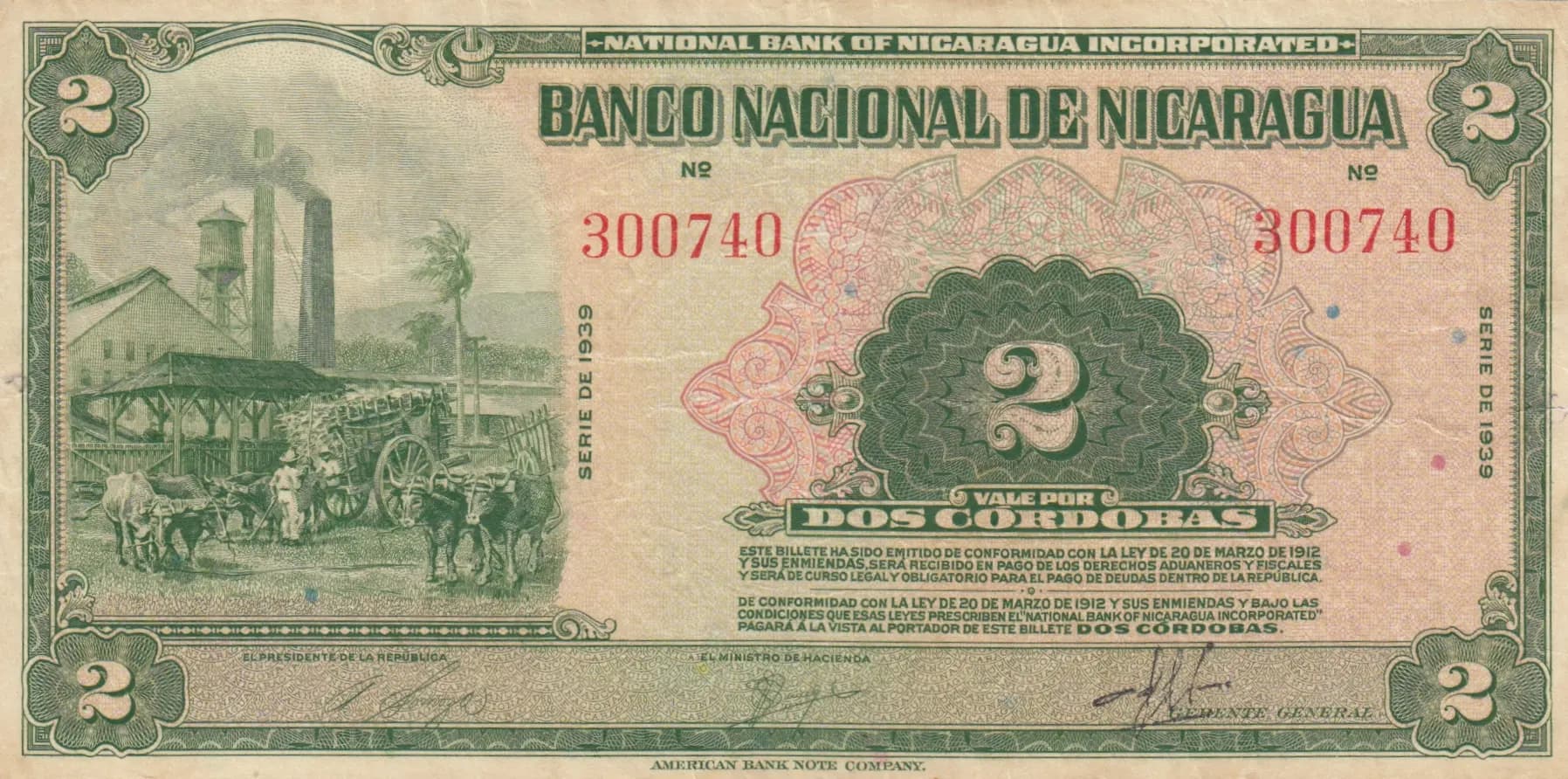
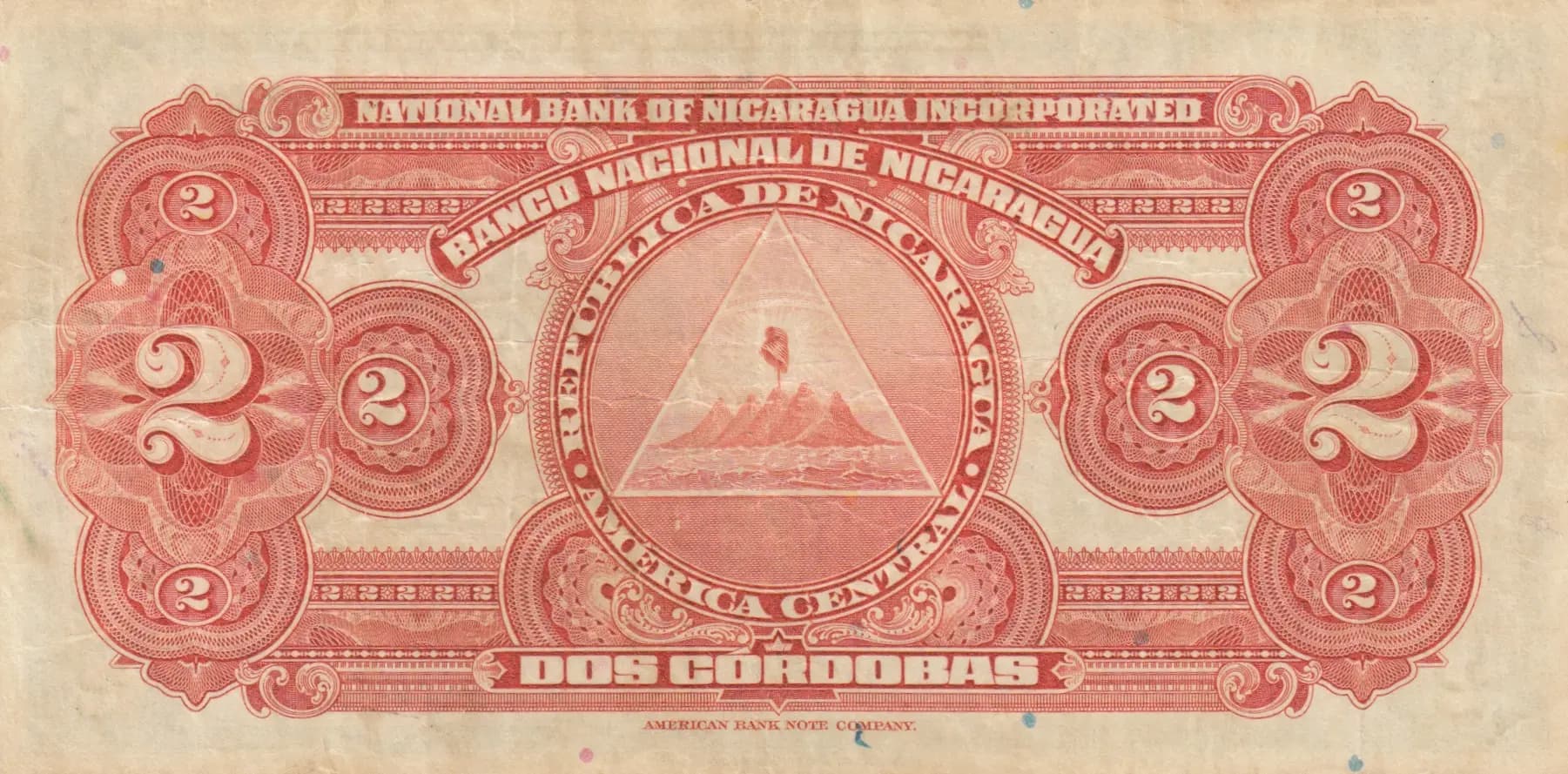
This 1939 Nicaraguan 2 Cordobas note (Pick 64) displays the characteristic industrial agricultural theme of early 20th-century Central American currency, featuring a detailed engraved sugar mill operation with oxen-drawn cart on the obverse and the iconic Momotombo volcano on the reverse. The note exhibits VF condition with light foxing and minor discoloration consistent with age, preserving the fine engraved details and vibrant green and red color scheme that exemplifies American Bank Note Company's quality work. As a pre-WWII issue from the Banco Nacional de Nicaragua, it represents an important piece of Nicaragua's monetary history during a period of economic development focused on agricultural exports.
common. The eBay pricing data cited in the reference materials (VG condition at $20.62 in 2018) and 2016 catalog values (G: $10, F: $50, EF: $200) indicate this is a commonly encountered note in the secondary market. The 1939 series of Nicaraguan 2 Cordobas notes was produced in significant quantities by the Banco Nacional de Nicaragua, and examples regularly appear in collections and dealer inventories. No evidence of restricted print runs, recalls, or short-lived issue periods elevates this to scarcity.
The 1939 series reflects Nicaragua's economy during the dictatorship of Anastasio Somoza García, with imagery emphasizing the nation's agricultural and industrial foundations. The sugar mill depicted on the obverse symbolizes the country's reliance on sugar production and export, while the reverse features Volcán Momotombo, a dominant geographical landmark and national symbol that anchored Nicaragua's identity and territorial claims. The bilingual English-Spanish inscriptions underscore the influence of American banking interests and capital investment in Central American financial institutions during this era.
The obverse features an industrial agricultural landscape dominated by a functioning sugar refinery with prominent smokestacks on the left side, reflecting Nicaragua's principal export industry. In the foreground, workers are depicted with an ox-drawn cart laden with sugarcane, emphasizing the labor-intensive harvest and transport processes. The center of the note displays a large ornamental rosette containing the denomination numeral '2' with 'DOS CORDOBAS' inscribed below. The reverse centers on Volcán Momotombo, Nicaragua's most iconic and symbolically significant volcano, depicted within a large circular emblem with a flag planted on its peak. The mountain is rendered with careful engraved detail showing its conical form rising above a landscape with water elements, symbolizing the nation's geographical identity. Both sides feature elaborate corner rosettes and ornamental borders typical of American Bank Note Company's decorative engraving style. The bilingual text prominently displays the English corporate name above the Spanish institutional name, reflecting the American banking interests behind the Banco Nacional de Nicaragua.
FRONT: 'BANCO NACIONAL DE NICARAGUA' / 'NATIONAL BANK OF NICARAGUA INCORPORATED' (bank name and English corporate designation); 'DOS CORDOBAS' (denomination in Spanish); 'SERIE DE 1939' (Series of 1939); 'AMERICAN BANK NOTE COMPANY' (printer attribution); Legal text: 'ESTE BILLETE HA SIDO EMITIDO DE CONFORMIDAD CON LA LEY DE 20 DE MARZO DE 1912 Y SUS ENMIENDAS. SERA RECIBIDO EN PAGO DE LOS DERECHOS ADUANEROS Y FISCALES Y SERA DE CURSO LEGAL Y OBLIGATORIO PARA EL PAGO DE DEUDAS DENTRO DE LA REPUBLICA.' (This bill has been issued in accordance with the Law of March 20, 1912 and its amendments. It will be received in payment of customs and fiscal duties and will be legal tender and mandatory for the payment of debts within the Republic.); Promise to pay: 'DE CONFORMIDAD CON LA LEY DE 20 DE MARZO DE 1912 Y SUS ENMIENDAS Y BAJO LAS CONDICIONES QUE LAS LEYES PRESCRIBEN EL NATIONAL BANK OF NICARAGUA INCORPORATED PAGARA A LA VISTA AL PORTADOR DE ESTE BILLETE DOS CORDOBAS' (In accordance with the Law of March 20, 1912 and its amendments and under the conditions prescribed by law, the National Bank of Nicaragua Incorporated will pay to the bearer of this bill Two Cordobas on sight). BACK: 'BANCO NACIONAL DE NICARAGUA' / 'NATIONAL BANK OF NICARAGUA INCORPORATED' (bank identification); 'REPUBLICA DE NICARAGUA' (Republic of Nicaragua); 'DOS CORDOBAS' (denomination); 'AMERICAN BANK NOTE COMPANY' (printer).
This note was produced using intaglio engraving and letterpress printing by the American Bank Note Company, New York—the premier American security printer of the era. The intaglio process is evident in the fine line work, intricate rosette designs, and detailed engraving visible throughout the note, particularly in the sugar mill machinery and the volcanic mountain landscape. The multicolor printing technique layered green on the obverse and red-orange on the reverse over a cream base, utilizing separate plates for each color pass. The fine line work, ornamental corner designs, and security elements characteristic of ABNC's work are fully preserved in this example.
The observed serial number 300740 appears twice on the obverse (upper left and right), which is standard for this issue. The visual analysis does not reveal evidence of signature varieties, overprints, or other distinguishing marks that would indicate a significant variety from the standard 1939 series. The note conforms to the standard Pick 64 type produced throughout 1939. See Pick 92 for the later similar design note referenced in catalog data.