50 cordobas 1979 specimen
Market Prices
About This Note
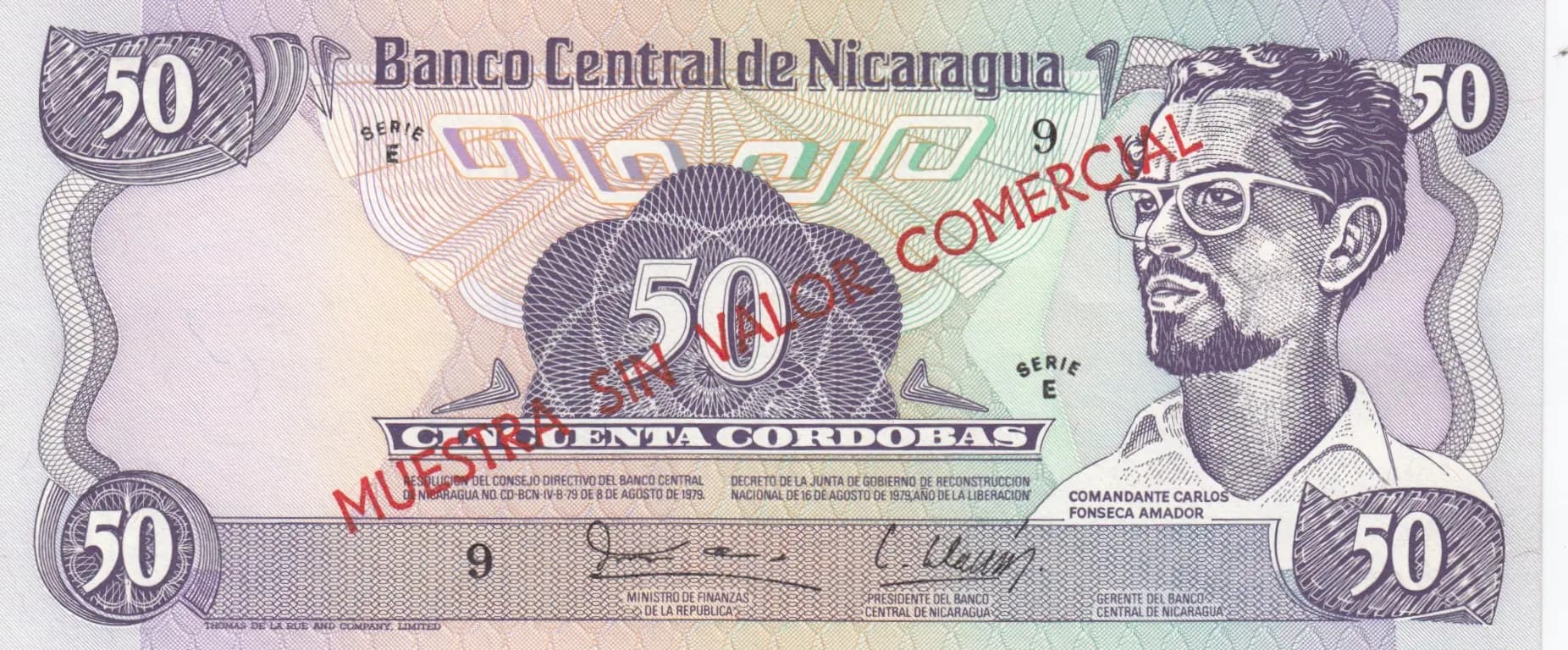
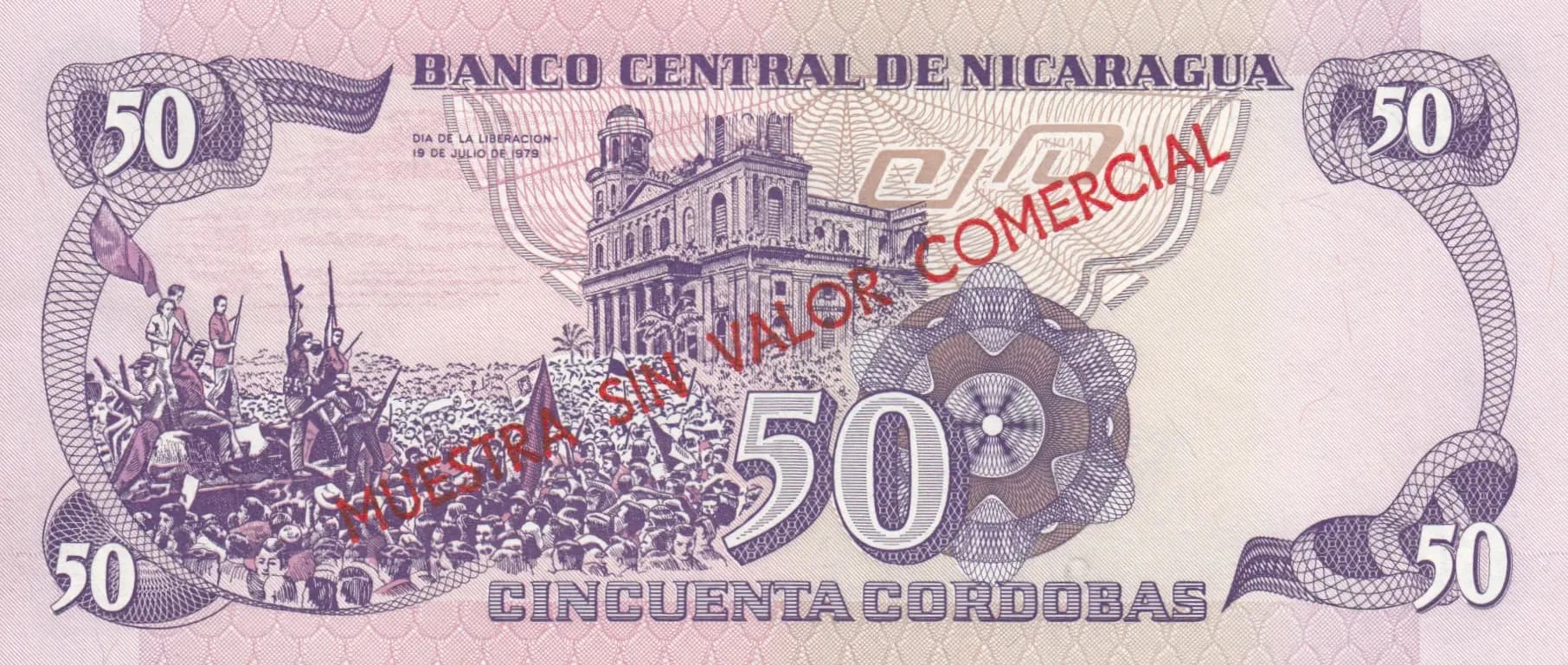
A 1979 Nicaraguan 50 cordobas specimen note issued by the Banco Central de Nicaragua in commemoration of the Sandinista Revolution's Liberation Day (July 19, 1979). This UNC specimen features a portrait of Comandante Carlos Fonseca Amador on the obverse and a dramatic historical scene of the liberation cathedral and crowds on the reverse, rendered in purple and green with extensive security guilloche work. The red 'COMERCIAL' and 'MUESTRA SIN VALOR' (sample without value) overprints confirm its status as a non-circulating specimen, making it a historically significant representation of Nicaragua's revolutionary period.
Common. While this is a specimen note from 1979, specimen notes were produced in substantial quantities for distribution to banks, currency dealers, and collectors. The eBay market data provided shows wide price variation ($1.99 to $72.00 USD for UNC examples), with most listings clustered in the $3–$25 range, indicating robust supply and moderate collector demand. Specimen notes from major security printers like Thomas de la Rue were typically produced in quantities sufficient to prevent scarcity. The note's historical significance and attractive design enhance its collector appeal but do not indicate rarity.
This note was issued during the immediate aftermath of the Sandinista Revolution's triumph on July 19, 1979, which overthrew the Somoza regime. Comandante Carlos Fonseca Amador, depicted on the obverse, was a founding member of the Sandinista National Liberation Front (FSLN) who was killed in 1976 but became a revolutionary martyr and symbol of the movement. The reverse commemorates this pivotal Liberation Day, reflecting the new government's effort to establish monetary symbols representing the revolutionary transition and the popular struggle that preceded it.
The obverse features a three-quarter portrait of Comandante Carlos Fonseca Amador, identifiable by his characteristic eyeglasses and facial hair, positioned on the right side of the note. The design incorporates a central circular seal containing the denomination 50, surrounded by intricate geometric guilloche patterns in green against a purple and beige background. Multiple denomination numerals appear in the upper left, center, and lower right corners for easy identification. The reverse depicts a commemorative historical scene showing the colonial cathedral (representing León or Managua) with its distinctive bell towers and crosses, surrounded by a large crowd representing the popular uprising and liberation struggle. The architectural landmark dominates the center-right composition, with elaborate decorative borders and denomination numerals framing the design. Both sides maintain consistent color harmony with purple as the dominant hue complemented by green security patterns.
FRONT: 'Banco Central de Nicaragua' (Central Bank of Nicaragua) | 'CINCUENTA CORDOBAS' (Fifty cordobas) | 'COMANDANTE CARLOS FONSECA AMADOR' (Commander Carlos Fonseca Amador) | 'MINISTERIO DE FINANZAS DE LA REPUBLICA' (Ministry of Finance of the Republic) | 'PRESIDENTE DEL BANCO CENTRAL DE NICARAGUA' (President of the Central Bank of Nicaragua) | 'GERENTE DEL BANCO' (Bank Manager) | 'SERIE E' (Series E) | 'COMERCIAL' (Commercial) | 'MUESTRA SIN VALOR' (Sample without value). REVERSE: 'BANCO CENTRAL DE NICARAGUA' (Central Bank of Nicaragua) | 'CINCUENTA CORDOBAS' (Fifty cordobas) | 'DIA DE LA LIBERACION' (Day of Liberation) | '19 DE JULIO DE 1979' (July 19, 1979) | 'COMERCIAL' (Commercial) | 'SIN VALOR' (Without value).
Lithographic printing as noted in the catalog references. The note was produced by Thomas de la Rue, London, a premier security printer. The extensive guilloche patterns, fine parallel security lines, geometric designs, and detailed engraving of both portraits and architectural scenes are characteristic of the advanced lithographic security printing methods employed by TDLR. The multi-color overprint application ('COMERCIAL' and specimen markings) indicates additional printing passes, typical of specimen note production protocols.
This is specifically identified as a specimen note (Pick P-136s, where 's' denotes specimen status). The visual analysis confirms Series E designation. The red 'COMERCIAL' overprint and 'MUESTRA SIN VALOR' markings are standard specimen identifiers rather than varieties. No signature varieties are clearly distinguishable from the image analysis provided. Known related variety: Pick P-140 represents a similar later commemorative issue for this denomination.