10 cordobas 1979 specimen
Market Prices
About This Note
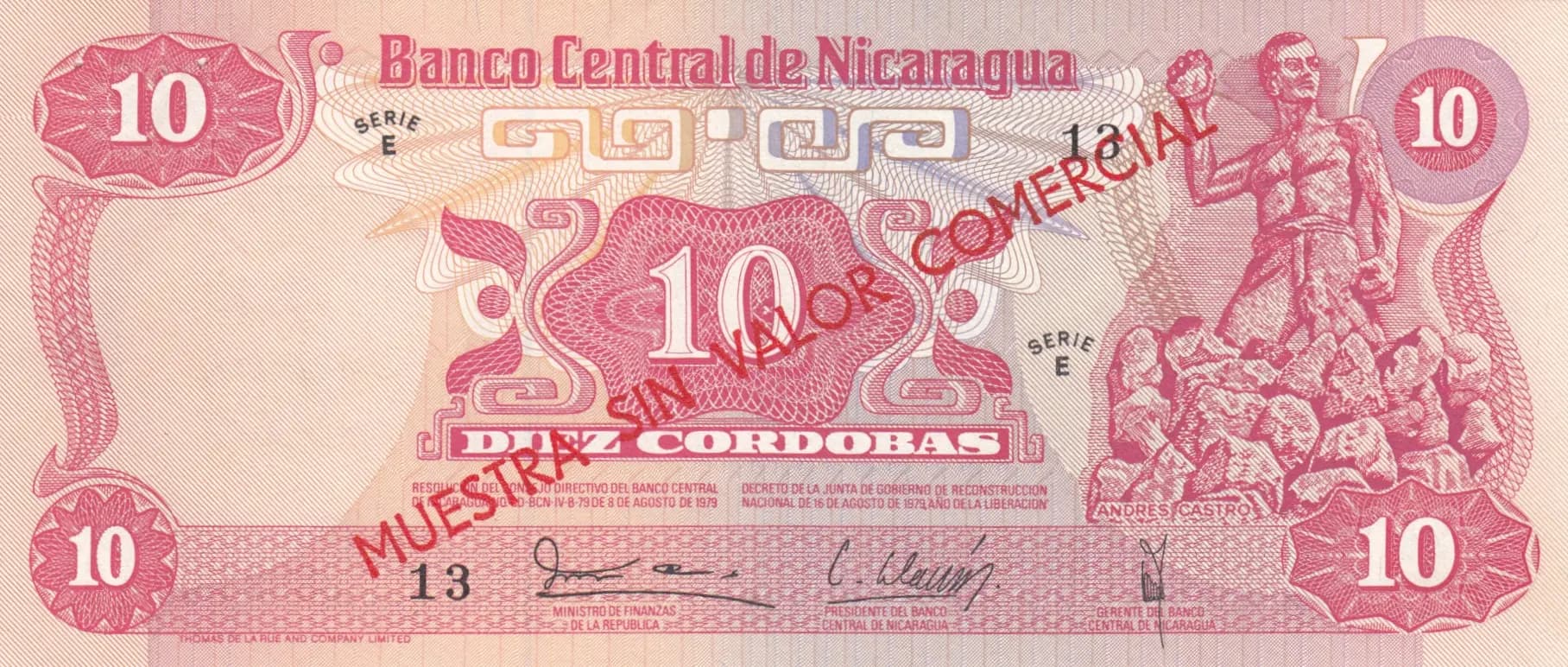
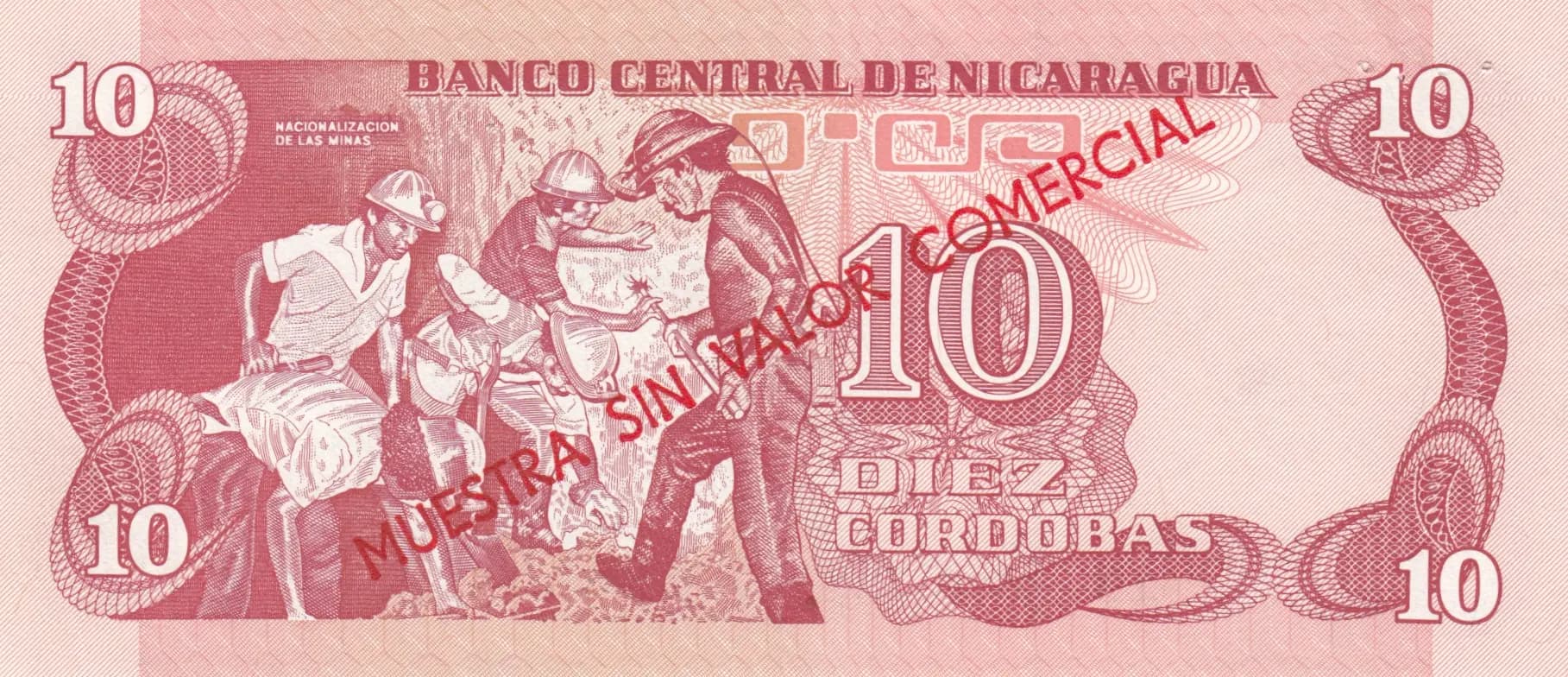
This is a pristine UNC specimen note from Nicaragua's Banco Central de Nicaragua issued August 16, 1979, featuring striking pink/magenta intaglio printing by Thomas de la Rue. The obverse depicts Andrés Castro standing prominently on the right in classical dress, while the reverse showcases a detailed mining scene symbolizing the nationalization of Nicaragua's mines—a key policy of the newly-formed Sandinista government. As a specimen note (marked 'MUESTRA COMERCIAL'), this piece represents an official presentation example from the revolutionary period and remains exceptionally well-preserved with crisp engraving throughout.
Common. As a specimen note from a major security printer (Thomas de la Rue) with no documented print run restrictions, and given eBay market data showing specimen notes in this condition typically ranging from $2.61 to $27.99 USD with most clustered under $10, this note is readily available to collectors. The 1979 issue date and Sandinista-era relevance provide historical interest rather than numismatic scarcity. Specimen notes, while not circulated, were produced in standard quantities for official distribution and archival purposes.
This note was issued on August 16, 1979, during the first year of the Sandinista National Liberation Front's (FSLN) rule following the overthrow of the Somoza regime. The Decreto de la Junta de Gobierno de Reconstrucción Nacional (National Reconstruction Government Board Decree) and the inscription 'Año de la Liberación' (Year of Liberation) directly reference this political transformation. The reverse design celebrating the 'Nacionalización de las Minas' (Nationalization of Mines) reflects the revolutionary government's immediate policy agenda to reclaim national resources and redistribute wealth, with miners depicted as heroic figures central to the nation's reconstruction.
The front features a classical allegorical composition with a seated female figure (likely representing Liberty or the Nation) on the left in draped robes, and the historical figure Andrés Castro standing prominently on the right in classical dress, positioned atop rocks. The reverse depicts a contemporary mining scene with multiple workers wearing hard hats and work clothes, actively engaged in ore extraction and processing using picks and mining equipment, symbolizing both labor and national resource control. Both sides employ extensive ornamental framework including circular denomination medallions at all four corners, decorative scrollwork, coiled rope designs, and fine guilloche patterns in cream/beige against the dominant pink and magenta background. This juxtaposition of classical allegory with revolutionary-era labor imagery reflects the government's positioning of itself as both heir to national sovereignty and champion of the working class.
FRONT SIDE: 'Banco Central de Nicaragua' (Central Bank of Nicaragua) / 'DIEZ CORDROBAS' (Ten cordobas) / 'SERIE E' (Series E) / 'MUESTRA' (Specimen) / 'COMERCIAL' (Commercial) / 'DECRETO DE LA JUNTA DE GOBIERNO DE RECONSTRUCCION NACIONAL DE 16 DE AGOSTO DE 1979 AÑO DE LA LIBERACION' (Decree of the National Reconstruction Government Board of August 16, 1979 Year of Liberation) / 'MINISTRO DE FINANZAS DE LA REPUBLICA' (Finance Minister of the Republic) / 'PRESIDENTE DEL BANCO CENTRAL DE NICARAGUA' (President of the Central Bank of Nicaragua) / 'GERENTE DEL BANCO CENTRAL DE NICARAGUA' (Manager of the Central Bank of Nicaragua) / 'ANDRES CASTRO' (Andrés Castro) / 'THOMAS DE LA RUE AND COMPANY LIMITED' (Thomas de la Rue and Company Limited) / Note number '13'. BACK SIDE: 'BANCO CENTRAL DE NICARAGUA' (Central Bank of Nicaragua) / 'NACIONALIZACION DE LAS MINAS' (Nationalization of Mines) / 'DIEZ CORDDOBAS' (Ten cordobas) / 'MUESTRA COMERCIAL' (Commercial Specimen) / Denomination '10' in corners.
Intaglio (engraved) printing by Thomas de la Rue and Company Limited, London. The visual analysis confirms the characteristic deep intaglio line patterns, fine geometric guilloche designs, complex background patterns, and precise detail work typical of security printing from this era. The crisp, sharply-defined engraving of both allegorical figures and the mining scene, along with the intricate decorative elements, are hallmarks of intaglio production. The note was lithographed with underprint extending to the edges, combining these techniques for a multicolor security-printed banknote.
This specific variety is identified as Pick P-134s (the 's' suffix designating specimen status). The note displays Series E with note number 13. The 'MUESTRA COMERCIAL' (Commercial Specimen) overprint/marking distinguishes it from circulating notes (P-134). Thomas de la Rue printing is confirmed via the printer attribution visible on the note. No other significant varieties are documented for this issue based on the visual evidence presented, though signature varieties of the Finance Minister, Bank President, and Manager positions may exist across the serial number range.