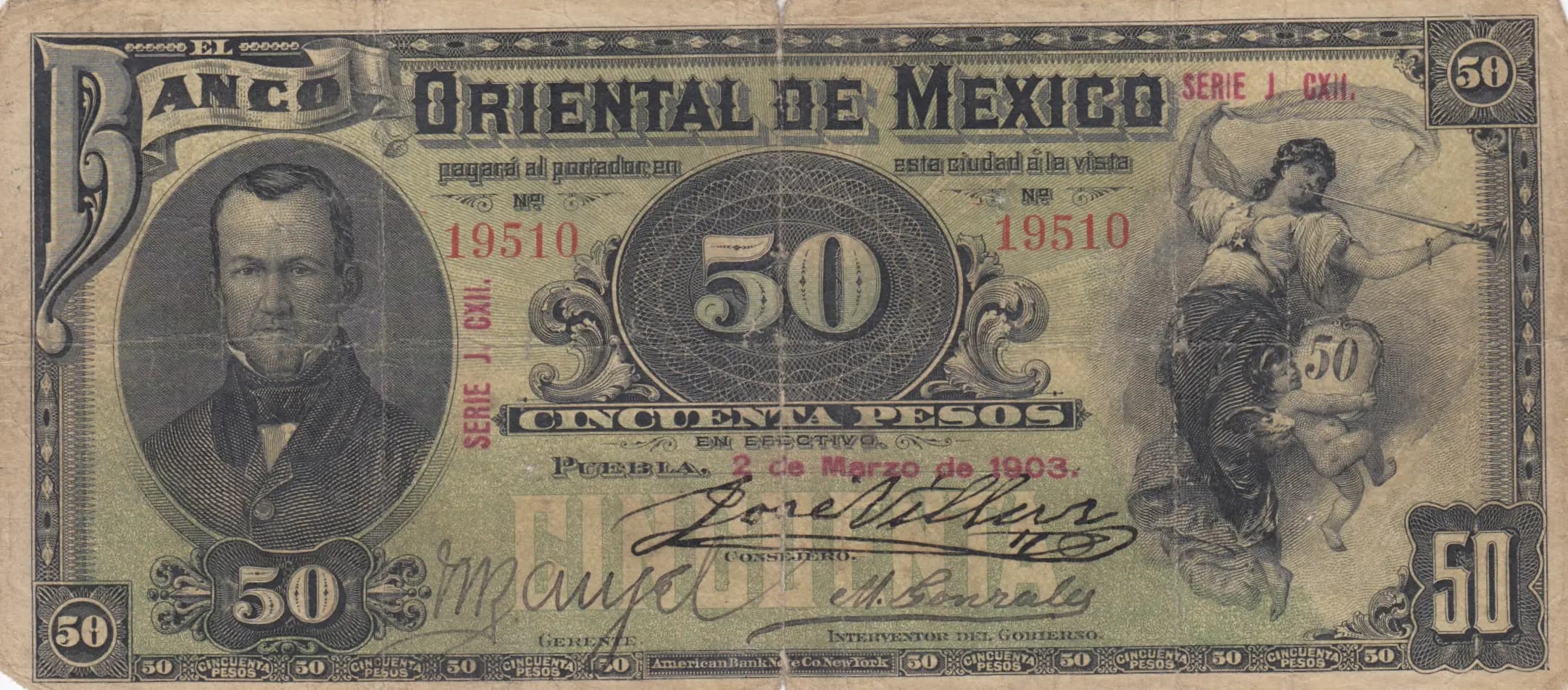
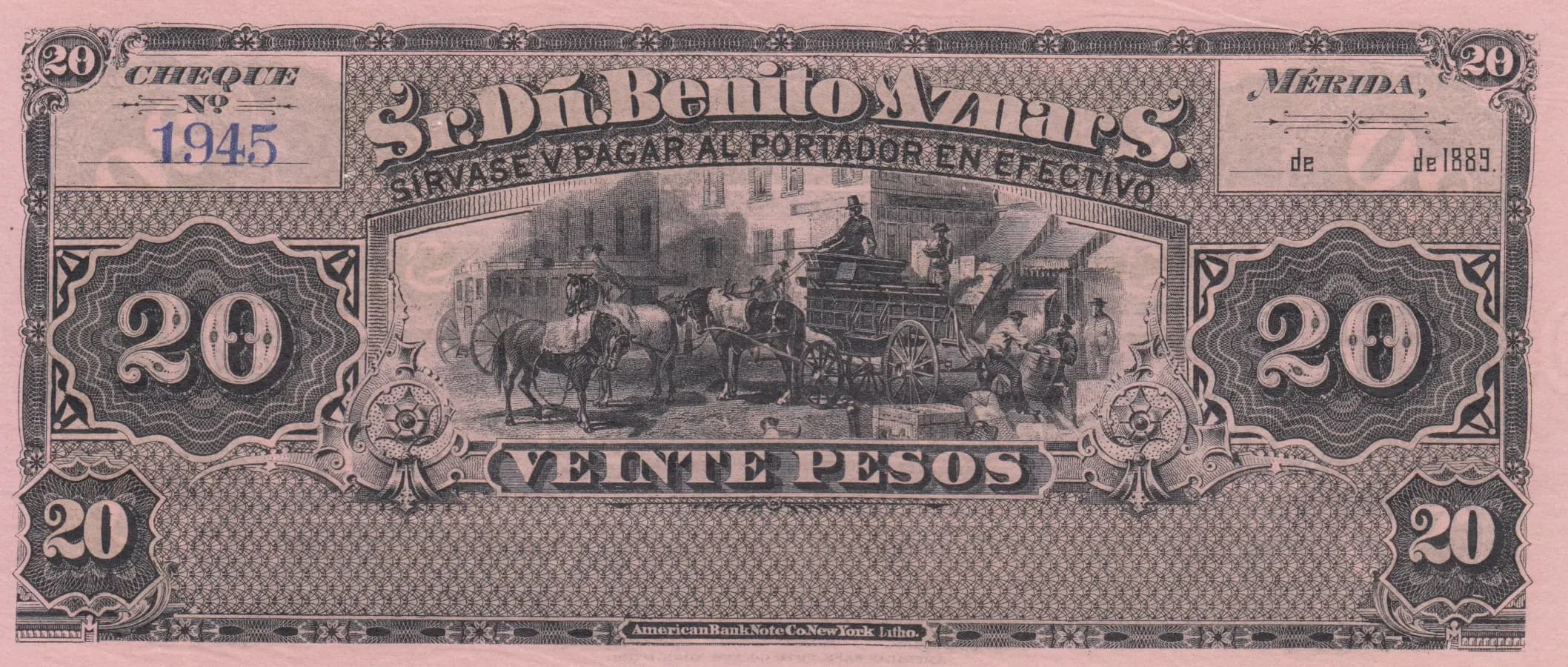
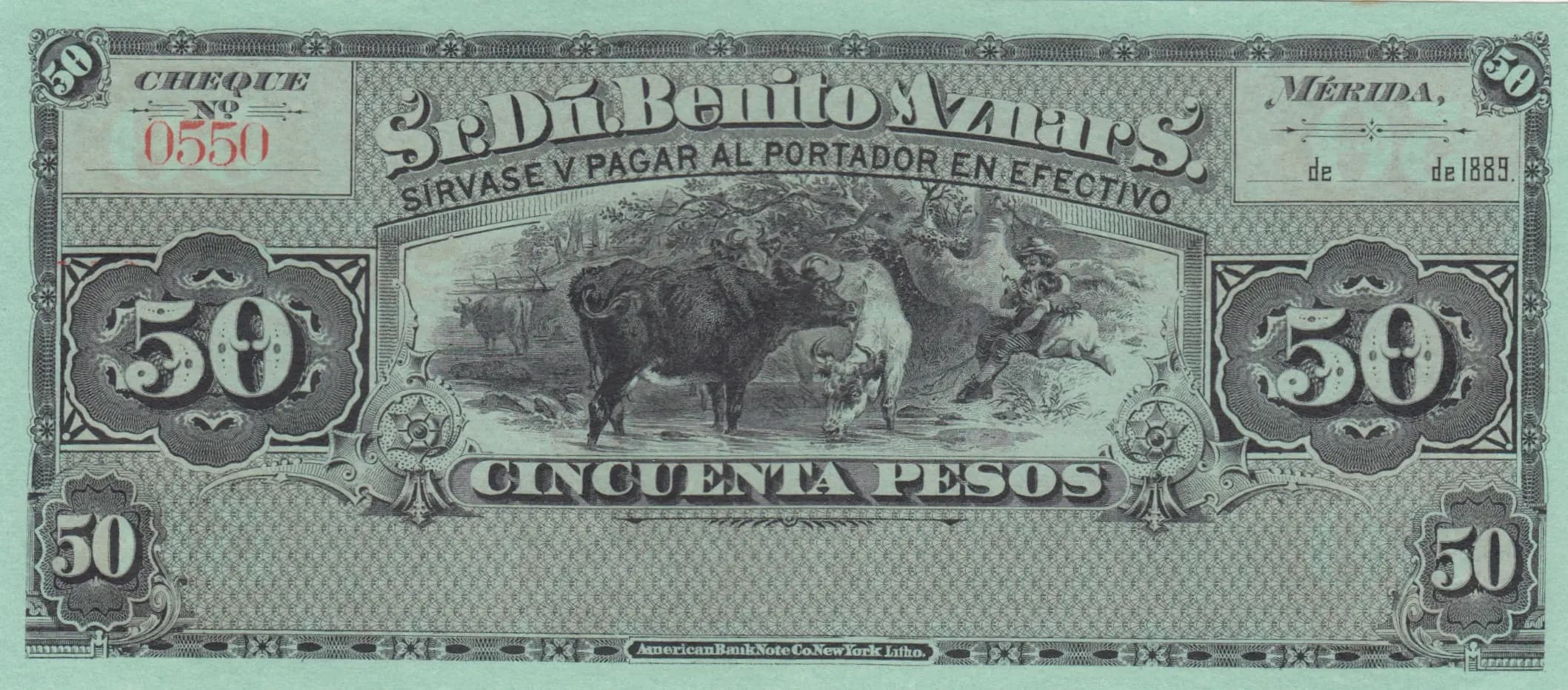
50 pesos 1909
Market Prices
About This Note
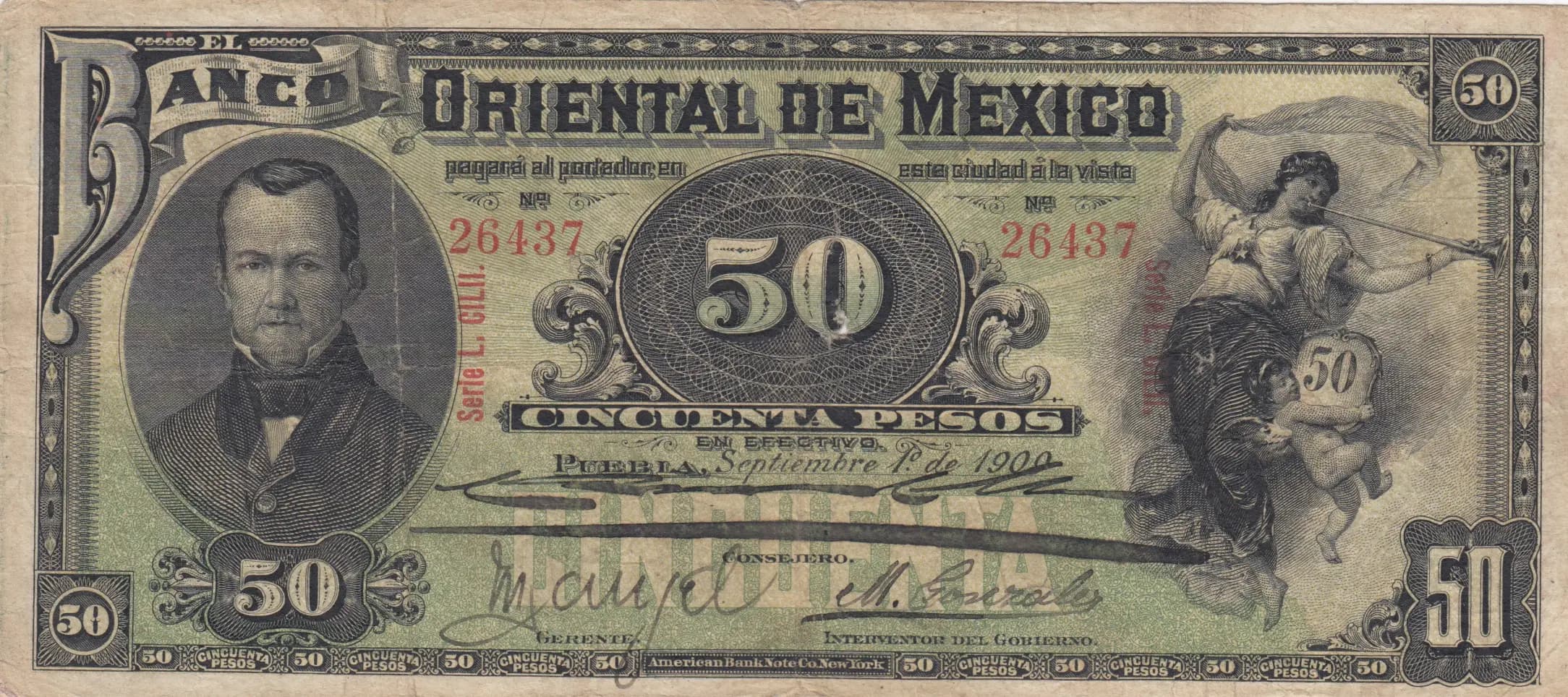
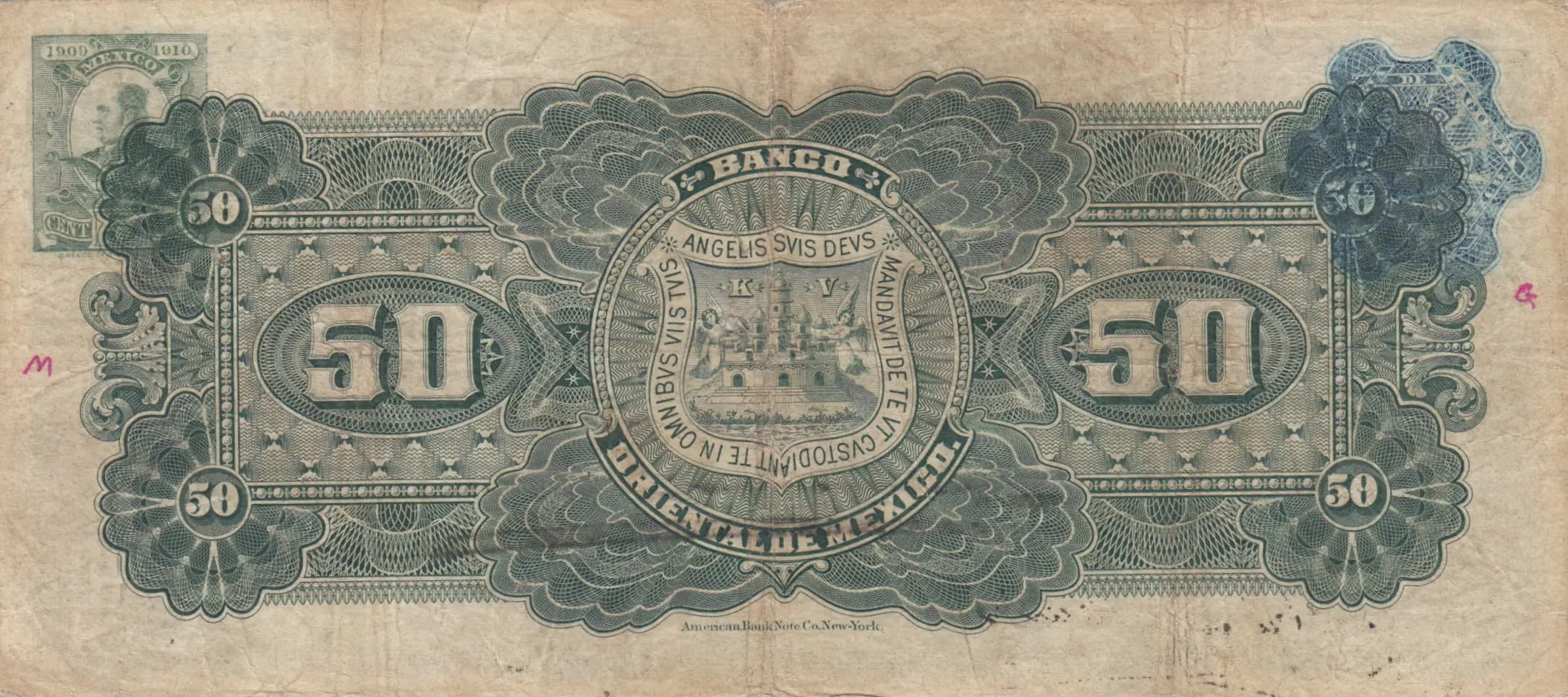
A 50 pesos banknote from Banco Oriental de Mexico issued in 1900, printed by the American Bank Note Company. The note displays exceptional classical engraving with a portrait of Estebán de Antúnano on the obverse and architectural imagery on the reverse. In Fair condition, the note shows significant aging with multiple creases, foxing, and circulation wear typical of early 20th-century currency, with red serial number 26437 still visible.
Common. The eBay market data provided shows F-condition examples listing at $1,100 USD, which while not negligible, reflects the substantial print run of this 10-year series (1900-1909) by a regional Mexican bank. The catalog Pick number S384b indicates this is a well-documented, non-emergency issue. Regional Mexican banknotes from this era, particularly from established institutions like Banco Oriental de Mexico, were produced in relatively high quantities and regularly circulated, resulting in common availability in numismatic markets despite their age.
This note was issued during Mexico's Porfiriato era (1876-1911) when regional banks maintained significant currency authority. The Banco Oriental de Mexico, based in Puebla, issued this denomination between 1900-1909 as part of Mexico's complex pre-revolutionary banking system. The cathedral depicted on the reverse reflects Puebla's ecclesiastical and commercial prominence, while the Latin motto 'Angelis Svis Devs' and classical allegorical figures on the obverse reflect the sophisticated design standards of American Bank Note Company's international work during this period.
The obverse features an oval portrait of Estebán de Antúnano, a prominent 19th-century Mexican industrialist and banker, positioned at left in formal attire characteristic of the period. The central design is dominated by the large denomination numeral '50' in ornate scrollwork. To the right stands an allegorical female figure (representing Commerce or Progress) with a cornucopia and cherub, typical of contemporary bank note iconography. The reverse displays a Puebla Cathedral or significant ecclesiastical landmark within a circular medallion at center, surrounded by ornamental scalloped borders and denomination numerals. The entire design employs intricate geometric patterns and fine line work as anti-counterfeiting measures.
OBVERSE: 'Banco Oriental de Mexico' (Oriental Bank of Mexico); 'Cincuenta Pesos' (Fifty Pesos); 'pagará al portador en esta ciudad a la vista' (will pay to the bearer in this city on sight); 'Puebla, Septiembre 1° de 1900' (Puebla, September 1st, 1900); 'Consejero' (Counselor); 'Gerente' (Manager); 'Interventor del Gobierno' (Government Auditor); Serial number '26437'; 'American Bank Note Co. New York'. REVERSE: 'Banco Oriental de Mexico' (Oriental Bank of Mexico); '50' (denomination); 'Angelis Svis Devs' (God with His Angels - Latin); '1900 1910' (commemorative date range); 'American Bank Note Co. New York'.
Intaglio engraving (line engraving), characteristic of American Bank Note Company's premium security printing. The note exhibits the fine parallel line work, geometric patterns, and detailed portraiture typical of late 19th/early 20th-century intaglio banknote production. No evidence of additional security printing techniques beyond traditional engraving.
This example corresponds to Pick S384b, the variant issued between 1.5.1901-1.9.1909 (May 1901 to September 1909). The date of 'Septiembre 1° de 1900' on the obverse represents the authorization/establishment date, while the actual printing period extended into 1909. The red serial number 26437 places this within the standard serial numbering range for this series. No evidence of overprints or unusual markings indicating a special variety.