50 centavos 1915
About This Note
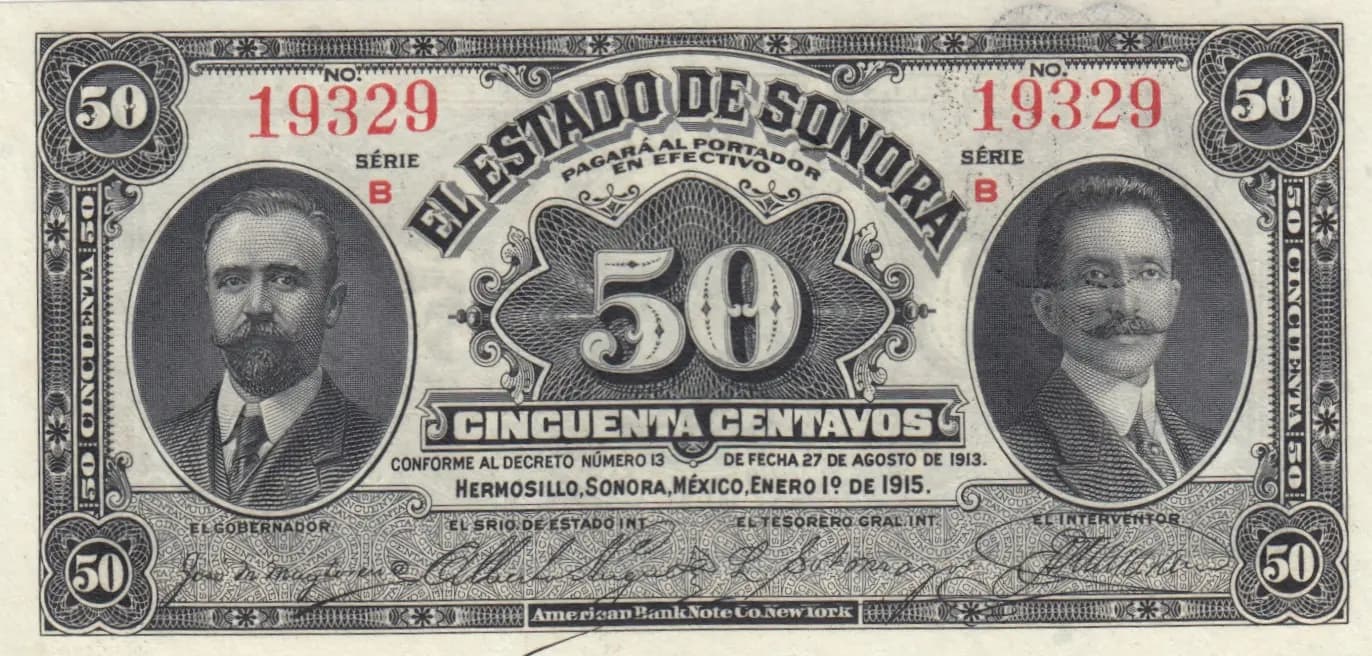
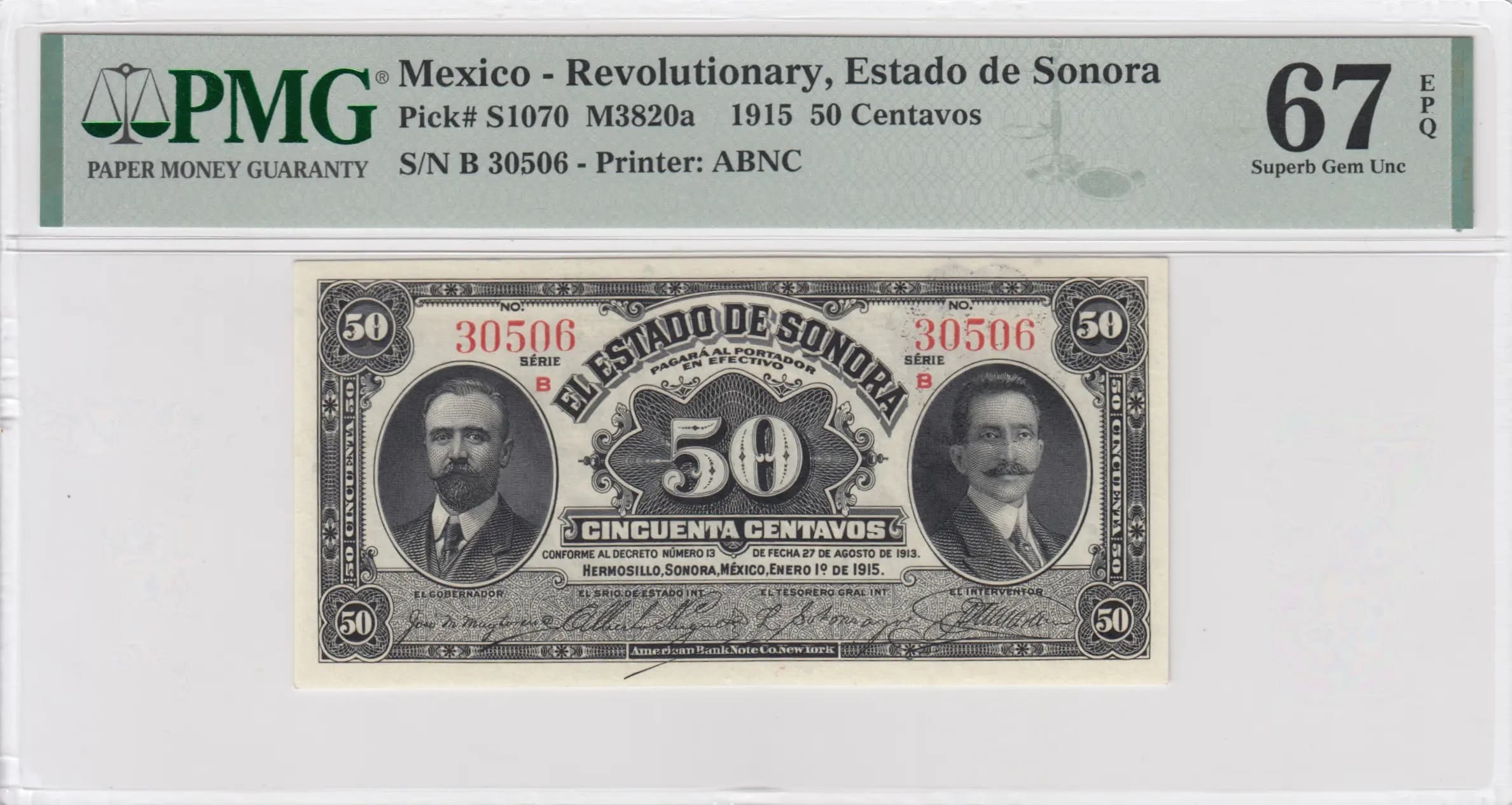
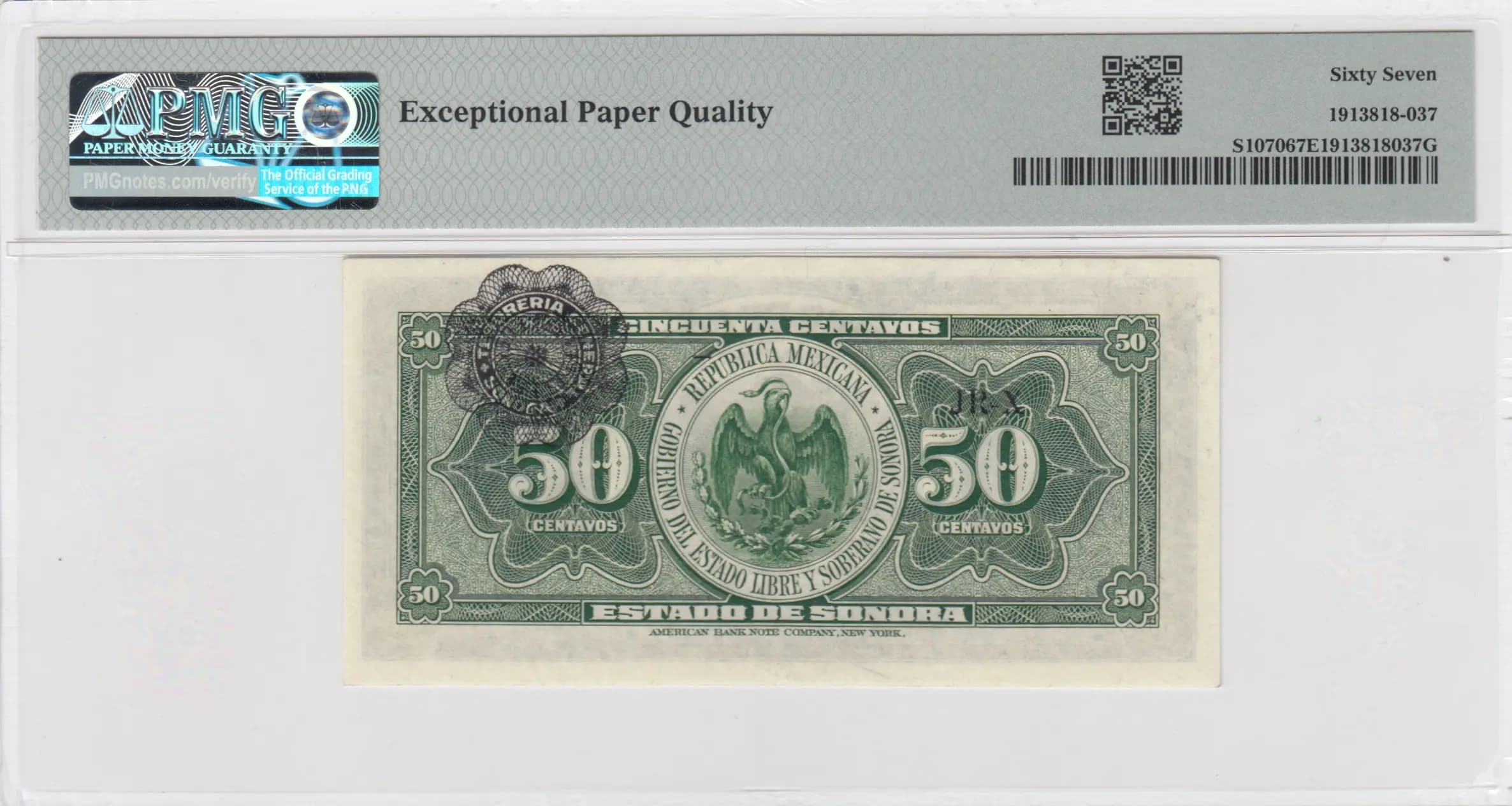
This is an exceptional example of a Mexican Revolutionary era 50 centavos banknote issued by the Estado de Sonora in Hermosillo on January 19, 1915. The note displays pristine condition with sharp, clear printing throughout, featuring two formal portrait medallions on the obverse and the Mexican national coat of arms on the reverse in vibrant green. The PMG 67 EPQ grade reflects the note's superior paper quality, bright appearance, and minimal wear, making it a highly desirable specimen of this early 20th-century regional currency.
common. While this is a regional Revolutionary-era Mexican state note with historical significance, the Estado de Sonora issued multiple series of banknotes during 1913-1915, and 50 centavos denominations were widely produced and circulated. The PMG 67 EPQ grade reflects exceptional preservation rather than rarity of the note itself. Series B, No. 30506 falls well within typical serial number ranges for these issues. These notes, though desirable to collectors of Mexican Revolutionary currency and regional issues, are not scarce in the market; multiple examples in various conditions are regularly available through numismatic channels.
This note was issued during Mexico's Revolutionary period under decree number B dated August 27, 1913, when regional states exercised greater monetary authority during the tumultuous years of political upheaval. The Estado de Sonora's issuance from Hermosillo represents the decentralized financial responses of Mexican states during the Revolution, when traditional federal currency was supplemented or replaced by state-issued scrip. The prominent display of the Mexican national coat of arms on the reverse, alongside the state's sovereignty declaration ('Estado Libre y Soberano de Sonora'), reflects the tension between regional autonomy and national identity during this transformative period.
The obverse features a horizontally-oriented rectangular design with dual portrait medallions positioned on the left and right flanking a central denomination display. The left portrait depicts a bearded gentleman in formal Victorian-era attire, while the right portrait shows a mustached man similarly formally dressed, both rendered in the refined engraving style typical of American Bank Note Company's production. Large ornamental '50' denominations appear in all four corners within decorative rectangular frames. The entire design is surrounded by elaborate ornamental borders featuring floral and geometric patterns with shield or coat-of-arms elements. The reverse displays the Mexican national coat of arms (the eagle) prominently centered within an elaborate circular medallion, surrounded by decorative frames, wreaths, and laurel designs. The architectural and heraldic elements reinforce both the sovereignty of the Estado de Sonora and its position within the Mexican Republic. The color scheme transitions from black and gray on the front (with red serial numbers and text accents) to green on the reverse, a common practice for distinguishing obverse and reverse in early 20th-century currency design.
FRONT SIDE: 'ESTADO DE SONORA' (State of Sonora) / '50 CINCUENTA CENTAVOS' (50 Fifty Centavos) / 'PARA EL PORTADOR DE ESTA SERIE B' (For the bearer of this series B) / 'CONFORME AL DECRETO NÚMERO B DE FECHA 27 DE AGOSTO DE 1913' (In accordance with decree number B dated August 27, 1913) / 'HERMOSILLO, SONORA, MÉXICO, ENERO 19 DE 1915' (Hermosillo, Sonora, Mexico, January 19, 1915) / 'EL GOBERNADOR' (The Governor) / 'EL JEFE DE ESTADO INT.' (The Chief of State Interior) / 'EL TESORERO GRAL INT.' (The General Interior Treasurer) / 'EL INTERVENTOR' (The Intervener/Controller) / 'NO. 30506 SERIE B' (Number 30506 Series B) / 'American Bank Note Co. New York' (American Bank Note Co. New York). REVERSE SIDE: '50 CINCUENTA CENTAVOS' (50 Fifty Centavos) / 'REPÚBLICA MEXICANA' (Mexican Republic) / 'ESTADO LIBRE Y SOBERANO DE SONORA' (Free and Sovereign State of Sonora) / 'ESTADO DE SONORA' (State of Sonora) / 'AMERICAN BANK NOTE COMPANY, NEW YORK' (American Bank Note Company, New York).
This note was produced entirely through engraving and intaglio printing methods, specifically by the American Bank Note Company of New York, as credited on both sides of the note. The fine line work, intricate guilloché patterns, elaborate border designs, and detailed portraiture visible throughout are all characteristic signatures of high-quality steel plate engraving. The precision of the denomination displays, the complex wreath and ornamental designs, and the detailed eagle engraving on the reverse represent the pinnacle of security printing technology available in 1915. No photographic elements or lithographic printing is evident; this is purely an engraved security print.
This specific note is identified as Series B, Number 30506, issued on January 19, 1915, from Hermosillo. The Estado de Sonora 50 centavos exists in multiple series (A, B, C, etc.) with different date printings and signature combinations reflecting different governmental officials. The designation 'SERIE B' on this example distinguishes it from Series A and other variant printings. The specific date of January 19, 1915, is notable as it represents one of the earlier issuances in the 1915 emission cycle. No overprints or modifications are visible on this example, indicating it is an unaltered original issue from the initial pressing.