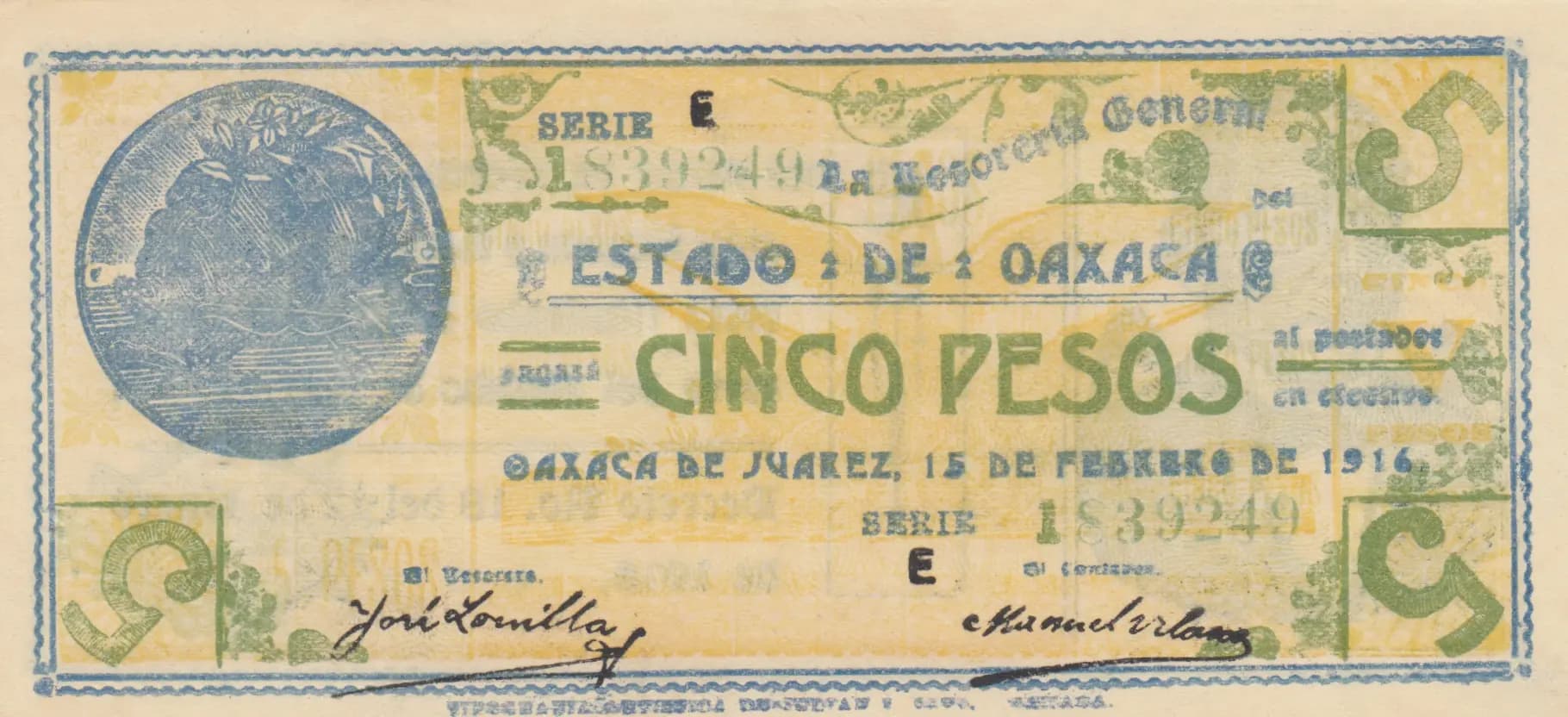
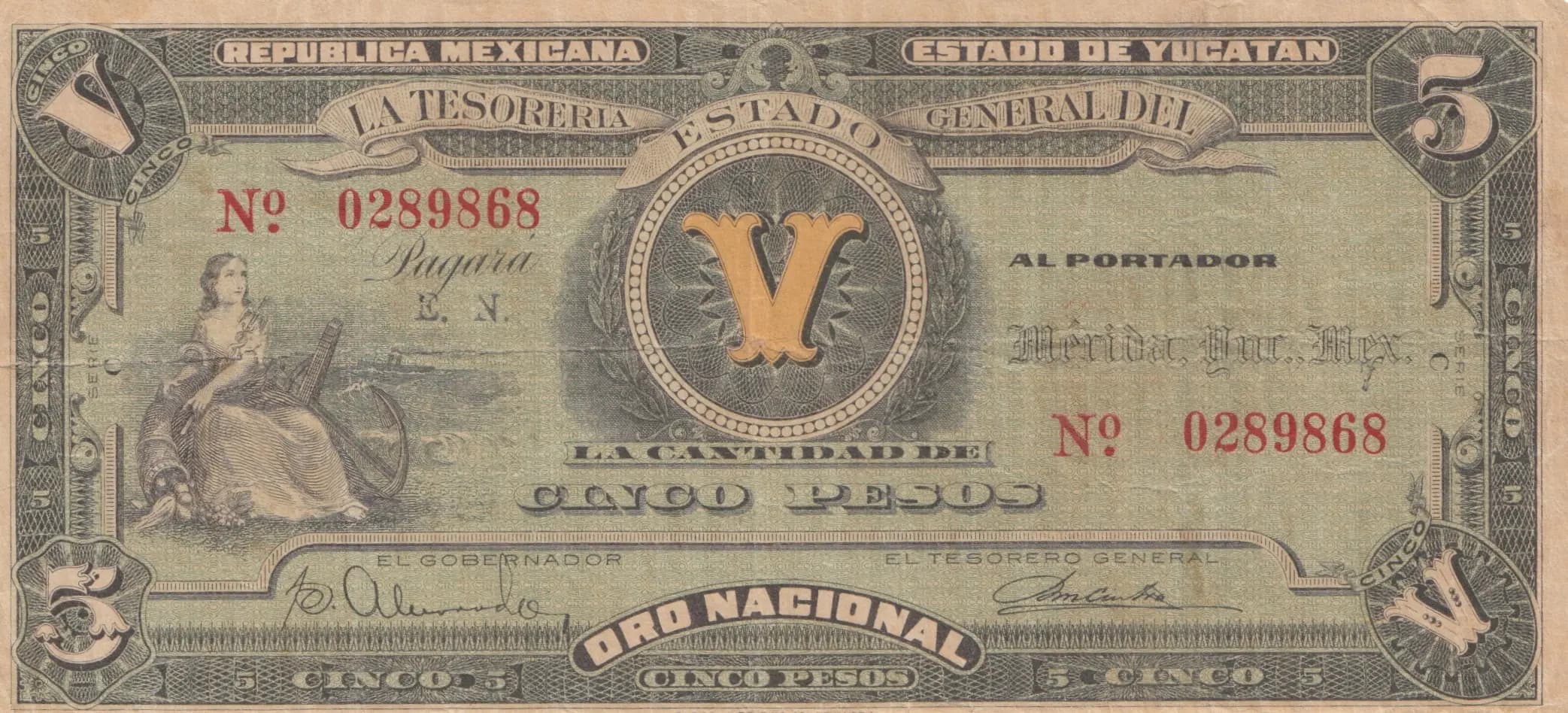
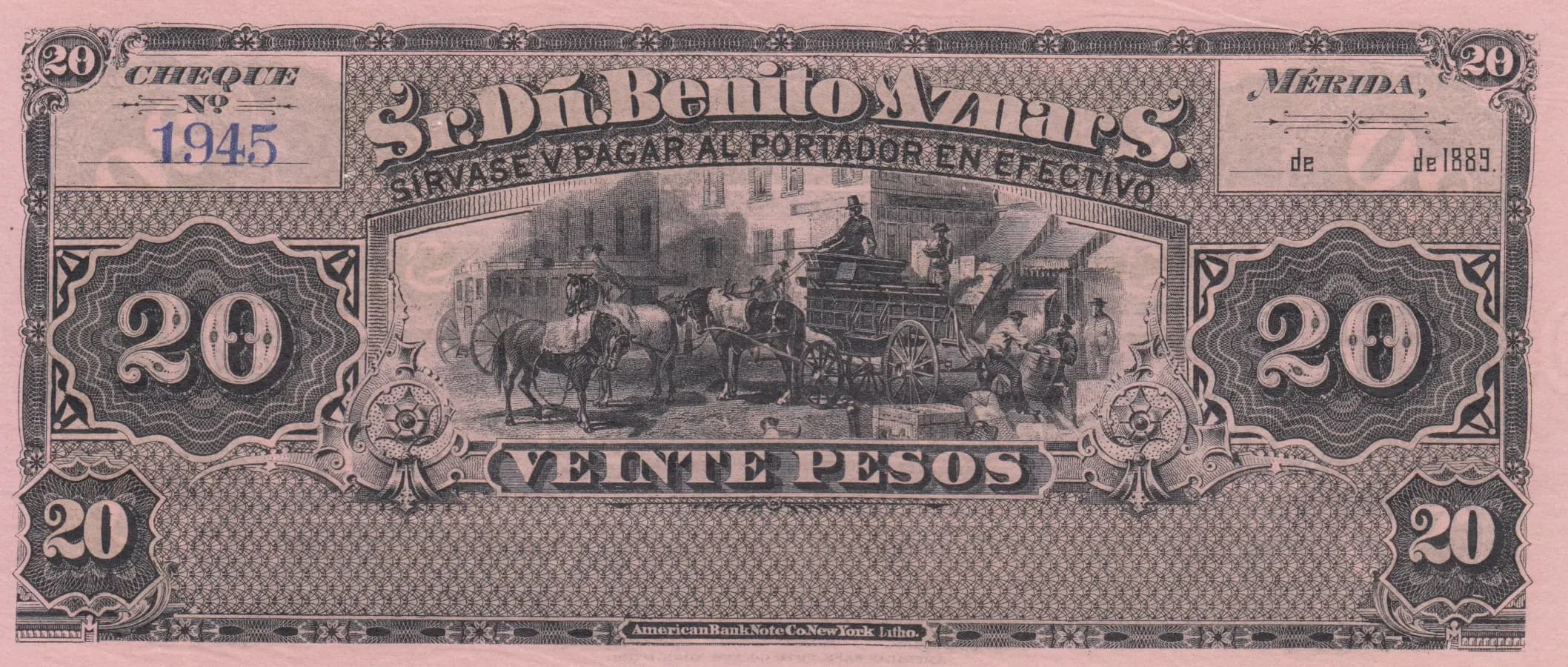
5 pesos 1916
About This Note
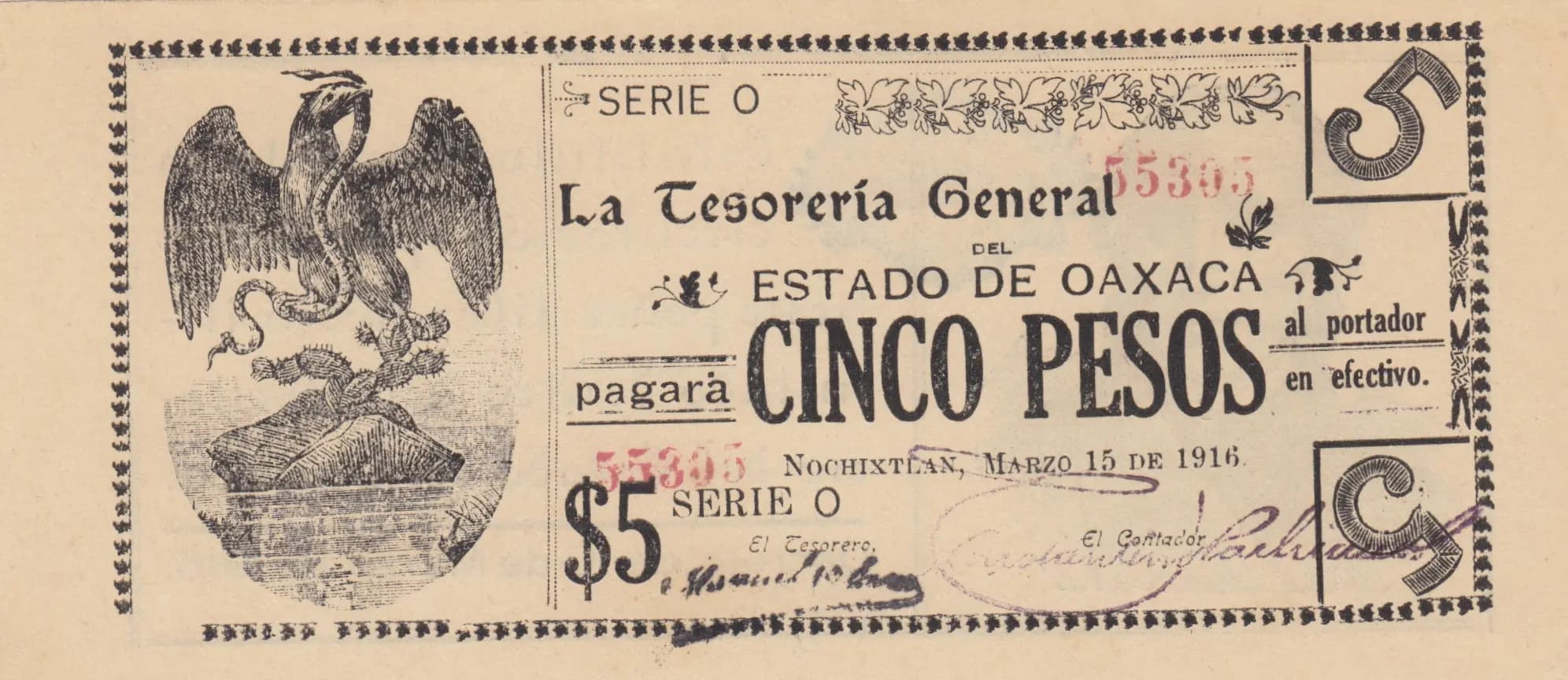
A handsome AU example of the 5 pesos issued by the State Treasury of Oaxaca in March 1916 during Mexico's revolutionary period. The note features the iconic Mexican national eagle emblem on the obverse and an engraved portrait on the reverse, with clear typography and well-preserved paper showing only age-appropriate yellowing and foxing consistent with its 108-year history. This state-issued credit instrument represents an important regional monetary emergency, authorized by decree during a period of central government weakness.
Common. State-issued emergency currency from the Mexican Revolution, particularly from Oaxaca, was produced in substantial quantities. The series designation 'O' and surviving examples in AU condition suggest adequate original production runs. These regional Mexican revolutionary banknotes, while historically significant, remain readily available to collectors. No evidence of severe scarcity or recall status affects this Pick number.
This banknote was issued by Tesoreira General del Estado de Oaxaca on March 15, 1916, during the Mexican Revolution when central monetary authority had collapsed and regional governments issued their own emergency currency. The decree authorization of March 10, 1916, preceded the actual issuance by five days, reflecting the desperate financial conditions in Oaxaca. The note's declaration of 'forced circulation' and 'unlimited liberatory power' within Oaxaca's territory underscores how fractured Mexico's monetary system had become, with state governments effectively functioning as independent monetary authorities.
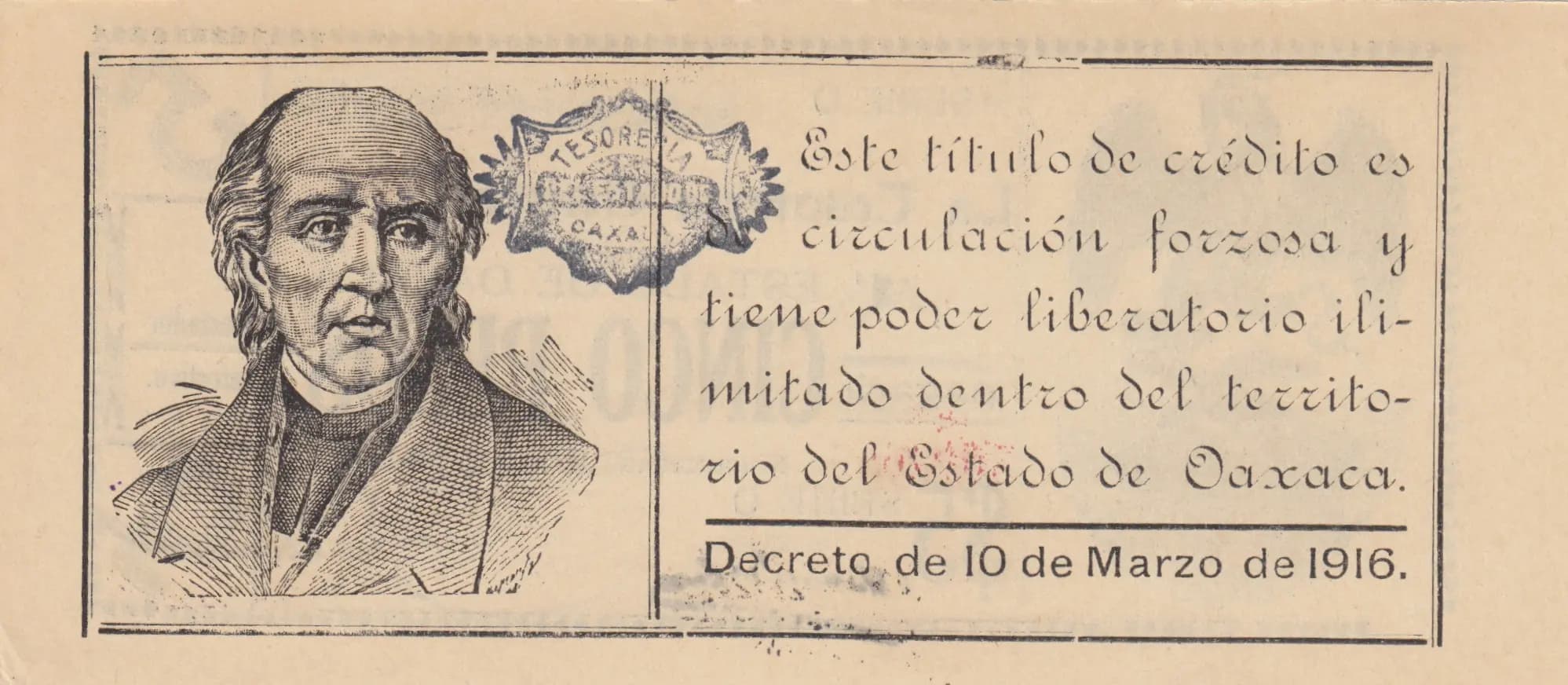
The obverse displays the Mexican national coat of arms—the águila mexicana (Mexican eagle) with wings fully spread, perched upon a nopal (prickly pear cactus) with a serpent coiled around it, rendered in fine line engraving on the left side. This heraldic emblem, central to Mexican national identity, is flanked by ornamental floral border patterns in a neoclassical style. Denomination and series information appear prominently in the lower left. The reverse features an engraved bust portrait of a bearded male figure in 19th-century formal dress with a ruffled collar, positioned on the left; a decorative seal labeled 'TESORERÍA' with ornamental borders crowns the composition at center top. The right side contains the legal text explaining the instrument's status as forced-circulation currency. Signature lines for the Treasurer (El Tesorero) and Accountant (El Contador) appear on the obverse, with red stamp marks bearing the number 5330 visible.
FRONT: 'SERIE O' (Series O) — 'La Tesorería General / DEL ESTADO DE OAXACA' (The General Treasury of the State of Oaxaca) — 'pagará CINCO PESOS en efectivo al portador' (will pay FIVE PESOS in cash to the bearer) — 'Nochixtlán, Marzo 15 de 1916' (Nochixtlán, March 15, 1916) — '$5' (Five Pesos) — 'El Tesorero' (The Treasurer) — 'El Contador' (The Accountant). BACK: 'TESORERÍA' (Treasury) — 'Este título de crédito es circulación forzosa y tiene poder liberatorio ilimitado dentro del territorio del Estado de Oaxaca.' (This credit instrument is forced circulation and has unlimited liberatory power within the territory of the State of Oaxaca.) — 'Decreto de 10 de Marzo de 1916.' (Decree of March 10, 1916.)
Intaglio engraving (copperplate or steel plate printing). The fine line work, portrait rendering, decorative borders, and heraldic imagery are characteristic of classical banknote engraving. The eagle emblem, bust portrait, and ornamental elements show the hallmark clarity and detail of professional security printing typical of early 20th-century Mexican state banknotes. Red stamps and apparent handwritten signatures were added post-printing.
Series O is noted on both obverse and reverse. The stamp marks visible (5330, 5330a) may represent batch or control numbers. The specific date of March 15, 1916, and location 'Nochixtlán' (alternate spelling: Nochixtlán) are fixed design elements. Variations in red stamp numbering and signature placement may constitute minor varieties within this issue, but standard cataloging treats P-S949 as a single primary variety.