5 pesos 1958
Market Prices
12 salesAbout This Note
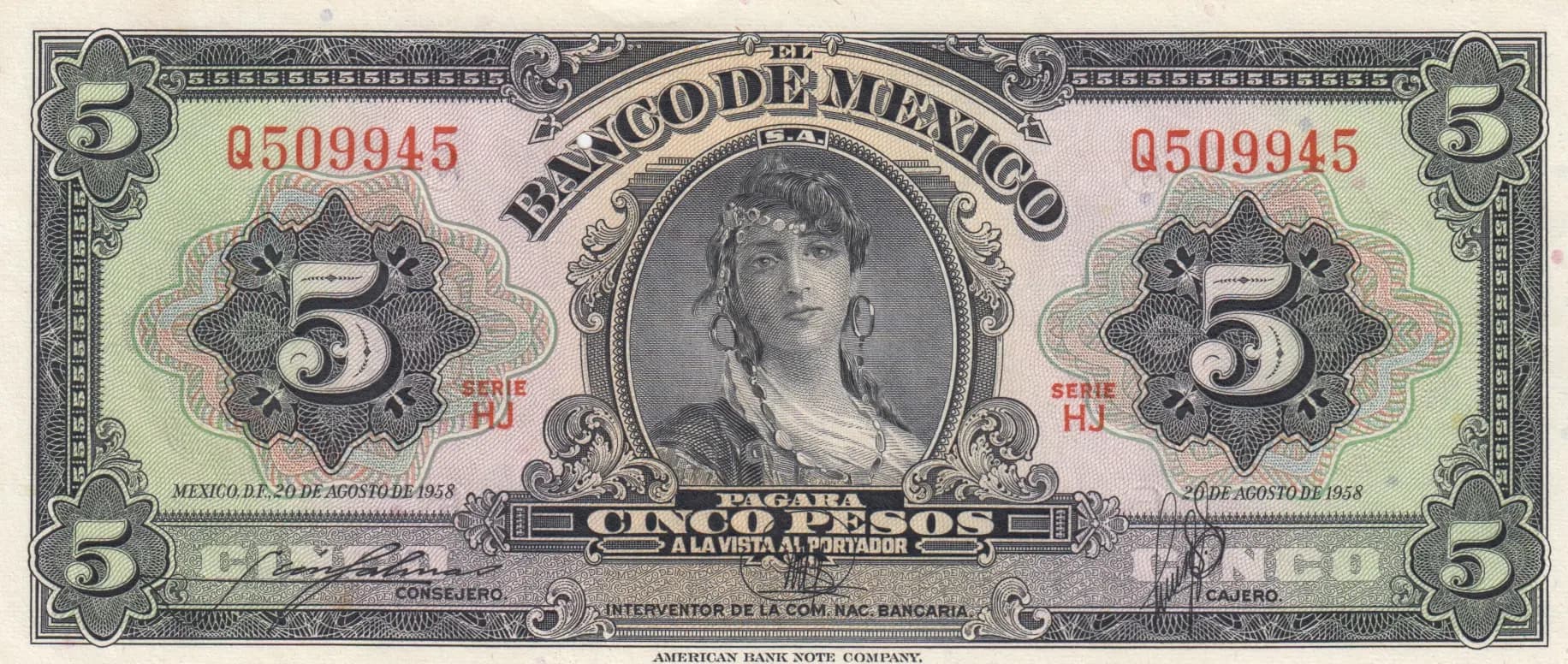
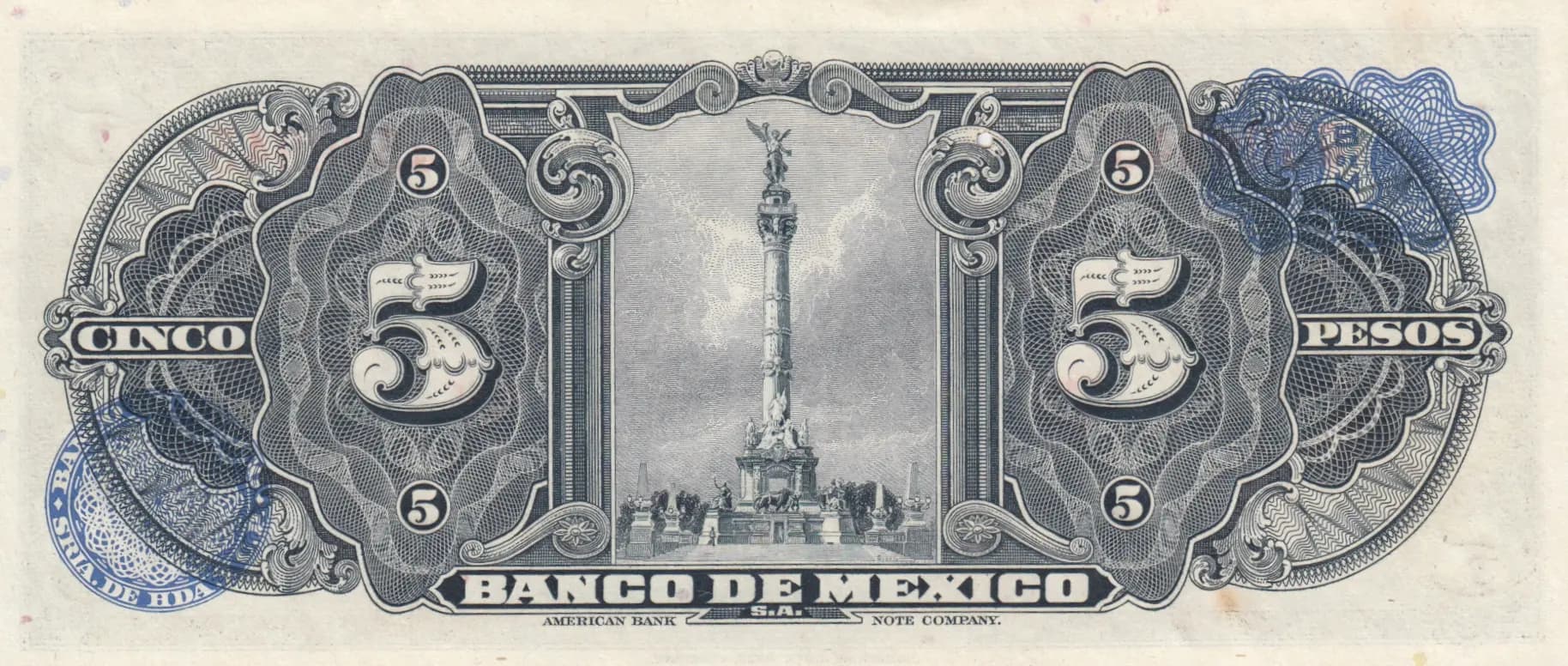
This is a Mexico 5 Pesos banknote from 1958 (Pick P-60c), issued by Banco de Mexico and printed by American Bank Note Company. The note features an ornate design with a portrait of a woman with braided hair on the obverse and the iconic Angel of Independence monument on the reverse, rendered in fine line engraving with black ink on multicolor underprint. While the visual analysis indicates some foxing and age-related discoloration consistent with a 65-year-old note, the cataloged condition is UNC, suggesting a well-preserved example with crisp printing and clear details.
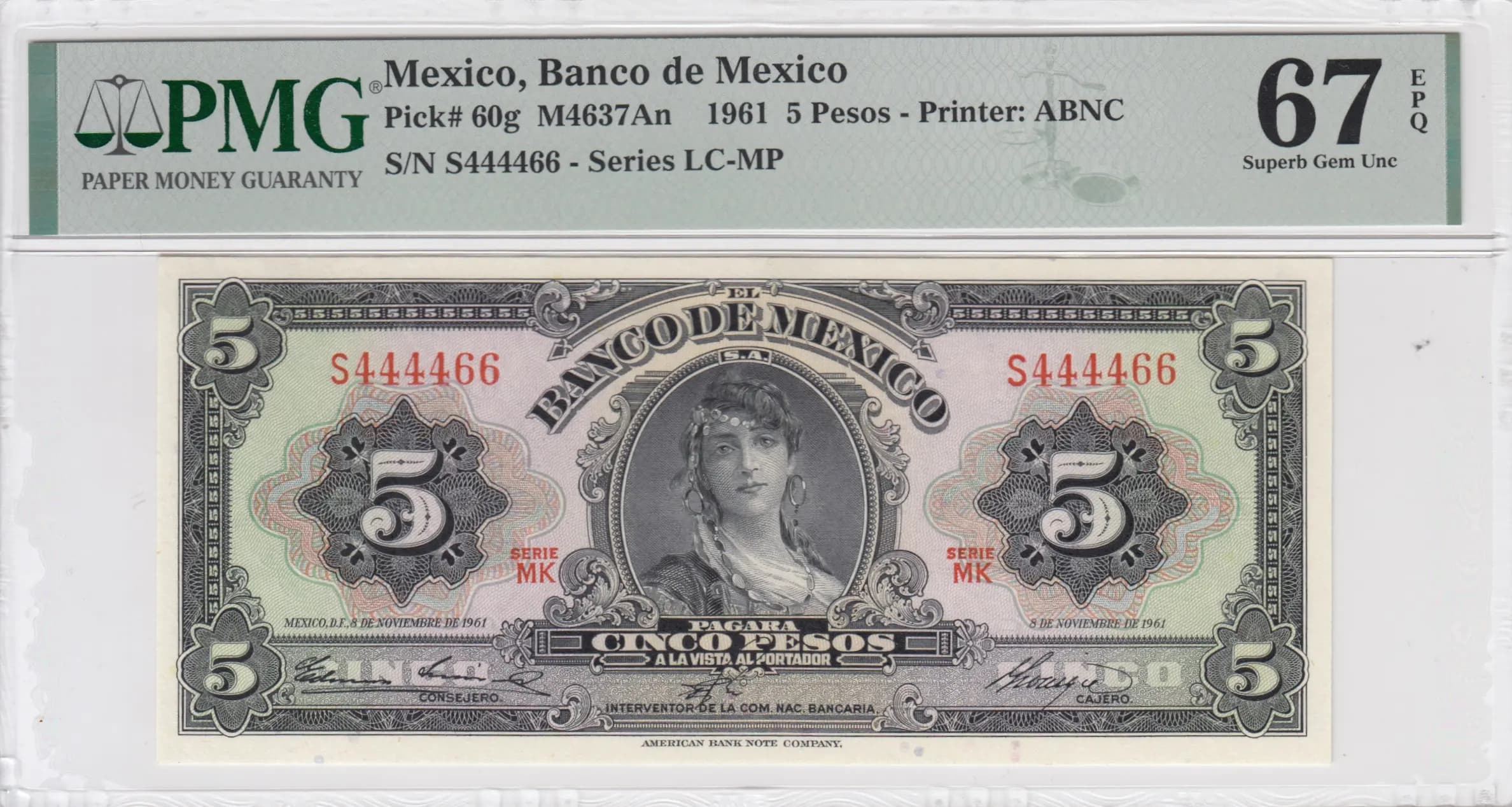
Common. eBay market data shows consistent sales across multiple condition grades from 2015-2021, with UNC examples (the condition of this note) selling for $5-6 range according to catalog values and historical auction records. No sales below $2.75 or above $45 except for higher-graded PMG specimens, indicating steady supply and consistent demand at modest prices. The series designation 'HC-HJ' represents a standard production run from this period. This is a standard circulation issue from Mexico's mid-century currency production with no evidence of scarcity.
Issued on August 20, 1958, this banknote represents Mexico's mid-20th century currency during a period of economic development and national consolidation. The inclusion of the Angel of Independence monument on the reverse reflects Mexico's national identity and pride in its independence, a recurring theme in Mexican numismatic design. The note's inscription 'PAGADERA EN ORO A LA VISTA AL PORTADOR' (payable in gold on sight to the bearer) reflects the gold-standard backing requirements of Mexican currency at this time, representing a transitional period in international monetary policy.
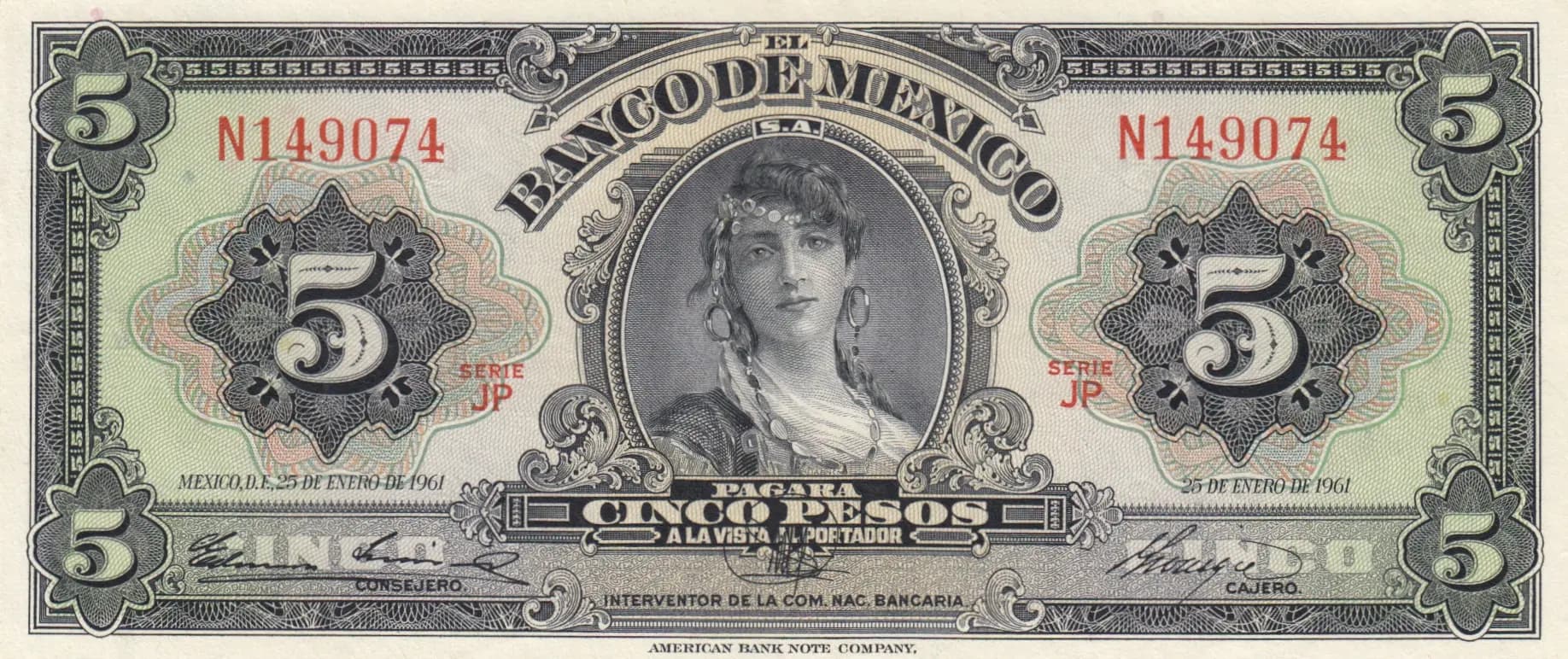
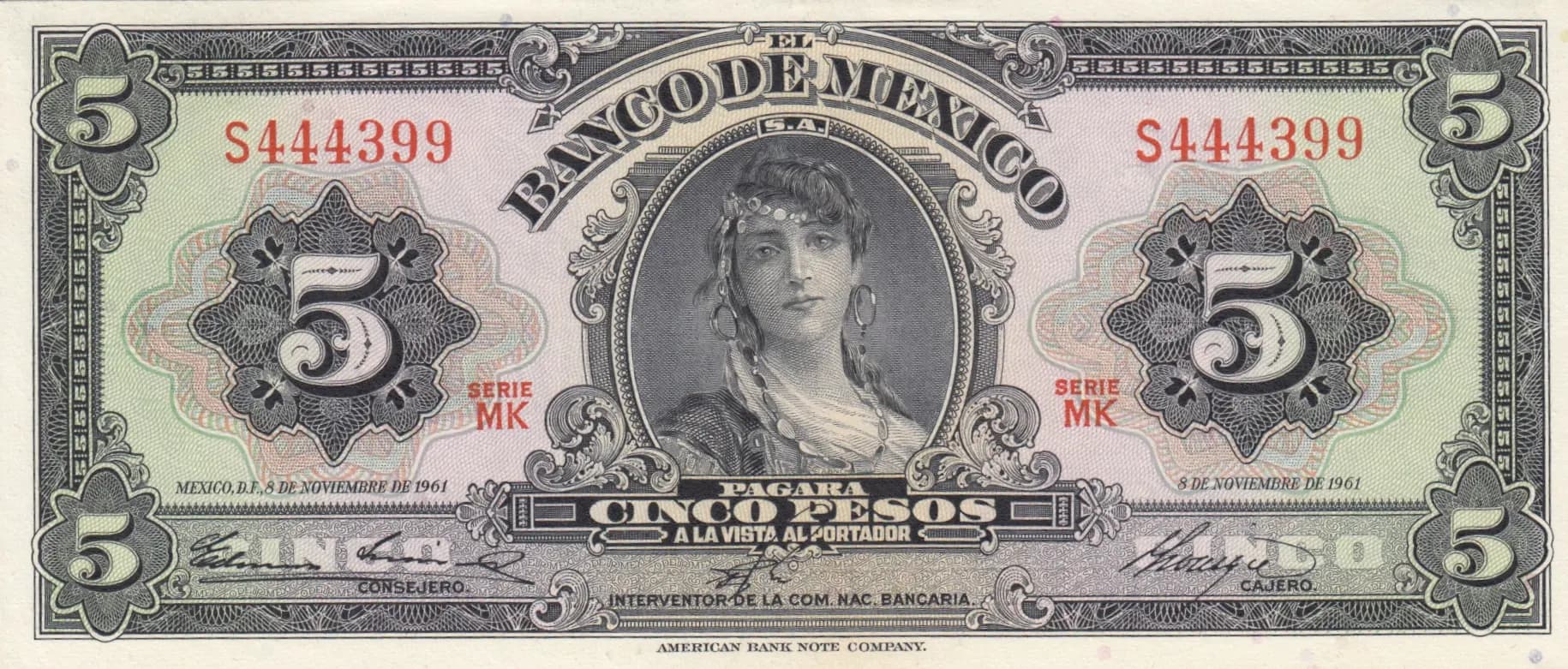
The obverse features a central oval portrait of an indigenous or mestiza woman with long braided hair, characteristic of Mexican cultural representation in the mid-20th century. She wears period costume with visible ear ornaments and faces slightly right. The portrait is framed by elaborate baroque-style ornamental scrollwork and geometric patterns. Decorative rosette designs containing the numeral '5' occupy the upper corners. The reverse depicts the Angel of Independence (Ángel de la Independencia), Mexico's most iconic monument located atop the Independence Monument (Monumento a la Independencia) in Mexico City, shown against an atmospheric clouded background. The monument is enclosed within ornate baroque framing with denomination cartouches. Both sides employ extensive fine line engraving with geometric and floral border patterns. The color scheme is predominantly black with green and pink tones in the underprint on the obverse; the reverse is primarily black and white.
OBVERSE: 'BANCO DE MEXICO' (Bank of Mexico) — issuing authority; 'CINCO PESOS' (Five Pesos) — denomination; 'MEXICO, D.F. 20 DE AGOSTO DE 1958' (Mexico City, August 20, 1958) — issue date; 'PAGADERA EN ORO A LA VISTA AL PORTADOR' (Payable in gold on sight to the bearer) — redemption clause; 'SERIE HJ' (Series HJ) — series designation; 'CONSEJERO' (Counselor), 'INTERVENTOR DE LA COM. NAC. BANCARIA' (Comptroller of the National Banking Commission), 'CAJERO' (Cashier) — authorization titles; 'AMERICAN BANK NOTE COMPANY' — printer; Serial number 'Q509945' in red. REVERSE: 'CINCO PESOS' (Five Pesos) — denomination; 'BANCO DE MEXICO' (Bank of Mexico) — issuing authority; 'AMERICAN BANK NOTE COMPANY' — printer.
Intaglio engraving (line engraving), characteristic of high-security banknote production. The American Bank Note Company (ABNC), one of the world's premier security printers, produced this note using traditional engraved plates creating the fine line detail work visible throughout both sides. The complex geometric patterns, ornamental borders, and detailed monument vignette demonstrate the sophisticated anti-counterfeiting techniques of 1950s banknote manufacturing. The multicolor underprint on the obverse was achieved through separate color printing passes.
This note is cataloged as Pick P-60c, distinguishing it from earlier variants (P-57 and earlier issues) by the inclusion of 'MEXICO D.F.' before the date on the obverse. The series 'HJ' places it within the designated range for this printing. The serial number prefix 'Q' and series 'HJ' are consistent with the standard issue parameters. No overprints or unusual markings are visible beyond the blue institutional stamp/seal on the reverse, which appears to be a handling mark rather than an official variety feature.