5 centavos 1914
About This Note
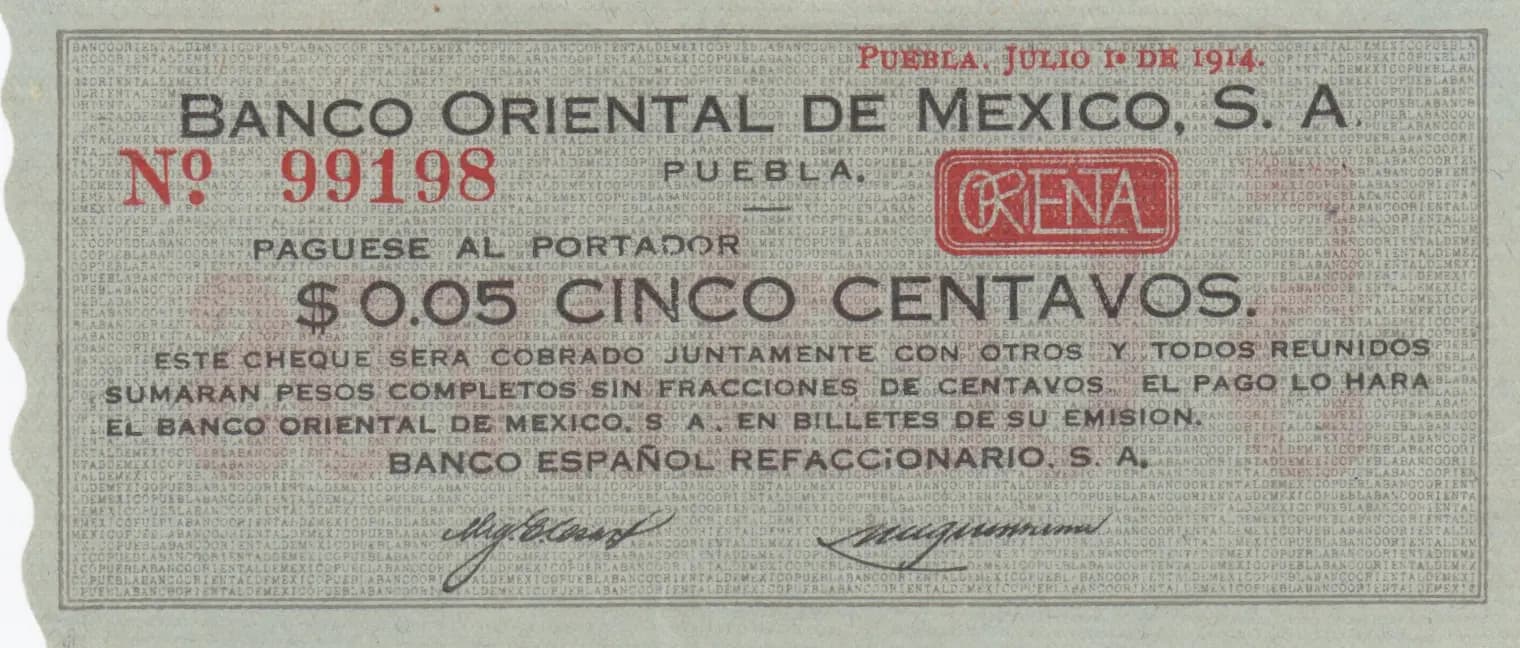
This is a 5 centavos fractional currency check issued by Banco Oriental de Mexico on July 1, 1914, from Puebla during Mexico's tumultuous Revolutionary period. The document is printed in red and black on cream-colored paper with decorative borders and repetitive security background text, bearing check number 99198 and two signatures. In AU condition, this note shows expected aging and foxing consistent with a 110-year-old document, but retains good legibility and structural integrity, making it a notable example of emergency fractional currency from a bank that operated during one of Mexico's most politically unstable eras.
Common. While Banco Oriental de Mexico operated during a historically significant period, fractional currency checks were issued in large quantities during 1914 to address circulating currency shortages. The specific denomination (5 centavos) and format (check/draft) were produced in substantial numbers. No evidence suggests this particular check number or issue date was part of a limited print run or short-lived emission. The AU condition grade is desirable but does not significantly elevate rarity for what was fundamentally utilitarian emergency currency.
Banco Oriental de Mexico issued this fractional check during the Mexican Revolution, a period when regular currency was scarce and banks issued emergency checks and drafts to facilitate commerce. The July 1, 1914 date places this during a critical moment when multiple factions vied for control and traditional monetary systems were disrupted. The notation that payment would be made 'in bills of its emission' reflects the common practice of banks backing fractional currency with their own banknote issues during this chaotic period.
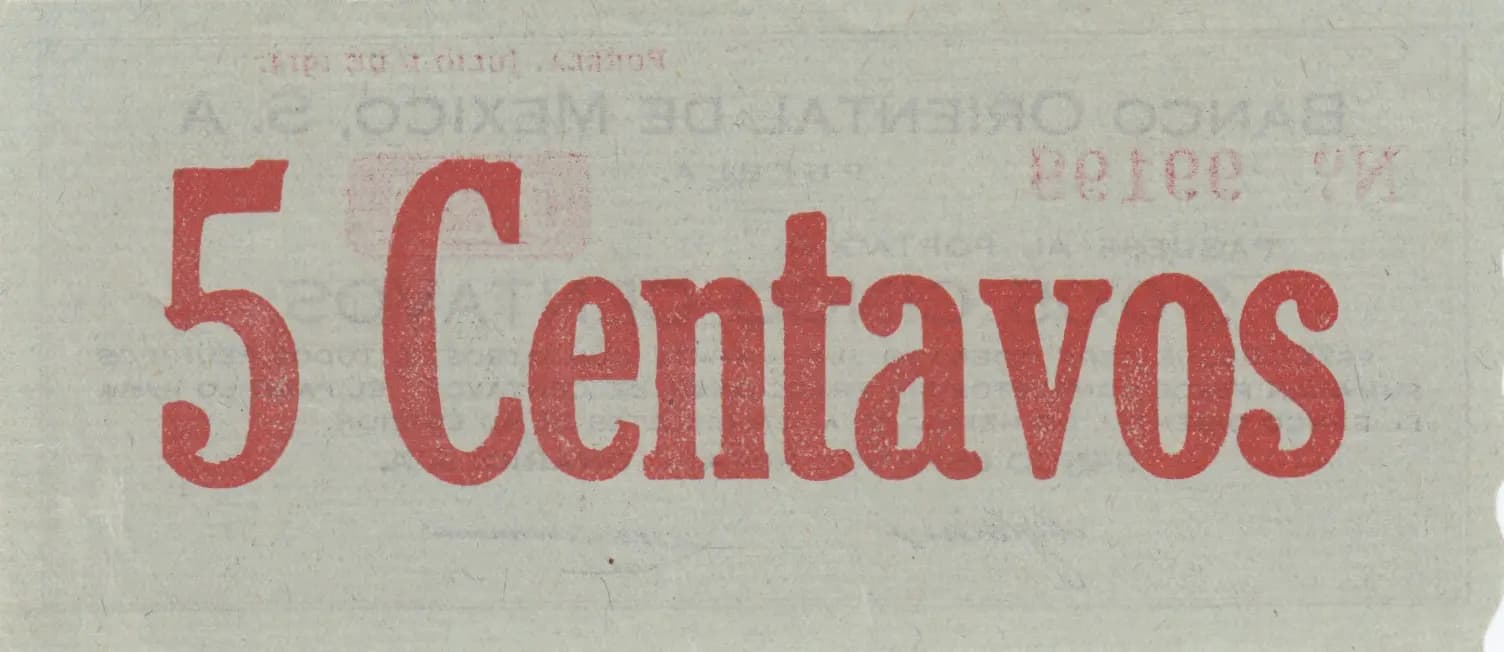
This is a bank draft or check rather than a traditional banknote, reflecting emergency currency practices during the Mexican Revolution. The front features a formal layout with the issuing bank's name at the top, location and date of issue (Puebla, July 1, 1914), and a large 'ORIENA' stamp/logo in a red rectangular box on the right side—likely an abbreviation or abbreviation of the bank's name. The denomination is clearly marked as '$ 0.05 Cinco centavos' with specific payment instructions ('Páguese al portador'—pay to bearer). Two signature lines appear at the bottom for authorization. The reverse side is largely blank except for the large red denomination '5 Centavos' centered on the page. The decorative border elements and repetitive background text pattern served as basic security features to prevent counterfeiting. The light tan/cream paper with black and red ink was typical of rapid wartime printing.
FRONT SIDE: 'Banco Oriental de Mexico, S.A.' (Oriental Bank of Mexico, S.A.); 'Puebla, July 1st, 1914' (Puebla, Julio 1º de 1914); Check number 99198 (Nº 99198); 'Pay to bearer' (Páguese al portador); '$0.05 Five centavos' ($ 0.05 Cinco centavos); 'This check will be collected together with others and all combined will total complete pesos without fractions of centavos. Payment will be made by Banco Oriental de Mexico, S.A. in bills of its emission.' (Condition clause regarding consolidation of checks); Bank name reference (Banco Español Refaccionario, S.A.); 'ORIENA' (bank logo/stamp marking). BACK SIDE: '5 Centavos' prominently displayed in red; Faint illegible repetitive text at top.
Letterpress printing on cream-colored paper using black and red inks. The repetitive background text pattern visible throughout the document served as a rudimentary security feature. The decorative borders appear to be typographic rules and ornamental type. No complex engraving or lithographic elements are evident, consistent with emergency wartime printing practices when speed and simplicity were prioritized over security sophistication.
This check is dated July 1, 1914, representing the early months of emergency currency issuance by this bank. The check number 99198 indicates this was part of a sequential series. Varieties for this Pick number likely include different check numbers, signature combinations, and possibly different issue dates throughout 1914. The 'ORIENA' stamp marking appears consistent with bank identification protocols. No overprints or modification marks are evident on this specimen. Collectors should note that individual check numbers and signature pairs create inherent varieties within this issue, though no specific cataloged sub-varieties for P-S964 are apparent from standard references.


