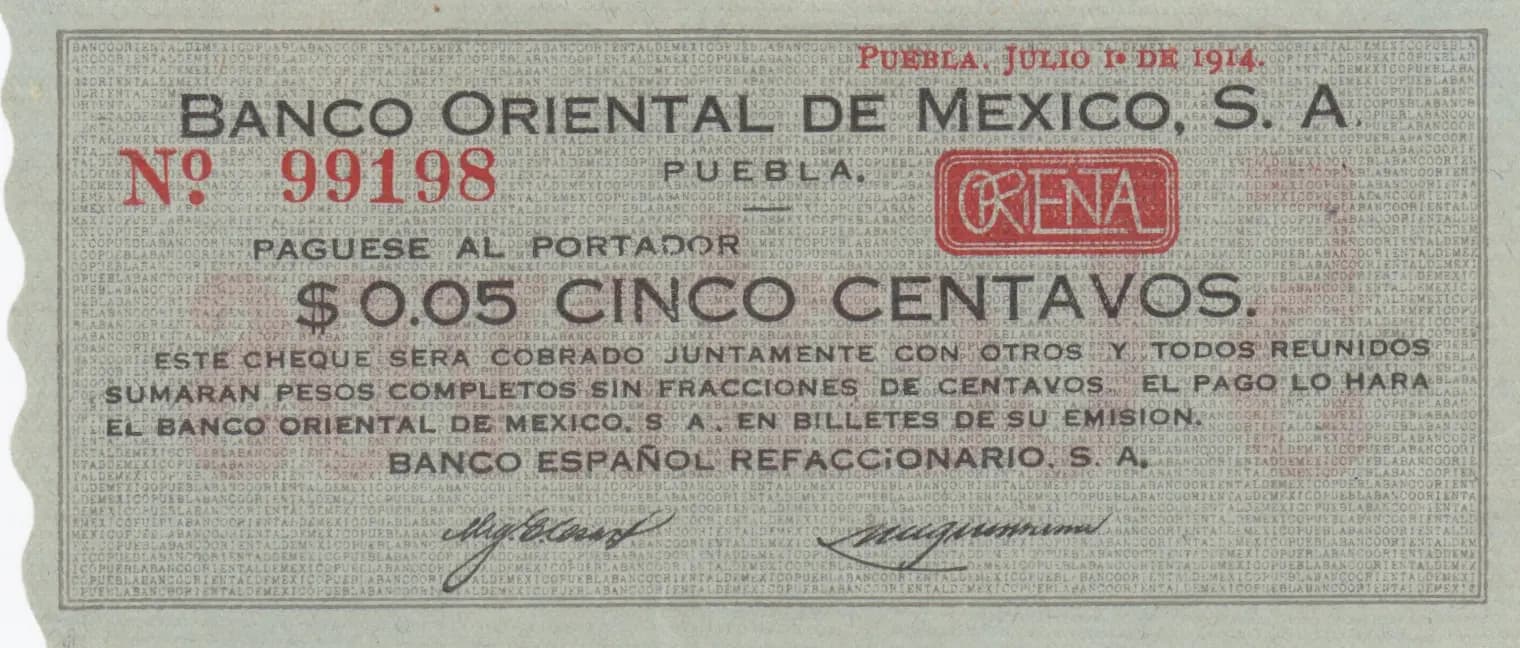
5 centavos 1914


About This Note
This 1914 Mexican 5 centavos note from the Gobierno Provisional de Mexico presents an attractive orange-toned example in VF condition, featuring classical allegorical imagery on both sides. The obverse displays a seated female figure in draped clothing holding a torch or staff, while the reverse showcases the Mexican national coat of arms—an eagle with spread wings. Despite visible age-related creasing, discoloration, and a red handwritten or stamped mark across the obverse, the note retains good clarity and detail, making it an interesting artifact of Mexico's tumultuous revolutionary period.
Common. While the Gobierno Provisional de Mexico issued notes over a relatively short period (1913-1914) during revolutionary upheaval, the 5 centavos denomination in this pick catalog position appears to have been produced in sufficient quantities to remain available to collectors. The VF condition grade and presence of period-appropriate handling marks are consistent with circulation experience, suggesting adequate original production runs. Provisional government notes from this era, though historically significant, were not produced in limited quantities, and examples regularly appear in dealer inventories and collector markets.
Issued during the Mexican Revolution by the Provisional Government (Gobierno Provisional de Mexico), this note represents the transitional monetary authority that existed during the conflict between 1913-1914. The classical female allegorical figure on the obverse likely represents Liberty or Mexico itself, while the reverse features Mexico's iconic national symbol—the eagle, emphasizing national sovereignty during a period of internal instability. The inscription 'CORREO PROVISIONAL DE MEXICO' and 'TRANSITO' suggests this may have also served postal or transit purposes, reflecting the improvised nature of provisional government services during the revolution.
The obverse features Liberty or an allegorical representation of Mexico as a classical seated female figure in Greco-Roman style, partially draped, holding a torch or staff symbolic of enlightenment or guidance. She is centered within ornamental scrollwork and decorative borders typical of late 19th/early 20th-century banknote design. The reverse displays the Mexican national coat of arms: an eagle with fully spread wings facing forward, a symbol deeply rooted in Aztec mythology and Mexican national identity. The eagle is similarly framed by ornamental borders with scrollwork. Denomination numerals appear in multiple locations on both sides (corners, center) to prevent counterfeiting. The overall design reflects neoclassical aesthetic principles common to Latin American banknotes of this era.
FRONT: 'CORREO PROVISIONAL DE MEXICO' (Provisional Mail of Mexico); 'TRANSITO' (Transit/In Transit); 'SERIE' (Series); '5' (denomination). BACK: 'REPUBLICA MEXICANA' (Mexican Republic); 'CINCO CENTAVOS' (Five Centavos); '5' and '5C' (denomination markers); 'EL FALSIFICADOR SERA CASTIGADO CON TODO RIGOR' (The counterfeiter will be punished with full rigor—standard warning inscription).
This note was produced using intaglio (engraved) printing, evidenced by the fine linework, detailed shading, and crisp denomination numerals visible in the images. The ornamental borders and allegorical figures display the characteristic depth and precision of intaglio work. For Mexican provisional government notes of 1914, printing was often contracted to established security printers, though specific printer information for Pick P-S697(2) requires specialist reference materials. The orange-brown color scheme is consistent with period-appropriate ink formulations.
This note is catalogued as Pick P-S697(2), indicating it is variety 2 of this specific pick number. Varieties may differ by series letters, signature combinations, or serial number prefixes. The observed series notation visible on the obverse should be documented. The red stamped or handwritten mark across the obverse may represent an individual bank or post office marking from the period, rather than a catalogued variety. For comprehensive variety identification, examination of serial number format and series letters would be necessary.