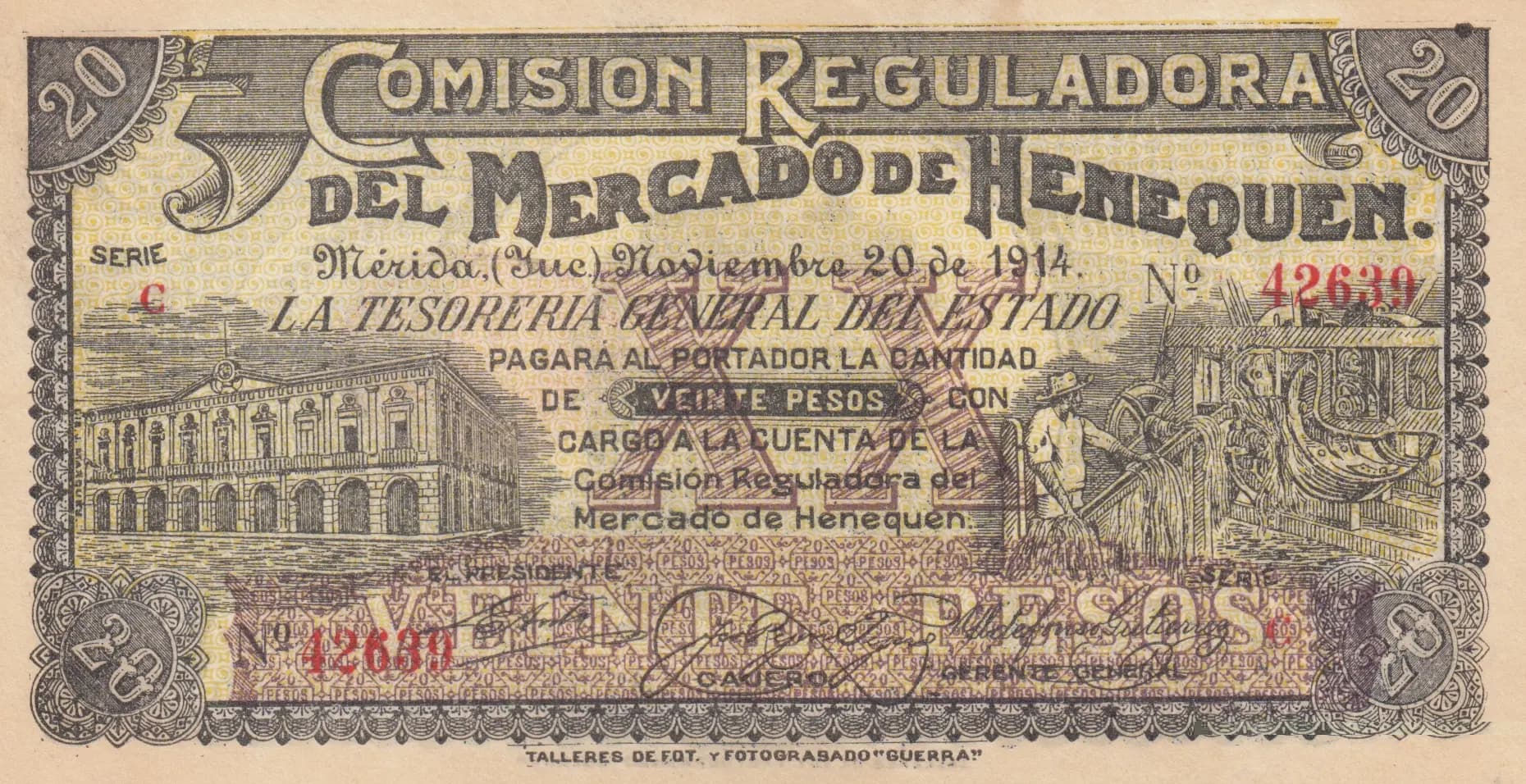
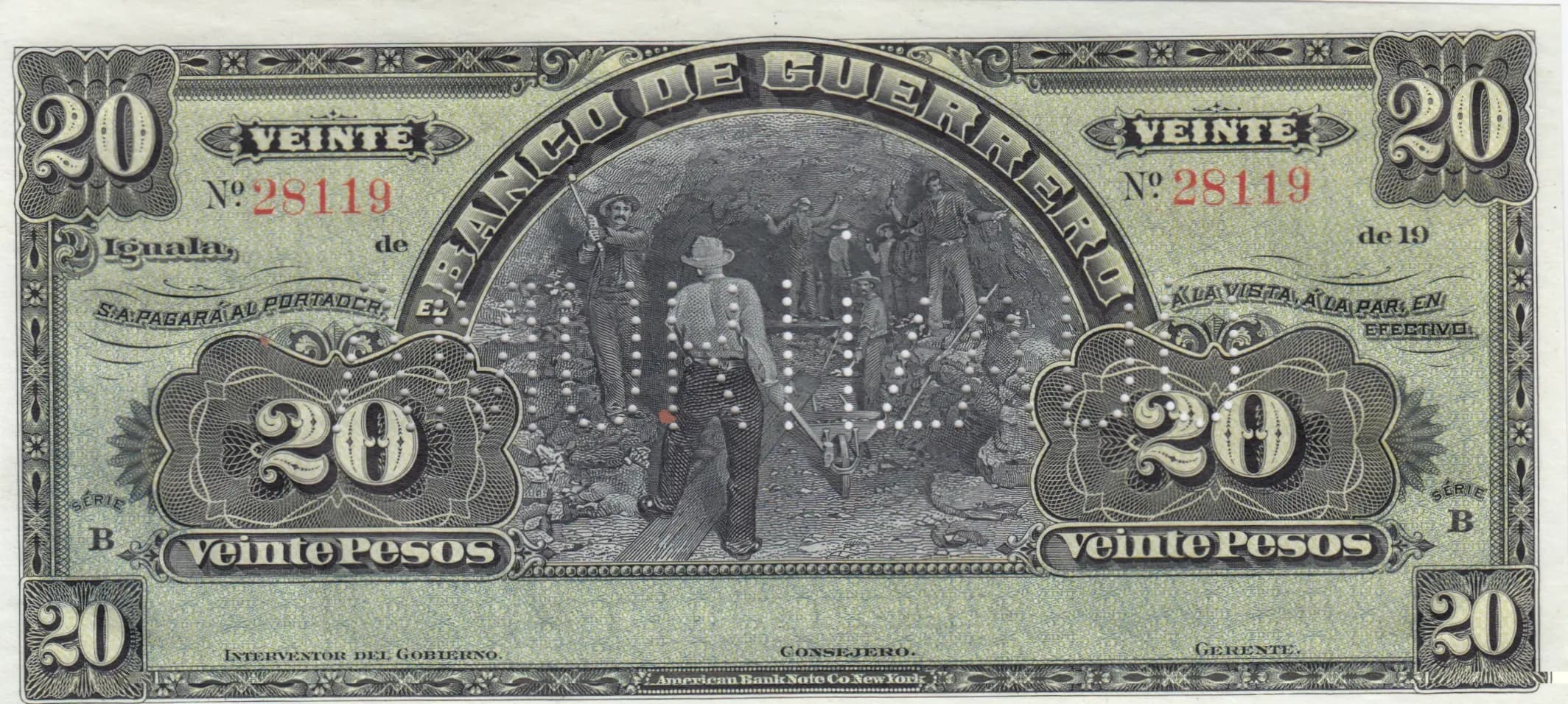
20 pesos 1914
About This Note
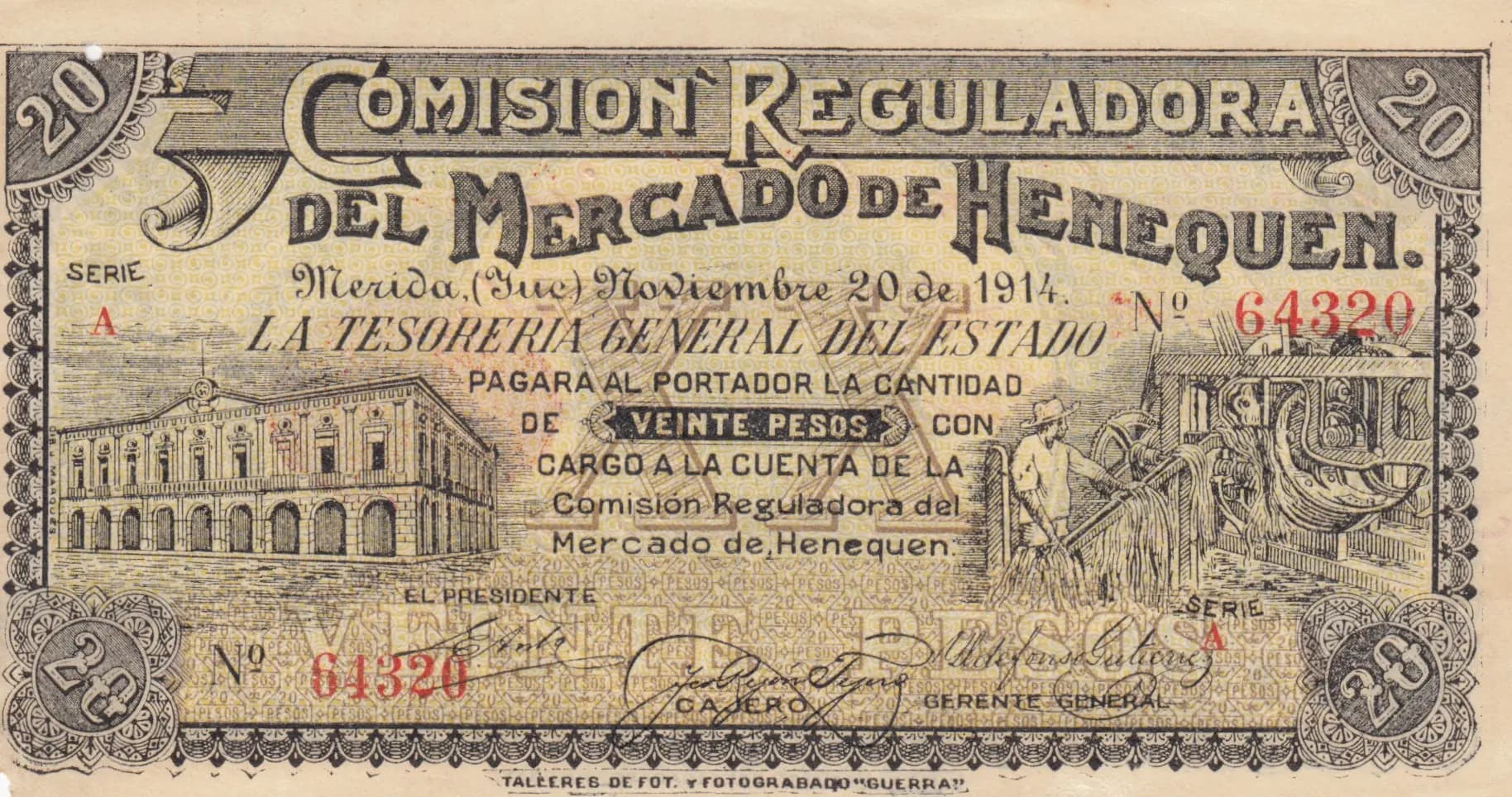
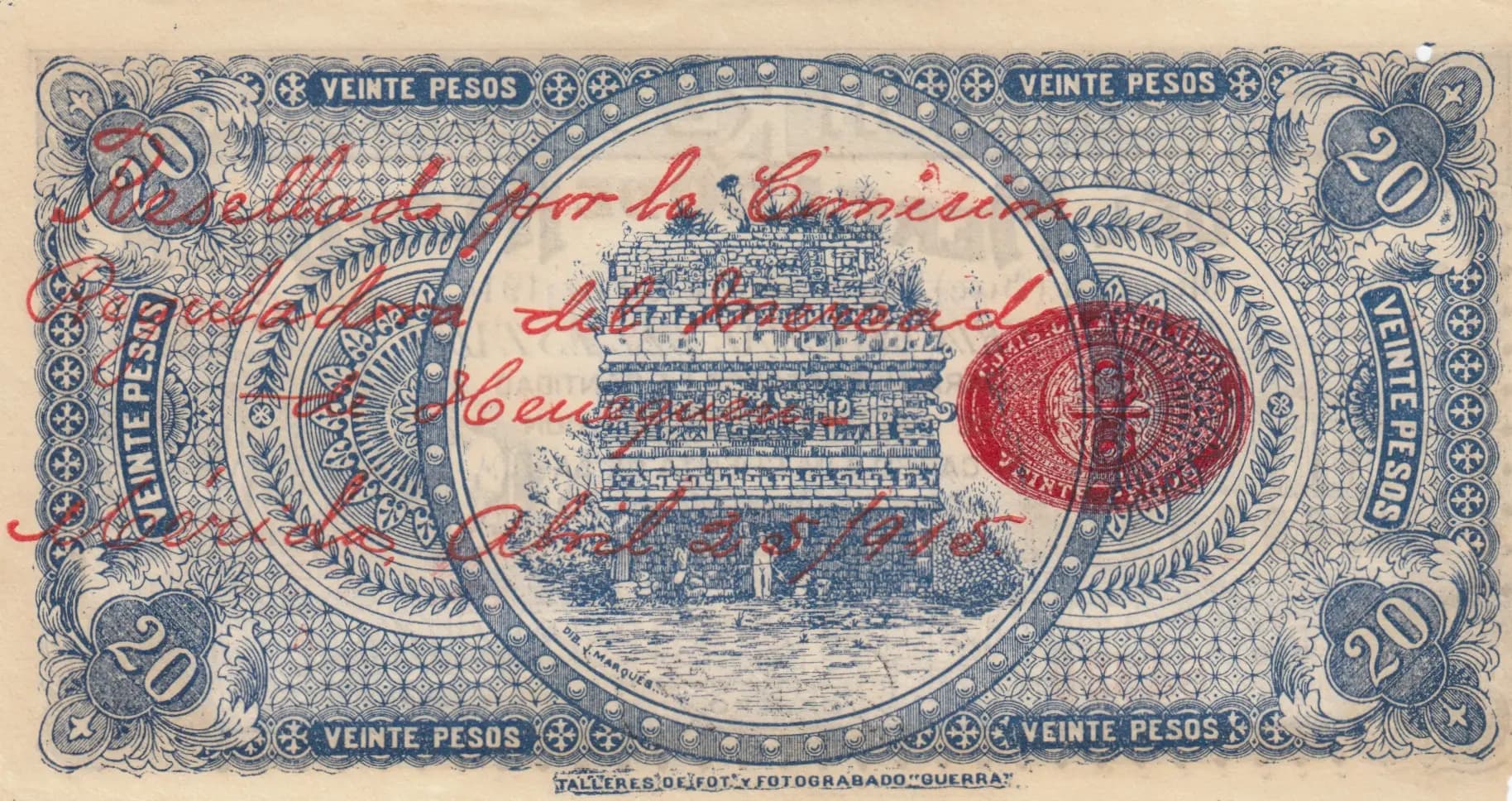
This is an exceptional AU-grade example of a 20 pesos banknote issued by the Comisión Reguladora del Mercado de Henequén on November 20, 1914, from Mérida, Yucatán. The note displays the characteristic cream and blue color scheme with fine line engraving, featuring a colonial-style building prominently displayed on both sides within an ornate oval frame on the reverse. Despite over a century of age, the note retains excellent visual clarity with only expected foxing and age-related patina, making it a desirable example of Mexican revolutionary-era regional currency.
Common. The Comisión Reguladora del Mercado de Henequén issued multiple denominations and series during 1914, and surviving examples in various conditions are encountered with moderate regularity in the Mexican revolutionary currency market. While this specific note (Series A, No. 64320 from November 1914) represents a single printing variety, the denomination and issuer were not subject to extreme scarcity like some shorter-lived or lower-denominated emergency issues. AU-grade examples command modest premiums reflecting their condition and historical interest, but the underlying note type is not particularly scarce. Regional Mexican emergency currency from 1914 exists in sufficient quantity to classify this as a common type, though individual serial numbers remain unique.
Issued during Mexico's tumultuous Revolutionary period, this note was generated by a specialized regulatory commission controlling the henequén (sisal) market in Yucatán—a critical commodity and source of state revenue during economic instability. The prominent colonial building depicted on the note likely represents the state treasury or regional administrative center in Mérida, symbolizing governmental authority during a time when local and regional authorities maintained quasi-independent monetary systems. The note's promise to pay 'on behalf of the General Treasury of the State' reflects the decentralized financial chaos of 1914, when multiple issuing authorities throughout Mexico created emergency currency.
The note's obverse features a balanced composition with the issuing authority's name prominently centered, flanked by allegorical and architectural imagery. On the left stands a multi-story colonial-style building with regular window patterns, representing institutional authority and regional governance. On the right is an allegorical female figure depicted with wings in the classical style, symbolizing commerce, justice, or prosperity—common iconographic elements in Latin American currency of the era. The reverse presents a more unified design focused on a large oval frame containing the same or similar colonial building, emphasizing governmental legitimacy. All four corners display ornamental designs incorporating the denomination '20' in multiple orientations. Red circular seals (likely official emblem stamps) appear on both sides, applied post-printing as security validation. The intricate decorative borders, particularly the blue/navy pattern on the reverse, frame the note with geometric precision characteristic of early 20th-century engraving standards.
FRONT SIDE: 'Comisión Reguladora del Mercado de Henequén' (Regulatory Commission of the Henequén Market) / 'Mérida (Yucatán) November 20, 1914' (date and location of issue) / 'La Tesorería General del Estado pagará al portador la cantidad de Veinte Pesos con cargo a la cuenta de la Comisión Reguladora del Mercado de Henequén' (The General Treasury of the State will pay to bearer the sum of Twenty Pesos, charged to the account of the Regulatory Commission of the Henequén Market) / 'El Presidente, Cajero, Gerente General' (The President, Cashier, General Manager—signature lines) / 'Serie A, No 64320' (Series A, Number 64320) / 'Taller de Fot. y Fotograbado "Guerra"' (Photo and Photoengraving Shop "Guerra") / BACK SIDE: 'Veinte Pesos' (Twenty Pesos—appears twice, top and bottom of oval frame) / 'Taller de Fot. y Fotograbado "Guerra"' (Photo and Photoengraving Shop "Guerra") / [Red handwritten endorsements/signatures crossing diagonally—post-issuance marks, not clearly legible in visual analysis]
The note was produced using photoengraving (fotograbado) and photolithography techniques, as explicitly credited to 'Taller de Fot. y Fotograbado "Guerra"' (Guerra Photo and Photoengraving Workshop) on both sides. The fine line work visible in the border patterns, the precision of the window details in the depicted buildings, and the overall aesthetic are consistent with advanced photoengraving methods of the era. The red seals were applied by hand-stamp after printing, a common security practice for emergency currency. The base printing shows characteristics of intaglio or relief printing with careful register, while the red ink elements represent secondary applied security features.
This example is identified as Series A, Number 64320, dated November 20, 1914. The note exhibits the standard design of the 20 pesos denomination issued by this commission. Known varieties for the Comisión Reguladora del Mercado de Henequén 20 pesos include different series designations (Series A being documented here) and potentially different signature combinations in the three signature lines for Presidente, Cajero, and Gerente General. The specific red handwritten endorsements visible crossing the note diagonally appear to be post-issuance circulation marks rather than printer varieties, possibly representing bank endorsements or transfer annotations. No overprints or surcharges are evident on this example.