20 pesos 1914
About This Note
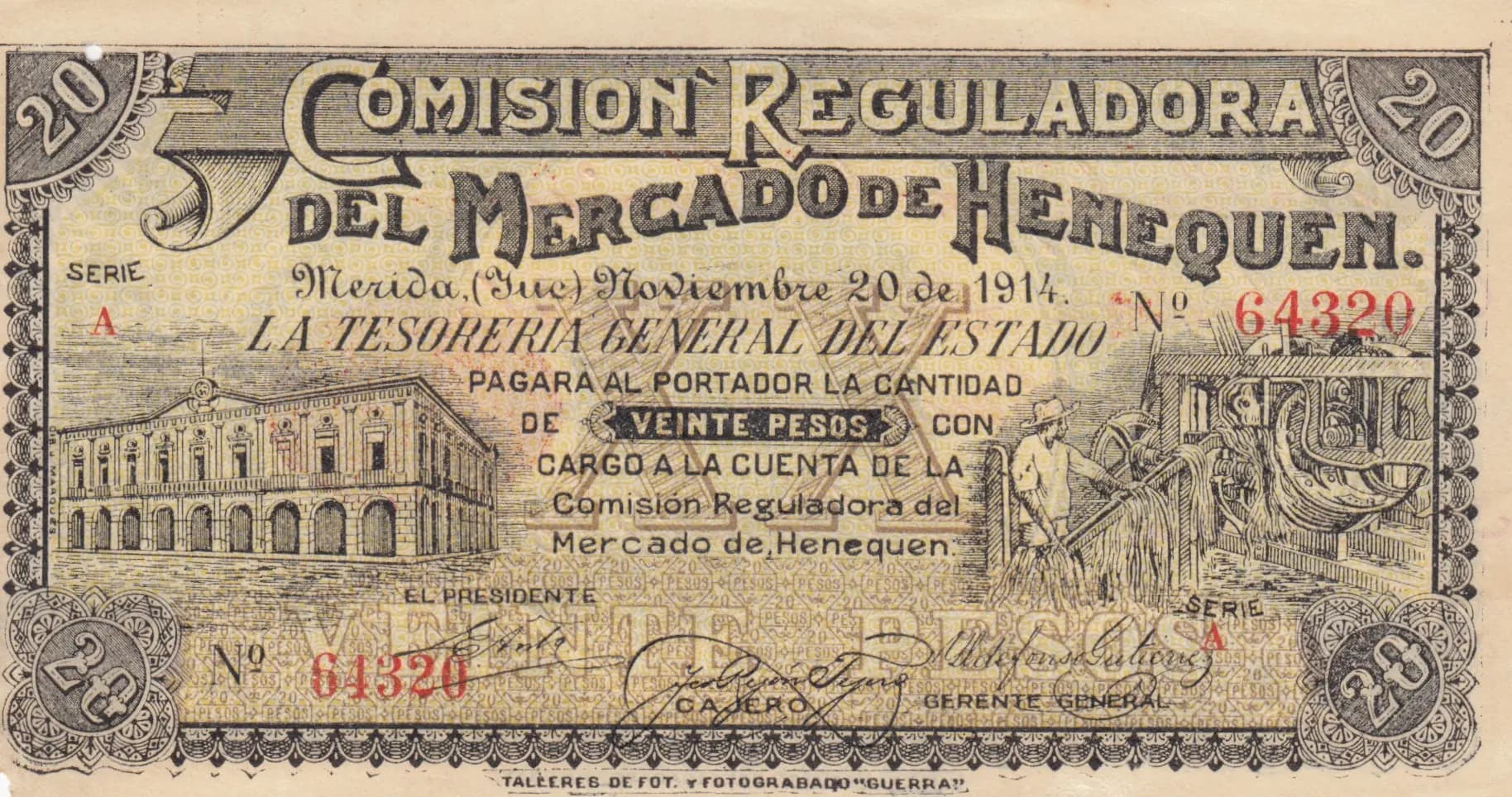
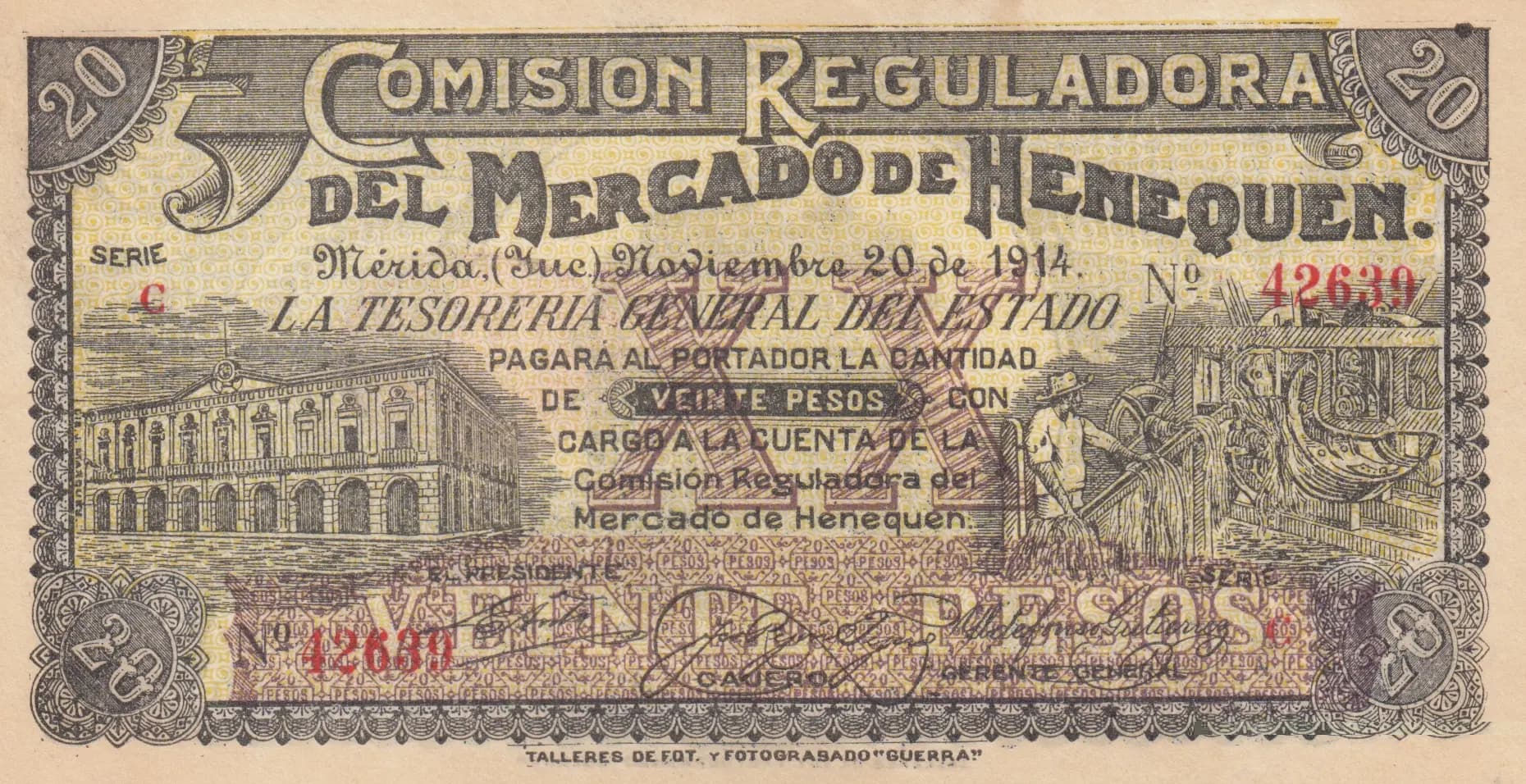
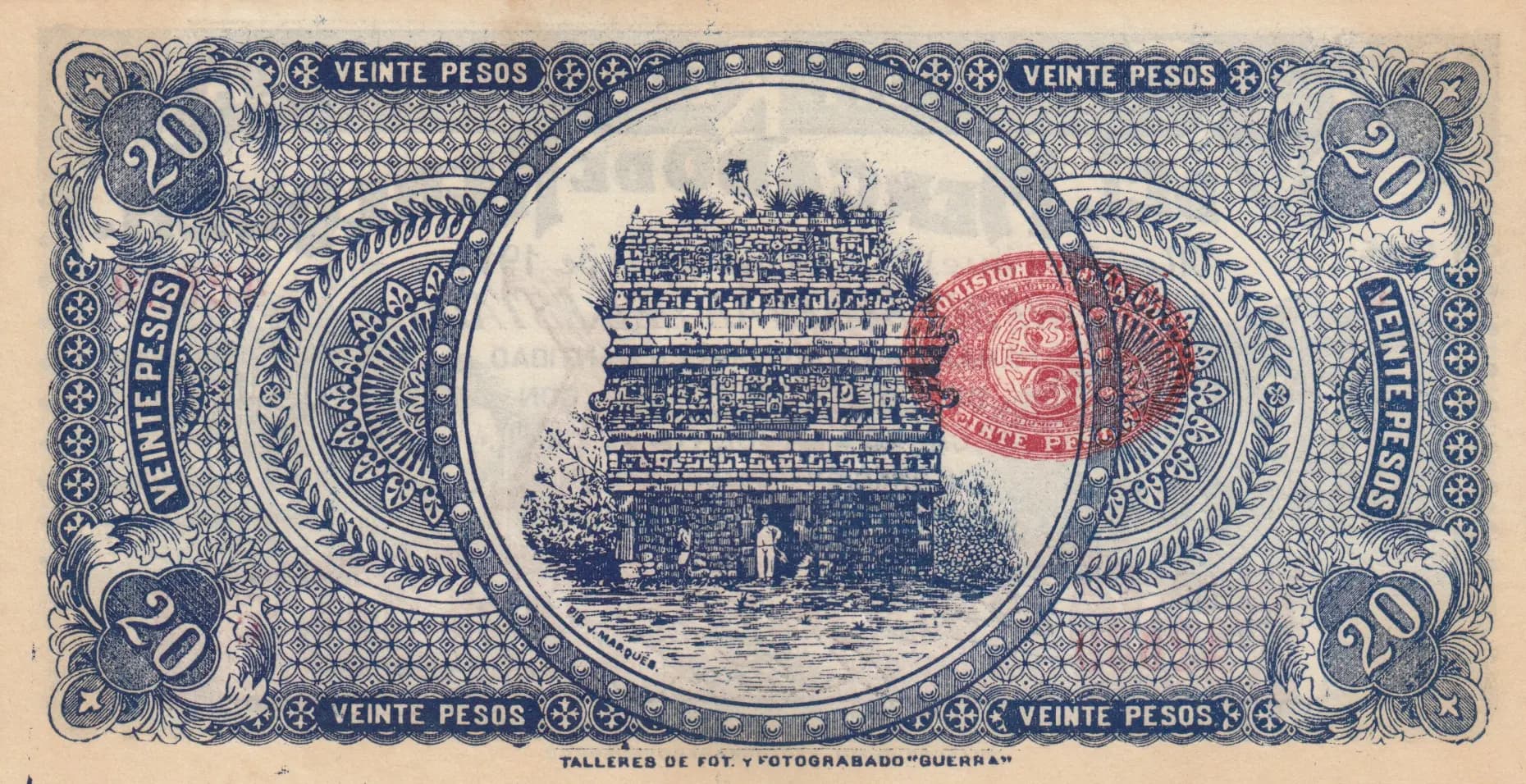
A 20 peso emergency banknote issued by the Comisión Reguladora del Mercado de Henequén in November 1914, printed by the Guerra photogravure workshops in Mérida. The note features classical Mexican governmental architecture on the obverse and a fortified tower structure on the reverse, both rendered in fine engraved detail. In AU condition, this example exhibits expected aging consistent with its 1914 vintage, including period creases and yellowed paper, with a prominent red official overprint stamp visible on both sides.
Common. This is a regional emergency issue from the Mexican Revolution period, issued by a specialized agricultural market commission rather than a central monetary authority. While such henequén commission notes are historically interesting, they were produced in reasonable quantities for circulation within the Yucatán trade network. The AU condition is respectable but not exceptional for a 110-year-old paper currency note. No evidence of scarcity or recall status is apparent; the note's value derives primarily from its historical and regional significance rather than rarity.
This note was issued during the Mexican Revolution, specifically by a henequén (sisal fiber) market regulatory commission in the Yucatán Peninsula state of Puebla. The depicted classical building and fortified tower likely represent important regional governmental and commercial structures, reflecting the henequén trade's significance to Yucatán's economy during this turbulent period. The November 1914 date places this during a critical phase of revolutionary upheaval when regional authorities and agricultural commissions issued emergency currency to facilitate commerce.
The obverse features an ornate rectangular border with decorative scrollwork corner elements, each containing denomination indicators. The composition is divided between a classical multi-story governmental building facade with regular window patterns on the left, and rural agricultural scenery depicting henequén fields on the right—imagery that emphasizes the note's purpose in the agricultural trade. The center contains detailed payment instructions from the State Treasury. A red circular official overprint stamp is prominently applied across the lower center-right portion. The reverse displays a large circular medallion containing a detailed engraved illustration of a fortified tower or fortress with multiple crenellated tiers and water/moat elements at its base, surrounded by radiating ornamental framing. All four corners bear decorative ornaments with 'VEINTE PESOS' repeated around the perimeter. A red circular seal/stamp overlaps the right side of the central medallion. The overall color scheme is brown/tan on the obverse with blue-white printing on the reverse.
FRONT SIDE: 'Comisión Reguladora del Mercado de Henequén' (Regulatory Commission of the Henequén Market) / 'Mérida (Puebla) Noviembre 20 de 1914' (Mérida, Puebla, November 20, 1914) / 'La Tesorería General del Estado pagará al portador la cantidad de veinte pesos con cargo a la cuenta de la Comisión Reguladora del Mercado de Henequén' (The General Treasury of the State will pay the bearer the sum of twenty pesos charged to the account of the Regulatory Commission of the Henequén Market) / 'Serie L No. 42639' (Series L Number 42639) / 'Talleres de Fot. y Fotograbado 'Guerra'' (Photography and Photogravure Workshops 'Guerra'). REVERSE SIDE: 'Veinte Pesos' (Twenty Pesos) appears four times around the border / 'Talleres de Fot. y Fotograbado 'Guerra'' (Photography and Photogravure Workshops 'Guerra').
Photogravure and photographic printing (fotograbado), as indicated by the credit line 'Talleres de Fot. y Fotograbado 'Guerra'' (Guerra Photography and Photogravure Workshops). The fine line-work engraving visible throughout both sides, particularly in the border ornaments and the central fortress medallion, indicates the photogravure process was employed to reproduce detailed engraved designs. Red overprint stamps were applied separately post-printing, likely as official authentication marks.
Series L, Number 42639. The red overprint stamp visible on this example represents the official authorization mark applied by the regulatory commission. Varieties of this Pick number may be distinguished by series letters and serial number ranges. The specific application and clarity of the red overprint stamp could vary across examples, as could the pressure and legibility of overprints applied to individual notes during issue.