20 pesos 1961
“2501.61”
Market Prices
2 salesAbout This Note
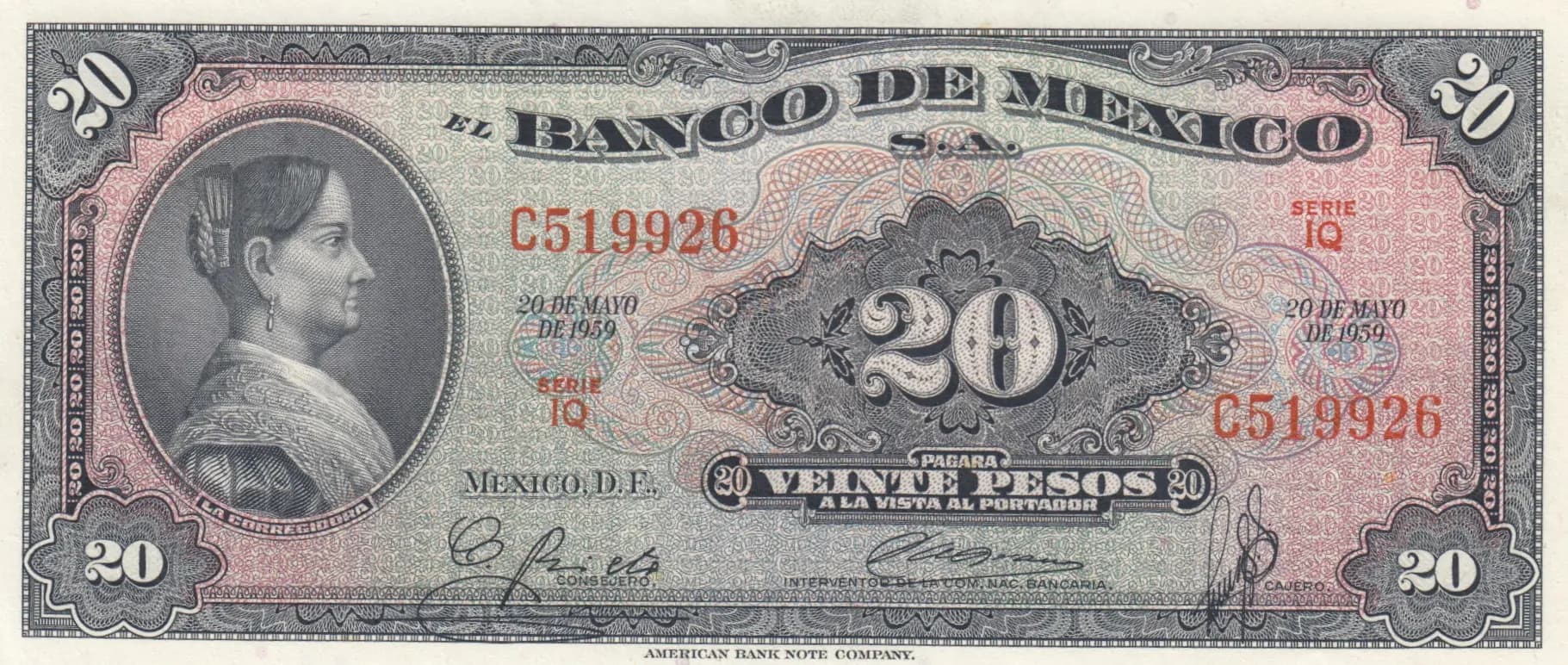
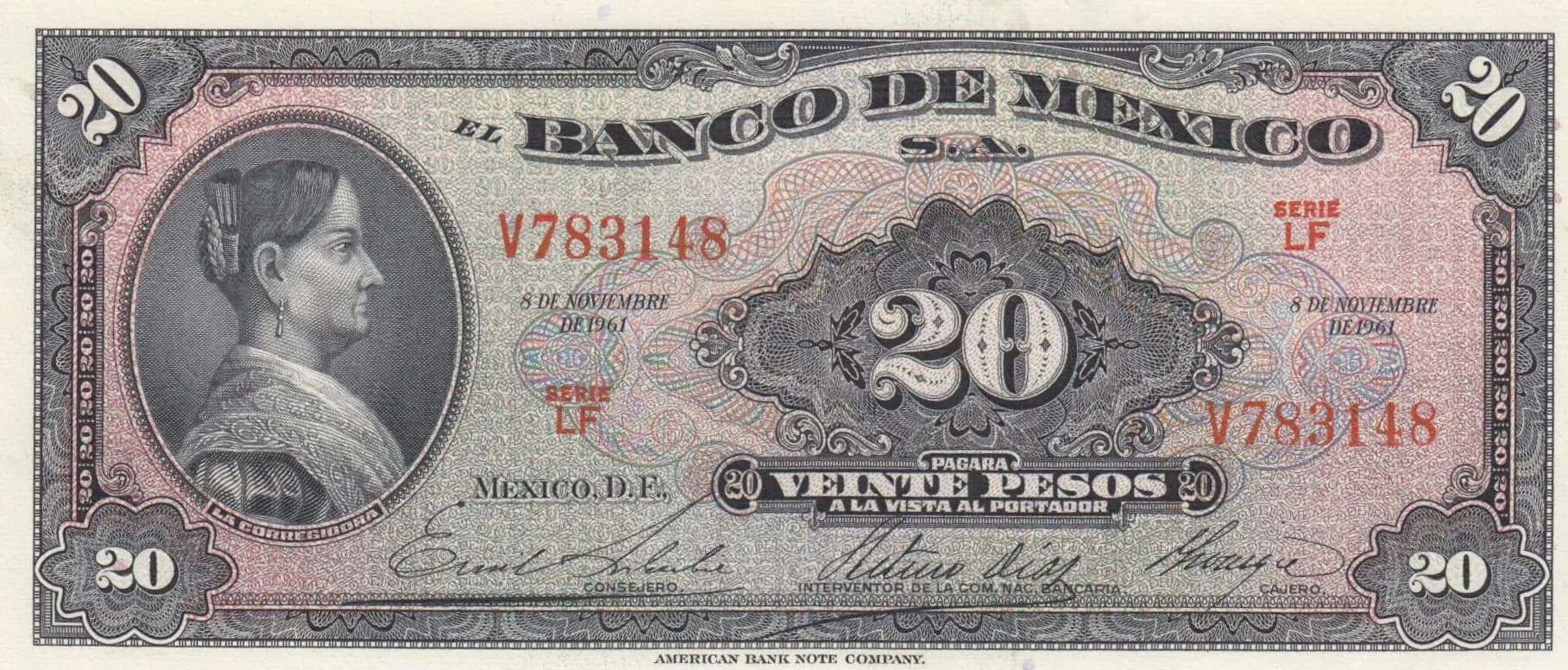
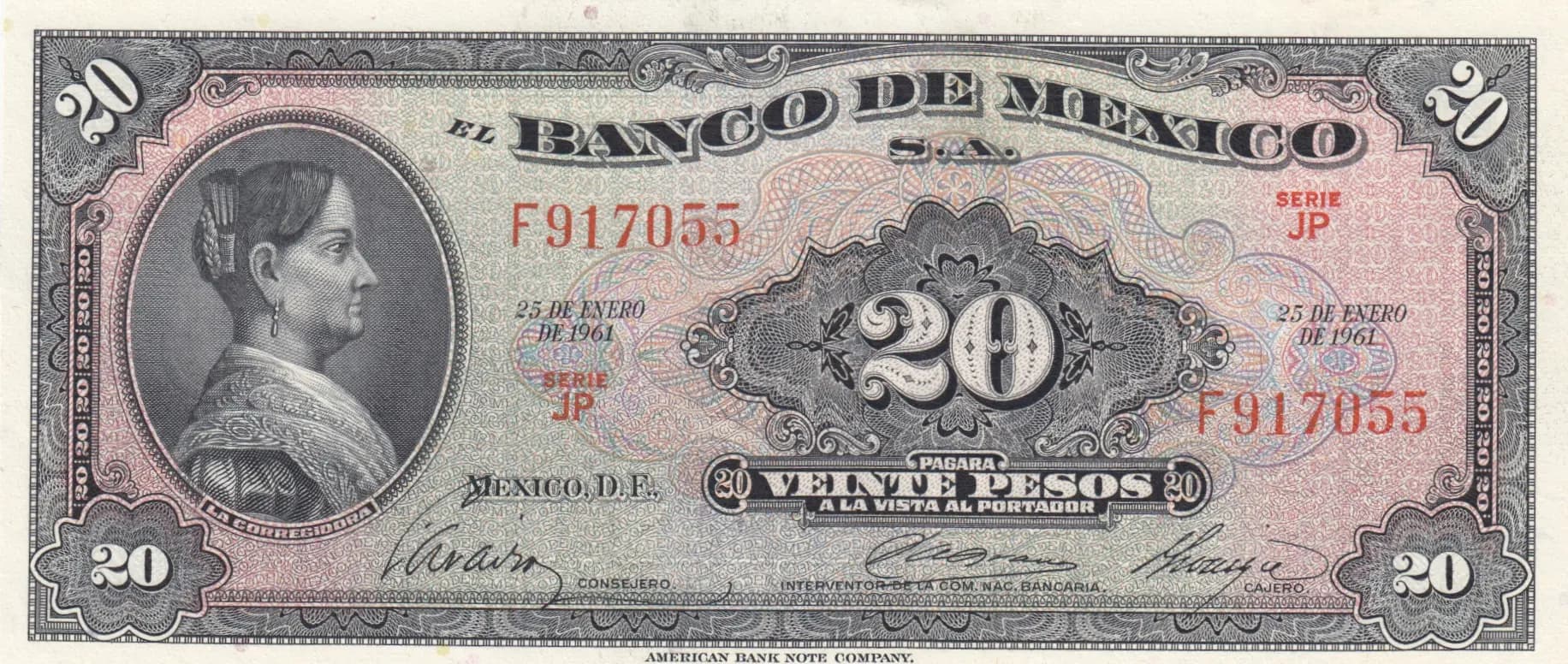
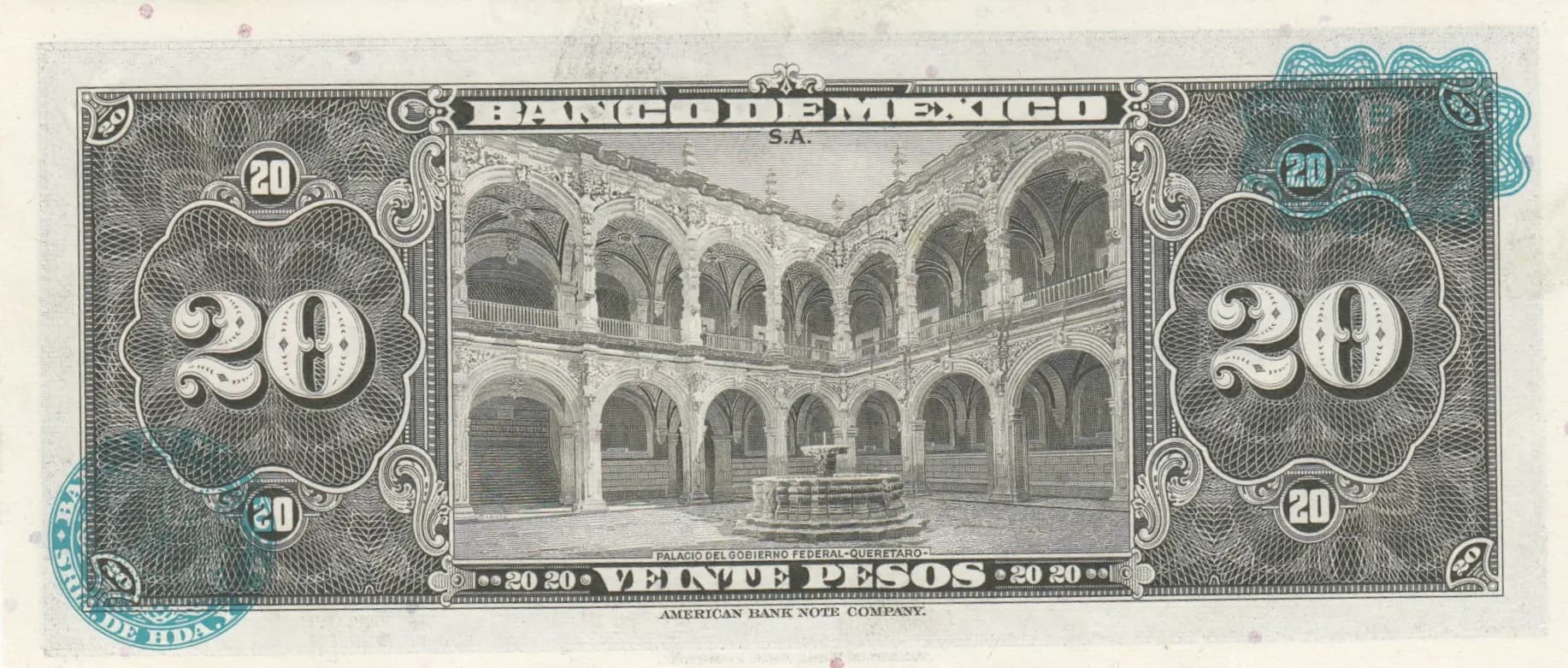
This is a Mexican 20 Pesos banknote from 1961 (Pick P-54i), issued by Banco de Mexico on January 25, 1961, in Series JP. The note displays exceptional uncirculated condition with crisp printing and vibrant color preservation across both sides. The obverse features an elegant profile portrait of a woman in period dress set against ornate baroque-style decoration, while the reverse showcases the Federal Palace courtyard in Querétaro rendered in detailed green-toned engraving, making this a visually striking example of mid-20th century Mexican currency design.
Common. This note represents a regular issue from 1961 with significant print runs across multiple series (JO, JP documented). Market evidence from the reference data shows PMG 65 and 66 examples selling in the $33-$100 range on eBay, consistent with common circulation-era banknotes. Current catalog valuations list UNC examples at $10, indicating this is a readily available note in the collector market despite its age and attractive design.
This 1961 issue represents a significant period in post-revolution Mexican monetary policy, when the Banco de Mexico was consolidating its authority over currency design and issuance. The Federal Palace of Querétaro depicted on the reverse holds historical importance as a symbol of Mexican governance and independence, having served as a seat of significant constitutional events in Mexican history. The American Bank Note Company printing credit reflects Mexico's reliance on established international security printers to produce high-quality currency during this period of economic development.
The obverse features a left-facing profile portrait of a classical female figure wearing period drapery, rendered in fine engraving with gray and pink coloration. The design incorporates elaborate baroque scrollwork and ornamental flourishes, with decorative medallions displaying the denomination '20' positioned strategically throughout. A cornucopia (horn of plenty) symbol appears on the left side, symbolizing prosperity and abundance. The reverse showcases the Palacio del Gobierno Federal in Querétaro, an important institutional landmark featuring classical architecture with multiple rows of arches, columns, and a central courtyard with fountain, rendered in detailed olive-green engraving. The back incorporates decorative circular denomination frames in all four corners with rope-like twisted cord border designs. Both sides employ intricate line work and fine shading techniques characteristic of high-security currency design.
OBVERSE: 'EL BANCO DE MEXICO S.A.' (The Bank of Mexico, Corporation) | 'VEINTE PESOS' (Twenty Pesos) | 'PAGARA A LA VISTA AL PORTADOR' (Will pay on demand to the bearer) | '25 DE ENERO DE 1961' (January 25, 1961) | 'MEXICO, D.F.' (Mexico City, Federal District) | 'SERIE JP' (Series JP) | 'F917055' (Serial number) | 'CONSEJERO' (Counselor) | 'INTERVENTOR' (Comptroller) | 'COM. NAC. BANCARIA' (National Banking Commission) | 'CAJERO' (Cashier) | 'AMERICAN BANK NOTE COMPANY' (printer credit). REVERSE: 'BANCO DE MEXICO S.A.' (The Bank of Mexico, Corporation) | 'VEINTE PESOS' (Twenty Pesos) | 'PALACIO DEL GOBIERNO FEDERAL-QUERETARO' (Federal Government Palace - Querétaro) | 'AMERICAN BANK NOTE COMPANY' (printer credit).
Intaglio engraving (recess printing), executed by the American Bank Note Company (ABNC). The note exhibits the characteristic fine line work, precise denomination placement, and complex background patterns typical of ABNC security printing from this era. The multicolor underprint on the obverse and the detailed architectural engraving on the reverse demonstrate sophisticated multi-plate printing techniques used to prevent counterfeiting.
This note is identified as Pick P-54i, representing a specific plate variety that omits the 'No.' designation above the serial number, distinguishing it from earlier P-48 variants. The observed example belongs to Series JP with serial number F917055. The note exhibits the standard signature varieties typical of this issue, with governmental officer signatures (Consejero, Interventor, Cajero) printed in their designated locations. The January 25, 1961 issue date is consistent with documented printing of this variety. No overprints or special markings are evident on this example.