20 centavos 1915
About This Note
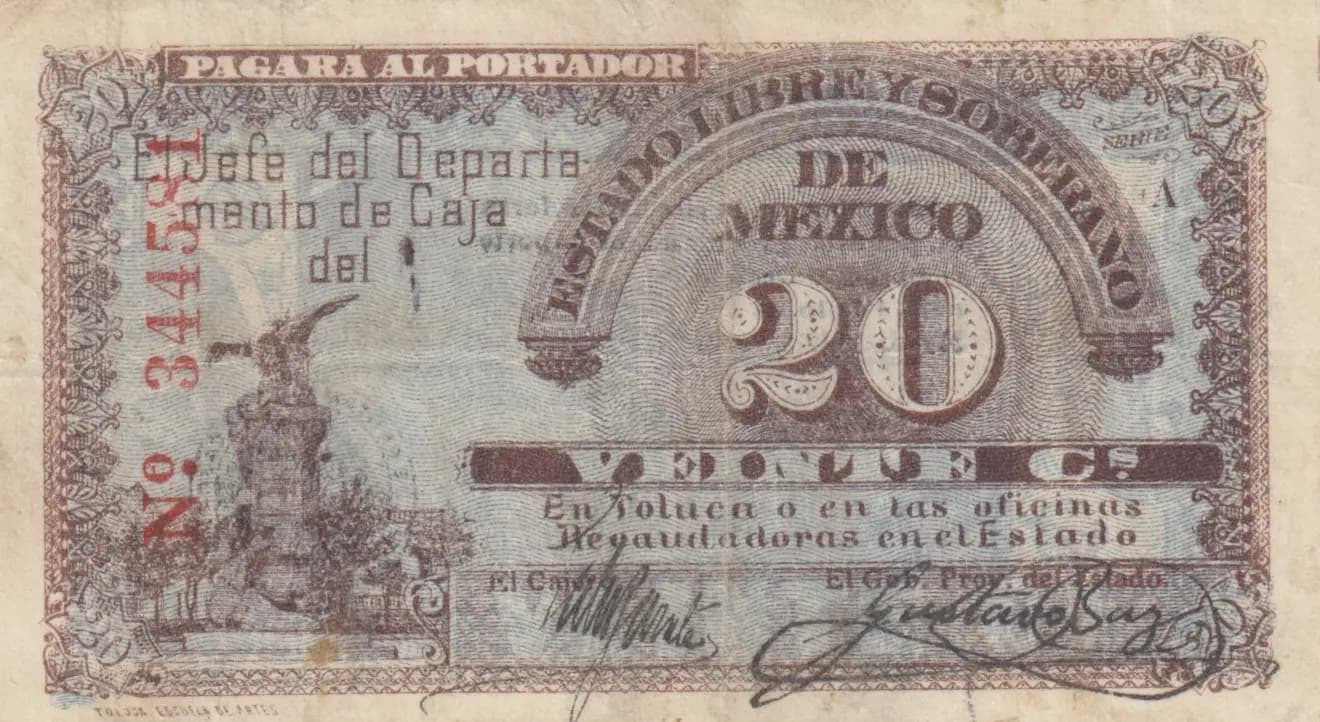
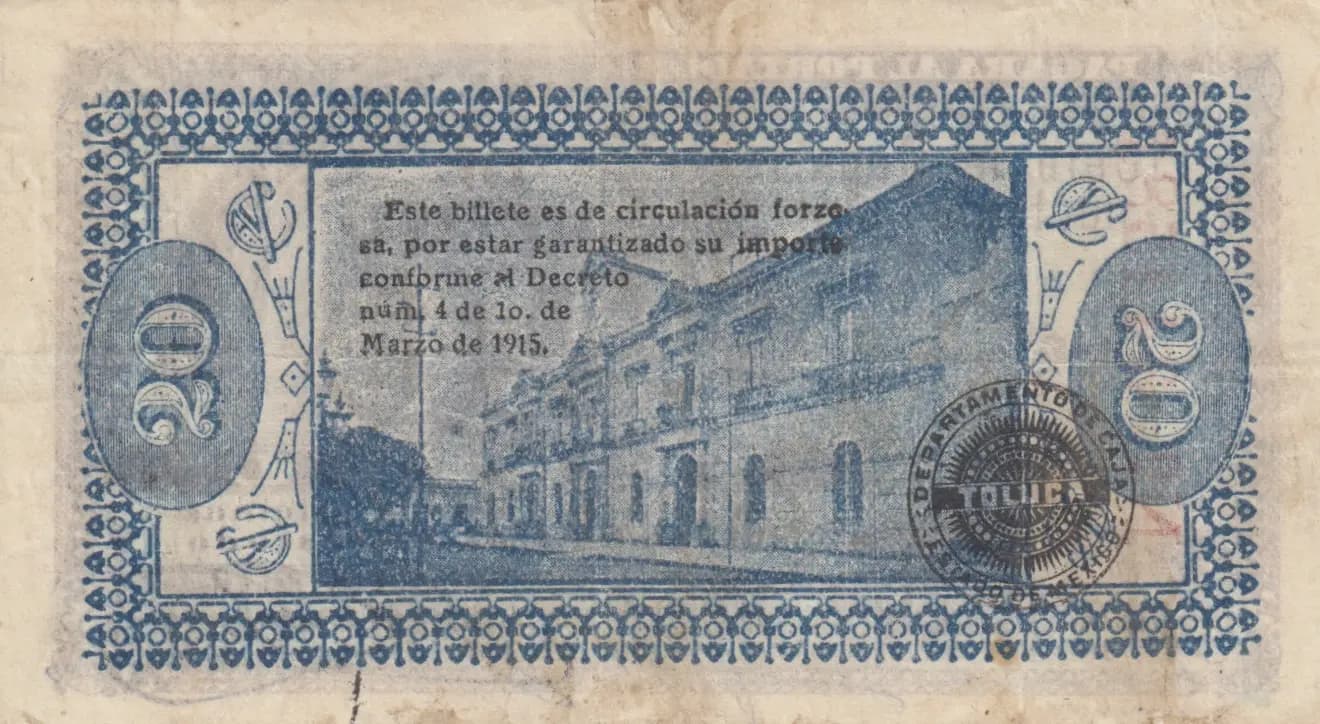
This 20 centavos banknote from 1915 issued by the Estado Libre y Soberano de Mexico represents an important transitional currency during Mexico's turbulent revolutionary period. The note displays the characteristic ornate design of early 20th-century Mexican state currency, with brown/burgundy front featuring architectural elements and a prominent '20' seal, paired with a blue reverse depicting an official government building. In Fair condition, the note shows significant circulation wear including creasing, foxing, age discoloration, and red handwritten marks, which is typical for currency from this tumultuous era that saw widespread circulation and economic instability.
Common. State-issued emergency currency from the Mexican Revolution (1915-1916 period) was produced in substantial quantities across multiple denominations by various state governments. The Estado de Mexico issued extensive quantities of these notes to facilitate commerce during the federal government's monetary collapse. While individual notes survive in various conditions due to heavy wartime circulation, the denomination, issuer, and year combination are well-represented in collector holdings and institutional collections. The Fair condition grade and presence of handwritten marks indicate this note saw active circulation, supporting the assessment that such notes were produced and circulated in considerable numbers.
Issued in 1915 during the height of the Mexican Revolution, this state-issued currency was guaranteed by Decree No. 4 of March 1, 1915, as noted on the reverse. The Toluca de Lerdo (State of Mexico) government issued these notes as part of emergency wartime currency measures when federal monetary authorities faced severe disruptions. The architectural imagery on the reverse—depicting a multi-story official building with classical features—symbolized state authority and institutional stability during a period of profound national fragmentation and civil conflict.
The front features an ornate brown and burgundy design with extensive decorative filigree borders in the classical style. A fortification or tower structure appears on the left side representing state authority and defense, while a large circular seal containing the denomination '20' dominates the center-right, accompanied by heraldic coat of arms imagery. The reverse adopts a blue color scheme and prominently displays a photograph or finely engraved image of a multi-story institutional building with arched windows and classical architectural proportions, flanked by a circular official seal and surrounded by repeating geometric border patterns. The design emphasizes governmental legitimacy and permanence during the revolutionary turbulence.
FRONT SIDE: 'DIGNATARIO PORTADOR' (Dignitary Bearer); 'Billete del Depósito Permanente de Caja del' (Ticket from the Permanent Deposit of the Treasury); 'DE MÉXICO' (Of Mexico); 'EMITIDOR Y SORTEADOR DEL ESTADO' (Emitter and Lottery Drawer of the State); 'En Toluca o en las oficinas Recaudadores en el Estado' (In Toluca or in the collector offices in the State); Serial number '3444'. BACK SIDE: 'Este billete es de circulación forzosa, por estar garantizado su importe conforme al Decreto núm. 4 de lo. de Marzo de 1915.' (This ticket is of forced circulation, as its amount is guaranteed in accordance with Decree no. 4 of March 1, 1915.)
This note was produced using intaglio printing, as evidenced by the intricate fine line work visible in the decorative borders and the crisp detail of the architectural engraving on the reverse. The combination of photographic or high-quality engraved building imagery with ornamental patterns suggests collaboration between multiple printing specialists. The security features, including complex filigree patterns and fine intaglio details, were intended as anti-counterfeiting measures. The specific printer for this Toluca emission is not definitively documented in standard references, but Mexican state currency of this period was often produced by regional printers or contracted security printers.
Serial number 3444 is observed on this example. The Pick catalog assignment P-S878 designates this specific emission. Minor varieties may exist based on signature variations, serial number prefixes, or printer imprints, but without examination of multiple examples, the primary variety markers are the serial number and any handwritten annotations (as seen with the red marks on this specimen). The handwritten elements suggest this may have been processed through official Treasury channels or lottery systems referenced in the inscriptions.