20 centavos 1914
About This Note
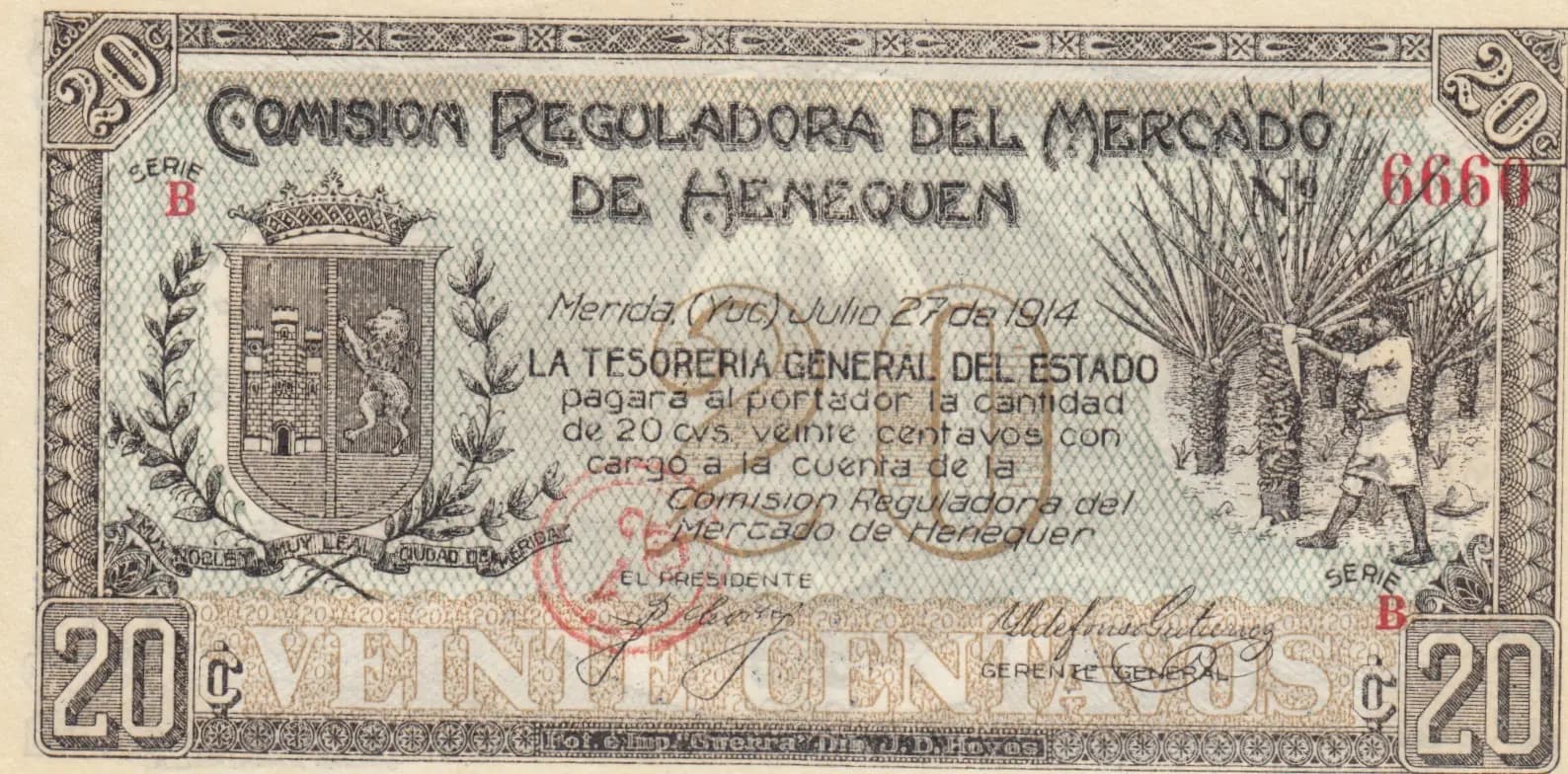
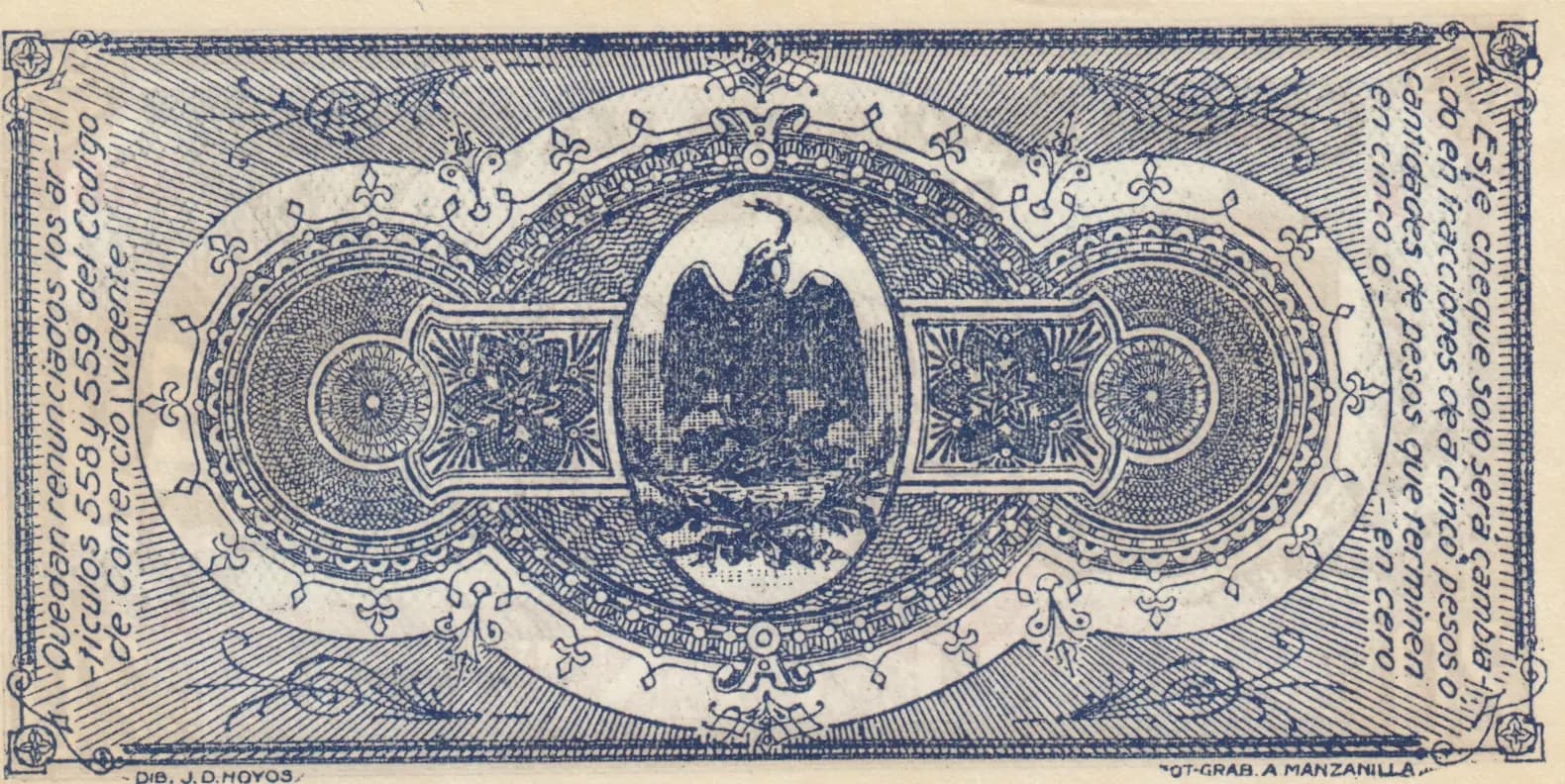
This is a fascinating example of revolutionary-era Mexican scrip issued by the Comisión Reguladora del Mercado de Henequén in July 1914, during a tumultuous period of political instability. The AU-graded note exhibits the characteristic aging, foxing, and handwritten signatures typical of emergency currency from this period, with bold front-side imagery of a fortified tower flanking the state coat of arms, and an elegant reverse featuring the Mexican eagle in an ornate medallion. This scarce regional issue represents an important chapter in Mexican monetary history when regional authorities issued their own currency independent of the central government.
Scarce. This is a regional emergency issue with a limited print run from a short-lived issuing authority (the henequén market commission operated only briefly during the revolutionary period). The specific series designation (Serie B) and serial number prefix (BBB1) suggest this is a later printing within a limited series. Regional Mexican revolutionary scrip from 1914 is considerably scarcer than standard central bank issues, and this particular issuer's notes see limited availability in the collector market. The AU condition grade also adds to the desirability, as many surviving examples show heavier circulation wear.
Issued during Mexico's Revolution, this henequén (sisal fiber) market regulatory commission note reflects the decentralization of monetary authority in Yucatán when regional economic bodies compensated for the chaos of national currency systems. The fortification tower imagery on the obverse likely references the colonial heritage of the Yucatán region, while the Mexican eagle on the reverse asserts the connection to national sovereignty despite the regional issuer. The July 27, 1914 date places this during the tumultuous period following the fall of the Huerta regime, when various factions and regional authorities issued competing currencies.
The obverse features a formal heraldic design with the Yucatán state coat of arms centered within an ornate shield bordered by laurel wreaths, symbolizing the regional authority and legitimacy of the issuing body. To the right stands a colonial fortification tower with crenellations, representing the region's historical military architecture and Spanish colonial heritage. The note employs a brown and black color scheme with red ink used for serial numbers and official stamps. The reverse displays the Mexican national eagle with spread wings in a formal pose, enclosed within an elaborate oval medallion surrounded by intricate geometric and floral ornamental frames rendered in dark blue ink. Both sides feature fine-line engraved borders with complex geometric patterns that serve both aesthetic and security functions. Handwritten signatures of officials appear on the obverse, consistent with emergency currency practices of the revolutionary period.
FRONT SIDE: 'Comisión Reguladora del Mercado de Henequén' (Regulatory Commission of the Henequen Market); 'Mérida (Yuc.) Julio 27 de 1914' (Merida, Yucatan, July 27, 1914); 'La Tesorería General del Estado pagará al portador la cantidad de 20 cvs. veinticinco centavos con cargo a la cuenta de la Comisión Reguladora del Mercado de Henequén' (The General Treasury of the State will pay the bearer the amount of 20 centavos charged to the account of the Regulatory Commission of the Henequen Market); 'El Presidente' (The President); 'Gerente General' (General Manager); 'Serie B' (Series B); denomination '20 Centavos'. BACK SIDE: 'Derechos de copia' (Copyright); 'J.D. Hoyos' (engraver/artist name); 'GOT-GRAB. A Manzanilla' (printing/engraving notation); 'Derechos de copia / Lic. 559 viverne 1914' (Copyright / License 559 November 1914).
Fine line engraving on steel plates, printed in brown/black on the obverse and blue on the reverse. The notation 'GOT-GRAB. A Manzanilla' on the reverse indicates printing by the Grabador A. Manzanilla printing establishment. The intricate border patterns, ornamental frames, and detailed engraving work are characteristic of high-quality bank note engraving techniques of the early 20th century. The presence of handwritten signatures and red ink stamps indicate post-printing authorization procedures typical of emergency currency.
This example is identified as Series B, distinguishing it from Series A printings. The serial number designation 'BBB1' indicates a specific printing block within the series. The date of July 27, 1914, with the November 1914 copyright notation on the reverse, suggests this represents a second printing authorized several months after the initial issue. Variations exist in signature placement and handwritten authorizations, as these were added individually to each note during issuance. The Pick catalog number P-S1120b designation (the 'b' suffix) indicates this is a known variety distinct from other printings of the same denomination and issuer.