2 pesos 1914
About This Note
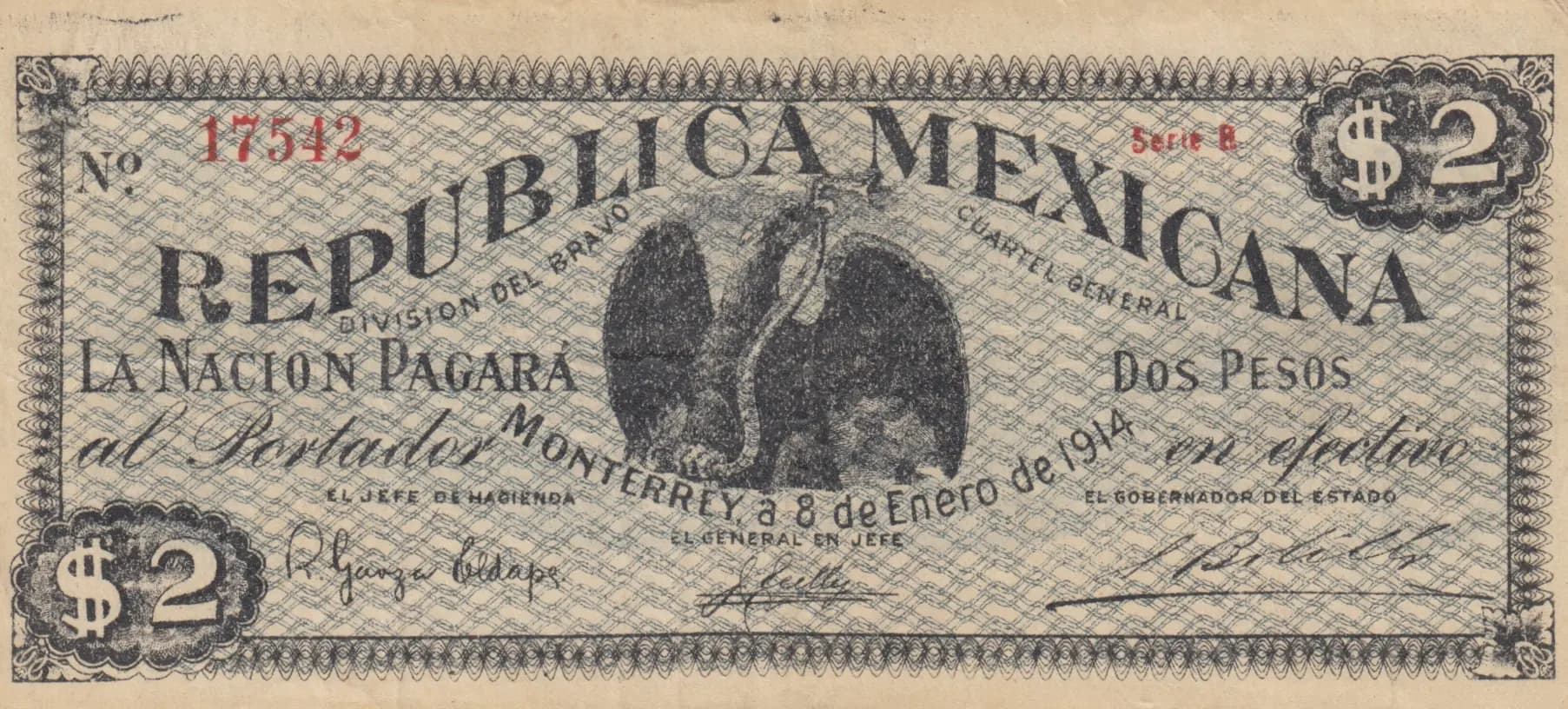
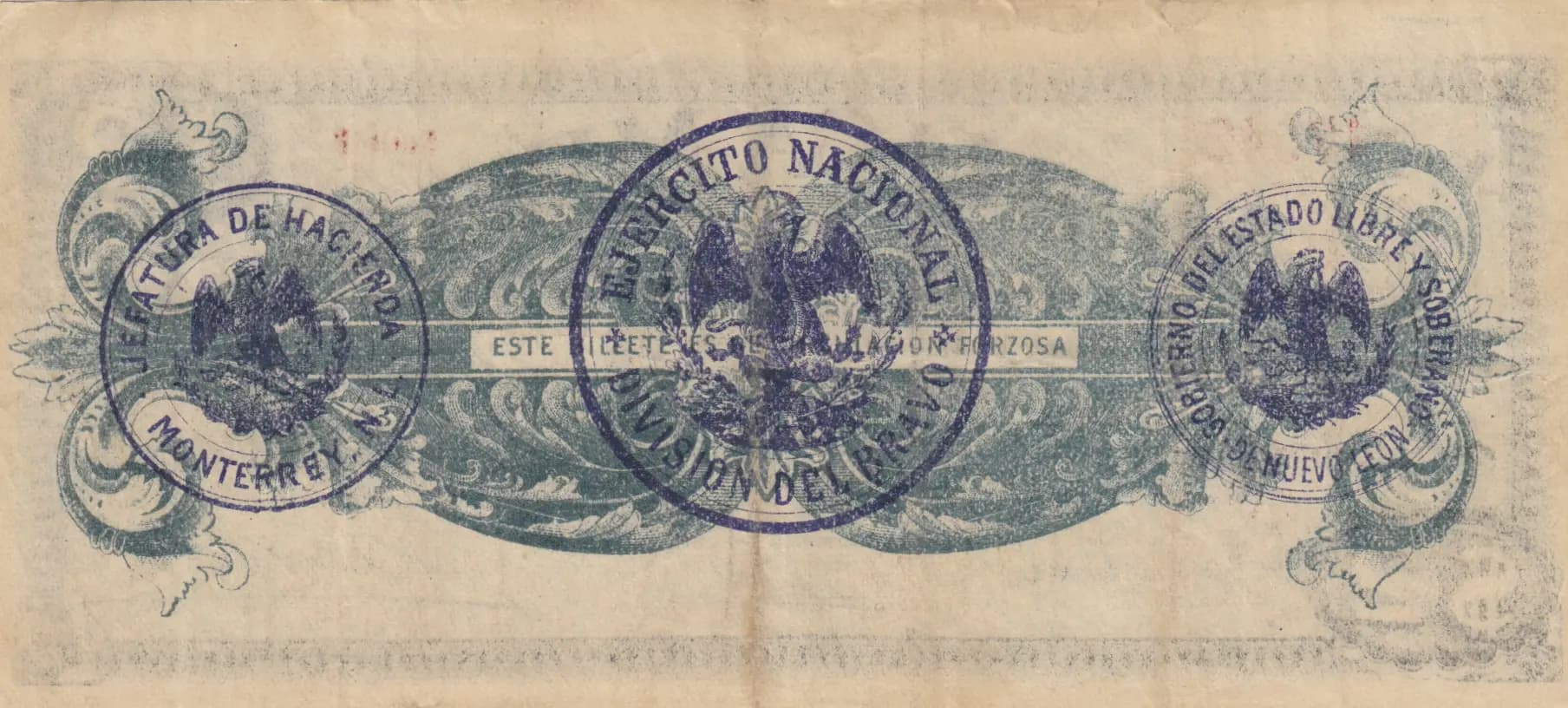
A scarce 2 Pesos banknote issued by División del Bravo on January 8, 1914, during Mexico's tumultuous Revolutionary period. The note features a striking central eagle on the obverse with ornamental borders in black and red inks, while the reverse displays three eagles in green/teal within circular medallions. In VF condition, the note shows expected aging with creasing, foxing, and yellowing consistent with early 20th-century circulation, including a notable circular stamp mark on the reverse.
Uncommon. Division del Bravo currency from early 1914 represents a limited emission period (January-April 1914) before Villa's forces were driven from Monterrey. These notes were issued in smaller quantities compared to major bank issues and saw heavy circulation during a chaotic period. Series B with mid-range serial number 17542 suggests moderate print run. The condition showing circulation wear and an added stamp mark indicates genuine period use rather than archival preservation. While not extremely rare, surviving examples in VF condition are scarcer than later Revolutionary emissions.
Issued during the Mexican Revolution by División del Bravo (the Northern Division under Pancho Villa), this banknote represents emergency military currency issued when central government authority collapsed in northern Mexico. The inscriptions referencing 'El General en Jefe' (The General in Chief) and 'Finance Chief' reflect the military junta structure that controlled Monterrey and surrounding regions. The promise 'SERÁ PAGADERO EN ORO' (Will Be Payable in Gold) on the reverse was a desperate attempt to maintain credibility in a period of extreme monetary instability, though such promises were often unfulfilled.
The obverse displays the Mexican National Eagle (Águila Mexicana) with outstretched wings centered on the note, rendered in black ink against a cream/beige background, with red ink used for denomination and text elements. Decorative cartouches in the top-right and bottom-left corners contain the '$2' denomination markers. The entire design is framed by intricate ornamental borders featuring repeating geometric patterns. The reverse features a more elaborate composition with three Mexican National Eagles, each rendered in green/teal ink within circular seal medallions—a central larger eagle flanked by two smaller eagles of equal size. Ornamental scrollwork and decorative elements surround each eagle medallion, creating a symmetrical, authoritative design intended to convey governmental legitimacy. The paper background shows significant aged patina typical of 1914-era Mexican currency.
FRONT SIDE: 'REPÚBLICA MEXICANA' (Mexican Republic) | 'DOS PESOS' (Two Pesos) | 'DIVISIÓN DEL BANCO' (Bank Division) [likely DIVISIÓN DEL BRAVO] | 'LA NACIÓN PAGARÁ al Portador' (The Nation Will Pay to the Bearer) | 'Monterrey' | '3 8 de Enero de 1914' (January 8, 1914) | 'EL JEFE DE HACIENDA' (The Finance Chief) | 'EL GENERAL EN JEFE' (The General in Chief) | 'EL GOBERNADOR DEL ESTADO' (The State Governor) | 'No 17542' (Serial Number) | 'Serie B' (Series B) | '$2'. REVERSE SIDE: 'ESTE PAGARÉ' (This Promissory Note) | 'SERÁ PAGADERO EN ORO' (Will Be Payable in Gold) | 'Hacienda de Hacienda' (Treasury Department) | 'Ejército Nacional' (National Army) | 'Gobierno del Estado Libre y Soberano' (Government of the Free and Sovereign State).
Letterpress printing with multicolor intaglio elements, utilizing separate passes for black, red, and green/teal inks. The fine line work, cross-hatching patterns, and ornamental details visible in the visual analysis are consistent with engraved steel die production. The distinct color separation and precise denomination cartouches indicate professional security printing standards for the period. This was likely produced by Mexican government security printers operating under revolutionary authority in northern Mexico, possibly in Monterrey.
This is Series B, as indicated by 'Serie B' on the obverse. The date of January 8, 1914 places this among the earliest División del Bravo emissions. Serial number 17542 is within the documented range for this series. Known varieties of this issue include different series designations (A, B, C) and varying signature combinations representing different officials. The presence of a circular stamp (visible on reverse) may indicate bank or treasury handling marks, a common variety characteristic for notes that passed through official channels.