2 pesos 1914
Market Prices
About This Note
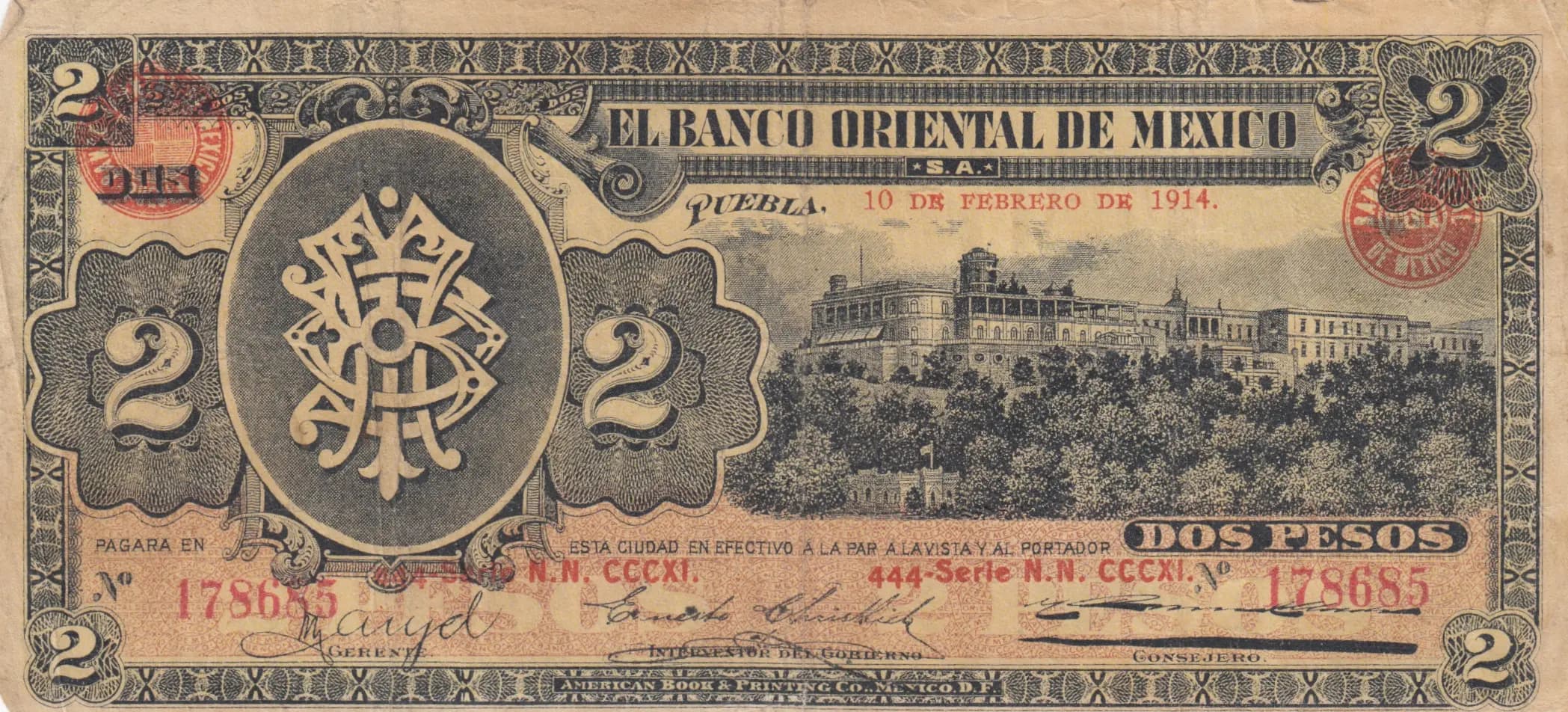
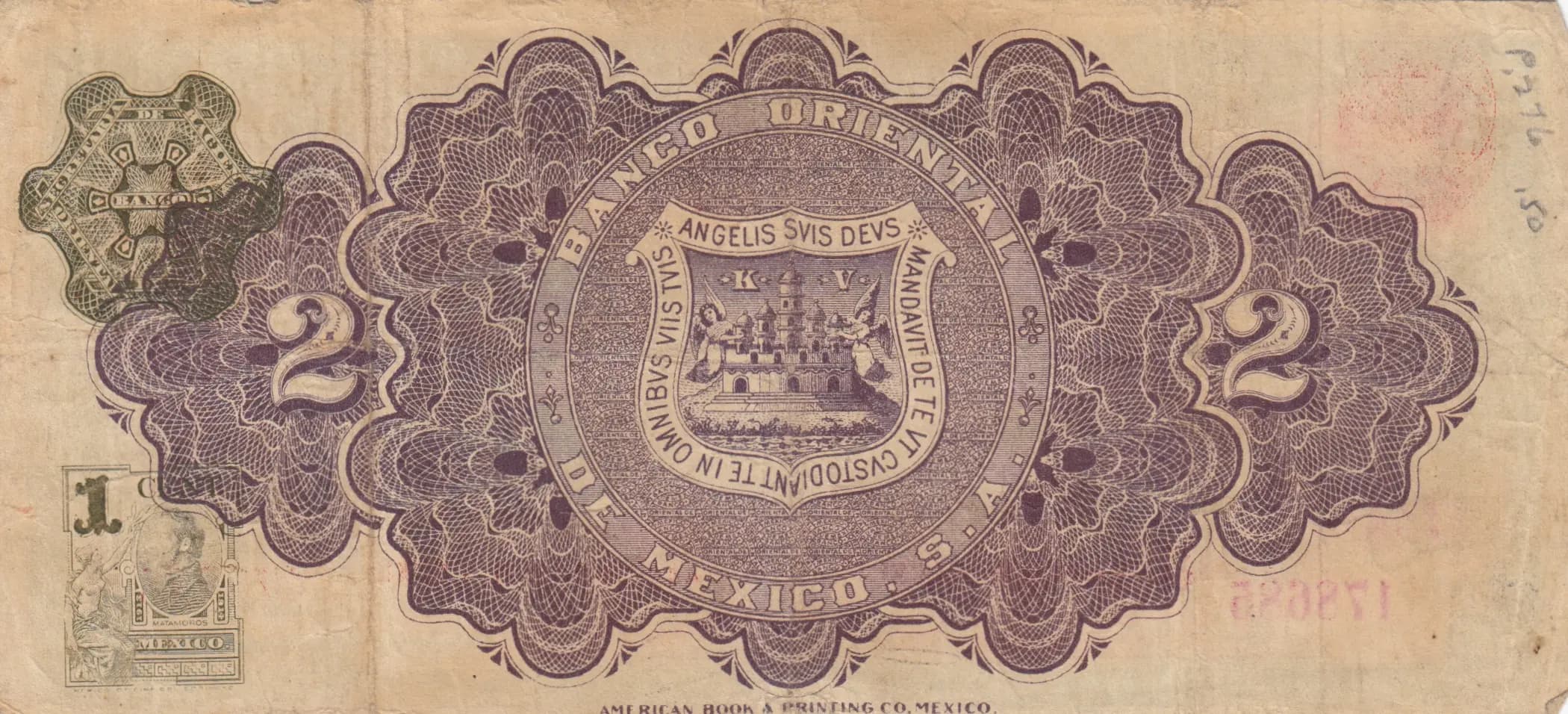
This is a 2 Pesos banknote issued by El Banco Oriental de Mexico on February 10, 1914, during Mexico's tumultuous revolutionary period. The note features an ornate front design with a decorative cross medallion and an institutional building on elevated terrain, while the reverse displays an elaborate coat of arms with a fortified castle and Latin inscription 'ANGELIS SVIS DEVS.' In Fine condition, the note shows significant aging with visible creases, foxing, and discoloration consistent with its early 20th-century origins, making it a compelling artifact of regional Mexican banking during the pre-Constitutionalist era.
Common. The eBay price tracking data shows a wide range of sales for this note type, with F-grade specimens selling in the $94.50 range, and multiple sales under $100. The existence of multiple comparable sales and the standard catalog listing indicate this is a regularly encountered note in the market. Banco Oriental de Mexico, while a regional issuer, was sufficiently well-capitalized and operated long enough to produce notes in considerable quantities. The absence of evidence of short print runs, recalls, or extreme scarcity markers suggests typical commercial distribution for a regional Mexican bank of this period.
The Banco Oriental de Mexico was a regional bank operating from Puebla during one of Mexico's most turbulent periods—the Mexican Revolution (1910-1920). The February 10, 1914 date places this note during the Huerta regime, a period of intense political instability when various regional banks issued their own currency as federal authority weakened. The fortress imagery on the reverse and religious Latin motto reflect the bank's attempt to project stability and legitimacy during this chaotic era when currency backed by regional banks was inherently uncertain.
The front of this banknote showcases the neoclassical aesthetic favored by early 20th-century Mexican banks. The left side features a large oval medallion containing an ornamental cross with elaborate decorative flourishes, symbolizing the bank's conservative values and stability. The right side depicts what is likely the Banco Oriental's headquarters or a significant civic building positioned on elevated terrain with surrounding vegetation—architectural imagery designed to convey institutional permanence. All four corners contain decorative numerals '2' within elaborate frames. The reverse displays a more heraldic design centered on a coat of arms featuring a fortified castle or stronghold, enclosed within an ornate circular medallion inscribed with the Latin phrase 'ANGELIS SVIS DEVS.' The design employs purple and mauve coloring on the reverse, contrasting with the cream and black printing of the obverse. Both sides are heavily decorated with filigree borders and scrollwork, reflecting the security printing standards of the period.
FRONT: 'El Banco Oriental de Mexico, S.A.' (The Oriental Bank of Mexico, Limited Company); 'Puebla' (city of issue); '10 de Febrero de 1914' (February 10, 1914); 'Dos Pesos' (Two Pesos); 'Pagará en esta ciudad en efectivo a la par a la vista y al portador' (Will pay in this city in cash at par on sight and to the bearer); 'N.N. CCCXI' (Series 9111 in Roman numerals); 'Gerente' (Manager); 'Intendedor del Gobierno' (Government Superintendent); 'Consejero' (Counselor); 'American Bank & Printing Co., Mexico D.F.' (printer attribution). BACK: 'Angelis Svis Devs' (God with his angels, in Latin); 'Banco Oriental' (Oriental Bank); 'Mexico' (country); 'Guanajuato' (referenced region); 'American Bank & Printing Co. Mexico' (printer attribution).
Intaglio engraving (recess printing), the standard security printing method for banknotes of this era. The note was produced by American Bank & Printing Co. of Mexico City, as noted in the printer attribution on both sides. The intricate filigree patterns, detailed border designs, and depth of the architectural and coat of arms imagery are characteristic of high-quality intaglio work. The multicolor printing (black and red on the front, purple/mauve on the reverse) was achieved through multiple passes through the printing press using different engraved plates.
The specific variety is identified as Pick S389a. Observed distinguishing features include: Series designation 'N.N. CCCXI' (Series 9111); serial numbers present (179685 and 178353 noted); handwritten signatures indicating manual authorization on this specimen; red stamp marks visible in the upper left corner; the February 10, 1914 date distinguishing this as the initial issue from the bank. The Pick catalog notation 'S389a' (as opposed to other potential varieties like S389) suggests this is one of the recognized varieties within the bank's 2 Peso emission, though without access to complete variety differentiation data for this bank, the specific distinguishing characteristics of the 'a' variety cannot be definitively enumerated.