10 pesos 1914
Market Prices
About This Note
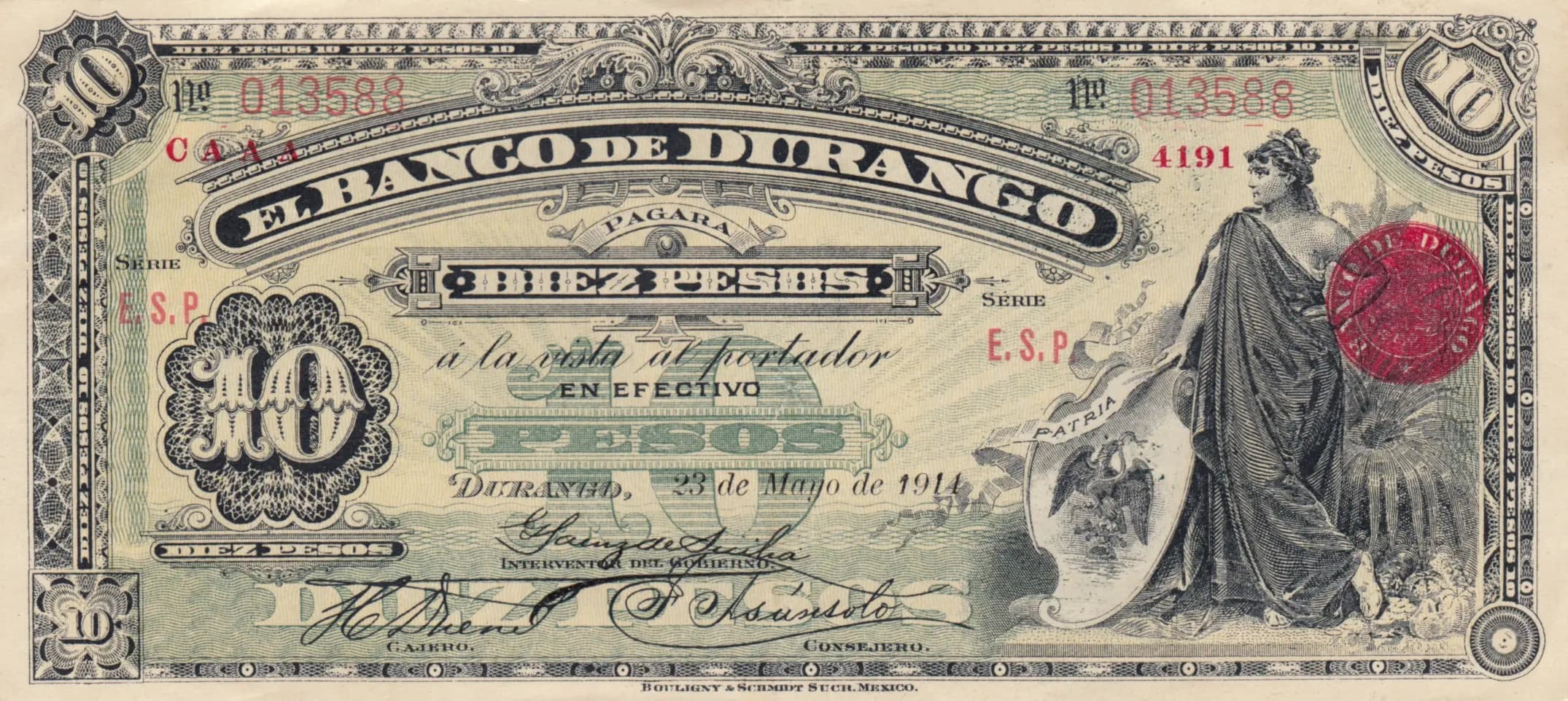
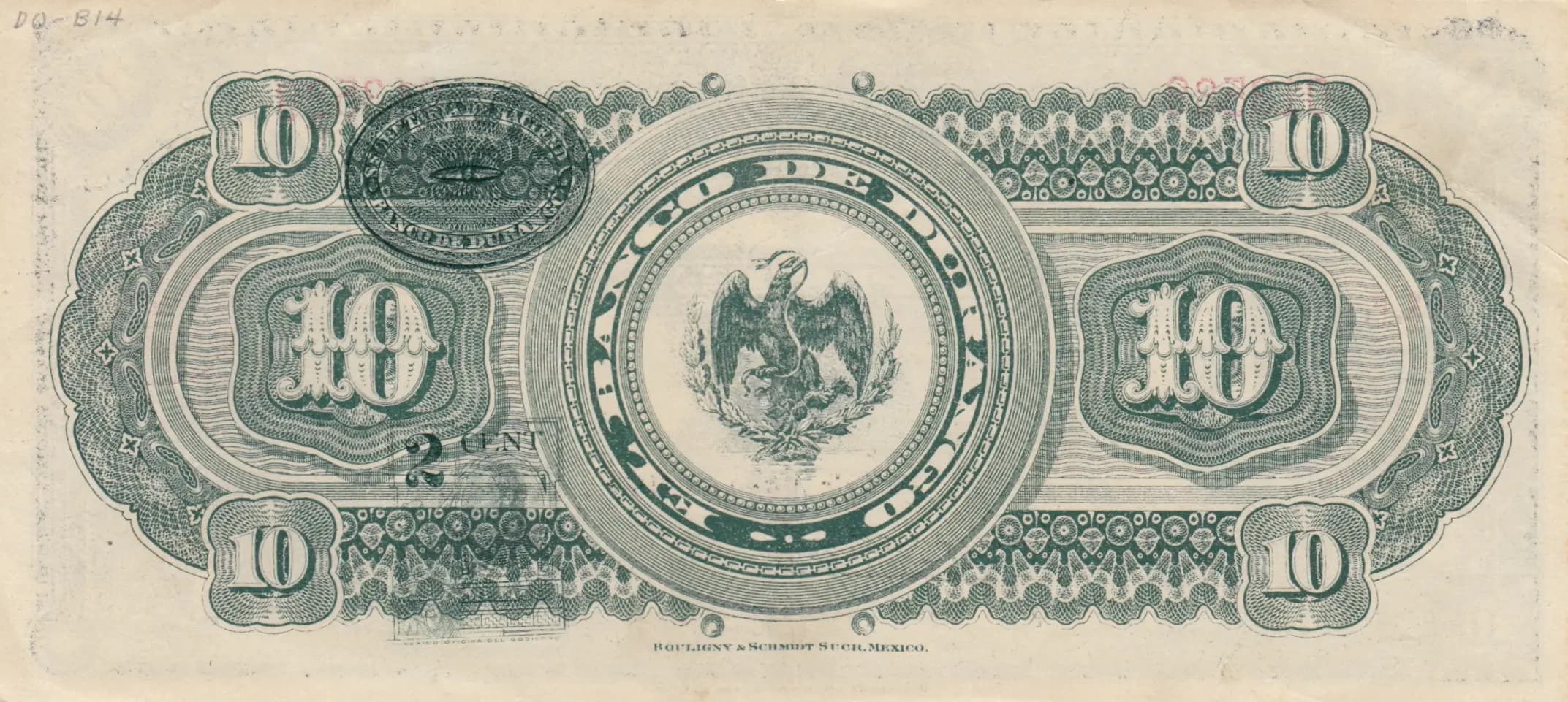
This is an exceptionally well-preserved example of a 10 pesos banknote issued by El Banco de Durango on May 23, 1914, during Mexico's Revolutionary period. The note displays the classic engraved aesthetic of early 20th-century Mexican currency, with an allegorical classical female figure dominating the obverse and the Mexican national eagle emblem on the reverse. In EF condition with visible red official stamps and overprints, this note shows the character and patina expected of authentic period currency that has been carefully preserved rather than heavily circulated.
Common. eBay market data shows this note and related Banco de Durango issues trading consistently in the $10-$100 USD range across multiple condition grades, with most examples selling between $17.99 and $69.99 USD. The EF condition example observed here falls well within normal market expectations. Banco de Durango notes were issued in significant quantities during 1914, and surviving examples are readily available to collectors. No evidence suggests this is a rare or scarce variety.
This note was issued during the Mexican Revolution (1910-1920), a period of significant political and economic upheaval when regional banks like Banco de Durango issued their own currency due to central government instability. The May 23, 1914 date places it during Victoriano Huerta's presidency, a particularly turbulent moment in the Revolution. The formal classical allegorical imagery and bilingual printer attribution (Boehler & Schmidt, a prominent Mexico City security printer) reflect the government's attempt to maintain legitimacy and currency stability despite the surrounding chaos.
The obverse features an allegorical representation of Liberty or Justice as a classical female figure in flowing robes, positioned prominently on the right side of the note, embodying the ideals of Mexican national sovereignty. The background depicts a mountainous landscape, grounding the allegorical figure in Mexican geography. The reverse centers on the Mexican national eagle emblem (the heraldic eagle from Mexico's coat of arms) enclosed in a wreath or laurel design, surrounded by a symmetrical border of geometric and floral engraved patterns. Denomination numerals '10' appear in ornamental medallions at corners on both sides. The overall design employs fine line engraving with intricate scrollwork borders, typical of prestigious banknote production for the period.
FRONT SIDE: 'El Banco de Durango' (The Bank of Durango) / 'Pagará al Portador en Efectivo' (Will Pay to the Bearer in Cash) / 'Diez Pesos' (Ten Pesos) / 'Durango, 23 de Mayo de 1914' (Durango, May 23, 1914) / 'Serie' (Series) / 'Intervenor del Gobierno' (Government Comptroller) / 'Cajero' (Cashier) / 'Consejero' (Counselor) / 'Patria' (Homeland) / 'Boehler & Schmidt Sucn. Mexico' (Boehler & Schmidt Successor, Mexico - printer) / BACK SIDE: 'Boehler & Schmidt Sucn. Mexico' (Boehler & Schmidt Successor, Mexico - printer) / Serial and administrative codes: S.P., E.S.P., C.D., and red overprint 'DI 3528'
This note was produced using intaglio engraving (line engraving) by Boehler & Schmidt Sucesora, the prominent Mexico City-based security and banknote printer. The fine detail visible in the decorative borders, allegorical figure, and eagle emblem are characteristic of high-quality steel plate engraving. Red overprints and official stamps were applied separately, indicating a multi-stage printing process combining intaglio engraving with stamp and overprint application.
The specific variety can be identified by the red overprint code 'DI 3528' and serial number '4191' visible on the obverse. The date of May 23, 1914 is consistent with the documented May 1914 issue series. Signature varieties exist based on the officials who signed (Intervenor del Gobierno, Cajero, Consejero), though the specific signatures are not fully legible in the analysis. The note belongs to the standard circulation series of El Banco de Durango's 1914 issue (Pick S281).