1 peso 1914
About This Note
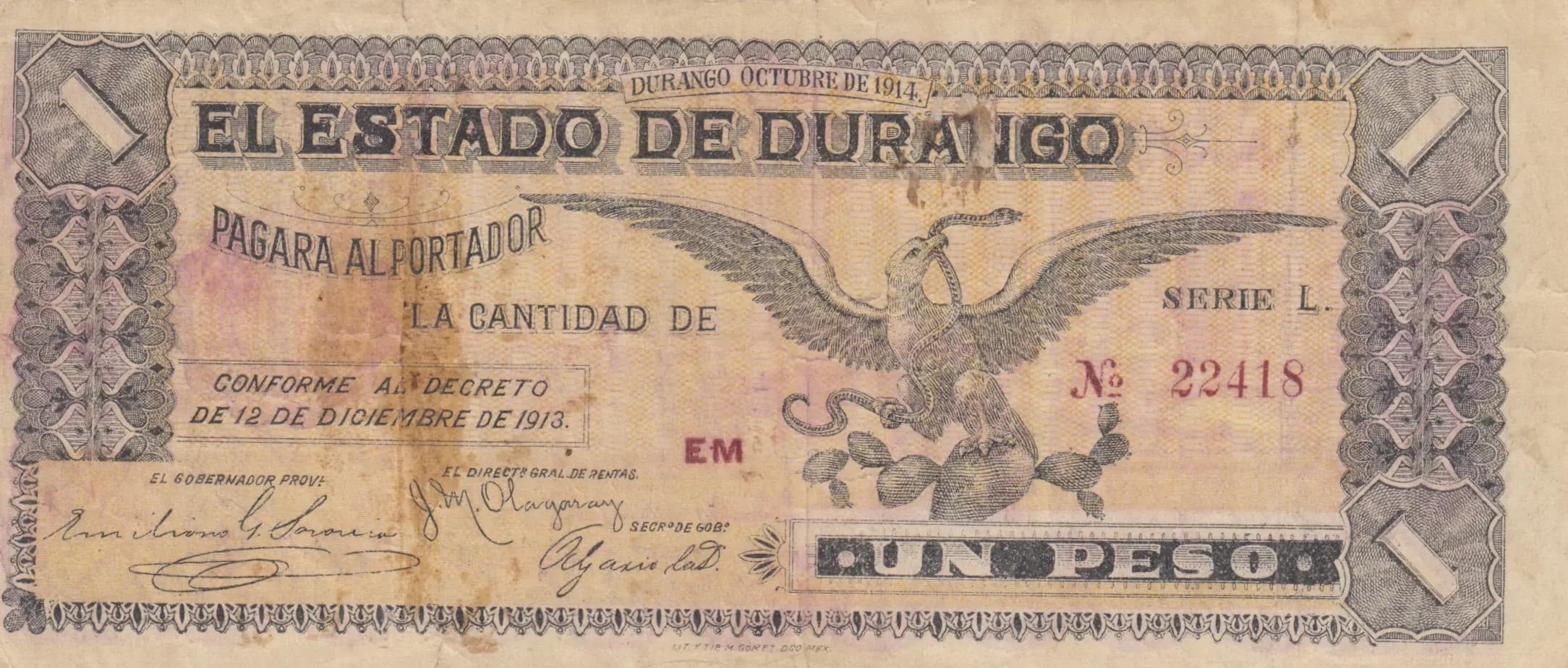
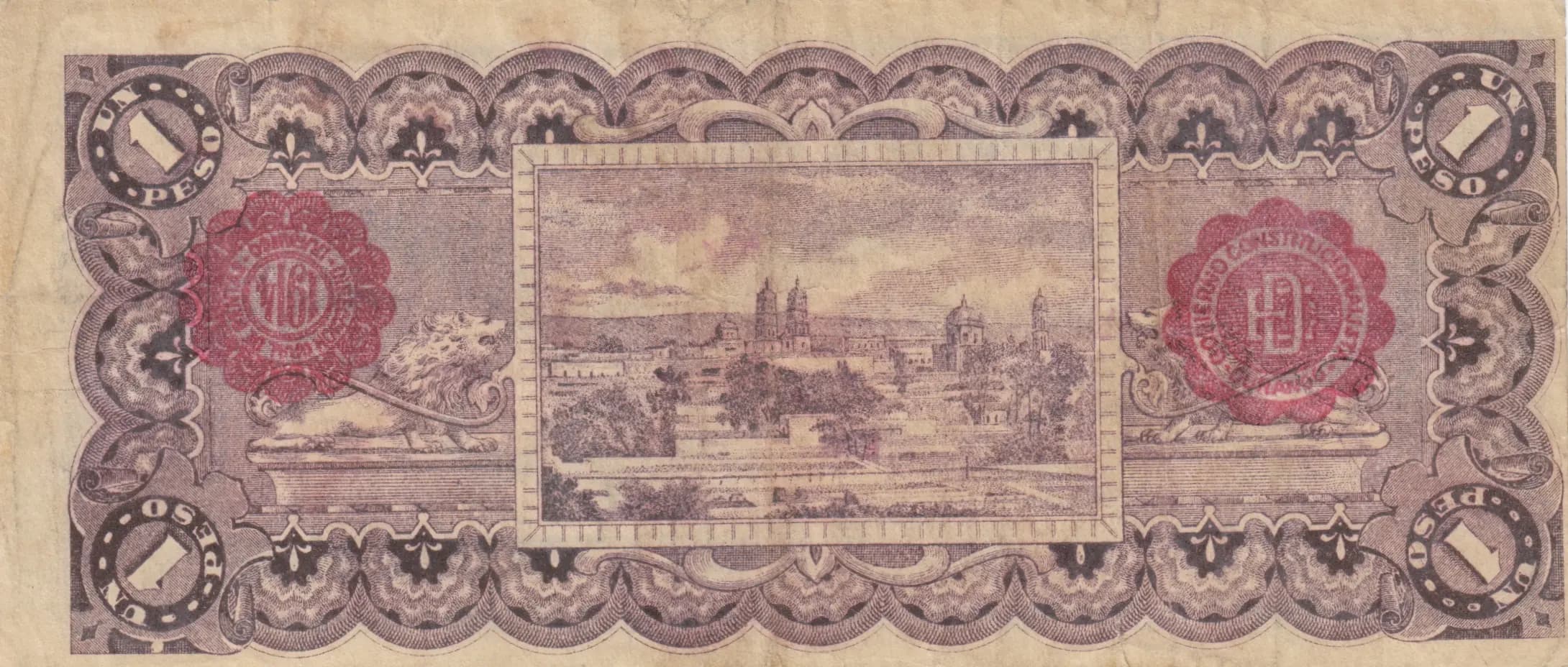
This 1 Peso note from Estado de Durango (October 1914) is a significant example of Mexican revolutionary-era emergency currency, issued during the tumultuous period following the Mexican Revolution. The front features a majestic central eagle with spread wings, flanked by ornamental borders, while the reverse displays a detailed engraved cityscape depicting a colonial Mexican city with prominent cathedral spires and fortifications. In Fair condition (F grade), the note exhibits expected aging with tan and brown discoloration, multiple creases, and foxing consistent with over a century of circulation, though the engraved details and handwritten signatures remain visible.
Common. Estado de Durango issued multiple denominations during the revolutionary period, and this 1 Peso denomination in Series L represents a standard circulation issue. While all revolutionary-era regional issues are now collectible, the print run for Durango's peso notes was substantial enough to ensure regular availability in numismatic markets. The Pick catalog listing reflects its status as a documented but not scarce issue. Fair condition examples are particularly common as these notes were heavily circulated during the period of monetary uncertainty.
This note was issued by the provisional government of Durango State in October 1914, during the Mexican Revolution when regional governments and military factions issued their own currency due to the collapse of national monetary authority. The decree date of December 12, 1913, references the constitutional framework under which Durango's provisional government operated during this chaotic period. The depicted colonial cityscape on the reverse likely represents Durango City itself, serving as a symbol of regional identity and legitimacy during a time when centralized Mexican authority was fragmented among competing revolutionary factions.
The front side features a central eagle with spread wings as the dominant heraldic symbol, representing Mexican national identity and state authority. The design incorporates symmetrical ornamental borders with scrollwork and rosette patterns on left and right sides, typical of banknote security design of the era. Two spaces for handwritten signatures appear in the lower left, representing authorization by the Provisional Governor and General Director of Revenue. The reverse presents an engraved panoramic cityscape showing a colonial-style metropolitan area with multiple church spires, cathedral towers, and fortification walls, surrounded by elaborate floral and geometric ornamental borders with red circular rosette security elements in the upper corners. This cityscape likely depicts Durango City, serving as a symbol of regional pride and legitimacy.
FRONT SIDE: 'EL ESTADO DE DURANGO PAGARA AL PORTADOR LA CANTIDAD DE / UN PESO' (The State of Durango will pay to the bearer the sum of / One Peso); 'CONFORME AL DECRETO DE 12 DE DICIEMBRE DE 1913' (In accordance with the decree of December 12, 1913); 'DURANGO OCTUBRE DE 1914' (Durango October 1914); 'EL GOBERNADOR PROV.' (The Provisional Governor); 'EL DIRECTOR GRAL. DE RENTAS' (The General Director of Revenue); 'SERIE L' (Series L); 'Nº 22418' (Number 22418). BACK SIDE: No visible text inscriptions; design-focused reverse with cityscape and ornamental elements.
The note was produced using engraving and lithography, typical of Mexican banknote production in the early 20th century. The detailed cityscape on the reverse and the fine ornamental borders characteristic of this series suggest skilled engraving work. The handwritten signatures and serial numbers were added after printing, indicating a hybrid production method combining pre-printed security elements with manual authorization marks. The color palette (brown, tan, purple/mauve, and black) reflects the printing capabilities and ink choices of 1914-era Mexican security printers.
This specimen is identified as Series L, Number 22418, issued in October 1914. Durango's 1914 peso notes exist in multiple series (various letter designations), with different series representing separate printing batches. The specific series letter and serial number range may indicate different printings or authorizations. Collectors should note variations in signature styles and series letters when cataloging examples; different series letters represent distinct varieties of this Pick number. The handwritten authorization signatures vary by individual issuing officials, making each note's signature combination a minor variety point of interest.