1 peso 1914
Market Prices
About This Note
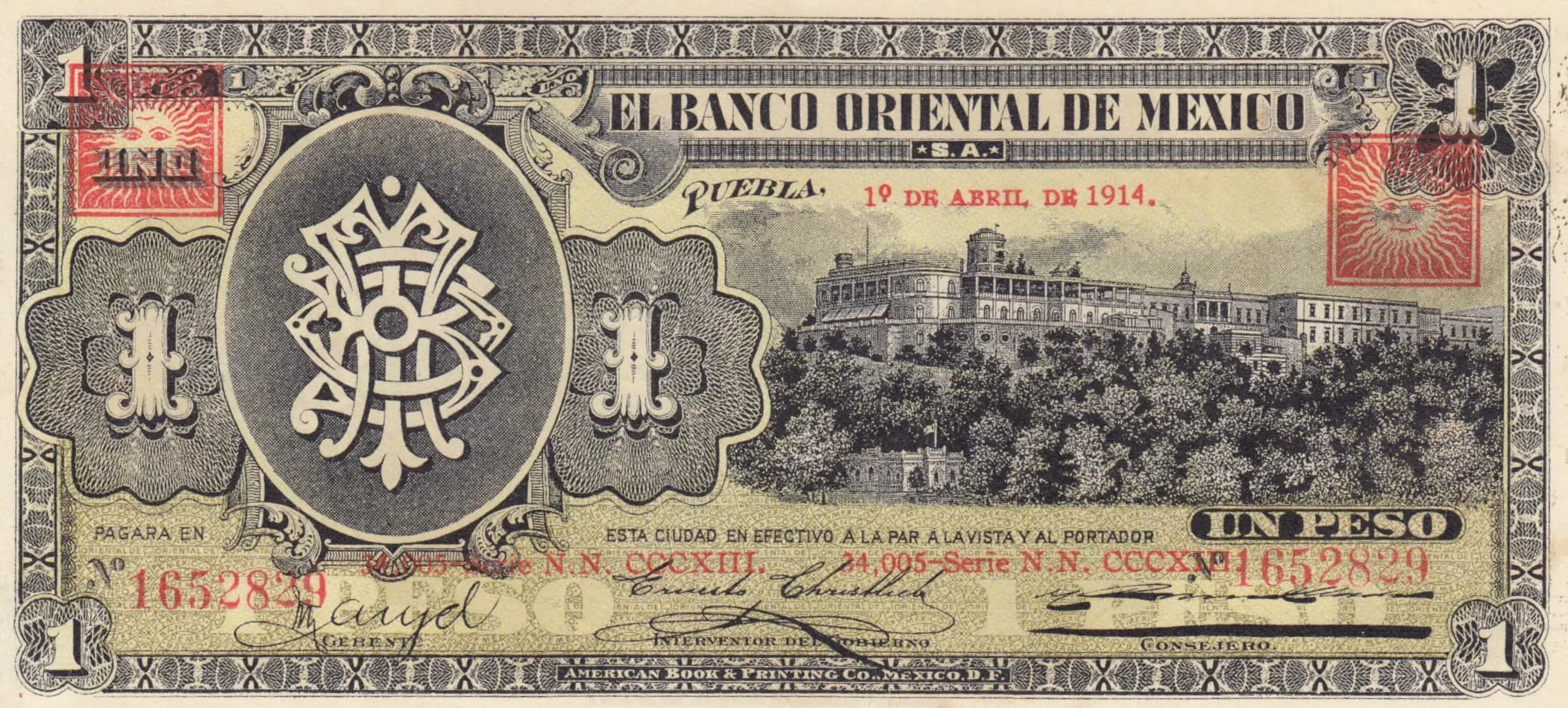
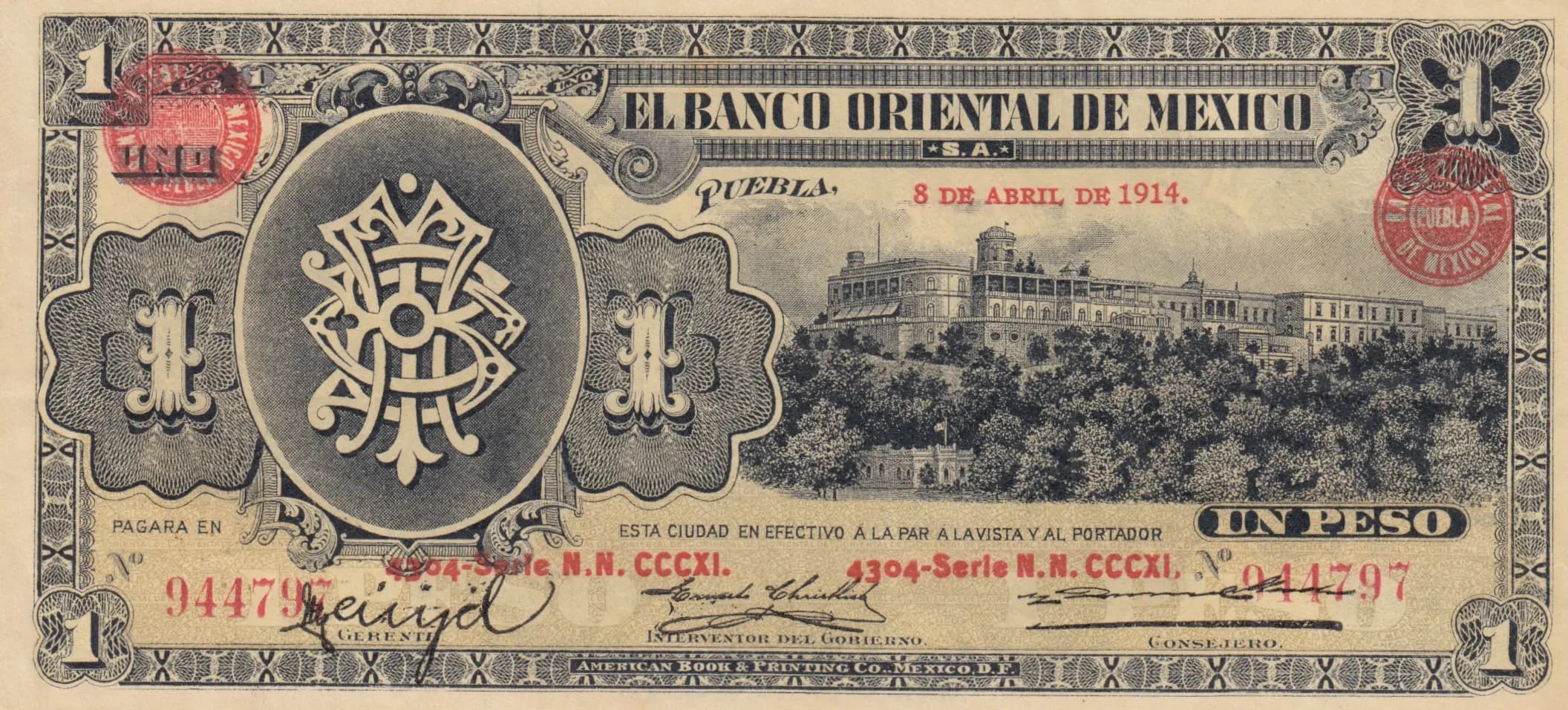
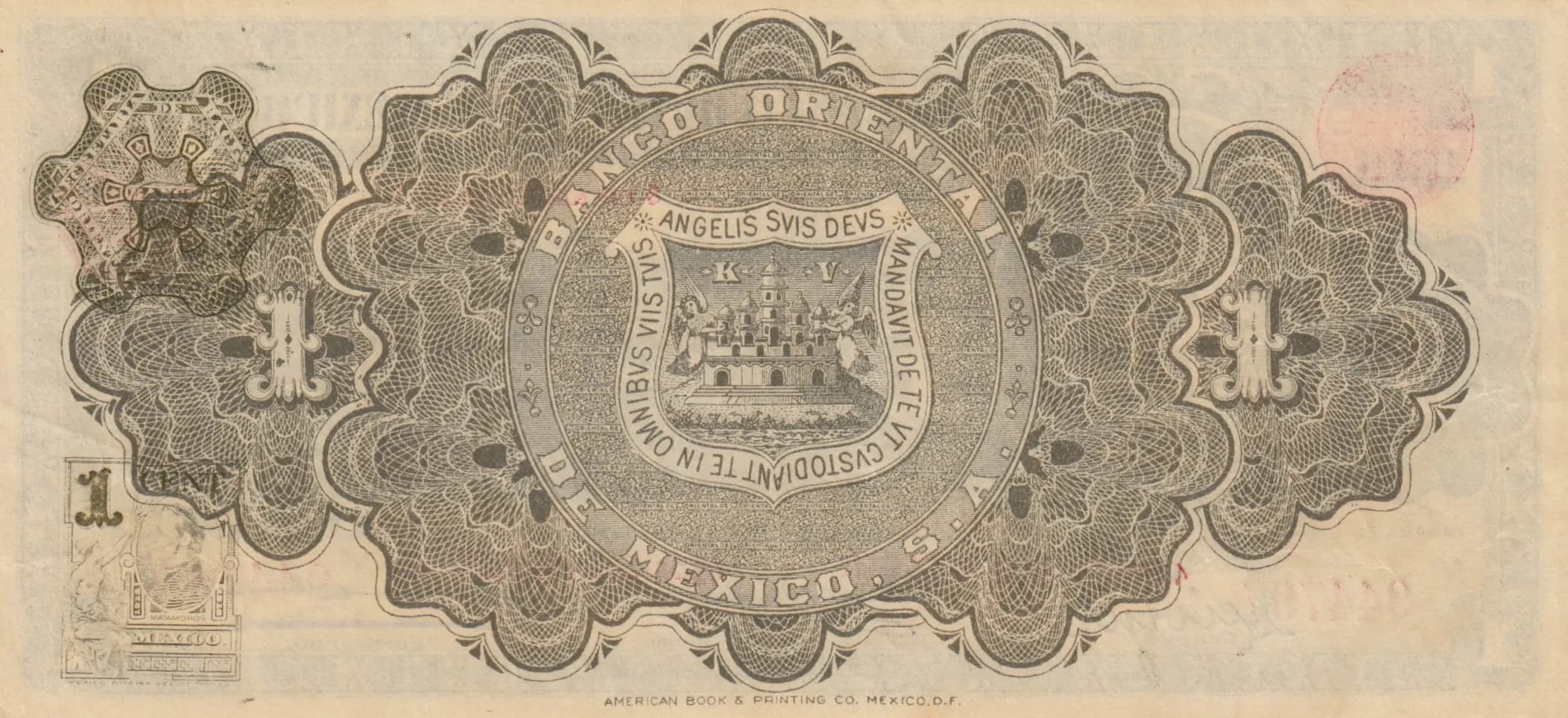
A VF-grade 1 peso note from Banco Oriental de Mexico dated April 8, 1914, featuring exceptional engraved design work by the American Book & Printing Co. The front displays an ornate oval medallion with a palatial hillside building, while the reverse showcases an elaborate circular seal with architectural imagery and Latin inscriptions. Despite visible aging, circulation wear, and period-appropriate red stamps with handwritten signatures, this represents a well-preserved example of early Mexican banking currency during a tumultuous revolutionary period.
Common. eBay price tracking shows multiple sales of this Pick number across various condition grades, with VF specimens commanding approximately $70 USD, consistent with supply sufficient for regular collector acquisition. The note's appearance in multiple eBay listings at differing prices and conditions indicates adequate circulation among dealers and collectors. While not worthless, it lacks the scarcity premiums associated with truly rare Revolutionary-era Mexican bank notes. The Banco Oriental de Mexico maintained sufficient operational history and note production volume to ensure these remain accessible to collectors.
Issued during the Mexican Revolution by the Banco Oriental de Mexico (based in Puebla), this note exemplifies the private banking system that operated alongside government currency during 1913-1914. The Latin inscriptions and American printing by American Book & Printing Co. reflect Mexico's reliance on foreign engraving expertise and international financial institutions. The palatial building depicted on the front likely represents either the bank's headquarters or a significant regional landmark in Puebla state, symbolizing institutional stability during political upheaval.
This banknote exemplifies the elaborate engraved aesthetic of early 20th-century Mexican banking currency. The obverse features a symmetrically balanced composition with an ornate oval medallion containing a cross and floral emblem on the left, while the right side displays a finely detailed landscape engraving of a multi-story palatial building set on a hillside with surrounding vegetation—likely the Banco Oriental's headquarters or Puebla's civic landmark. The reverse presents an even more complex design: a large circular seal dominates the center, containing an architectural structure (possibly a cathedral or fortified building) rendered in minute detail, surrounded by Latin text in a circular band. Corner ornaments displaying the numeral '1' anchor all four corners. The entire composition is framed by intricate scrollwork and floral border patterns characteristic of security engraving. The color scheme of black ink on tan/cream stock was typical for the period.
FRONT SIDE: 'EL BANCO ORIENTAL DE MEXICO S.A.' (The Oriental Bank of Mexico, Limited Company) | 'PUEBLA' (location) | '8 DE ABRIL DE 1914' (April 8, 1914) | 'PAGARA EN ESTA CIUDAD EN EFECTIVO A LA PAR A LA VISTA Y AL PORTADOR' (Will pay in this city in cash at par on demand and to bearer) | 'UN PESO' (One Peso) | Serial numbers: '944791' and '944797' | '4304-Serie N.N. CCCXI' (4304-Series N.N. CCCXI) | Signature lines for 'GERENTE' (Manager), 'INTERVENTOR DEL GOBIERNO' (Government Auditor/Inspector), and 'CONSEJERO' (Counselor) | BACK SIDE: 'ANGELIS SVIS DEVS' (God with his angels - Latin) | Partially legible Latin text | 'AMERICAN BOOK & PRINTING CO. MEXICO, D.F.' (American Book & Printing Co., Mexico City)
Steel-plate intaglio engraving (taille-douce), executed by American Book & Printing Co. of Mexico City. The extremely fine line work, precise architectural detail, and ornamental border patterns are hallmarks of intaglio printing, the gold standard of banknote security printing. Handwritten signatures in black ink were applied after printing. Red circular stamps/seals were stamped in place, possibly indicating authentication or government oversight marks required during the Revolutionary period.
This specimen represents series N.N. CCCXI (Roman numerals 391) with serial number 944791. Varieties of this Pick number P-S388a may be distinguished by: (1) different series designations within the N.N. prefix range; (2) varying signature combinations reflecting changes in bank officials (Gerente/Manager, Interventor del Gobierno/Government Auditor, Consejero/Counselor); (3) the presence or absence of red government authentication stamps; and (4) handwritten signature variations. The specific date of April 8, 1914 appears consistent with the standard issue date for this series, though earlier or slightly later printings may exist. No overprints or obvious varieties beyond normal serial number progression are apparent on this specimen.