1 peso 1914
Market Prices
About This Note
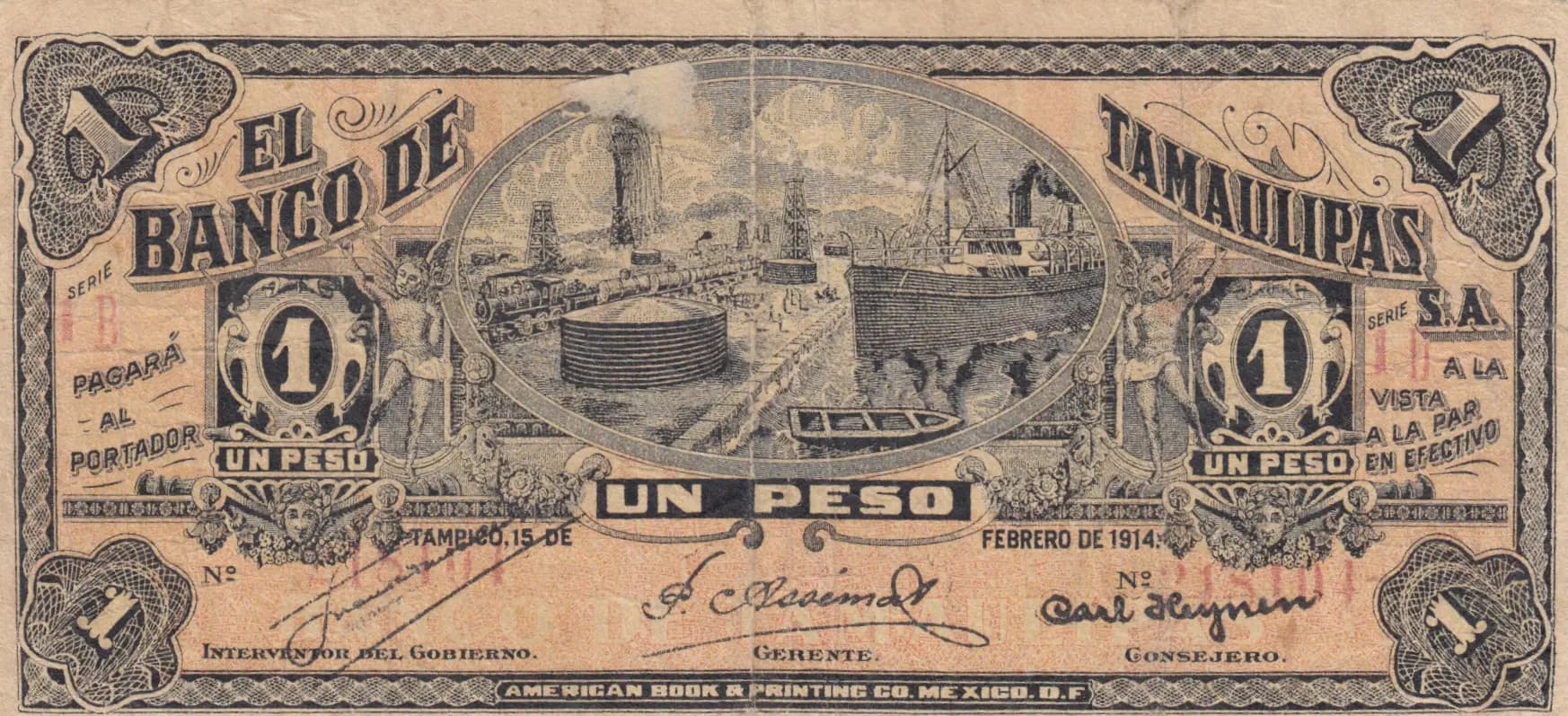
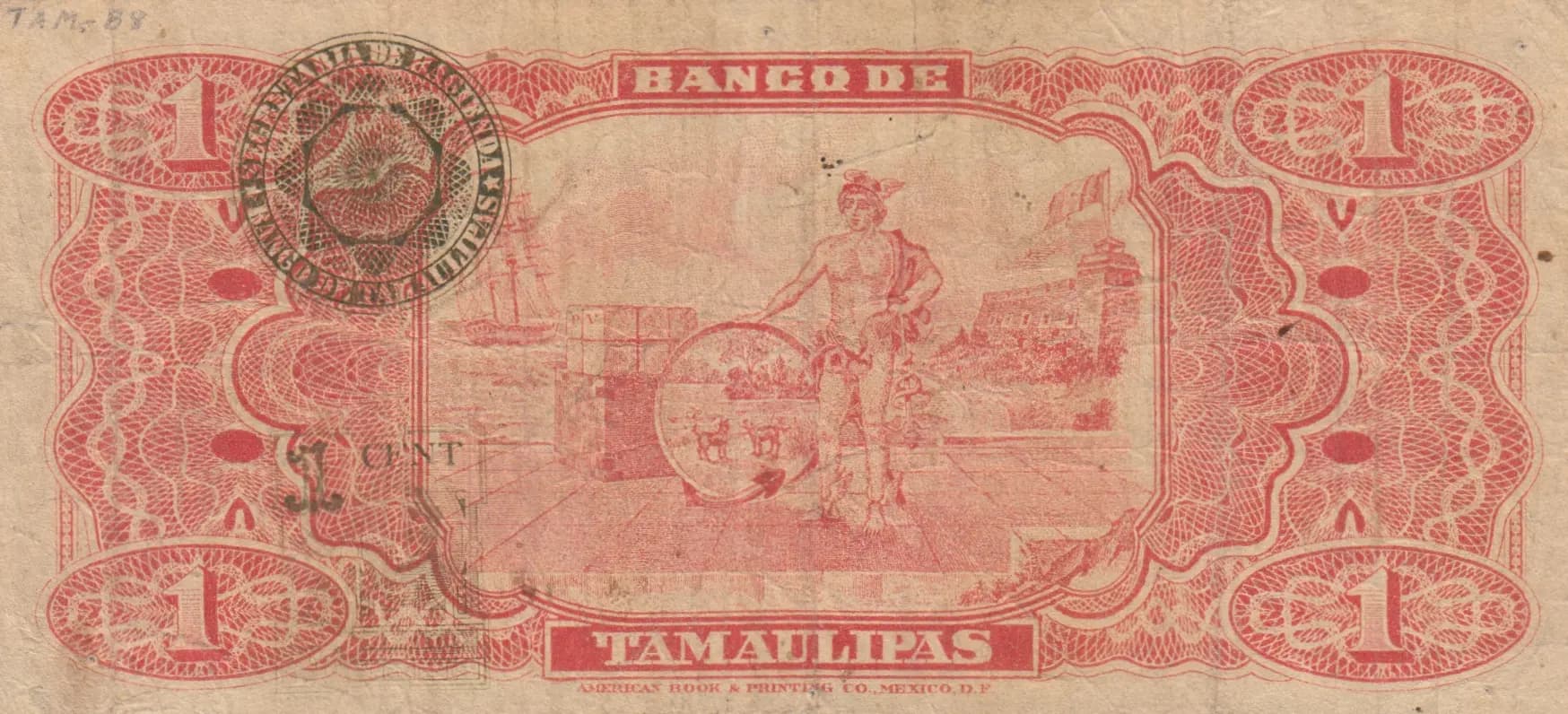
This is a 1914 Banco de Tamaulipas 1 peso note issued in Tampico on February 15, 1914, graded in Fine condition. The obverse features industrial and maritime vignettes in tan and black ink depicting oil infrastructure, freight trains, and harbor scenes—reflecting Tamaulipas's economic importance during Mexico's oil boom era. The reverse displays an allegorical female figure (Mercury or Commerce personification) in red ink with ships and fortifications in the background. The note shows expected circulation wear including central creasing, foxing, ink fading, and a visible cancellation mark, consistent with genuine period use over a century ago.
Common. The eBay price tracking data shows a wide range of sales ($7.50 to $499.95 USD), with most Fine-graded examples selling between $35.97 and $202.51 USD, and numerous listings indicating regular market availability. Banco de Tamaulipas was an active regional issuer with presumably reasonable print runs. The note's appearance in multiple condition grades on secondary markets, combined with the moderate pricing for Fine examples, confirms this is a commonly encountered note among collectors of Mexican regional banknotes.
The Banco de Tamaulipas issued this note during a turbulent period of Mexican history, just as the Mexican Revolution was intensifying in 1914. The imagery prominently celebrates Tamaulipas's industrial and maritime prosperity—oil rigs, storage tanks, steamships, and fortifications—reflecting the state's strategic importance as a petroleum-producing region and major port (Tampico). The allegorical figure of Mercury (god of commerce) on the reverse symbolizes the bank's role in facilitating commercial and industrial development, while the fortification imagery may reference both the region's defensive importance and its commercial security.
The note's obverse features an elaborate ornamental border with geometric and floral corner ornaments typical of early 20th-century Mexican banknote design. The central composition displays three interconnected circular vignettes showcasing Tamaulipas's economic foundation: industrial facilities with smokestacks and manufacturing equipment (left), a central harbor scene with multiple merchant vessels and dock infrastructure, and complementary maritime imagery. The denomination 'UN PESO' appears prominently at bottom center. The reverse presents Mercury (or a personified figure of Commerce/Prosperity) in classical dress, positioned within an industrial landscape with sailing ships, fortifications, and harbor facilities in the background—symbolizing the god's traditional association with trade and commerce. Decorative oval frames with '1' denominations appear in all four corners. The fine-line engraving throughout demonstrates the skilled craftsmanship of the American Bank Note Company's Mexico City facility.
FRONT SIDE: 'EL BANCO DE TAMAULIPAS' (The Bank of Tamaulipas) / 'UN PESO' (One Peso) / 'SERIE' (Series) / 'PAGARÉ AL PORTADOR' (Promissory note payable to bearer) / 'A LA VISTA A LA PAR EN EFECTIVO' (On demand at par in cash) / 'TAMPICO, 15 DE FEBRERO DE 1914' (Tampico, 15th of February 1914) / 'INTERVENTOR DEL GOBIERNO' (Government Intervener) / 'GERENTE' (Manager) / 'CONSEJERO' (Counselor/Advisor) / 'AMERICAN BOOK & PRINTING CO. MEXICO, D.F.' (American Book & Printing Co. Mexico, D.F.). BACK SIDE: 'BANCO DE TAMAULIPAS' (Bank of Tamaulipas) / '1' (denomination) / 'AMERICAN BOOK & PRINTING CO. MEXICO, D.F.' (American Book & Printing Co. Mexico, D.F.).
This note was printed using steel engraving, the standard security printing method for banknotes of this era. The obverse was printed in black ink on an orange/tan underprint, while the reverse was printed in red/pink ink. The printer, American Book & Printing Co. (AB&PC) operating from Mexico City, employed multiple engraved steel plates for the ornamental borders, vignettes, and text. The fine line work visible in the borders and the detailed allegorical vignette required master engravers and represents the highest printing technology available in 1914. The layered ornamental security design with repetitive patterns was intentionally complex to deter counterfeiting.
The catalog reference indicates Series 1A:1J and 1A:1P with 2 known signature varieties for this denomination. The visual analysis does not provide sufficient resolution to definitively identify which specific signature variety is present on this example, though the presence of three signature lines (for Government Intervener, Manager, and Counselor) is confirmed. Collectors of this note should record the signature variety and series designation (visible in the 'SERIE' area) for precise cataloging. The cancellation mark visible on the reverse suggests this note may have been part of a bank archive or official collection, which could indicate different handling or processing.