1 peso 1914
About This Note
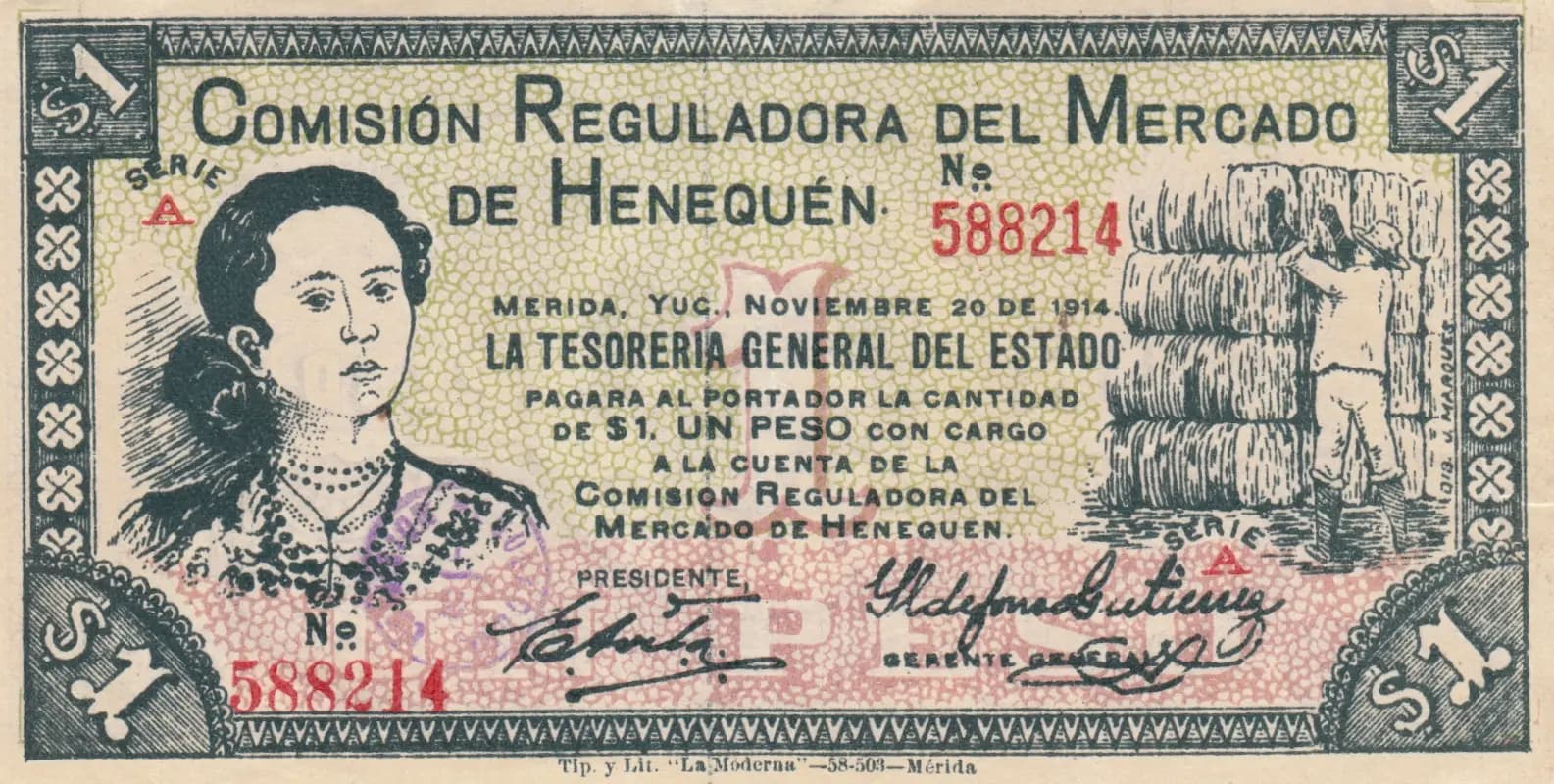
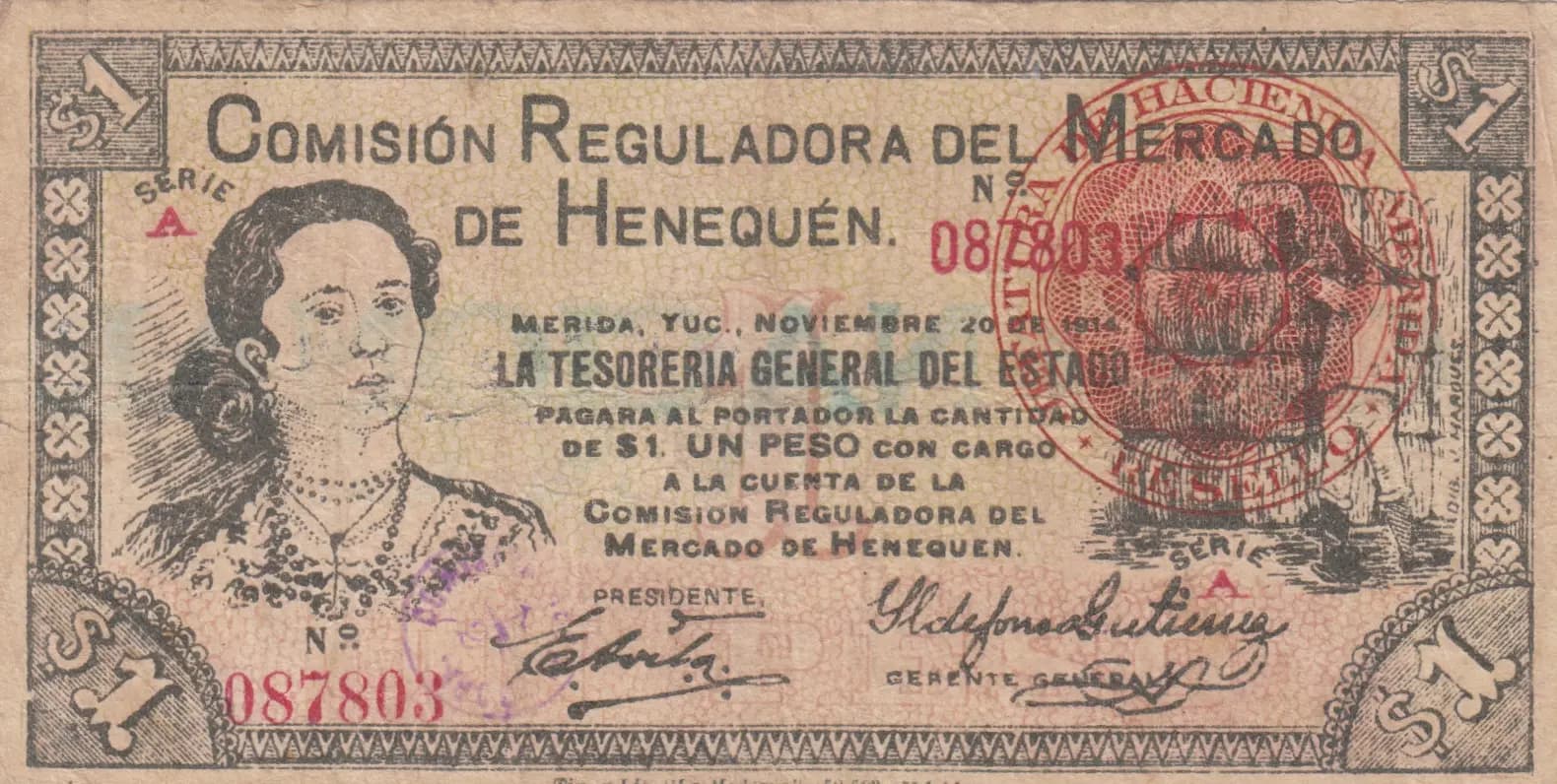
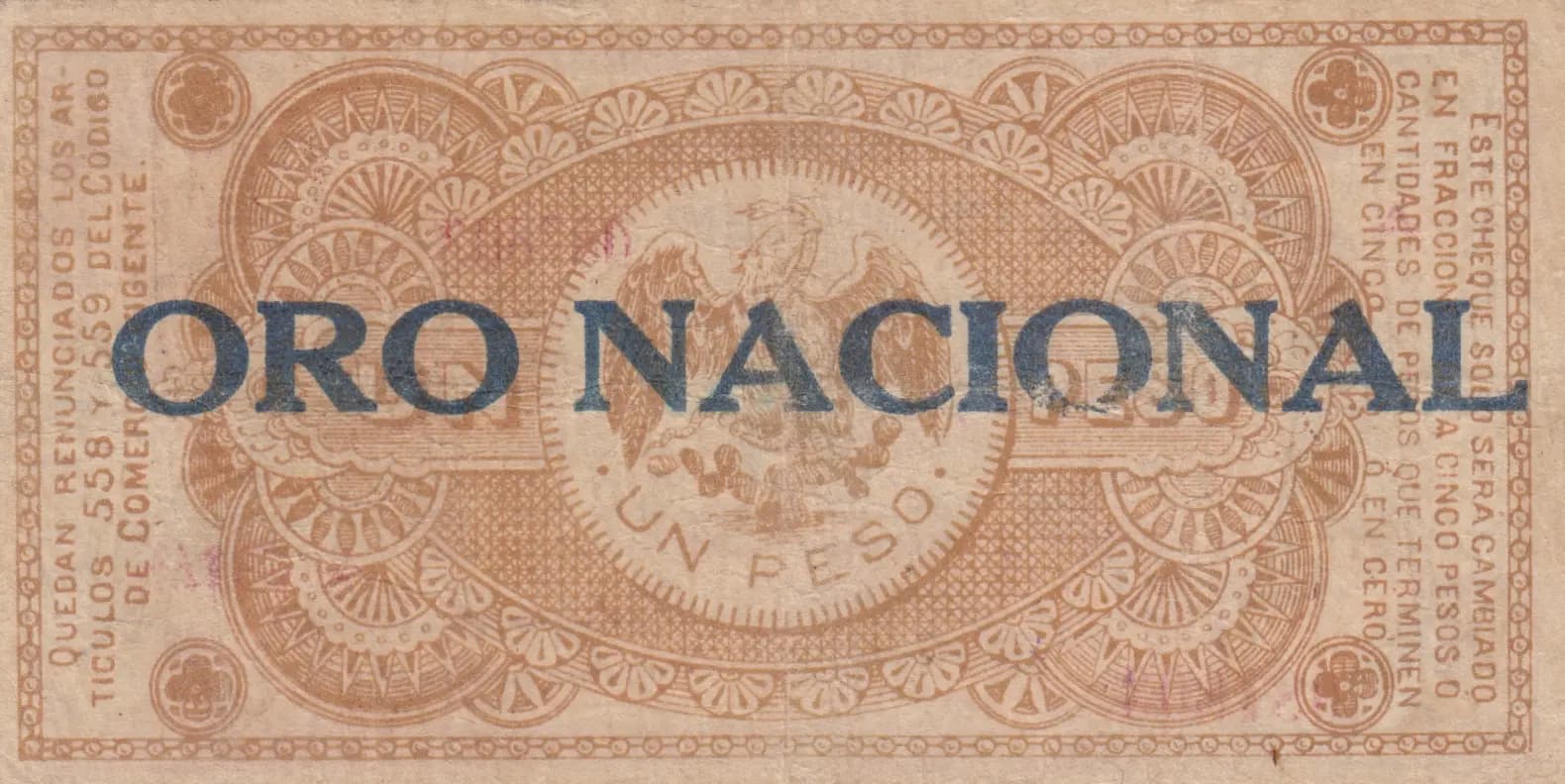
This is a 1 peso note from 1914 issued by the Comisión Reguladora del Mercado de Henequén, the regulatory body for Yucatan's henequen (sisal) trade during the Mexican Revolution. The note features an elegantly engraved portrait of a woman on the obverse and displays the patriotic inscription 'ORO NACIONAL' (National Gold) on the reverse, reflecting the economic nationalism of the period. In Fair condition, the note shows appropriate aging with foxing and patina consistent with over a century of circulation, along with period stamps and handwritten signatures documenting official handling.
Common. While this note represents an interesting regional emergency issue from a specific historical moment, the Comisión Reguladora del Mercado de Henequén issued these notes in substantial quantities for circulation within Yucatán's commercial system between 1914-1915. Multiple series and denominations were produced, and examples survive in various grades. The note's Fair condition and the apparent survival of multiple specimens with sequential serial numbers suggest an adequate surviving population. Regional Mexican Revolutionary-era notes of this type are neither particularly scarce in the collector market nor highly sought-after premium items, and this specific Pick number does not command the significant premiums associated with rare or very rare issues.
This emergency currency was issued during the Mexican Revolution when Yucatan's henequen-producing region required alternative financial instruments. The Comisión Reguladora, established to stabilize the henequen market during wartime, issued these notes backed by the state treasury in Mérida. The prominent 'ORO NACIONAL' inscription reflects Mexico's broader attempts to maintain monetary credibility and nationalist economic control during the chaotic revolutionary period, while the November 1914 date places this firmly in the early phases of the Revolution when regional authorities still exercised significant financial autonomy.
The obverse features a refined portrait of a woman in left profile, rendered in black engraving with careful attention to period hairstyling and formal attire, positioned on the left side of the note. The portrait is framed by ornate baroque-style geometric borders with crossed lines and corner ornaments typical of early 20th-century Mexican currency design. A red circular seal or state emblem appears on the right side of the obverse. The reverse displays a central heraldic emblem—likely incorporating Mexican national symbols or the state seal of Yucatán—surrounded by elaborate baroque decorative borders featuring shell motifs and geometric patterns. Both sides employ fine-line engraving throughout, with the reverse dominated by the bold central inscription 'ORO NACIONAL' printed in dark blue ink, emphasizing the note's backing by national resources. The overall design reflects the sophisticated security and aesthetic standards expected of even emergency revolutionary-era currency.
FRONT: 'COMISIÓN REGULADORA DEL MERCADO DE HENEQUÉN' (Regulatory Commission of the Henequen Market); 'SERIE A' (Series A); 'MERIDA, YUC., NOVIEMBRE 20 DE 1914' (Mérida, Yucatán, November 20, 1914); 'LA TESORERÍA GENERAL DEL ESTADO PAGARÁ AL PORTADOR LA CANTIDAD DE $1. UN PESO CON CARGO A LA CUENTA DE LA COMISIÓN REGULADORA DEL MERCADO DE HENEQUÉN' (The General Treasury of the State will pay the bearer the sum of $1. One Peso, charged to the account of the Regulatory Commission of the Henequen Market); 'PRESIDENTE' (President); 'GERENTE GENERAL' (General Manager); Serial number '087803'; Date stamp '08/8/14' (August 8, 1914); 'ALMACENES' (Warehouses). BACK: 'ORO NACIONAL' (National Gold); 'DUEDAN RENOVADOS LOS ARTICULOS 55 DEL CODIGO' (Let articles 55 of the code be renewed); 'EN FRAUDE O FALSIFICACIÓN DE ESTE DOCUMENTO SERÁ CASTIGADO CONFORME A LOS ARTICULOS DEL CODIGO PENAL VIGENTE' (Fraud or falsification of this document will be punished in accordance with the articles of the applicable Penal Code); 'CON FESO' (With acknowledgment).
Intaglio engraving (copperplate printing), which was the standard security printing method for Mexican banknotes of this period. The fine-line detail visible in the portrait, the complex geometric borders, and the heraldic emblem demonstrate the characteristic depth and precision of intaglio work. Multiple ink colors (black, red, dark blue) were applied in separate passes, a technique known as multi-color intaglio printing. The specific printer for this Yucatán regional issue is not definitively documented in standard references, but it was likely produced by a Mexican security printer or, given the emergency nature and regional scope, possibly by local printing facilities under government supervision.
This example is identified as Pick S1122c (Series A variant 'c'). The visual analysis indicates this is Series A ('SERIE A' marking visible), with serial number 087803. Known varieties of this 1 peso Henequén commission issue include different series designations and signature combinations. The date stamp '08/8/14' (August 8, 1914) appears on this example, though the note itself is dated November 20, 1914, likely indicating when it was formally authorized versus when this particular specimen was stamped during distribution or warehouse receipt. The presence of purple ink stamps and what appear to be handwritten signatures of the President and General Manager represent typical administrative varieties on notes from this series, as individual officers' signatures varied over the emission period.