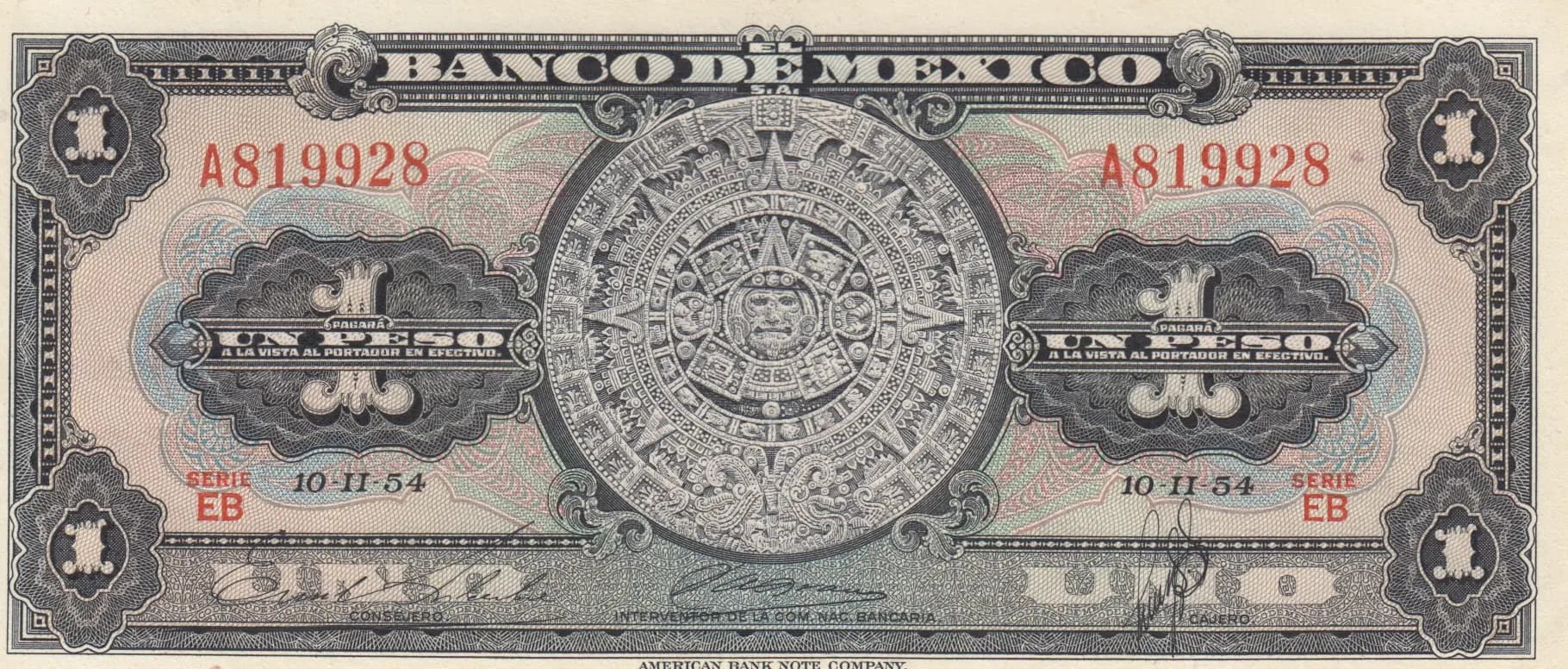
1 peso 1954
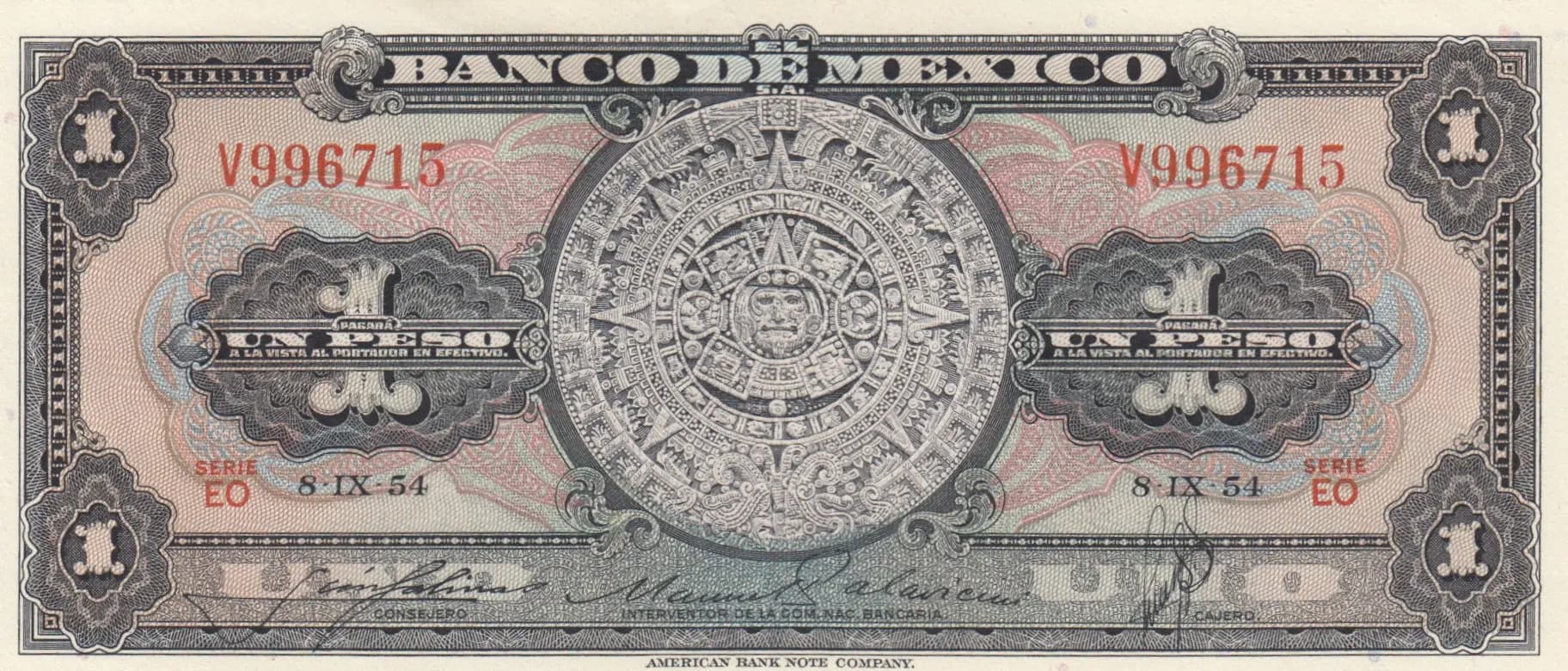
“08.09.54”
Market Prices
18 salesAbout This Note
An exceptional example of Mexico's 1954 1 Peso note (Pick P-56b) in uncirculated condition, featuring the iconic Aztec Sun Stone dominating the obverse in classic beige and red tones. The reverse showcases a commemorative monument in pink tones, with both sides displaying the hallmark baroque ornamentation and fine engraving characteristic of American Bank Note Company work. This well-preserved specimen exhibits sharp printing, clean paper, and vibrant coloring throughout, making it an attractive addition to Mexican currency collections.
Common. The 1954 1 Peso (P-56b) is a standard regular-issue note from Mexico's active currency circulation, indicated by the strong secondary market evidence: numerous UNC examples sold between $2.25–$9.00 (2020–2021), with more recent sales at $7.77 (2026). The 2016 catalog value of $4 for UNC specimens, combined with consistent auction activity and multiple PMG-graded examples in the population report, confirms this as a readily available note in collections. No evidence of limited print run, recall status, or scarcity factors. The relatively modest pricing across multiple sales venues reinforces common status.
Issued on 8 September 1954 by the Banco de México, this note reflects Mexico's post-revolutionary cultural nationalism through its prominent Aztec calendar stone imagery, symbolizing the nation's pre-Columbian heritage. The reverse monument further underscores the Mexican government's emphasis on national commemoration and historical identity during the mid-20th century. Printed by the American Bank Note Company (ABNC), the note represents the high-quality security printing standards employed by Mexican authorities during the 1950s.
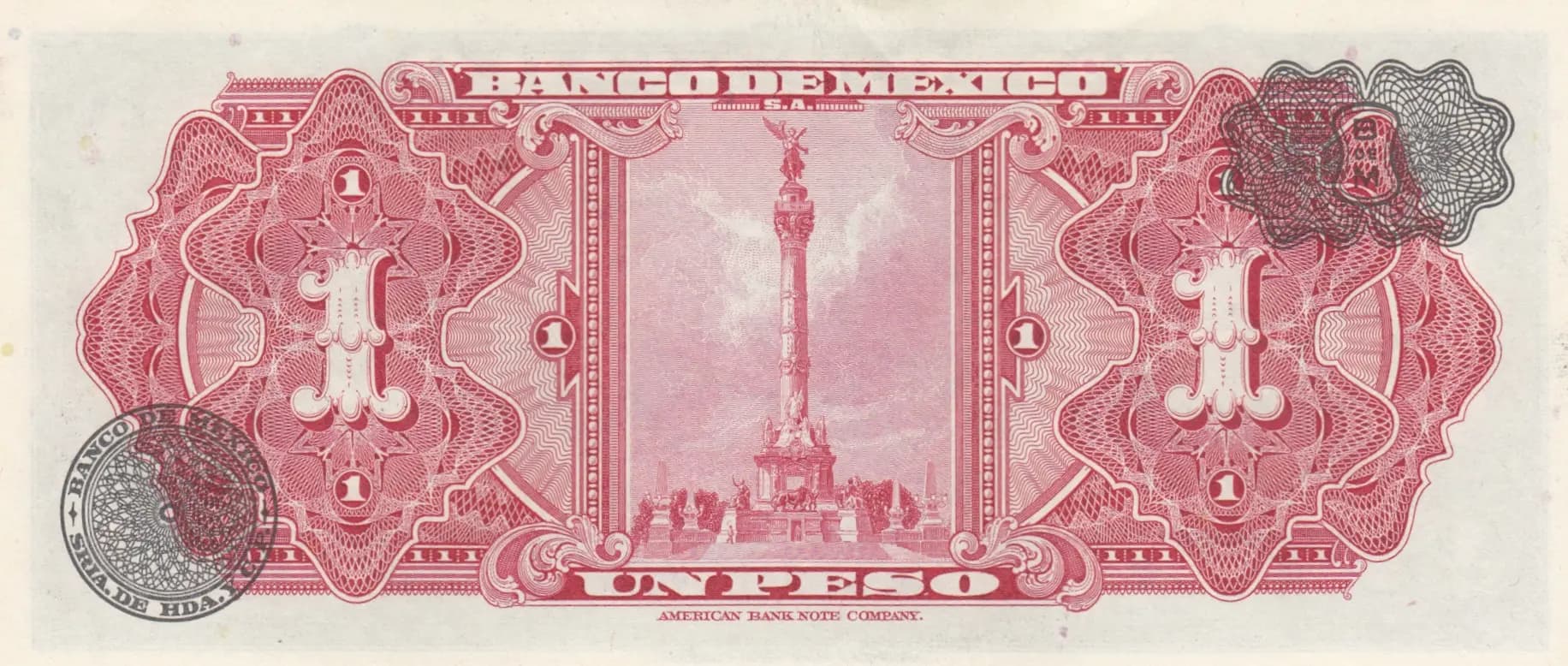
The obverse centers on the Aztec Sun Stone (Piedra del Sol), the monumental 24-ton basalt sculpture carved by the Mexica civilization, rendered as an intricate circular medallion in black line engraving against the beige field. This symbol of Mexican national identity is flanked by ornamental shield-shaped cartouches in all four corners featuring baroque scrollwork. Serial number 'V996715' appears in red on both sides. The reverse depicts a tall commemorative monument or cenotaph structure with a statue or figural element crowning its apex, surrounded by elaborate pink-toned baroque ornamentation including floral and scrollwork motifs. A circular governmental seal of the Secretaría de Hacienda y Crédito Público appears in the lower left corner, anchoring the reverse design.
FRONT: 'BANCO DE MEXICO' (Bank of Mexico) — institutional issuer; 'UNA PIASTRE AL PORTADOR EN EFECTIVO' (One Peso Bearer in Cash) — denomination and payment obligation; 'SERIE E0' (Series E0) — series designation; '8·IX·54' (8th September, 1954) — issue date; 'V996715' (Serial number, appears left and right); 'AMERICAN BANK NOTE COMPANY' (American Bank Note Company) — printer attribution. BACK: 'BANCO DE MEXICO' (Bank of Mexico); 'UNO PESO' (One Peso) — denomination; 'AMERICAN BANK NOTE COMPANY' (American Bank Note Company) — printer; 'SECRETARIA DE HACIENDA Y CREDITO PUBLICO' (Ministry of Finance and Public Credit) — visible on circular seal, indicating government authority.
Intaglio engraving (line engraving and cross-hatching), characteristic of security currency production in the mid-20th century. The note employs fine line work and intricate cross-hatching patterns throughout to create anti-counterfeiting depth and visual complexity. Printed by the American Bank Note Company (ABNC), one of the world's premier security printers, utilizing their established processes for Mexican currency during this period. Multi-color printing with distinct color zones (beige/tan with black and red on obverse; pink/red on reverse) applied through separate passes.
This note is identified as Pick P-56b, with series designation 'E0' and issue date '8·IX·54' (8 September 1954). The serial number prefix 'V' and series 'E0' are consistent with this variety. PMG records indicate one catalogued variant for the base Pick number P-56b. No visible overprints, signature variations, or printing anomalies are evident in this specimen that would indicate a scarce sub-variety. The standard format and design elements conform to the established P-56b specification.