50 rupees 1960
Market Prices
16 salesAbout This Note
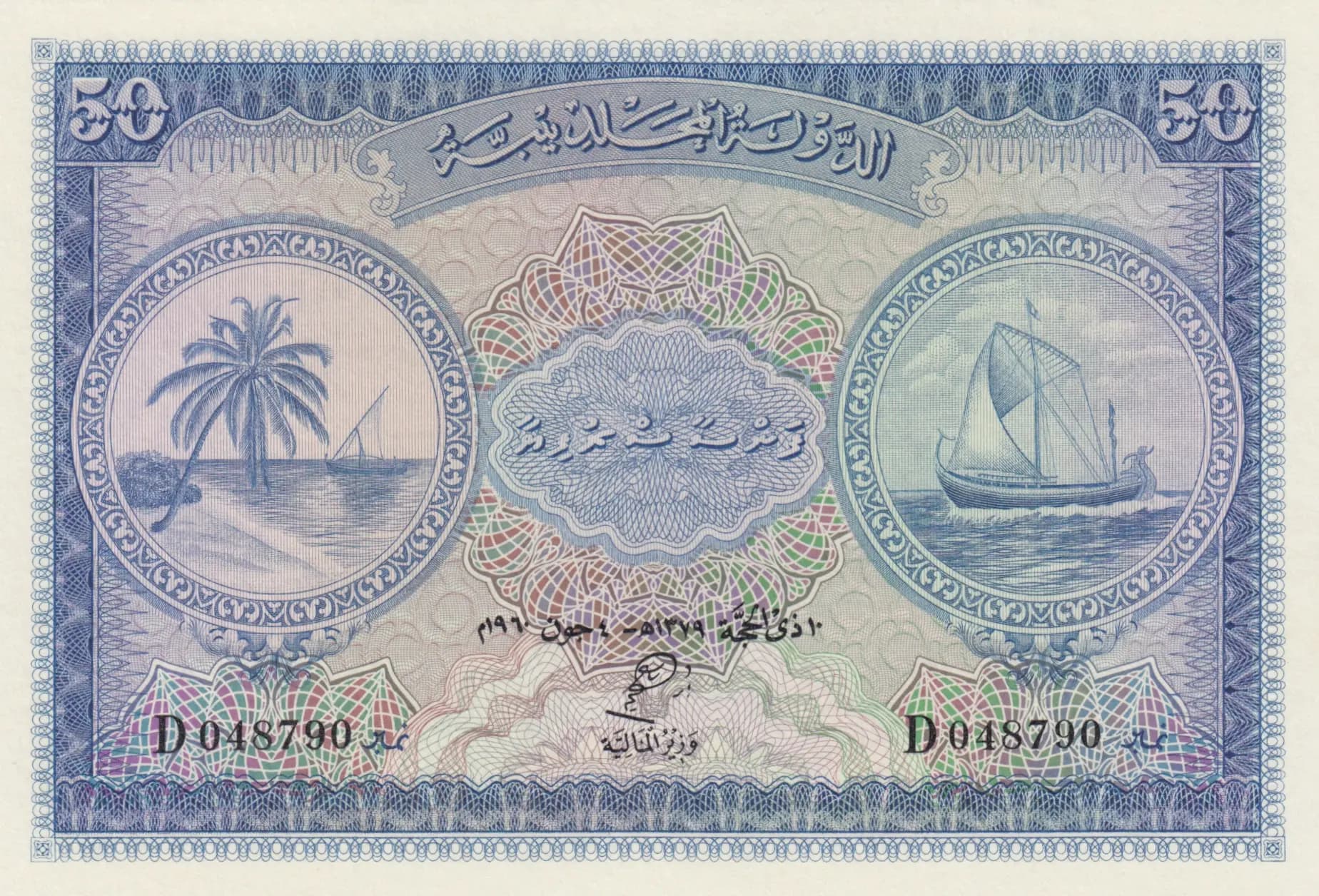
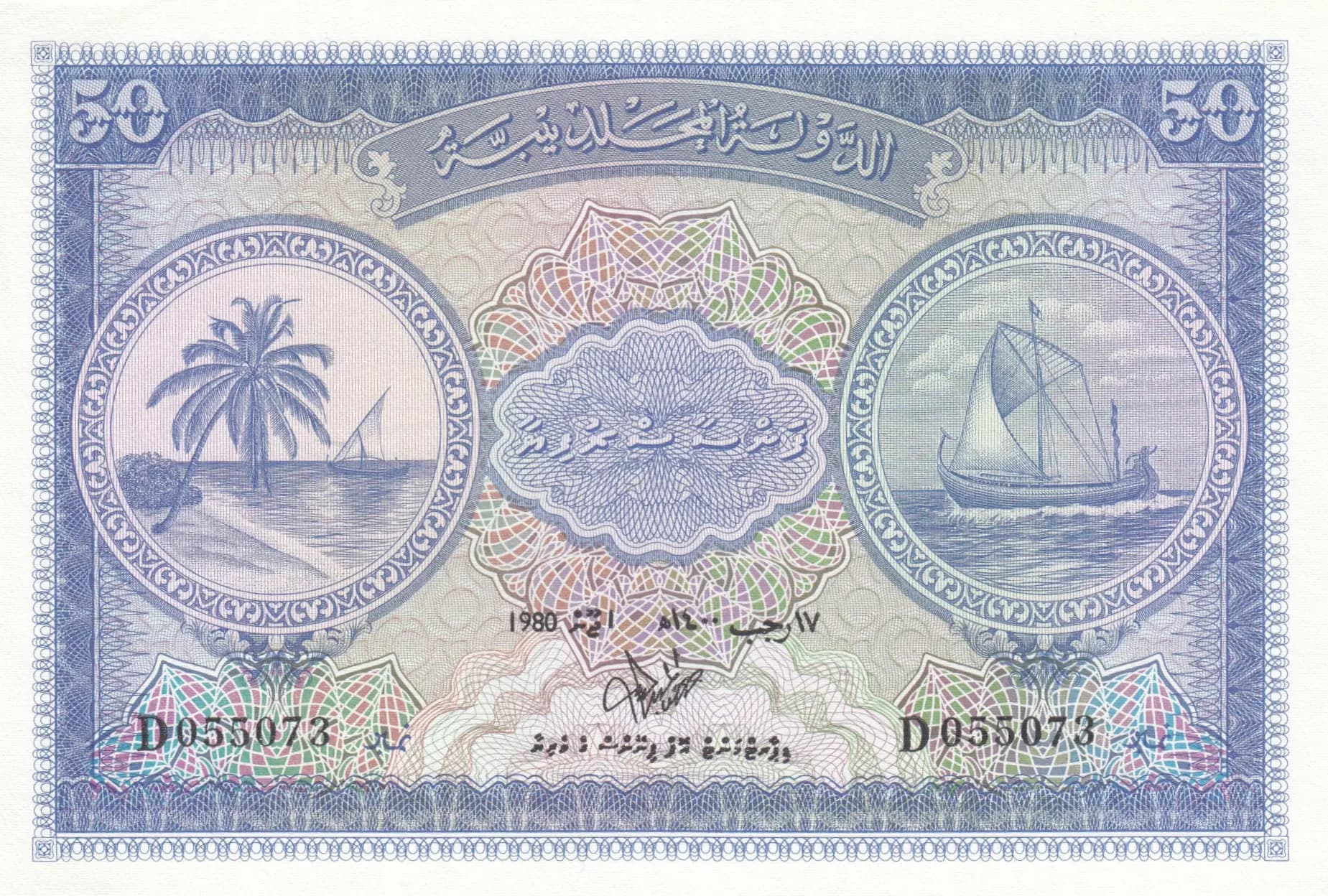
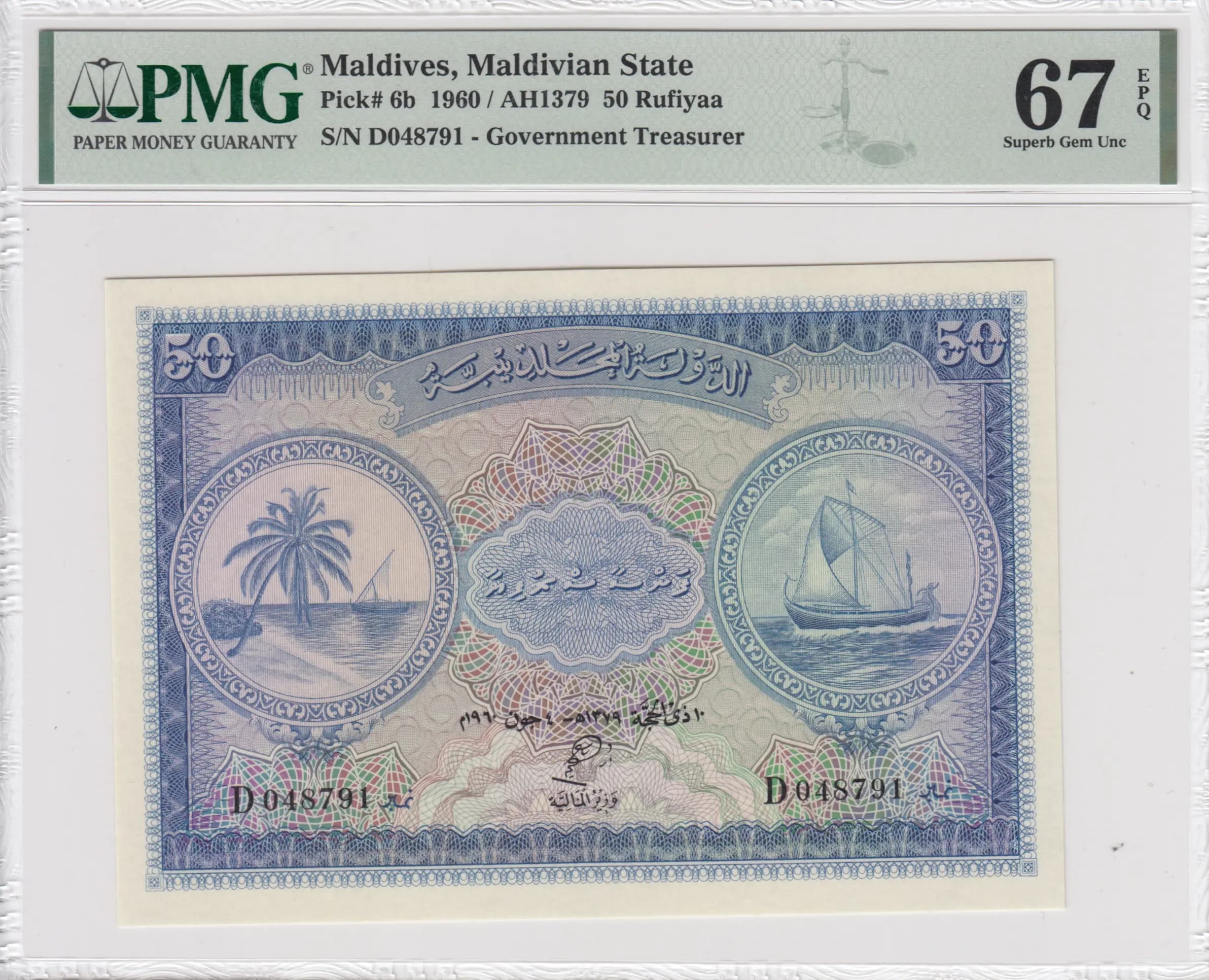
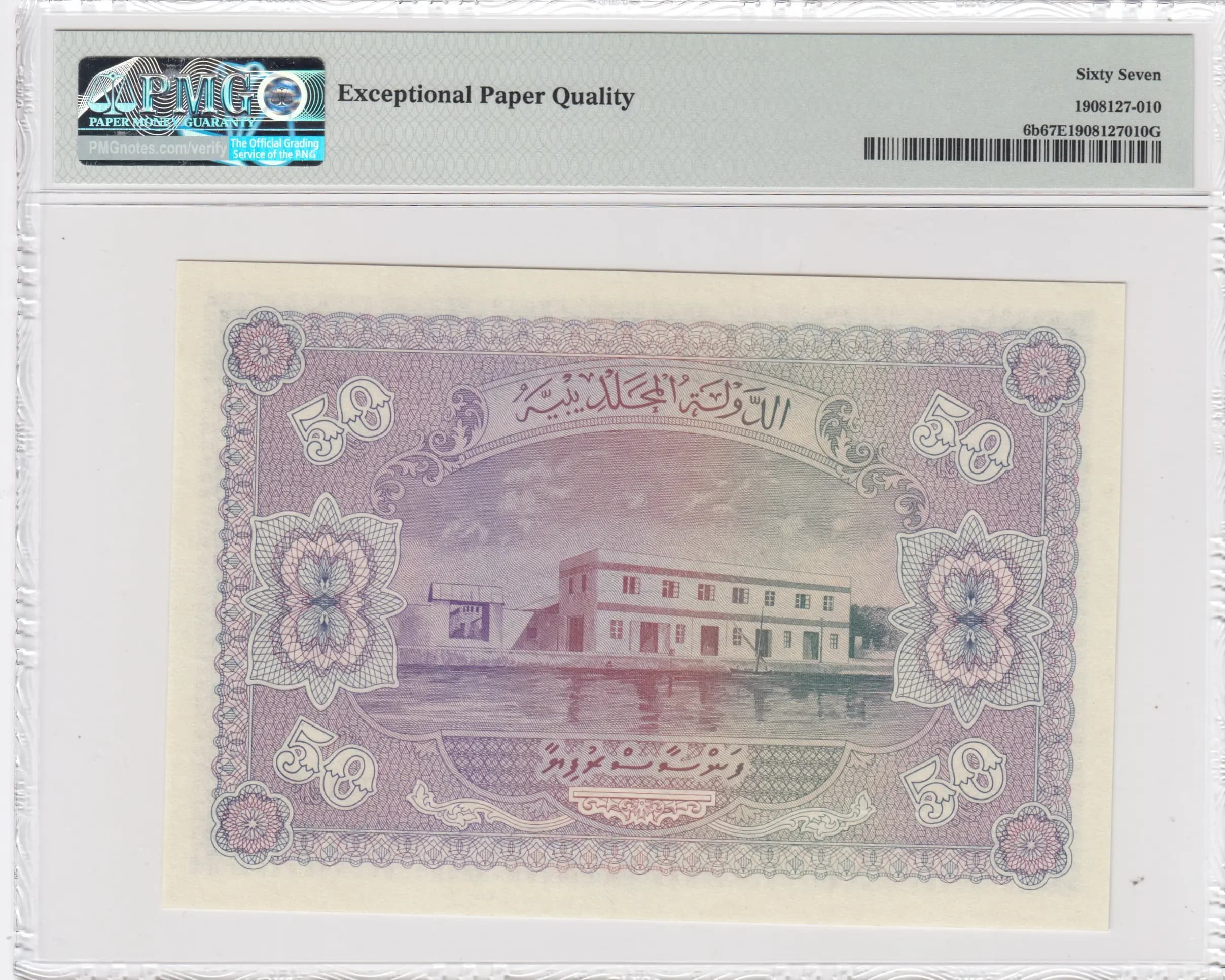
An exceptionally well-preserved example of the 1960 Maldivian 50 Rufiyaa note (Pick P-6b), graded PMG 67 EPQ. The obverse features three circular medallions containing a palm tree, ornate central design, and traditional dhow sailing vessel, while the reverse depicts the Ibrahimiyya building (Royal Embarkation Gate) at Male in architectural detail. The note displays crisp, sharp printing with vibrant multicolored intaglio work and exhibits no wear, creases, or stains, reflecting its uncirculated status and premium collector appeal.
Common. Despite its premium condition grade (PMG 67 EPQ), this note is fundamentally common in the wider collector market. eBay sales data shows consistent, regular transactions across multiple condition grades spanning 2010–2024, with PMG 67 examples averaging $260–$330 in recent years. The note has a substantial print run dating from 1960 and was in circulation during the Maldives' early independence period. The 2019 catalog valuation of $200 for UNC examples further confirms availability. While PMG 67 is an attractive grade commanding prices in the $300+ range, the note itself is neither scarce nor difficult to obtain, making it common relative to the broader numismatic market.
Issued in 1960 during the early period of Maldivian monetary sovereignty, this note represents the transition of the Maldives toward greater independence (full independence achieved in 1965). The imagery—featuring the palm tree and dhow—reflects the archipelago's maritime heritage and tropical economy, while the prominent depiction of the Ibrahimiyya building and Royal Embarkation Gate at Male emphasizes governmental authority and the nation's administrative center. The note was issued by the Maldivian State Treasury during a formative period of national identity and institutional development.
The obverse (front) features a distinctive three-medallion composition arranged horizontally within an ornamental border frame. The left medallion depicts a naturalistic palm tree on sandy beach with water, representing Maldivian tropical landscape. The central medallion contains elaborate arabesque and floral geometric patterns in green, red, pink, and beige, serving as an ornamental device. The right medallion shows a traditional dhow sailing vessel on water, symbolizing the nation's maritime heritage and seafaring tradition. The entire obverse is framed by decorative arabesque borders with geometric designs. The reverse depicts the Ibrahimiyya building (Royal Embarkation Gate/Palace) at Male as a central vignette—rendered as a two-story colonial-era institutional structure with red brick and cream-colored masonry walls, fronting a waterscape. Four ornamental floral corner medallions adorn the reverse corners, with the central building vignette surrounded by an elaborate arabesque border frame featuring geometric and floral patterns in pink/mauve, purple, green, cream, and blue.
Front side: Denomination '50' appears in Arabic numerals; serial number 'D048791' in Latin characters; Arabic script at top identifies the issuing authority (Maldivian State Treasury or equivalent governmental body); Arabic script in central area marking government authority or denomination. Back side: Denomination '50' in Arabic numerals; Arabic script at top indicating state authority; Arabic script at bottom confirming denomination or authority marking. Note: Full precise translation of Arabic inscriptions would require direct paleographic analysis, but the text consistently refers to the issuing governmental authority and the 50 Rufiyaa denomination.
Intaglio (engraved) printing on multicolored underprint. The fine line work visible in the border patterns, ornamental medallions, and intricate arabesque designs are characteristic of high-quality intaglio production. The precise color registration, fine detail in the architectural rendering of the Ibrahimiyya building, and the crisp impression of decorative elements indicate professional security printing, likely produced by a recognized currency printer (specific printer attribution for this Maldivian series would require archival documentation).
This example is cataloged as Pick P-6b, indicating it is the 'b' variety of the 1960 50 Rufiyaa issue. The PMG population report identifies multiple varieties for this base Pick number: P-6a, P-6as, P-6b, P-6c (Litho), P-6cs (Lithographed), P-6r, and P-6s. The visual analysis shows crisp intaglio printing and the serial number prefix 'D' visible on this specimen. The 'b' designation likely reflects a specific printing period, signature variant, or serial number range within the 1960 issuance. The note's EPQ (Exceptional Paper Quality) designation confirms superior preservation with no staining, foxing, or deterioration.