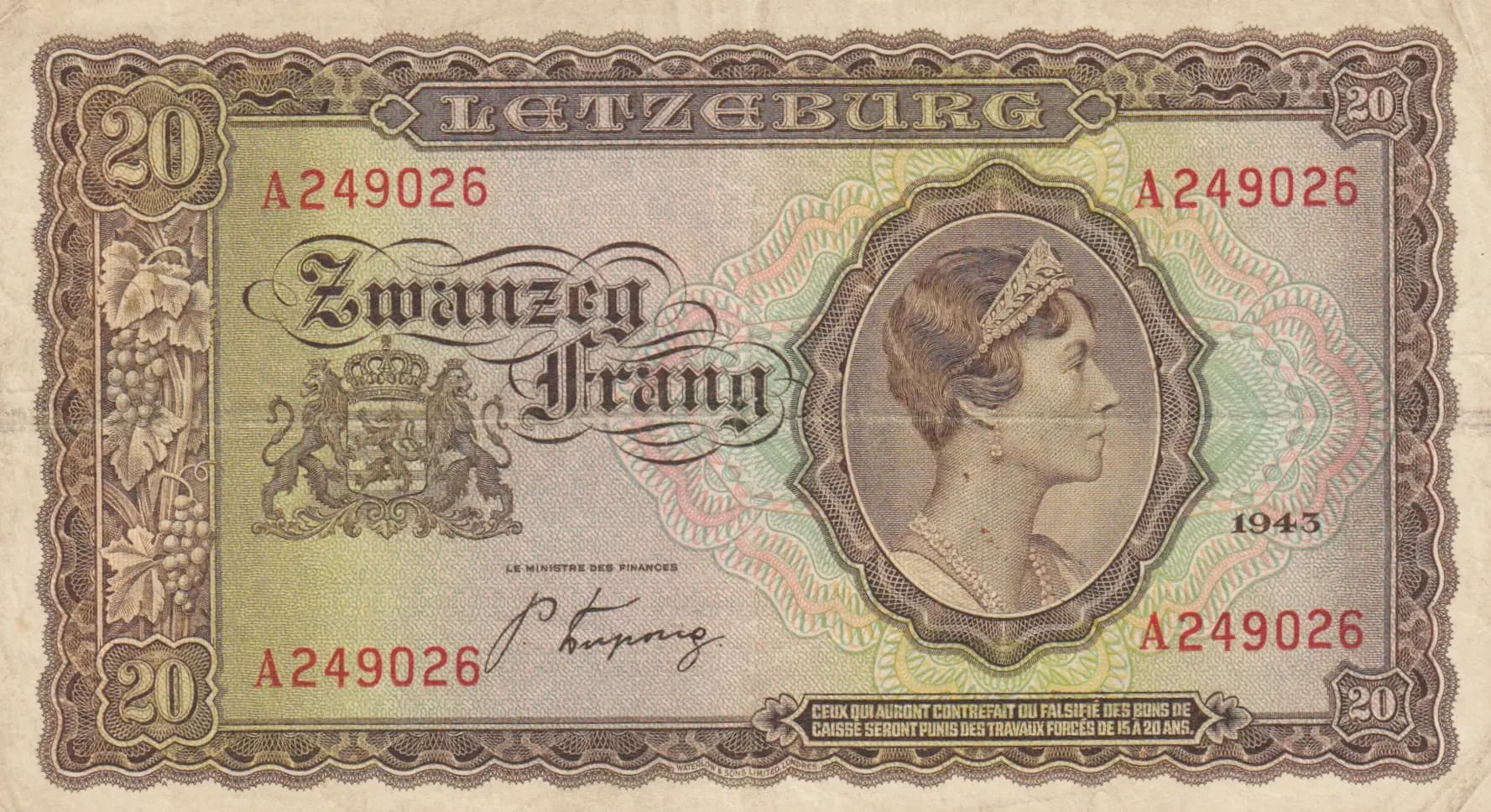
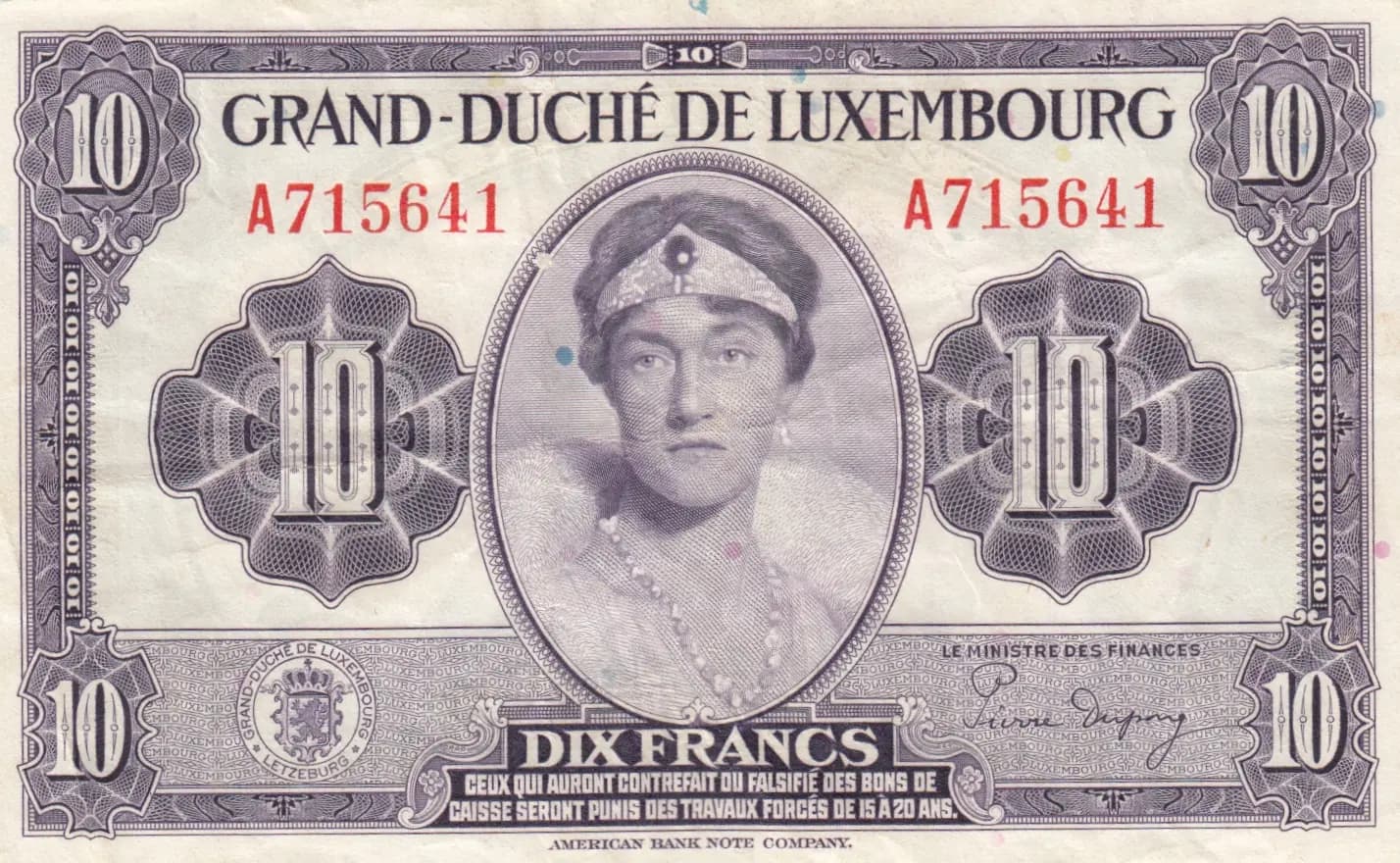
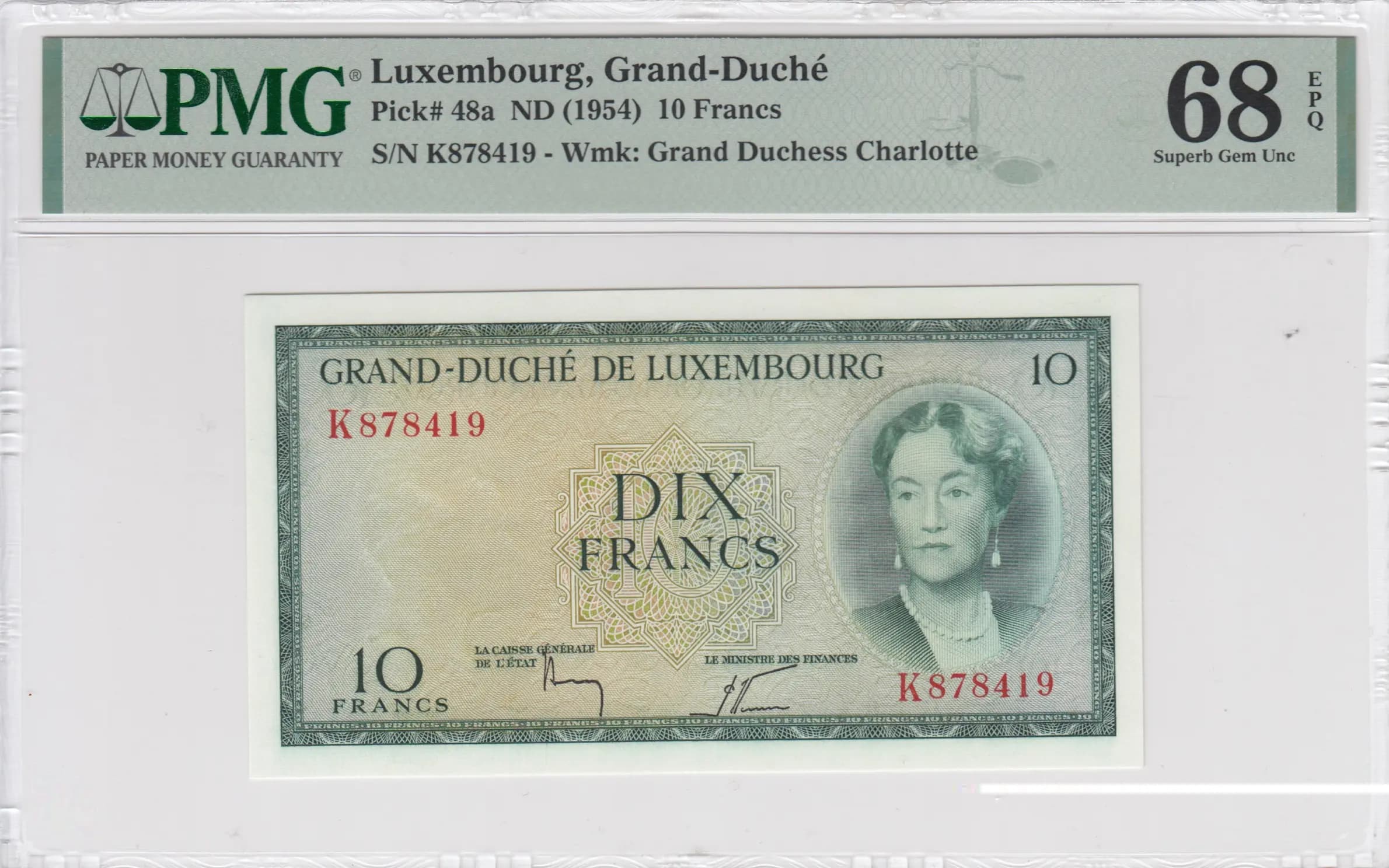
25 francs 1919
Market Prices
About This Note
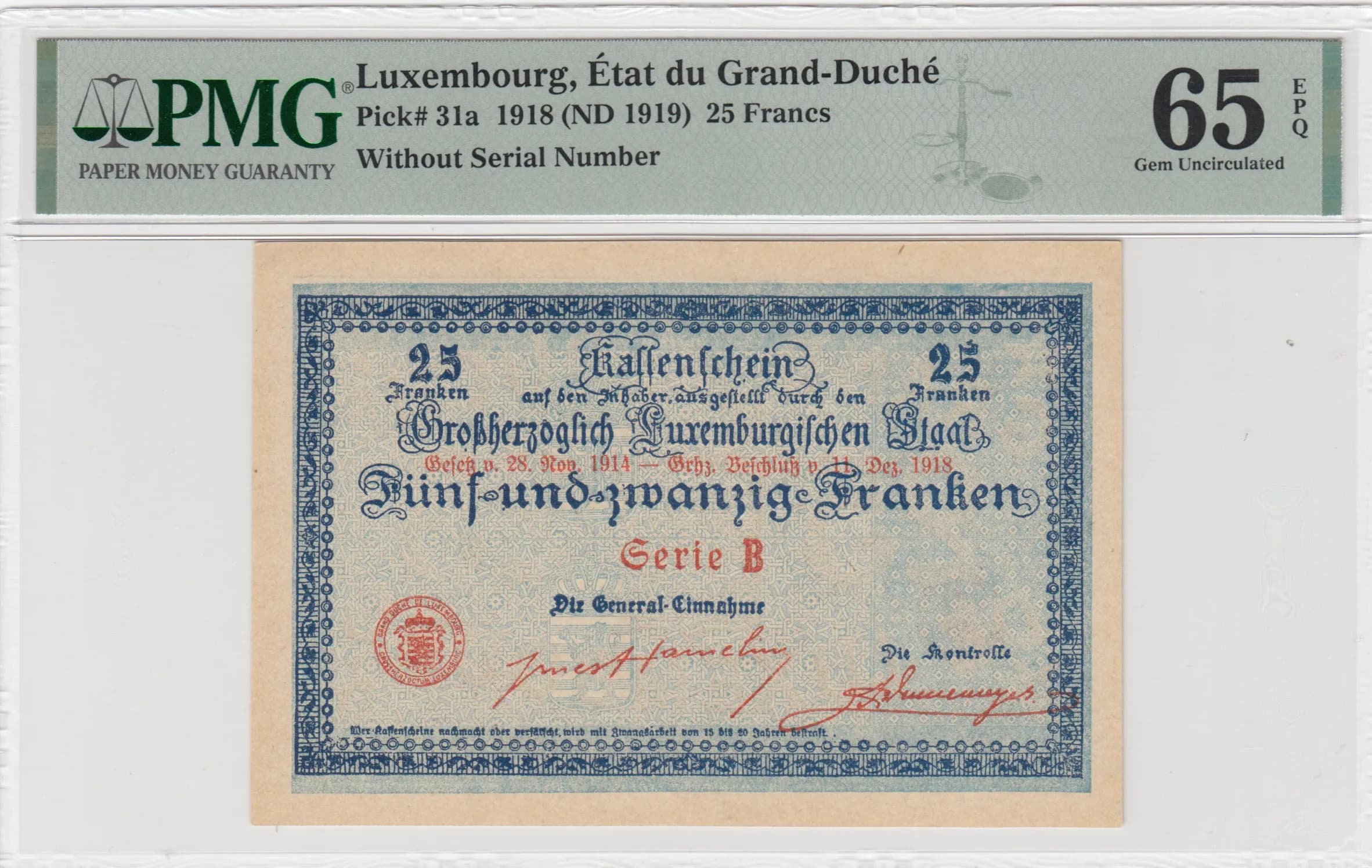
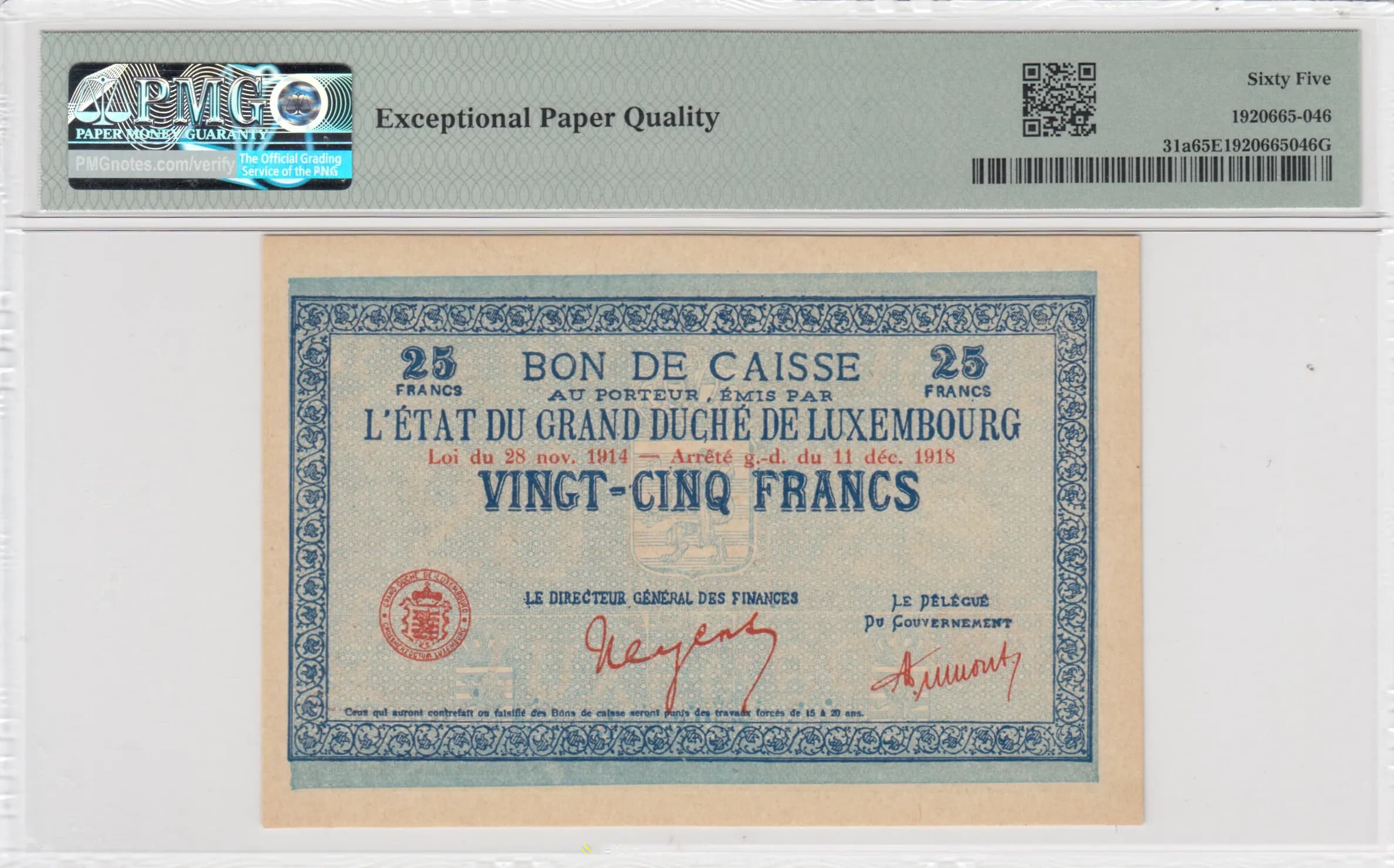
This is an exceptional PMG 65 Gem Uncirculated example of the Luxembourg 25 Francs 1919 emergency currency note, featuring pristine paper quality with vibrant blue-green and red coloration throughout. The note displays the characteristic bilingual design (German obverse/French reverse) with ornate decorative borders and official government seals, representing a critical wartime financial instrument issued during the post-WWI period. The gem grade and exceptional preservation make this a desirable specimen for collectors of early 20th century Luxembourg currency and emergency wartime issues.
Common. The eBay price tracking data provided shows wide circulation of comparable examples across multiple condition grades, with VF examples listed at $42.46, XF examples ranging from $139.98 to $2,895.00 (the latter likely an outlier or misgraded), and uncirculated examples at $199.00. The 2016 catalogue value of $40 for UNC examples further supports common status. While PMG 65 gems represent high-quality specimens, the denomination and issue are not scarce in the market. These emergency notes were produced in substantial quantities to meet wartime currency needs, and surviving examples remain relatively accessible to collectors despite their historical significance.
Issued under the Law of November 28, 1914 and Grand Ducal Decree of December 11, 1918, this note represents Luxembourg's emergency currency response during World War I and its immediate aftermath. The bilingual German and French inscriptions reflect Luxembourg's complex linguistic and diplomatic position between Germany and France during the occupation and post-war period. The formal designation as 'Bon de Caisse' (cash voucher) and 'Kassenschein' (cash certificate) indicates these were temporary treasury notes rather than regular banknotes, issued to maintain liquidity during the economic disruption of the war years.
This bilingual banknote features a formal classical design typical of early 20th century European emergency currency. The obverse is rendered in German with text emphasizing the legal authority (Law of 1914, Government Resolution of December 1918), while the reverse employs French. Both sides are dominated by an intricate blue-green decorative border featuring geometric and floral patterns in a classical frame design. Central to each side are red circular seals bearing the coat of arms of the Grand Duchy of Luxembourg—representing the official authority of the state. Two red signatures appear in the lower portion of each side, representing authorized government officials (the General Director of Finance and Government Delegate). The absence of a portrait is notable, reflecting the emergency nature of these treasury notes rather than regular currency. The denomination '25' appears prominently in Arabic numerals, with the full text 'Fünf-und-zwanzig Franken' (German) and 'VINGT-CINQ FRANCS' (French) spelled out. The overall design conveys solemnity and governmental authority appropriate to wartime financial instruments.
OBVERSE (German): '25 Franken' (25 Francs); 'Kassenschein' (Cash Certificate); 'auf den Mxaber, ausgestellt durch dem Großherzoglich Luxemburgischen Staat' (issued to bearer by the Grand Duchy of Luxembourg State); 'Gesetz n. 28. Nov. 1914 - Gehr. Beschluss v. Der. 1918' (Law of Nov. 28, 1914 - Government Resolution of Dec. 1918); 'Fünf-und-zwanzig Franken' (Twenty-five francs); 'Serie B' (Series B); 'Die General-Einnahme' (The General Revenue Office); 'Die Kontrolle' (The Audit/Control). REVERSE (French): '25 FRANCS'; 'BON DE CAISSE' (Cash Voucher); 'AU PORTEUR, ÉMIS PAR L'ÉTAT DU GRAND DUCHÉ DE LUXEMBOURG' (To Bearer, Issued by the State of the Grand Duchy of Luxembourg); 'Loi du 28 nov. 1914 — Arrêté g.-d. du 11 déc. 1918' (Law of Nov. 28, 1914 — Grand Ducal Decree of Dec. 11, 1918); 'VINGT-CINQ FRANCS' (Twenty-five francs); 'LE DIRECTEUR GÉNÉRAL DES FINANCES' (The General Director of Finance); 'Le DÉLÉGUÉ Du Gouvernement' (The Government Delegate).
This note was produced using intaglio/engraved printing methods, evidenced by the crisp, fine-line reproduction of the ornamental border patterns, the sharp detail in the coat of arms seals, and the precise rendering of the Gothic and formal scripts visible in the inscriptions. The layered color application (blue-green primary color with red accent printing for seals and signatures) indicates multi-plate printing typical of security-conscious government currency production. The printer for this series is not definitively identified in the catalog data, though Luxembourg's emergency notes of this period were typically produced by established European security printers, possibly including Banque Générale du Luxembourg or contracted international security printing firms.
This example is catalogued as Pick P-31a, one of two known variants for the 25 Francs denomination from this issue (P-31a and P-31b variants exist). The visual analysis notes this particular specimen is 'Without serial number (unfinished)' according to RealBanknotes.com reference data, which may indicate a specific printing stage or variety. The 'Serie B' designation visible on the obverse may represent printing sequence variants. No additional overprints, security features beyond the standard coat of arms seals, or unusual signatures are noted that would distinguish this as a particularly scarce variety within P-31a classification.