100 francs 1993
Market Prices
54 salesAbout This Note
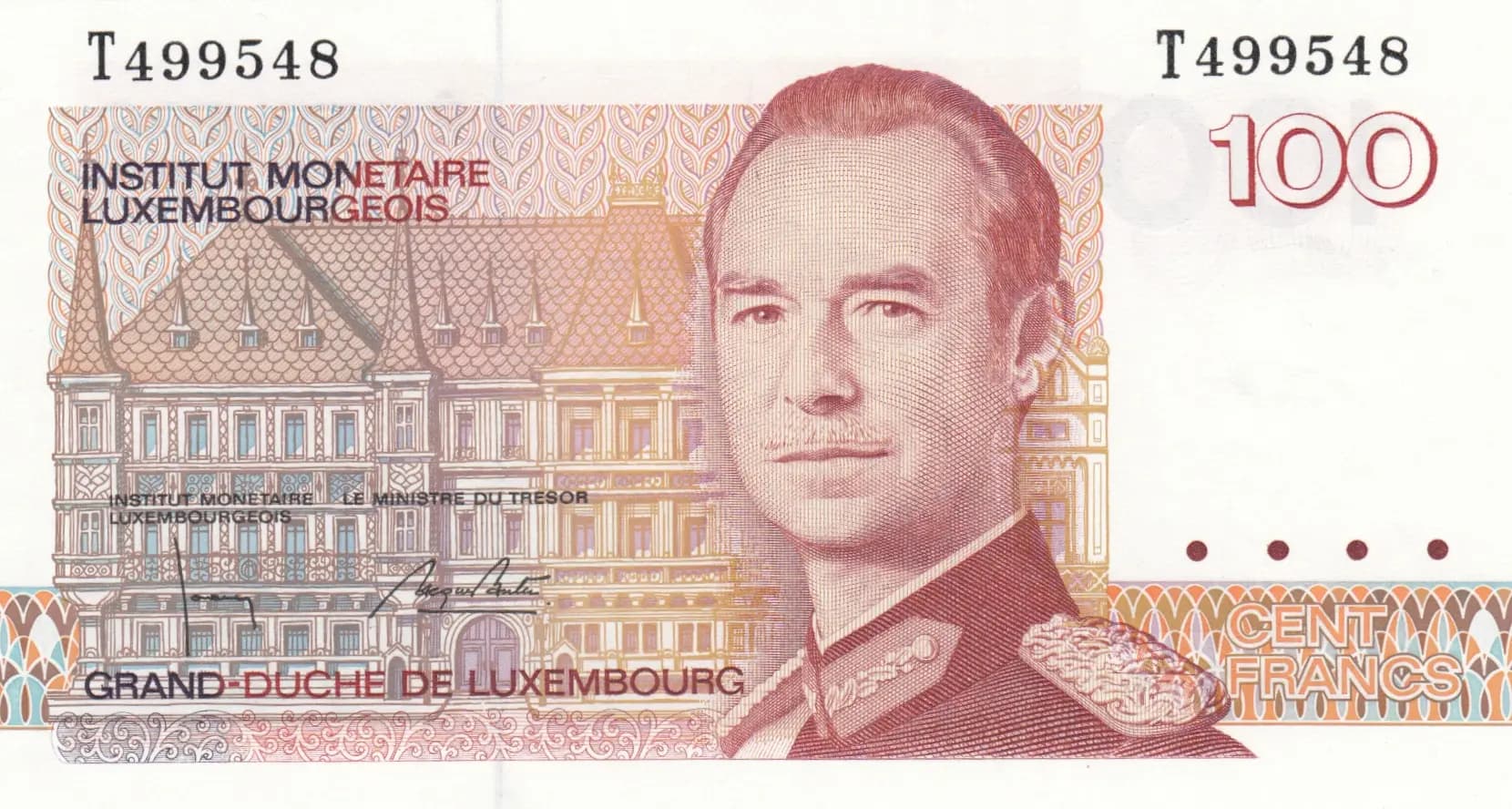
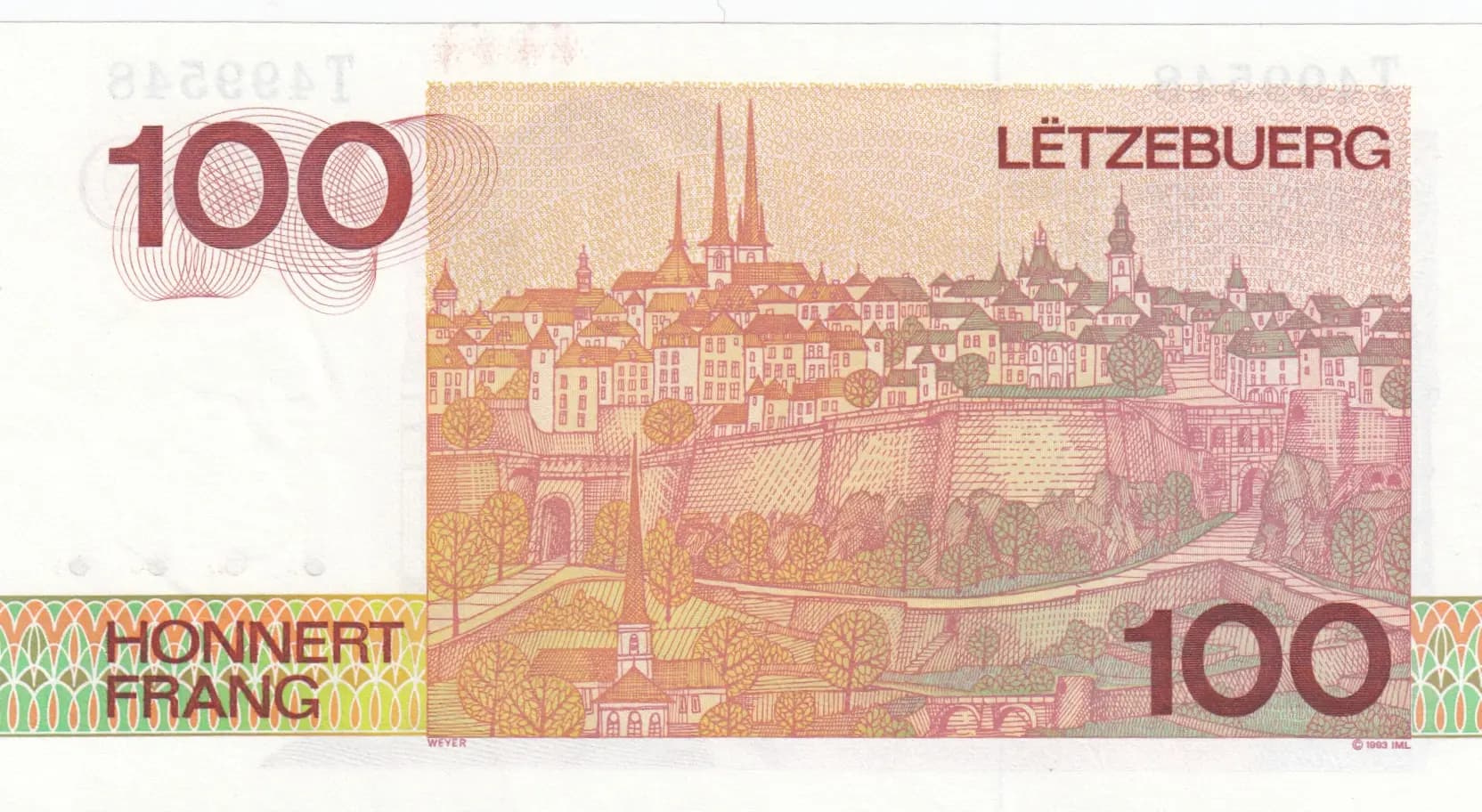
This is an uncirculated example of the Luxembourg 100 Francs P-58b (1993 issue), featuring Grand Duke Jean in formal military dress on the obverse and a panoramic view of Luxembourg City on the reverse. The note displays pristine condition with crisp intaglio printing, vibrant rose, gold, and tan coloration, and no visible wear or damage. The 1993 copyright notation on the reverse and dual-language inscriptions (French and Luxembourgish) reflect Luxembourg's cultural identity during the pre-Euro period.
Common. eBay market data shows consistent sales of UNC examples in the $7–$12 range from 2011–2022, with occasional higher prices ($26–$36) for PMG-graded examples. The note's regular circulation status, lack of special printing characteristics, and the availability of multiple sales transactions across more than a decade of market data indicate this is a widely available issue with no scarcity premium.
Issued in 1993 by the Institut Monétaire Luxembourgeois under the Grand-Duché de Luxembourg authority, this banknote represents the final decade of the Luxembourg franc before the country's transition to the Euro in 2002. The obverse portrait honors Grand Duke Jean, who reigned from 1964 to 2000, while the reverse depicts Luxembourg City's iconic skyline with church spires and fortified ramparts, symbolizing the nation's historical and cultural identity. The bilingual French-Luxembourgish inscriptions reflect the country's linguistic heritage during this transitional period.
The obverse features a formal portrait of Grand Duke Jean positioned at center-right, depicted in military dress uniform with ornate shoulder insignia and decorative braiding, reflecting his role as head of state. Behind the portrait stands an architectural building with a distinctive mansard roof and dormer windows, likely representing a significant Luxembourg landmark or palace. The background employs ornamental geometric and floral pattern designs with circular dot arrangements typical of high-security banknote design. The reverse presents a detailed landscape engraving of Luxembourg City (Lëtzebuerg) showing the characteristic skyline with multiple church spires, traditional European architecture, fortified walls or ramparts, cultivated fields, and vegetation in the foreground, conveying the nation's historical significance and natural landscape. A decorative geometric pattern border frames the lower portion of the reverse.
FRONT: 'INSTITUT MONÉTAIRE LUXEMBOURGEOIS' (Luxembourgish Monetary Institute); 'MINISTRE DU TRÉSOR' (Minister of Treasury); 'GRAND-DUCHÉ DE LUXEMBOURG' (Grand Duchy of Luxembourg); '100' and 'CENT FRANCS' (One Hundred Francs in French). Serial number 'T499548'. BACK: '100' (denomination numeral); 'LËTZEBUERG' (Luxembourg in Luxembourgish); 'HONNERT FRANG' (One Hundred Francs in Luxembourgish); 'WEYER' (artist/engraver signature); '© 1993 IML' (Copyright 1993 Institut Monétaire Luxembourgeois).
Intaglio printing (line engraving and steel plate printing), evidenced by the sharp definition of the portrait, architectural details, and landscape elements. Security features include fine line patterns, microprinting visible in ornamental sections and decorative borders, and multi-color offset printing creating the complex color composition of rose, mauve, gold, tan, yellow, green, and white. The watermark area is visible as a lighter section in the background. This is consistent with professional central bank banknote production standards of the 1990s.
This is identified as P-58b per the Pick catalog, indicating it represents the second signature variety (Sign. #2) of the 1993 issue. The Pick catalog records four variants for this base number: P-58a (Sign. #1), P-58b (Sign. #2), P-58cts (Watermark: Grand Duke Jean), and P-58s. The visual analysis confirms the copyright date of 1993 on the reverse, consistent with the 1993 issue variant designation. The serial number prefix 'T' is visible but does not appear to be a noted distinguishing feature among cataloged varieties.