5 pounds 1963
Market Prices
9 salesAbout This Note
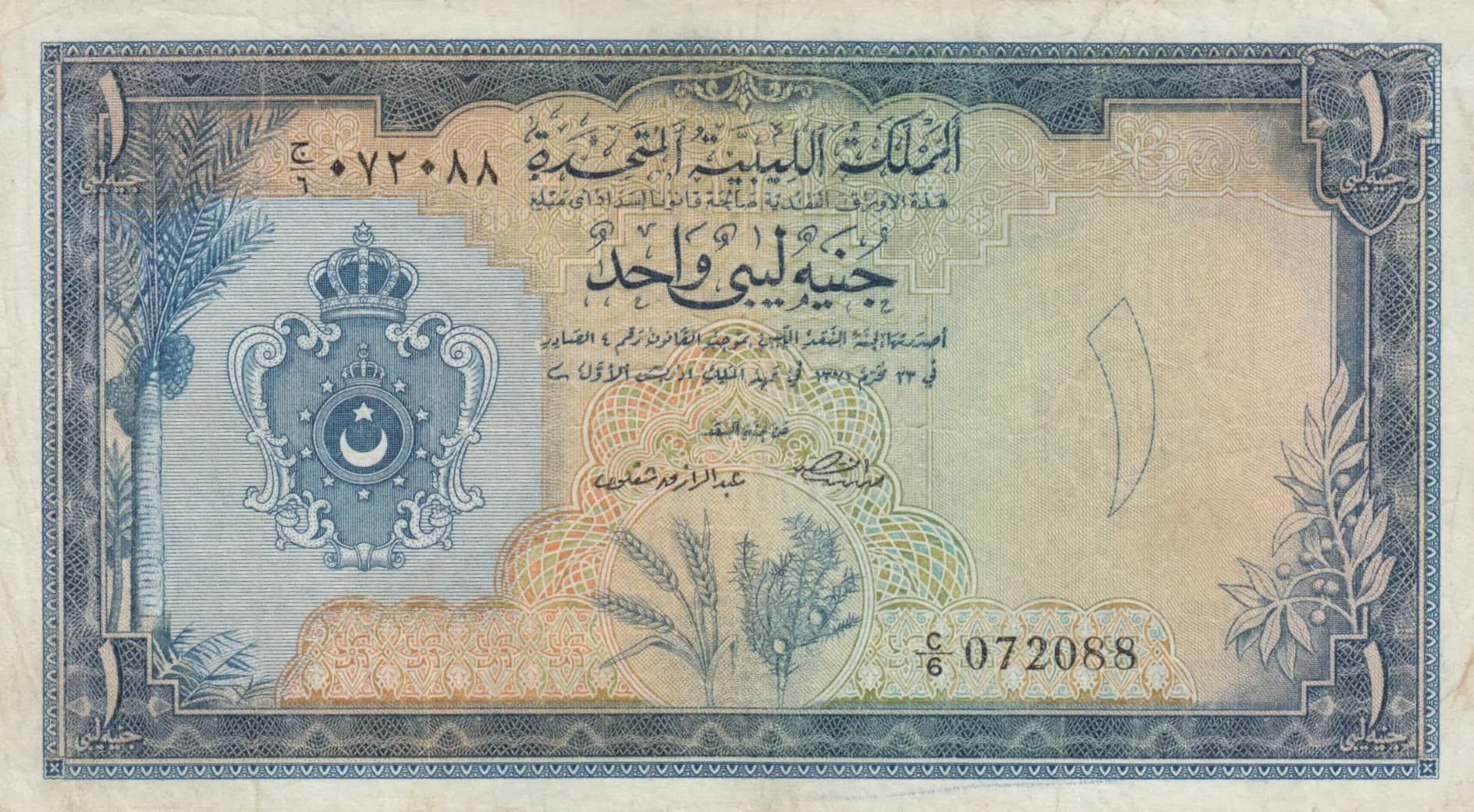
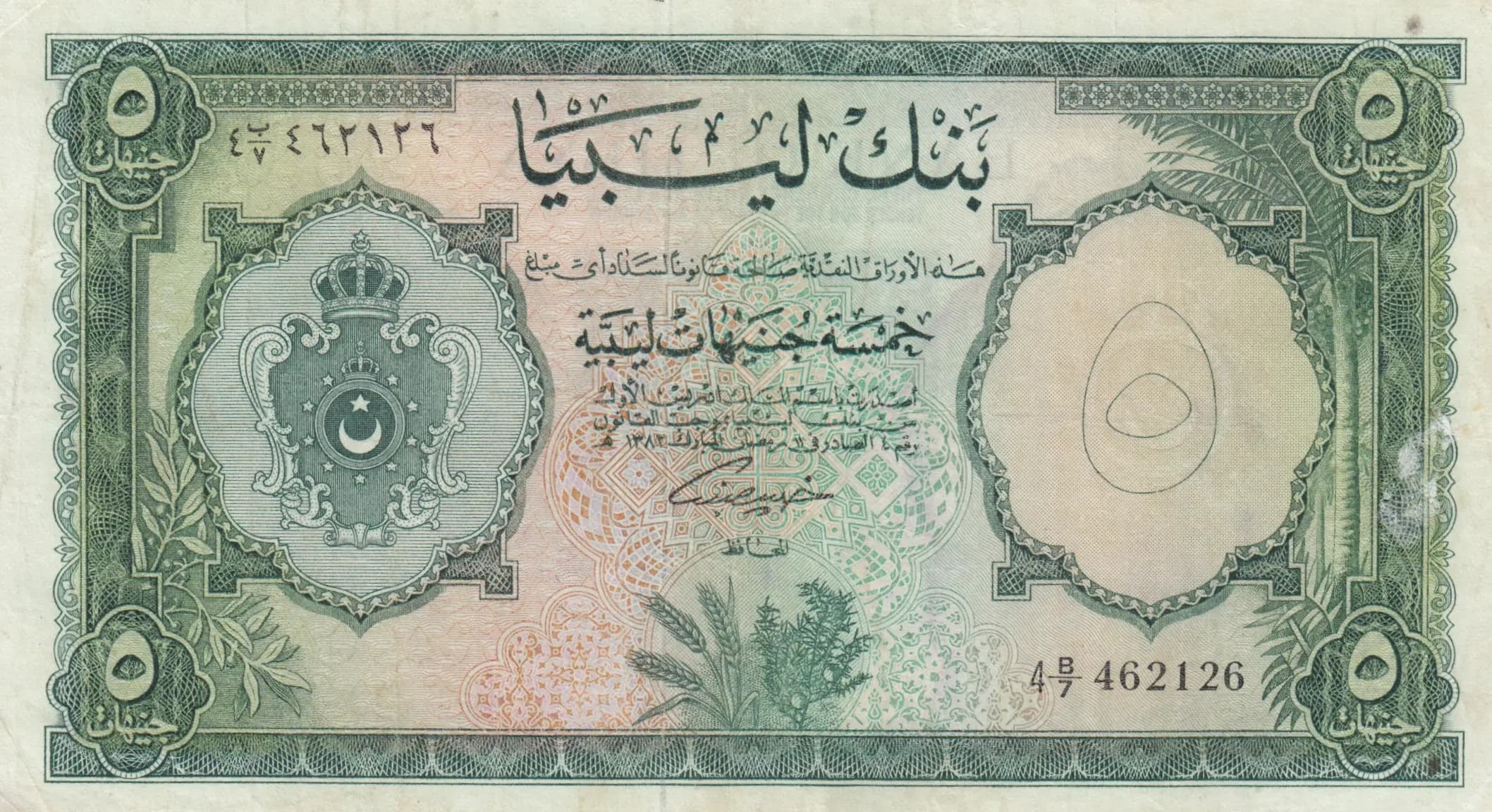
This is a VF-graded 5 Libyan Pounds note from 1963, the inaugural issue of the Bank of Libya under King Idris I. The note features an elegant design with ornate green decorative borders, cream center field, and the Libyan national coat of arms (crescent moon and star within a crowned shield) prominently displayed on the obverse. Despite visible evidence of circulation including horizontal creasing and minor foxing, the note remains well-preserved with sharp detail in the fine geometric and floral ornamental patterns throughout, making it an attractive example of Libya's early post-independence currency.
Common. The eBay market data shows consistent sales ranging from $24.50 to $150.50 over an extended period (2013-2021), with most ungraded VF examples selling in the $25-40 range. The catalog value of $250 for VF specimens appears somewhat optimistic relative to actual realized prices, but the consistent availability and moderate pricing indicates this was a substantial print run. The PMG population report shows minimal graded population, typical of notes from this era which were not systematically submitted for grading until recent decades, rather than indicating genuine scarcity. This note is a standard part of Libya's early currency series and presents no evidence of being a short print or recalled issue.
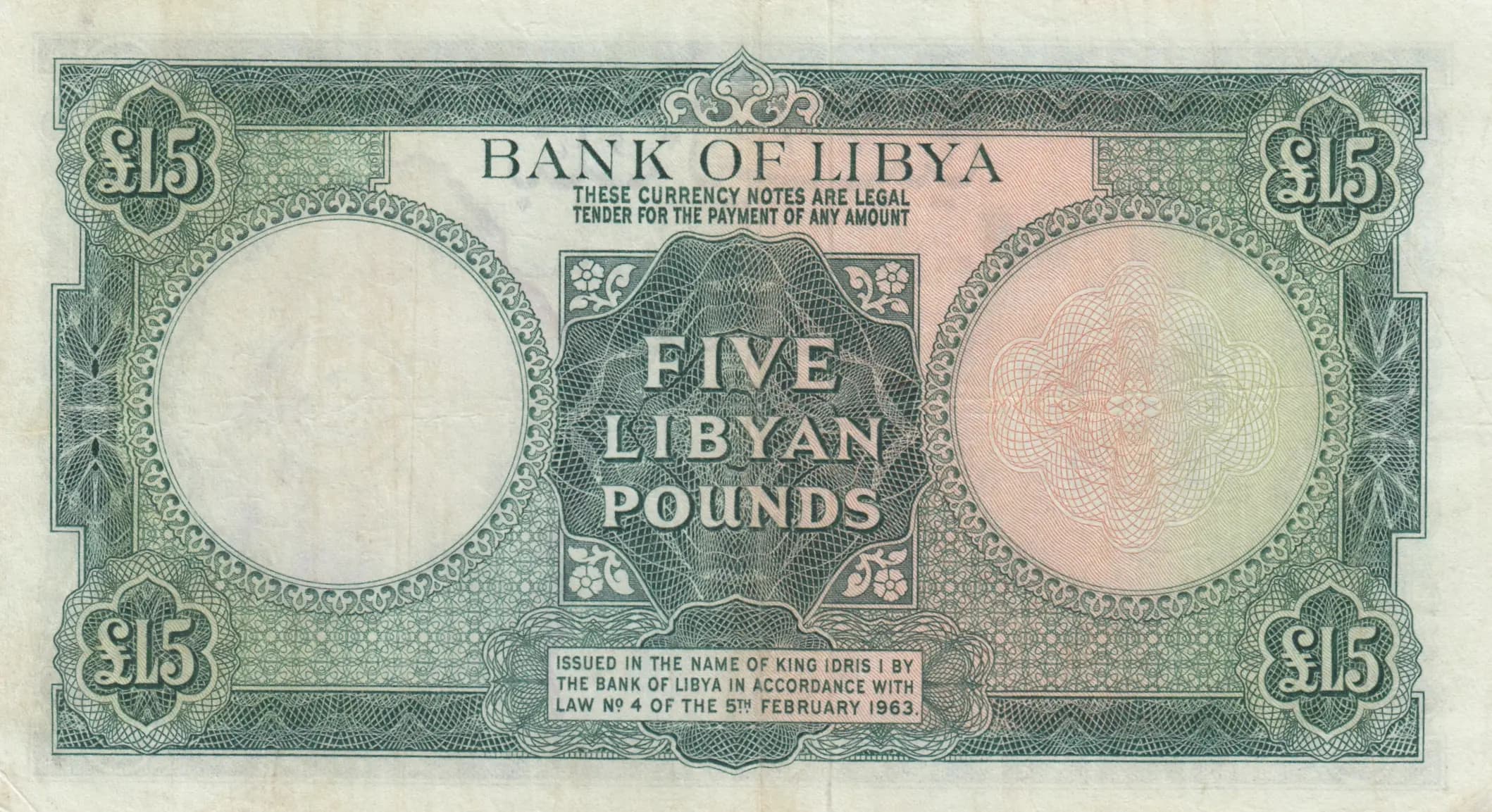
This note was issued on February 5, 1963, during the reign of King Idris I, shortly after Libya's independence from Italian and British administration. The obverse prominently features the national coat of arms with crescent moon and star—symbols central to Libyan and Islamic identity—while the reverse explicitly states it was 'ISSUED IN THE NAME OF KING IDRIS I BY THE BANK OF LIBYA IN ACCORDANCE WITH LAW No 4 OF THE 5TH FEBRUARY 1963,' establishing the legal foundation for Libya's modern currency. This early issue represents a significant numismatic artifact from Libya's monarchical period before the 1969 revolution.
The 5 Libyan Pounds note features a symmetrical, formal design typical of mid-20th century Commonwealth and former colonial currency practices. The obverse displays the Libyan national coat of arms—consisting of a crescent moon and five-pointed star within an ornate crown-topped shield—positioned on the left side, symbolizing Libya's Islamic heritage and sovereignty. The note employs a two-tone color scheme of green and cream with black text and borders. Both sides feature elaborate corner rosettes bearing numerals (50 on obverse, 15 on reverse, likely referring to security numbering systems). The design includes intentional empty oval spaces on both sides—one on the right obverse and two flanking the center reverse—which serve as watermark areas and security features. The borders throughout consist of intricate geometric and floral patterns, including palm frond motifs reflective of Mediterranean and North African design traditions. Arabic text appears on the obverse while English text dominates the reverse, reflecting Libya's official bilingual currency practices of the period.
OBVERSE: Arabic text 'بنك ليبيا' (Bank of Libya); Serial number visible as '4 ع 462126' (4 X 462126); Ornamental Arabic text in center panel (decorative, not bearing specific legal text). REVERSE: 'BANK OF LIBYA' (English); 'FIVE LIBYAN POUNDS' (English); 'THESE CURRENCY NOTES ARE LEGAL TENDER FOR THE PAYMENT OF ANY AMOUNT' (English legal tender declaration); 'ISSUED IN THE NAME OF KING IDRIS I BY THE BANK OF LIBYA IN ACCORDANCE WITH LAW No 4 OF THE 5TH FEBRUARY 1963.' (English legal and historical authorization text).
This note was produced using intaglio printing (also called line engraving), as evidenced by the fine, consistent line work visible in the detailed border patterns, the intricate geometric designs, and the precise rendering of the coat of arms. The technique of intaglio printing, combined with the high-quality paper stock and fine microprint-style detail throughout the design, was standard security practice for central bank currency of this era. The specific printer for the 1963 Bank of Libya series is not definitively identified in standard references, though De La Rue and Bradbury Wilkinson were primary suppliers to African central banks during this period.
The observed serial number is '4 ع 462126,' indicating an Arabic prefix designation system. While minor variations in serial number prefixes and occasional signature varieties exist for the 1963 Libyan issue, no major documented varieties are recorded for Pick-26. The note exhibits the standard obverse design with crowned arms at left and reverse with dual oval spaces. No overprints, color variants, or error notes are noted in this specimen. The condition grade VF with visible circulation marks is consistent with notes from the 1960s that saw actual use in commerce before becoming collectible.