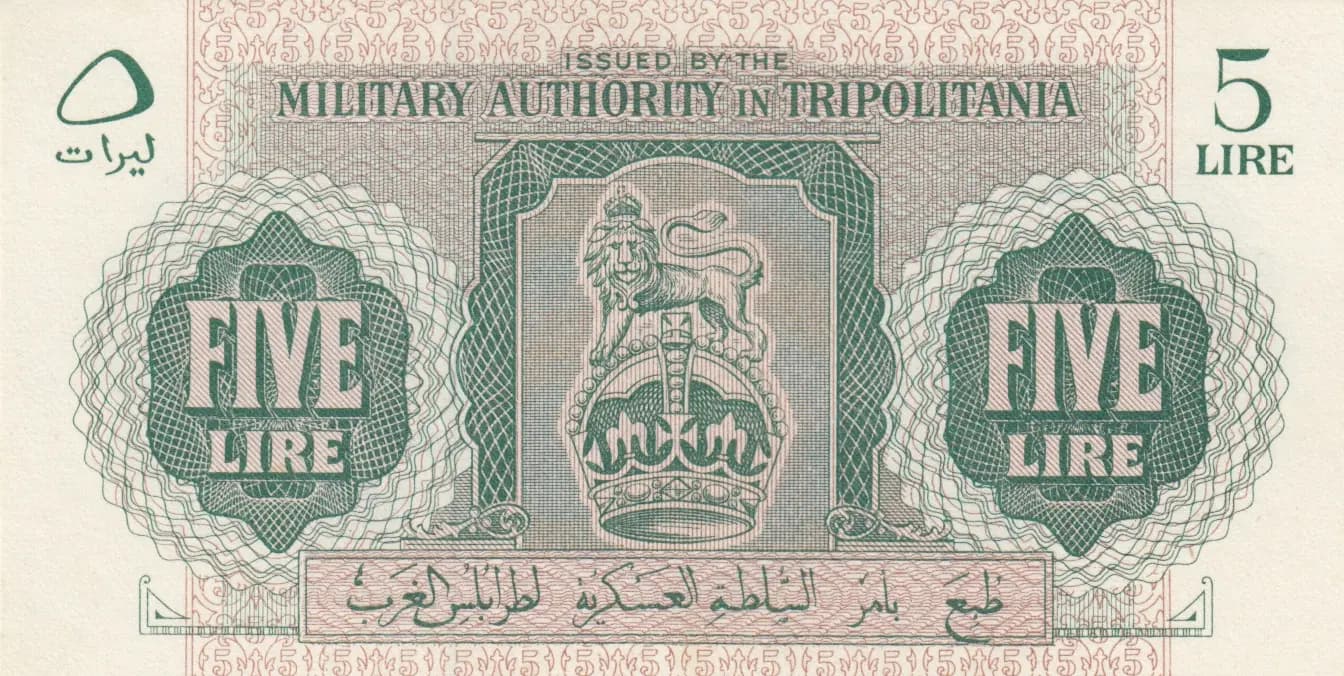
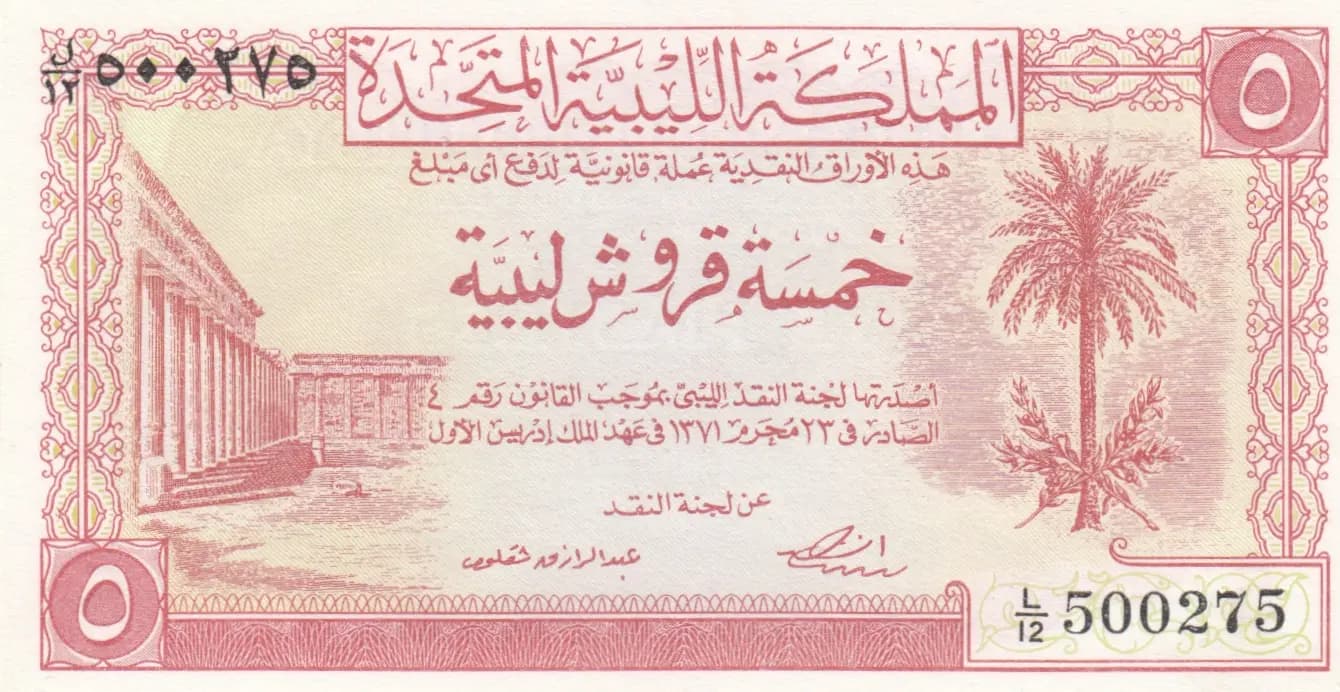
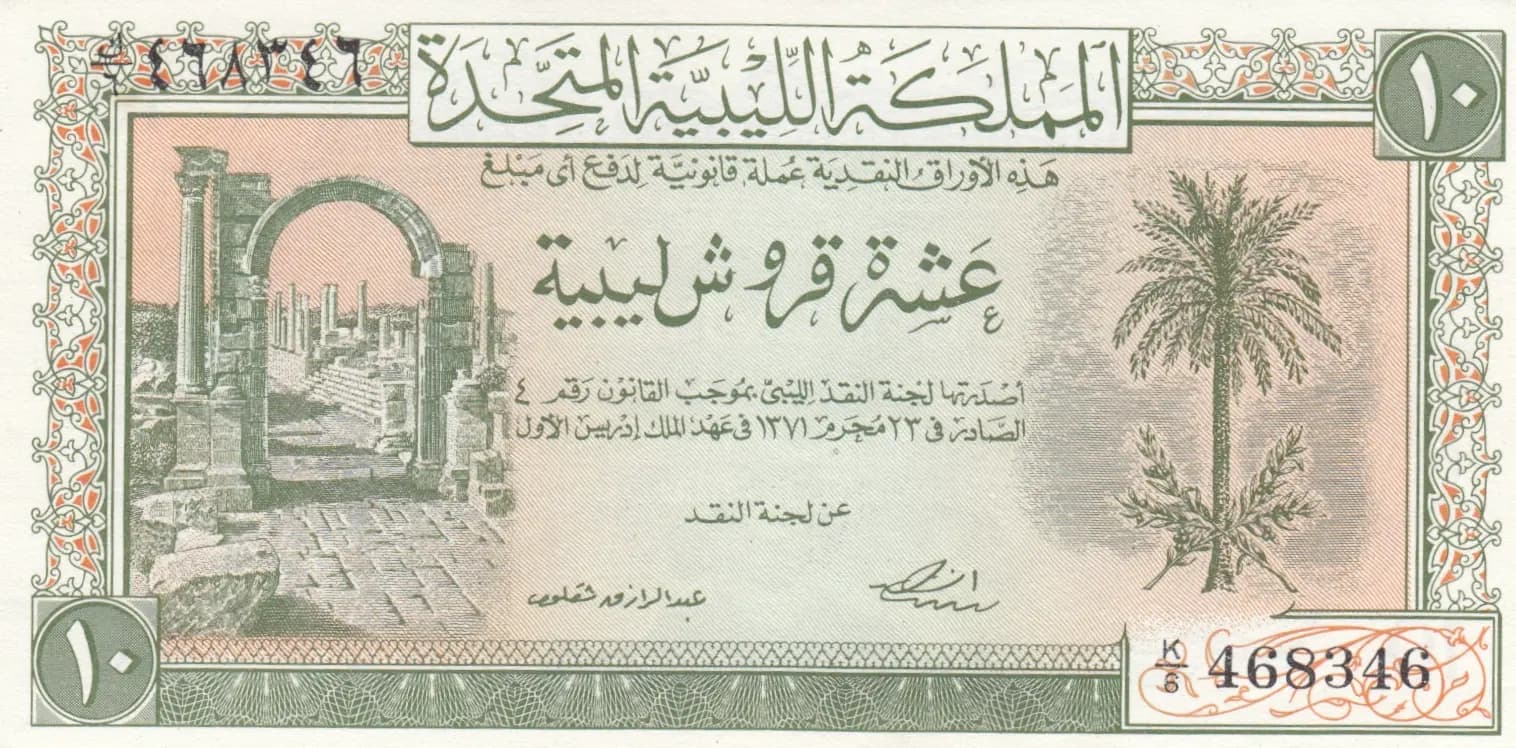
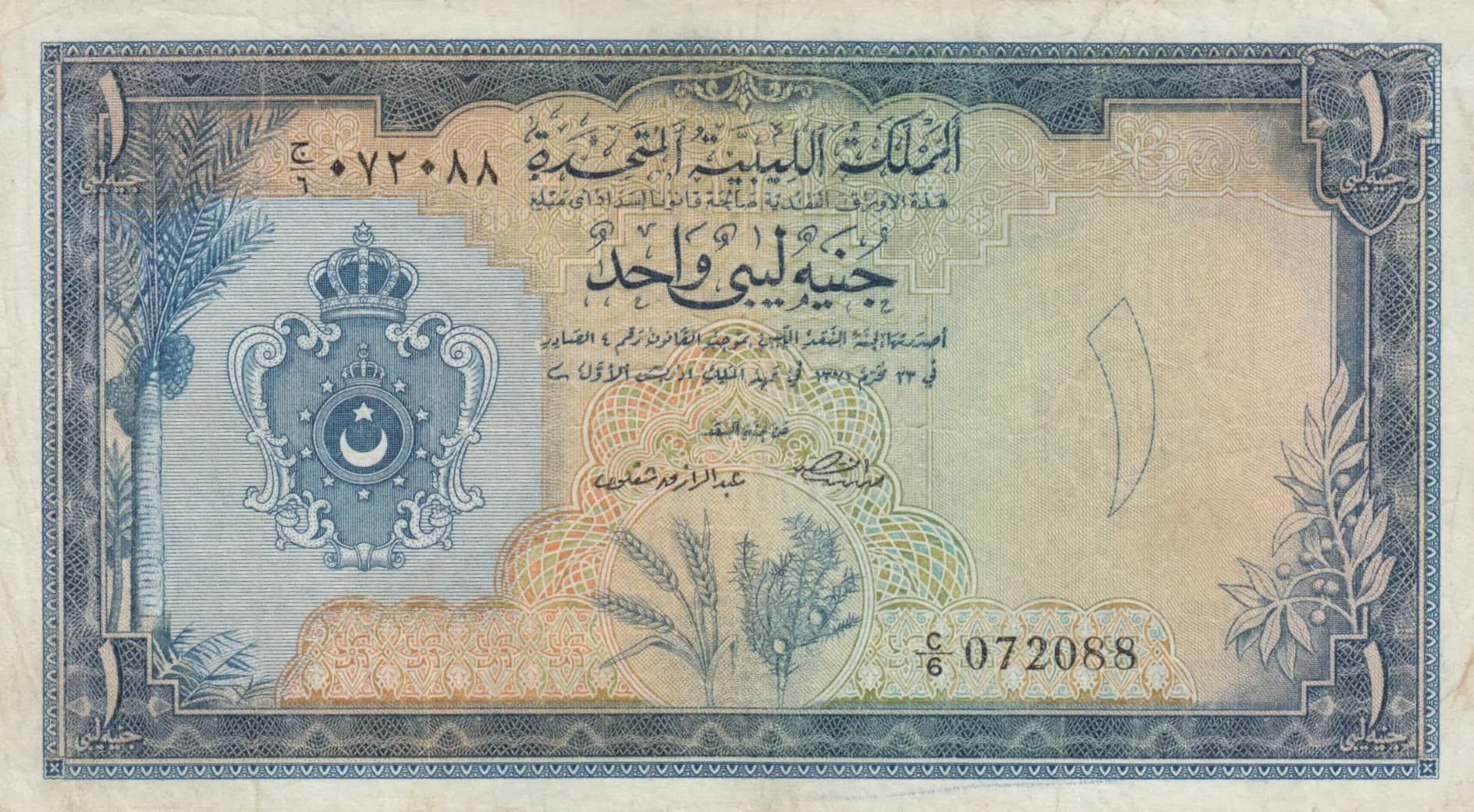
5 piastres 1952
Market Prices
10 salesAbout This Note
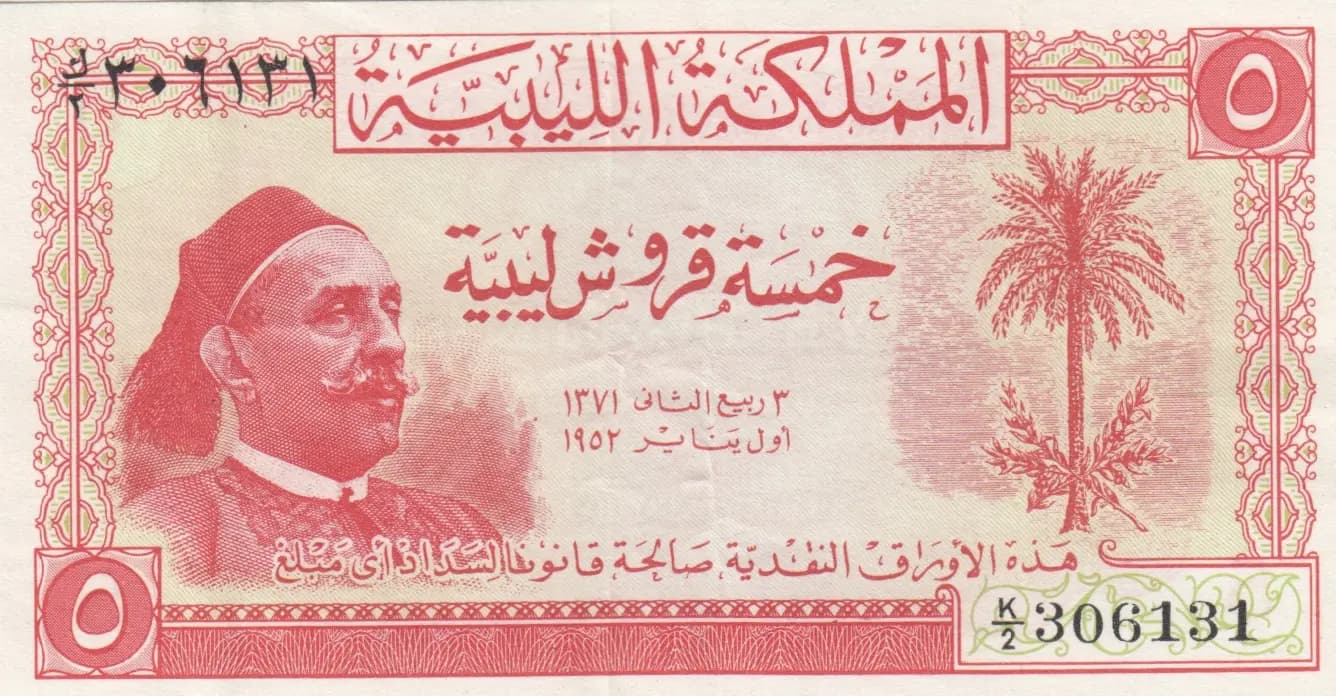
This Kingdom of Libya 5 Piastres from January 1952 presents a historically significant early-independence issue featuring a striking red intaglio portrait of King Muhammad Idris I in traditional Sanussi headwear. The note displays excellent preservation in VF condition with minimal aging, clear intaglio detailing on both obverse and reverse, and bilingual Arabic-English inscriptions reflecting Libya's post-colonial transition period.
Common. This note regularly appears on the collector market with consistent eBay sales activity spanning from 2014 to 2025. Recent comparable sales in VF condition sold for approximately $21 (May 2021), with Fine condition notes selling in the $10–$17 range. The 2016 catalogue value for VF is listed at $40, and current market prices align with this assessment. The note was issued as part of Libya's regular currency series with substantial print runs typical of post-independence national issues.
Issued on January 1, 1952, just weeks after Libya's independence from Italian colonial rule and British/French trusteeship, this banknote represents the newly established Kingdom of Libya under King Idris I. The prominent portrait of the Sanussi leader and the symbolic date palm tree reflect Libya's cultural identity and the Sanussi Movement's central role in the nation's independence struggle. The dual-language inscription (Arabic and English) documents the transitional governance period and British influence remaining in the region.
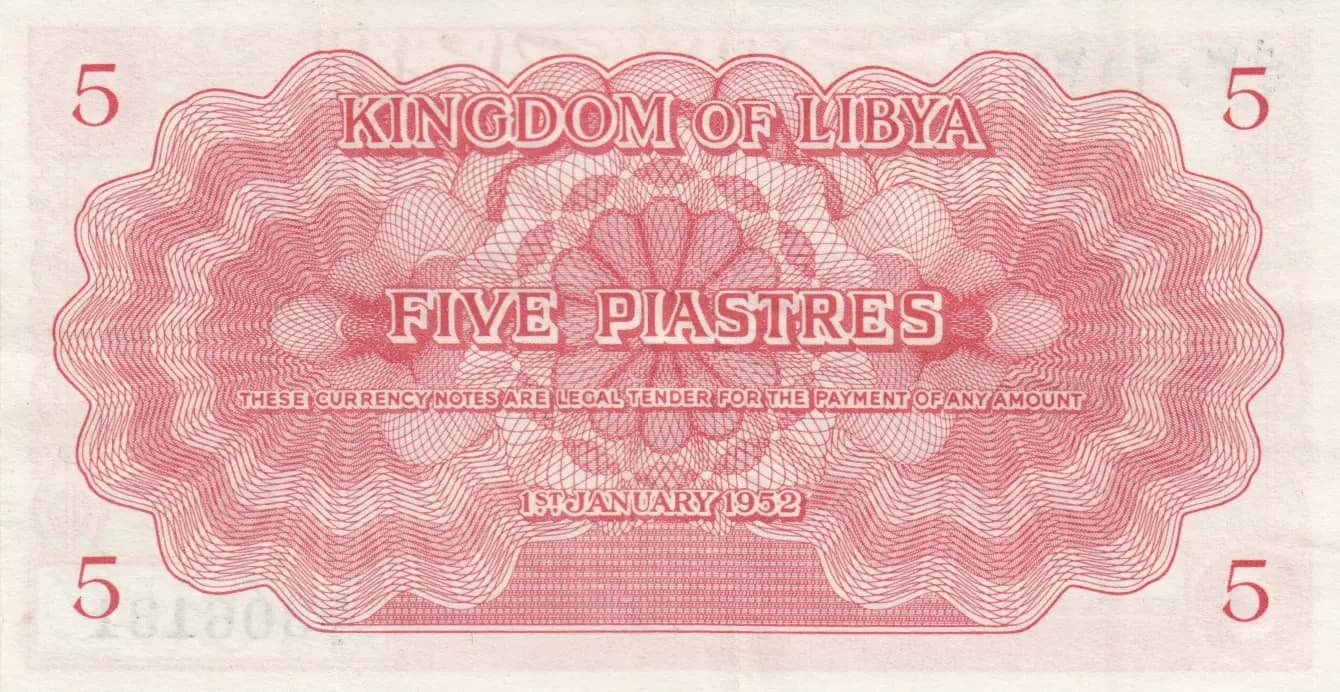
The obverse features a left-facing profile portrait of King Muhammad Idris I as Sanussi, rendered in red intaglio printing with meticulous detail showing his characteristic long beard and traditional Sanussi fez headdress. A date palm tree appears on the right side, symbolizing Libya's geography and prosperity. The reverse displays primarily decorative guilloche patterning and a central ornamental rosette medallion in fine linework, with denomination numerals '5' positioned in all four corners. The note employs a cream-colored paper with red/pink intaglio work throughout, framed by ornamental geometric borders featuring decorative corner flourishes.
Front: 'المملكة الليبية' (Kingdom of Libya) in Arabic; denomination markings in Arabic; '3 ربيع الثاني 1371' (3rd Rabi' al-Thani 1371 Islamic calendar); 'اولبنات 1952' (January 1952); Serial number 'K 306131'. Back: 'KINGDOM OF LIBYA' in English; 'FIVE PIASTRES' in English; 'THESE CURRENCY NOTES ARE LEGAL TENDER FOR THE PAYMENT OF ANY AMOUNT' (legal tender declaration); '[JANUARY 1952]' in English.
Intaglio printing (recess printing) is evident throughout both sides, with fine line work, geometric crosshatch patterns, and detailed portrait engraving characteristic of high-security currency production. The guilloche patterns on the reverse and the intricate border work demonstrate professional security printer capabilities. The printer for Libya's early-independence currency issues was Giesecke+Devrient (a standard supplier for Commonwealth-era banknotes), though specific attribution should be verified against archival records.
Specific variety identified by serial number prefix 'K' and issue date January 1952. The visual analysis indicates a single variant catalogued under Pick P-12. No overprints or obvious security measures beyond standard intaglio printing are evident. Serial number 'K 306131' suggests this note is from the first printing series of the 1952 issue. PMG population data indicates limited numbers have been professionally graded, but this does not indicate scarcity—rather, most examples circulate ungraded.