10 pounds 1963
Market Prices
12 salesAbout This Note
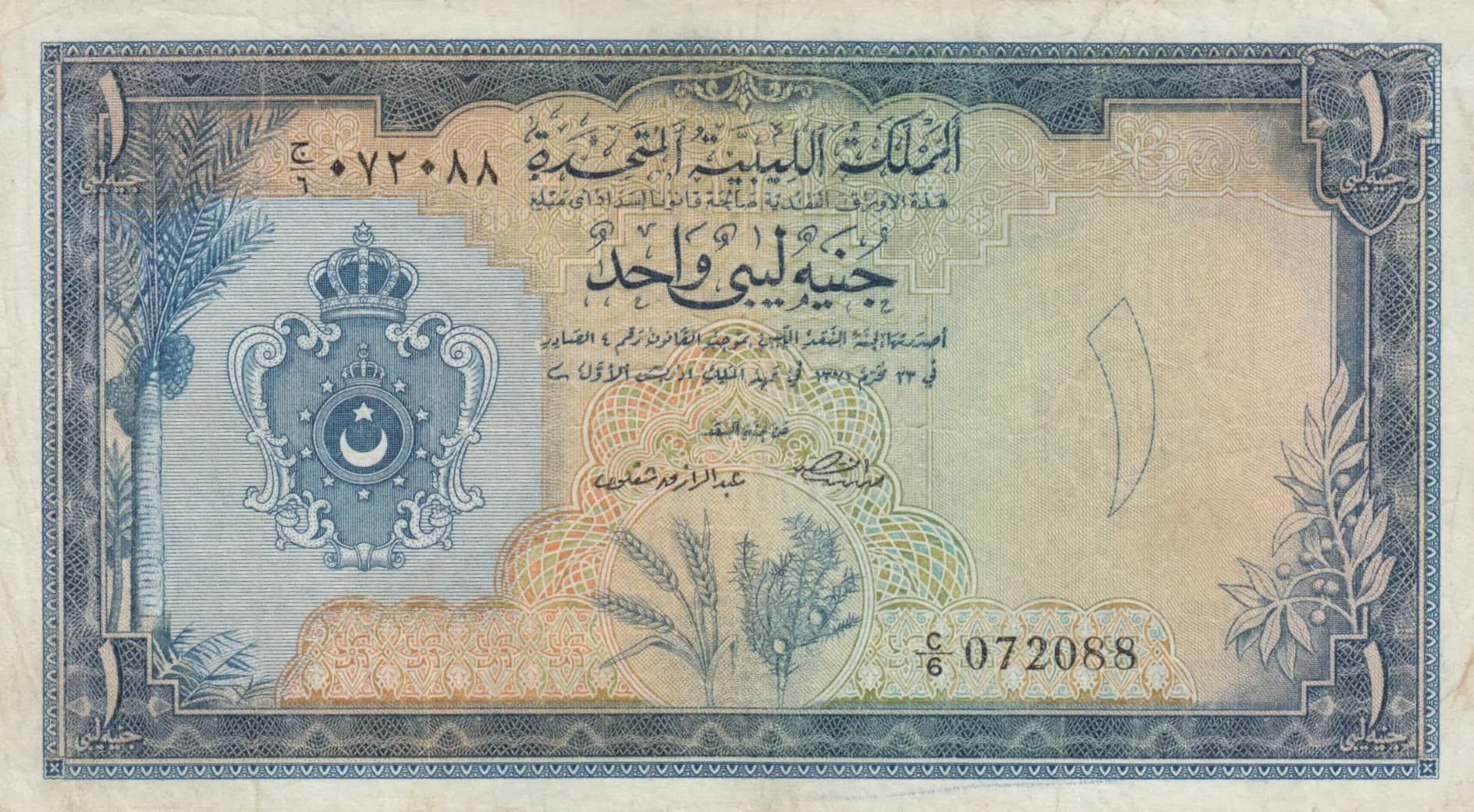
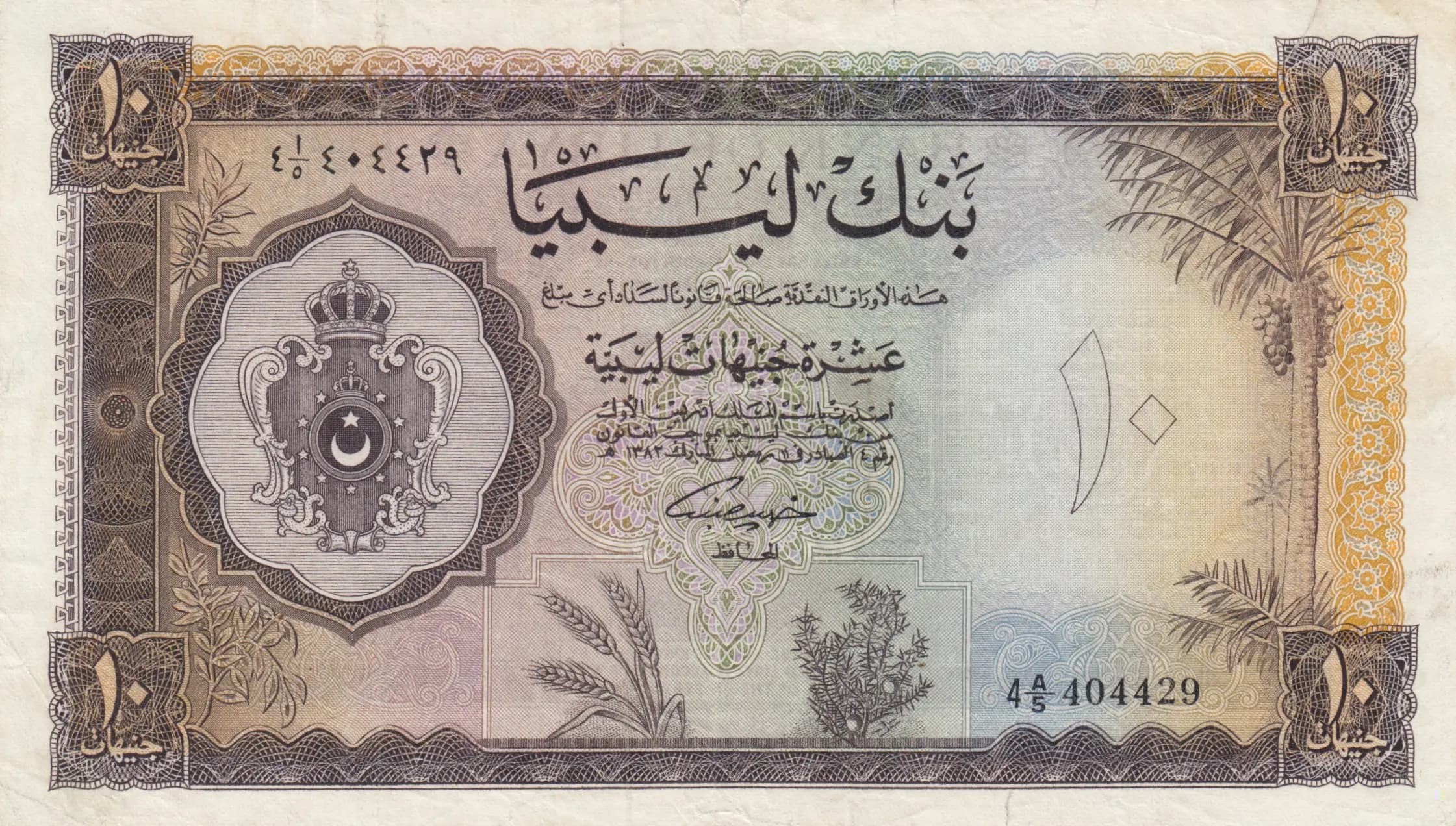
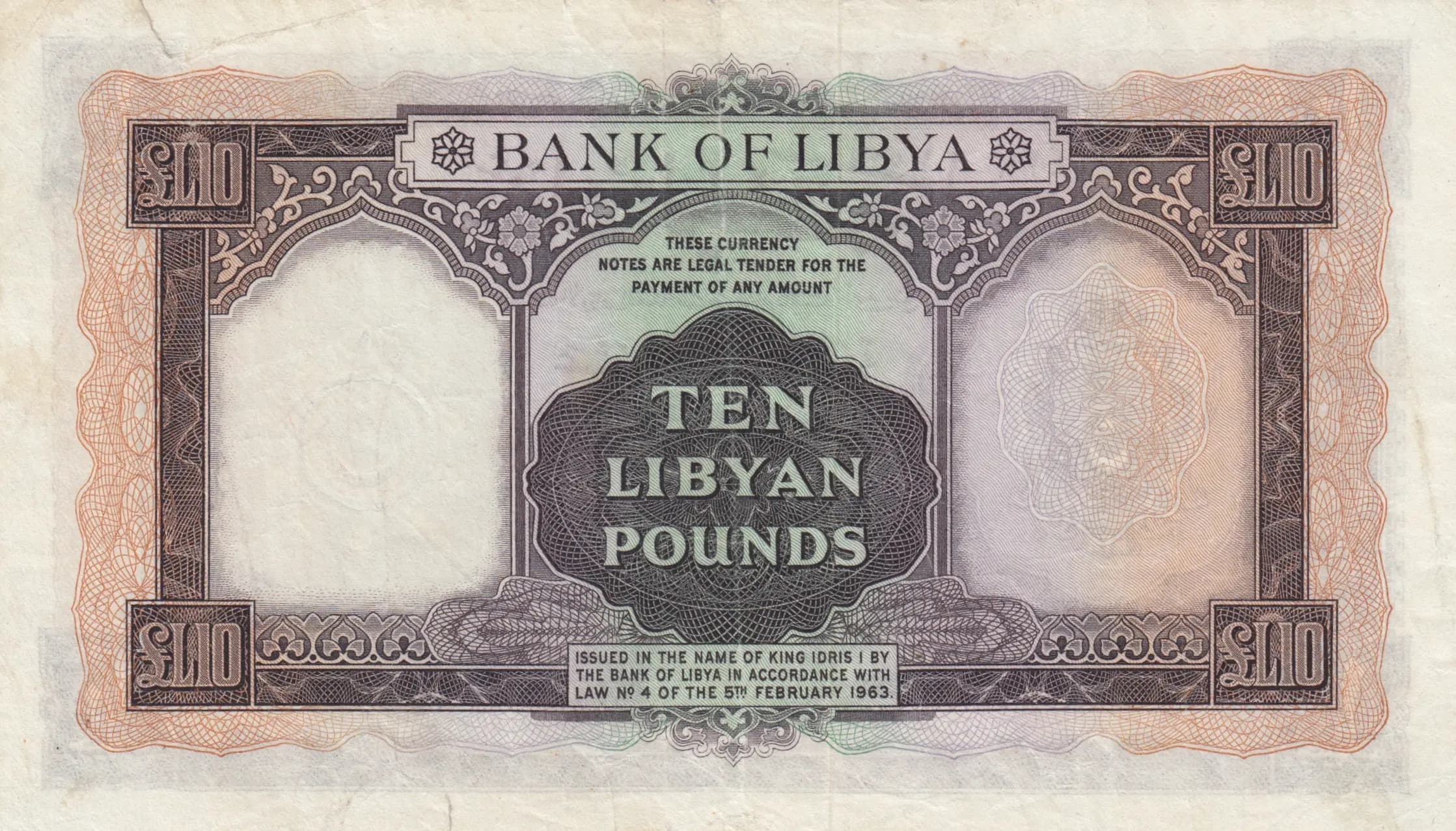
This is a VF-graded 10 Libyan Pounds note from 1963, issued by the Bank of Libya under King Idris I. The note features exceptional ornate Islamic geometric patterns and decorative engraving work on both sides, with the obverse dominated by a crowned coat of arms with crescent moon symbol flanked by wheat and palm fronds in brown and green tones. Despite visible creasing, foxing, and age-related discoloration consistent with circulation, the intricate security printing and fine line work remain clearly visible, making this an attractive example of Libya's first independent currency issue.
Common. The 1963 10 Libyan Pounds (P-27) is a regular issue with substantial print runs typical of early independent-nation currency. eBay market data shows consistent availability with VF examples selling in the $36–$50 range in recent years (2021–2025), indicating active collector interest but routine market supply. The 2019 catalog value of $350 for VF represents a significant premium over realized prices, suggesting the catalog value may be inflated relative to actual market demand. The note's commonality is further supported by PMG population reports showing multiple examples graded, and the regular issue designation confirms it was not a limited or commemorative release.
This note was issued on February 5, 1963, shortly after Libya's independence in 1951, representing the country's early monetary sovereignty under King Idris I. The design emphasizes Libyan national symbols—the crowned arms with crescent moon at the center, wheat and palm fronds representing the nation's agricultural heritage, and bilingual Arabic/English inscriptions reflecting Libya's position between Arab and Western spheres during the early Cold War era. This particular issue predates the 1969 revolution that would overthrow the monarchy and establish the Libyan Arab Republic, making it a historically significant artifact of the kingdom period.
The obverse features the Royal Coat of Arms of Libya at left center, enclosed in an elaborate scalloped frame and topped with a crown—the central heraldic element being a crescent moon symbol representing Islamic heritage and Libyan national identity. To the right of the arms are botanical symbols: wheat stalks and palm fronds arranged within a diamond-shaped outline, symbolizing Libya's agricultural resources and natural wealth. The reverse presents a more formal, English-language design with the Bank of Libya's institutional seal at top, multiple ornamental frames with scalloped cartouches, and legal and issuing authority text at the base. Both sides employ intricate filigree borders and geometric patterns characteristic of Islamic art traditions adapted for security currency design. The color palette transitions from brown, tan, and green on the obverse to salmon pink, coral, and brown on the reverse.
FRONT SIDE: Arabic inscriptions include 'بنك ليبيا' (Bank of Libya) and 'عشرة جنيهات ليبية' (Ten Libyan Pounds), with the date '١٩٦٣' (1963) in Arabic numerals. Serial number 'AA404429' appears in English. BACK SIDE: English text reads 'BANK OF LIBYA' at top, 'TEN LIBYAN POUNDS' in the central scalloped cartouche, and the legal tender declaration 'THESE CURRENCY NOTES ARE LEGAL TENDER FOR THE PAYMENT OF ANY AMOUNT.' The issuing authority statement reads: 'ISSUED IN THE NAME OF KING IDRIS I BY THE BANK OF LIBYA IN ACCORDANCE WITH LAW No 4 OF THE 5TH FEBRUARY 1963.' Denomination numeral '10' appears prominently.
Intaglio engraving, evidenced by the fine line work, intricate filigree patterns, decorative borders, and the dimensional quality visible in the security printing throughout both sides. The precision of the geometric patterns, the depth of the engraved coat of arms, and the security features relying on fine line work are characteristic of high-security intaglio production. The note was produced by a major security printer serving the Bank of Libya; while specific printer attribution requires additional documentation, the quality and style are consistent with European security printing houses active in the early 1960s.
The observed specimen carries serial number AA404429 with the 'AA' prefix, indicating a standard issue from the initial series. The note is identified as P-27 per the Pick catalog. PMG records indicate two cataloged variants for this base Pick number: P-27 (standard) and P-27cts (Specimen/Cancelled note variant). The observed note is the standard P-27 variety. No overprints, signatures, or date variations are apparent from the visual analysis—this represents the primary type issued under Law No 4 of February 5, 1963.