10 piastres 1952
Market Prices
7 salesAbout This Note
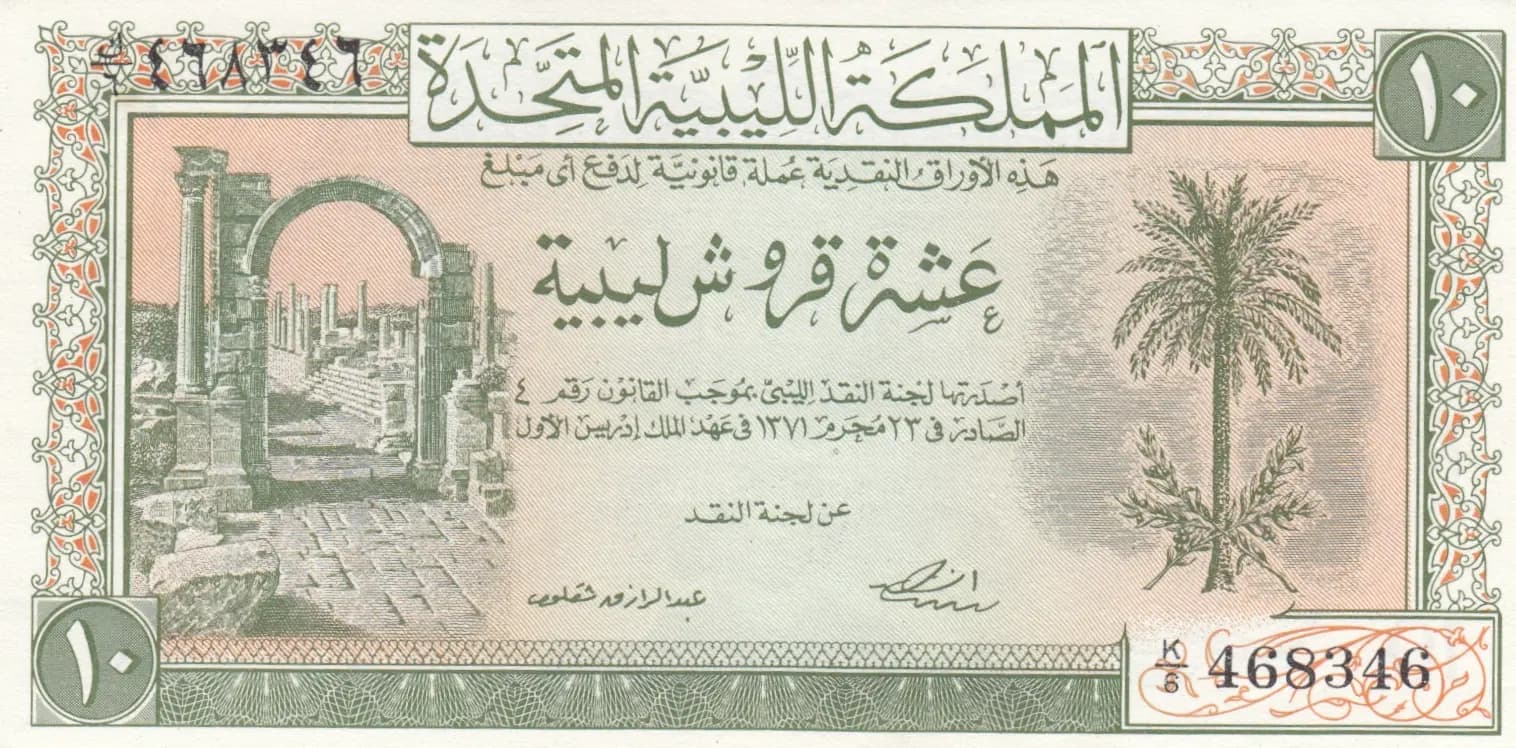
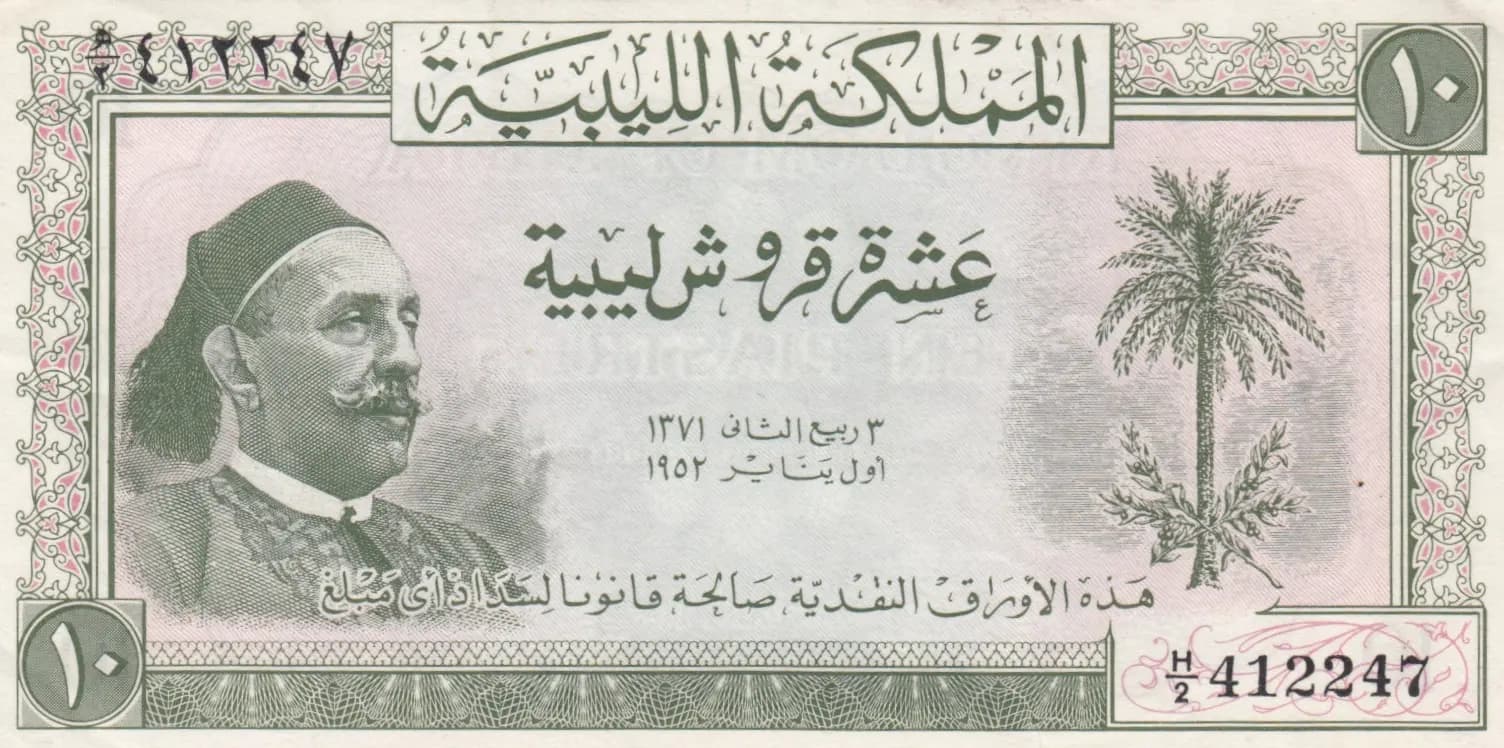
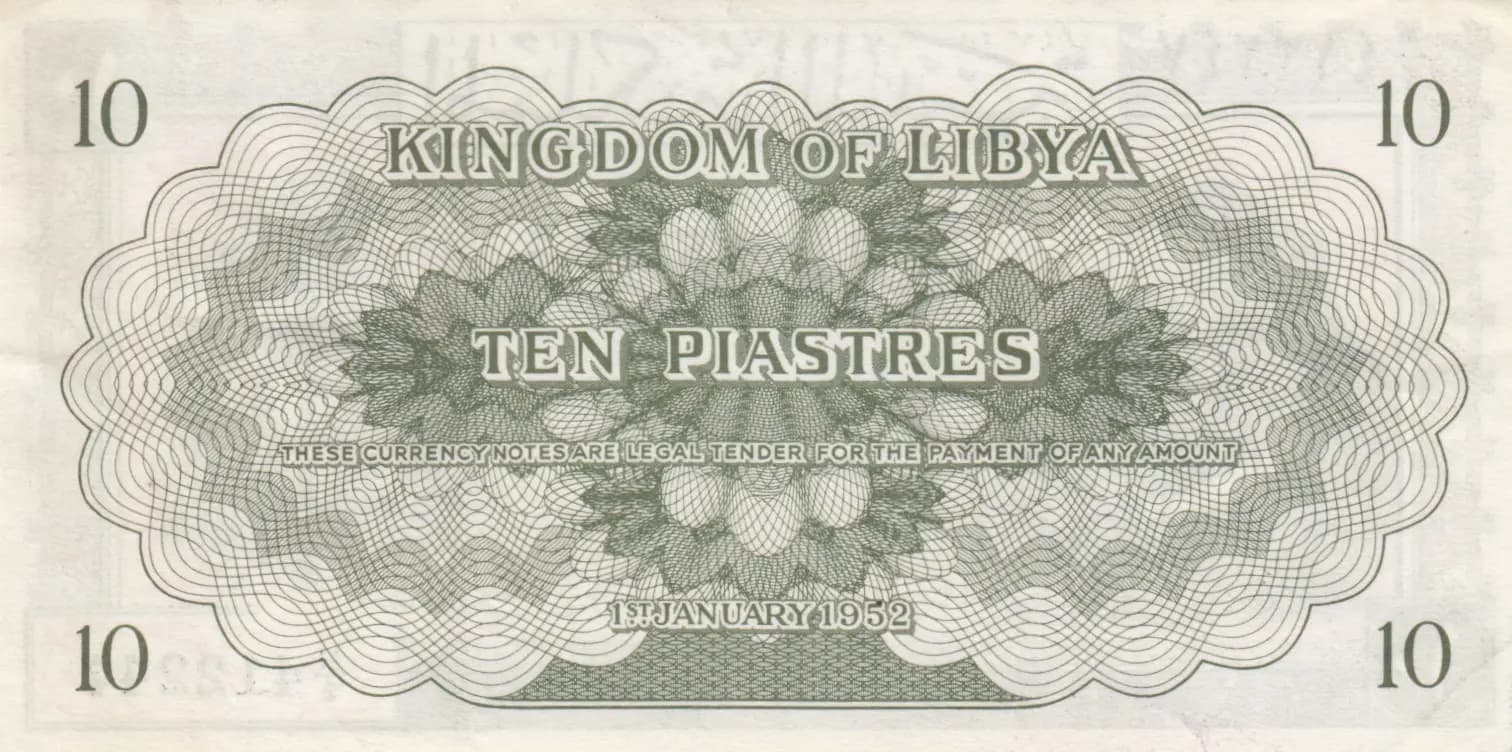
This is a Kingdom of Libya 10 Piastres note from 1952, the inaugural year of Libya's independence, presented in AU (About Uncirculated) condition. The obverse features a striking portrait of King Muhammad Idris al-Sanussi in traditional North African dress on the left, complemented by a palm tree on the right, with ornate pink and green decorative borders. The reverse displays an intricate floral wreath design in green with fine engraving work and bilingual inscriptions in Arabic and English, representing the nation's dual cultural identity at its founding.
Common. The eBay price history demonstrates consistent market availability with multiple sales across different condition grades from 2012 to 2021, ranging from $10.53 to $44.88 for circulated examples, and with catalog values for VF at $60 and UNC at $140 (2016). The PMG population report shows this is a standard catalogued variant without rarity restrictions. Early independence-period banknotes from Libya, while historically significant, were produced in sufficient quantities to ensure regular availability in the collector market.
Issued on January 1st, 1952, this note commemorates Libya's independence from Italian colonial rule and the establishment of the United Kingdom of Libya under King Idris I. The portrait of King Muhammad Idris al-Sanussi, the revered religious and political leader who unified the Libyan regions, reflects the legitimacy and continuity of traditional Libyan leadership in the newly sovereign nation. The bilingual presentation (Arabic and English) and Islamic calendar dating alongside the Gregorian calendar demonstrate Libya's position as a modern independent state rooted in Islamic tradition.
The obverse presents a formal portrait of King Muhammad Idris I positioned at the left, rendered in classical engraving style with careful attention to his dignified bearing, elaborate turban headdress, and formal collar—symbols of his authority and traditional legitimacy. A stylized palm tree illustration on the right symbolizes Libya's geography and prosperity. The note is framed by an elaborate ornamental border featuring geometric and floral patterns in pink/red and green, typical of Islamic artistic traditions. The reverse features a large circular botanical wreath or flowering plant motif in the center, executed with extremely fine line engraving and surrounded by a geometric mesh background pattern and scalloped border frame. Denomination numerals '10' appear in circular medallions in the corners of the obverse. Both sides employ a predominantly green color scheme with white/cream backgrounds.
FRONT (Arabic): المملكة الليبية (Kingdom of Libya), عشرة قروش شرقية (Ten Eastern Piastres), 2 ربيع الثاني 1371 (2 Rabi' al-Thani 1371 Islamic calendar), اول يناير 1952 (1st January 1952), مذه الاوراق النقديه صالحه قانونا لسداد اى مبلغ (These currency notes are legally valid for payment of any amount), Serial number: H 2412247. BACK (English): KINGDOM OF LIBYA, TEN PIASTRES, THESE CURRENCY NOTES ARE LEGAL TENDER FOR THE PAYMENT OF ANY AMOUNT, 1ST JANUARY 1952.
Intaglio engraving (line engraving), evidenced by the fine detail visible in the portrait, the geometric mesh patterns, intricate border designs, and the high-quality reproduction of the floral wreath. The security printing techniques include elaborate ornamental borders and fine engraving patterns designed to prevent counterfeiting. Historical records indicate the 1952 Kingdom of Libya banknotes were produced by the Bank Misr Printing Press in Egypt or British security printers; exact attribution for this Pick-13 note would require further documentation.
The serial number prefix 'H' is visible on this example (H 2412247). This Pick-13 note represents the standard 1952 issue from the Kingdom of Libya's first bank note emission. PMG has catalogued this as a single variant for Pick-13, with no known major subtypes, overprints, or error variants documented. The Islamic calendar date of 2 Rabi' al-Thani 1371 corresponds to January 1, 1952 (Gregorian calendar), confirming this as the inaugural regular-issue denomination for the newly independent nation.