1 libyan pound 1963
Market Prices
9 salesAbout This Note
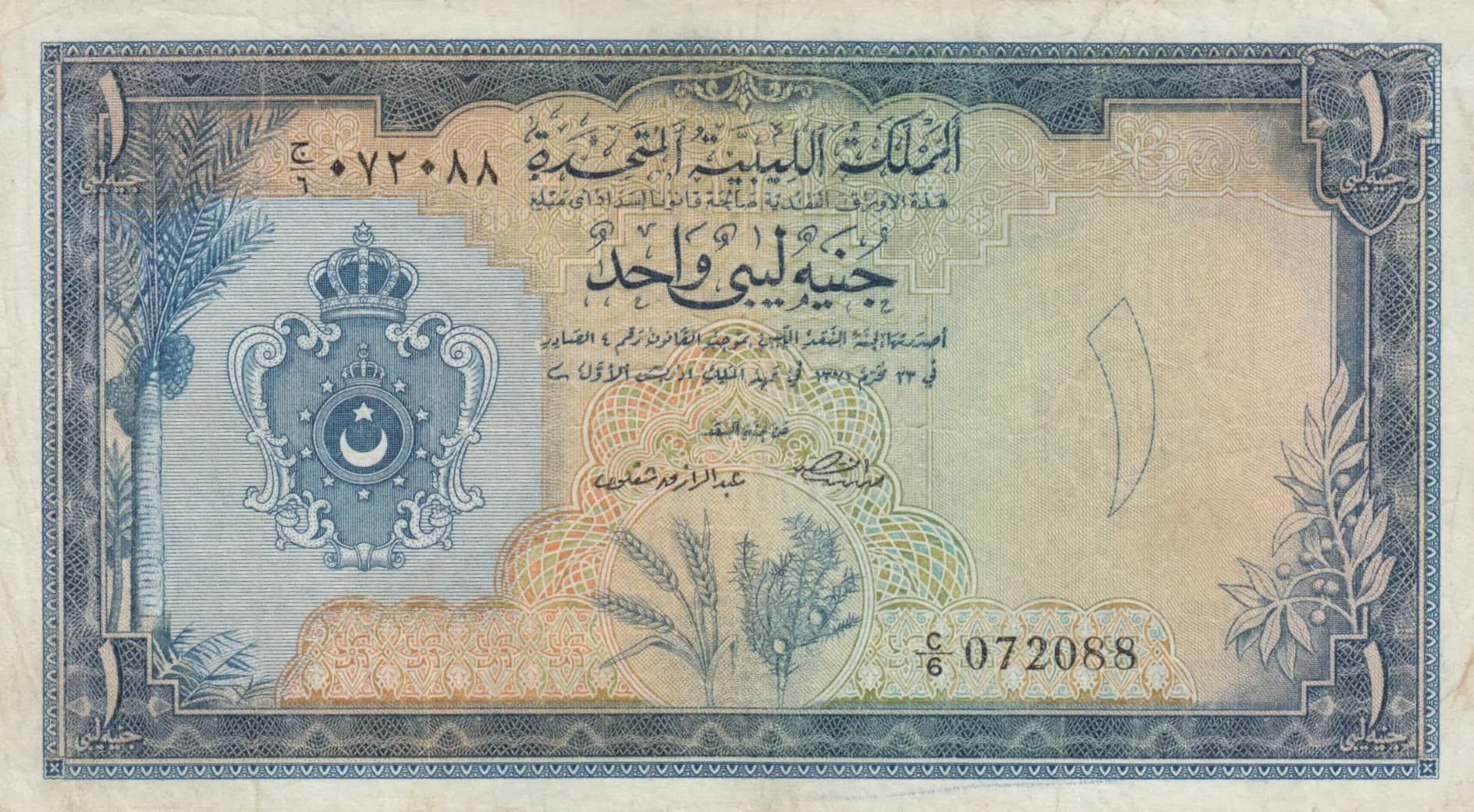
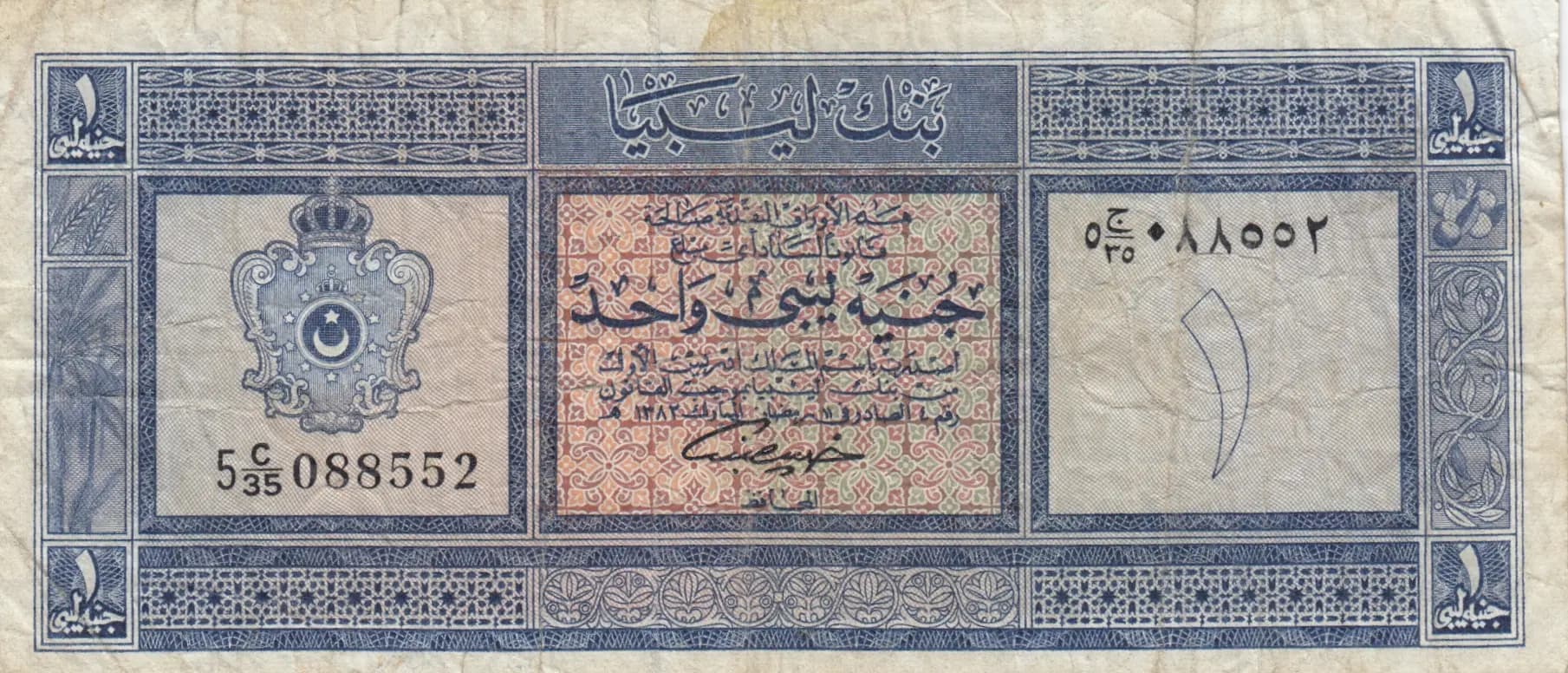
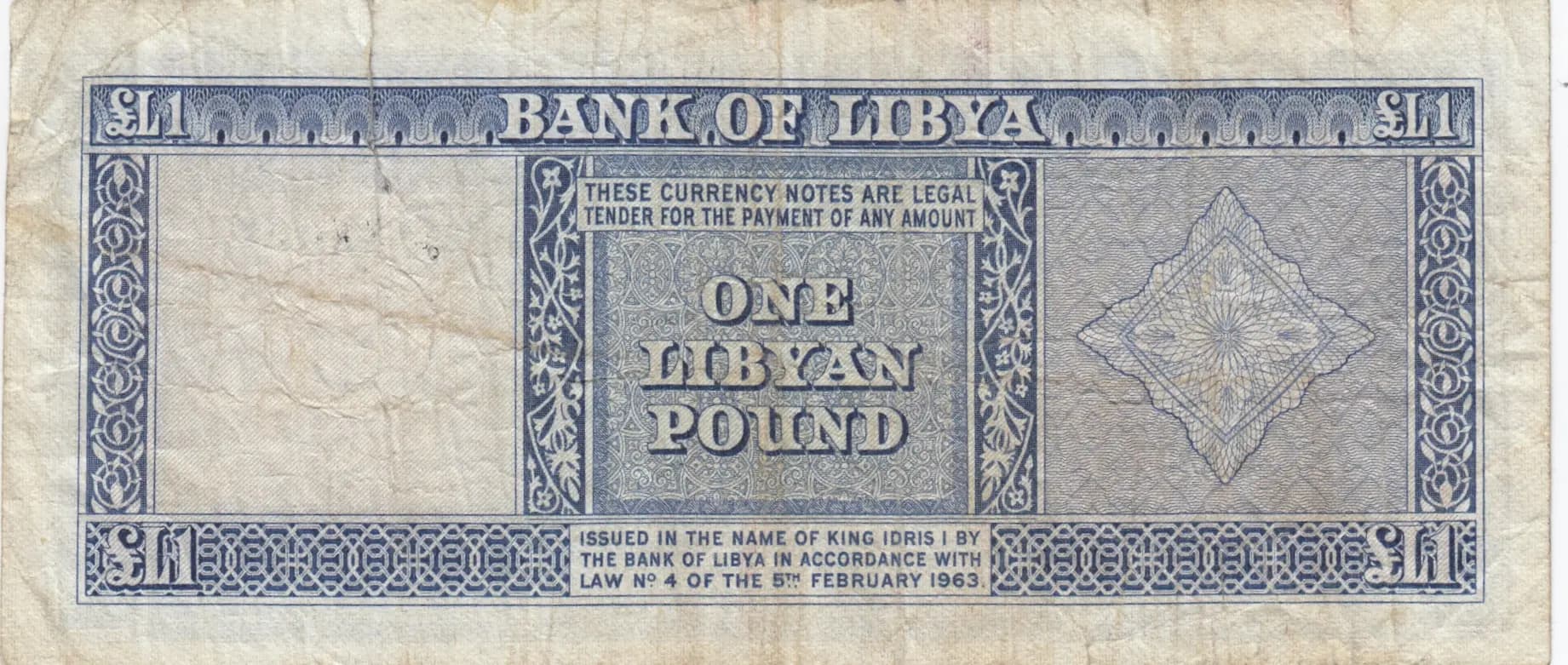
This is a 1963 Bank of Libya 1 Libyan Pound note (Pick P-30) in VG condition, issued under King Idris I. The note displays the characteristic blue and multicolored design of Libya's first independent currency, featuring an ornate crowned arms at left on the obverse and a geometric diamond motif on the reverse. Despite visible circulation wear including creasing, foxing, and age-related discoloration, this note remains an important early example of post-independence Libyan currency before the 1969 revolutionary changes.
Common. While this is an early post-independence Libyan note with historical significance, eBay market data shows VG specimens selling for approximately $11.50 (2010), with F and VF grades typically ranging from $12.85 to $40. The catalog values for 2019 (VF: $50, UNC: $425) indicate reasonable collector demand, but the consistent availability at affordable prices on secondary markets and the existence of multiple varieties catalogued by PMG suggest this was produced in sufficient quantity for circulation. The note is not scarce or rare in collectible grades.
This note was issued on February 5, 1963, just two years after Libya gained independence in 1951, representing the nation's early monetary sovereignty under the Libyan monarchy of King Idris I. The obverse features the crowned arms with crescent and star emblem, symbols of Libya's Islamic heritage and national identity during the constitutional monarchy period. The reverse's legal tender declaration and formal issuance language reflect the institutional establishment of the Bank of Libya as the country's central monetary authority, a framework that would be significantly altered following the 1969 coup d'état.
The obverse features a sophisticated symmetrical design with an ornate crowned coat of arms centered on the left panel, displaying a shield with a crescent and star emblem—the national symbols of Libya. The crowned arms are rendered with detailed shading and fine engraving work. The central section contains Arabic text on an intricate geometric and floral patterned background, while the right panel displays denomination numerals. A decorative cartouche-style banner spans the top, with feather and leaf ornamental motifs in the corner elements. The reverse presents a more austere design typical of currency reverses, with 'BANK OF LIBYA' in an English-language banner and 'ONE LIBYAN POUND' prominently displayed within an ornamental frame. A distinctive geometric diamond-shaped design with radiating line patterns occupies the right side of the reverse, serving both aesthetic and security purposes. Decorative geometric borders frame all edges. The overall color scheme of blue on multicolored underprint with beige and tan tones creates a visually distinctive note characteristic of early 1960s Middle Eastern currency design.
OBVERSE: بنك ليبيا (Bank of Libya) appears in Arabic script. Serial numbers are present in both Arabic numerals (٢٠٠٢.٨٨٥٠) and Latin characters (5C 0885552). REVERSE: 'BANK OF LIBYA' appears in English in a decorative banner at top. The denomination reads 'ONE LIBYAN POUND' in an ornamental frame in the center. The legal tender statement reads: 'THESE CURRENCY NOTES ARE LEGAL TENDER FOR THE PAYMENT OF ANY AMOUNT.' The issuance statement reads: 'ISSUED IN THE NAME OF KING IDRIS I BY THE BANK OF LIBYA IN ACCORDANCE WITH LAW N° 4 OF THE 5 FEBRUARY 1963.' All inscriptions reflect the bilingual (Arabic/English) administrative practice of the period.
This note was produced using intaglio engraving (letterpress/recess printing), evidenced by the fine line engraving visible throughout both sides, the detailed shading in the coat of arms, and the intricate geometric patterns characteristic of high-security banknote production. The quality of the engraving and the multicolor printing capability suggest production by a specialized security printer, likely one of the major European banknote printers of the period (such as De La Rue or similar firms that worked with newly independent African nations), though specific printer attribution would require additional documentation.
PMG has identified at least three catalogued variants for Pick number P-30: the standard P-30, P-30cts, and P-30s (with watermark: arms). The observed specimen shows the characteristic arms watermark and reduced size format noted in the catalog data. The serial number prefix '5C' visible in the image may correspond to a specific print run or series batch, though without additional documentation, specific variety attribution beyond the base Pick P-30 classification cannot be definitively determined from visual inspection alone. The bilingual design (Arabic obverse/English reverse) is standard for all P-30 variants of this issue.