1/4 libyan pound 1963
Market Prices
7 salesAbout This Note
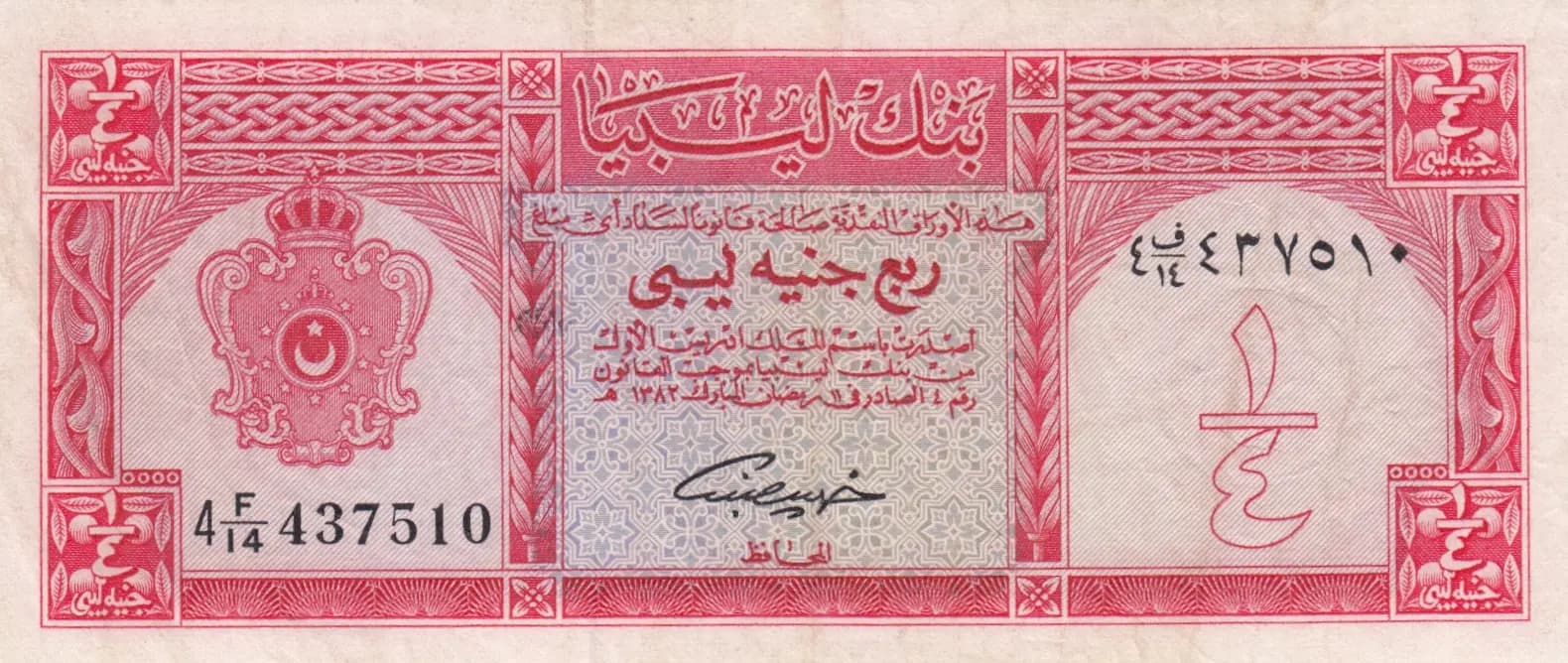
This 1/4 Libyan Pound note from 1963 is an attractive example of early post-independence Libyan currency featuring the royal arms of King Idris I. The note exhibits the fine engraving work characteristic of this issue, with intricate geometric and floral border patterns in red/pink on cream stock. In VF condition, it displays moderate circulation wear with visible creasing and slight discoloration, yet retains sharp detail in the ornamental design elements—a desirable intermediate grade for collectors of North African currency.
Common. The secondary market data provided shows regular sales activity with modest prices (VF examples sold for $29.99 in 2024, with historical pricing in the $8-$25 range for circulated examples), indicating steady supply and collector interest without scarcity premium. This is a standard regular issue from a major central bank with presumably substantial original print runs.
Issued on February 5, 1963, under Law No. 4 in the name of King Idris I, this note represents the early period of the Bank of Libya's independent currency operations following Libya's independence. The royal arms depicted on the obverse and the formal legal tender declaration on the reverse reflect the monarchical constitutional government of the era, before the 1969 revolution that would dramatically alter Libya's political trajectory and currency designs.
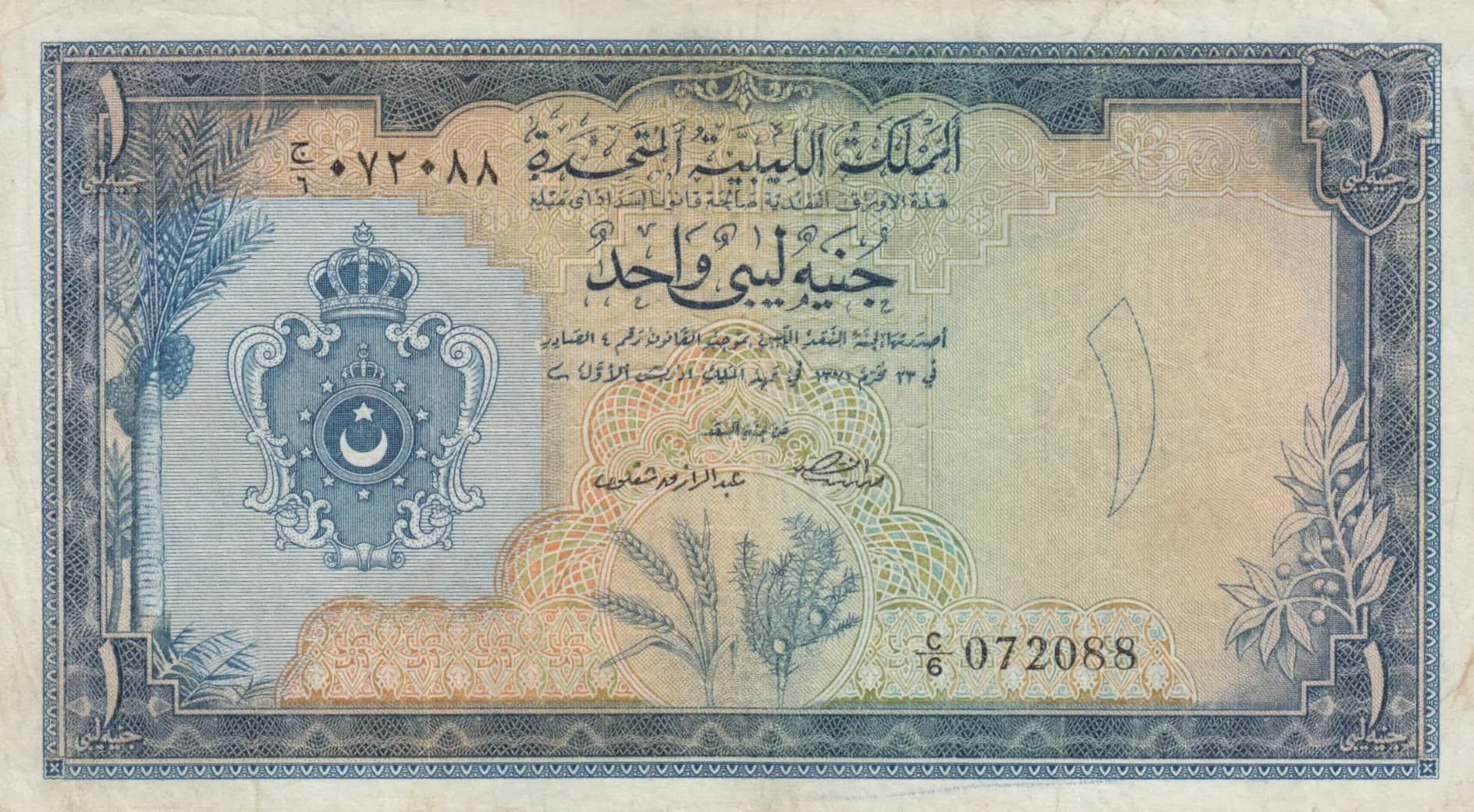
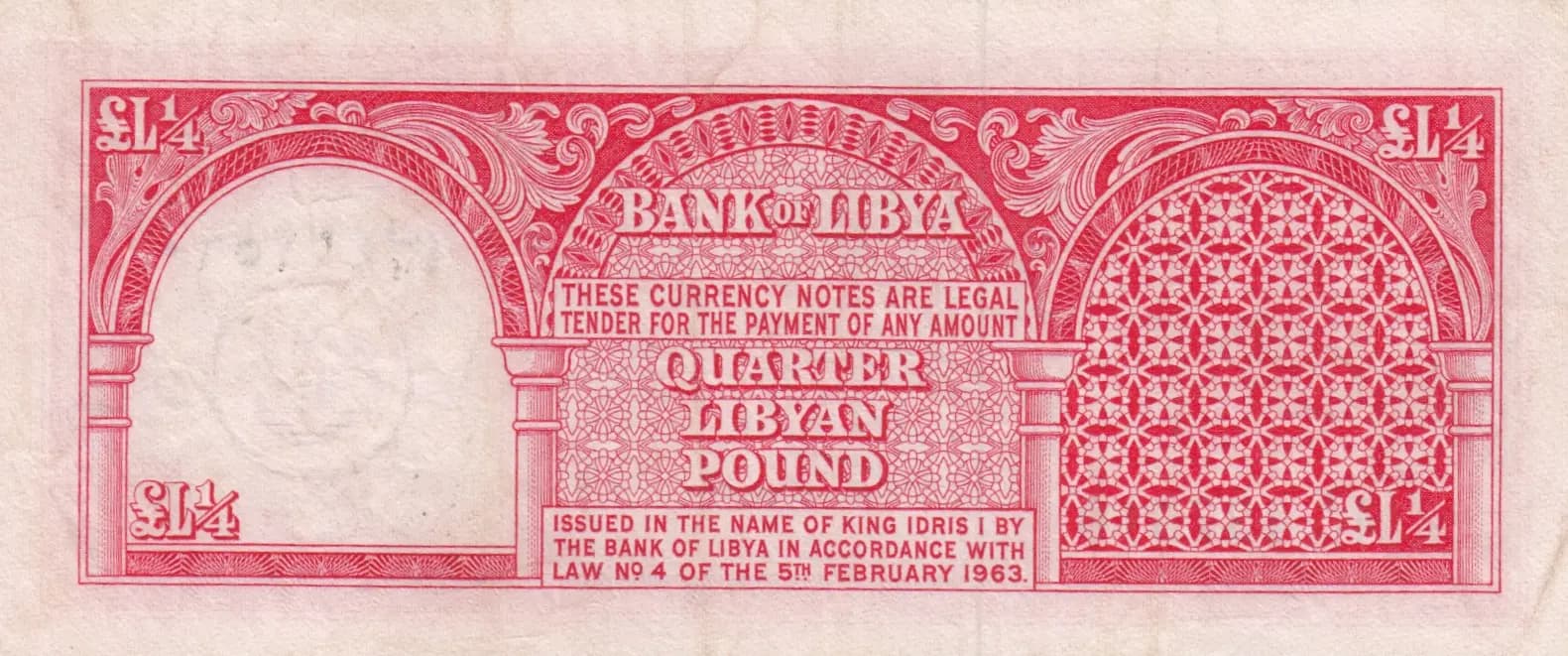
The obverse features a dominant circular emblem incorporating the Libyan national arms—a crescent moon and star within an ornate heraldic crown or seal positioned at the left side, surrounded by elaborate floral and geometric border patterns rendered in fine line engraving. The reverse presents a symmetrical architectural composition with two Islamic-style archways or gateway structures flanking the central text area; the right arch incorporates geometric Islamic pattern work characteristic of Libyan design traditions of the period. Both sides employ bilingual presentation (Arabic and English) reflecting Libya's post-colonial institutional identity. The overall design emphasizes classical engraving techniques with intricate line work throughout.
Front Side: 'بنك ليبيا المركزي' (Bank of Libya/Central Bank of Libya); 'ربع جنيه ليبي' (Quarter Libyan Pound); Serial number in mixed alphanumeric and Arabic numerals ('¼437510' / '٢٧٥١٠٤'). Back Side: 'BANK OF LIBYA'; 'QUARTER LIBYAN POUND'; 'THESE CURRENCY NOTES ARE LEGAL TENDER FOR THE PAYMENT OF ANY AMOUNT'; 'ISSUED IN THE NAME OF KING IDRIS I BY THE BANK OF LIBYA IN ACCORDANCE WITH LAW NO 4 OF THE 5TH FEBRUARY 1963.'; Denomination numeral '¼'.
Intaglio (engraved) printing process, evident from the fine line detail work, geometric patterns, and the crisp impression visible in both the ornamental borders and architectural elements. The security printer for this issue is not definitively identified from the provided documentation, though European security printers were common for Middle Eastern central bank issues of this era.
P-28 with watermark arms is the catalogued variant. The serial number visible on this example ('¼437510' in Latin numerals and '٢٧٥١٠٤' in Arabic numerals) is consistent with the standard issue format. PMG records note three variants (P-28, P-28cts, and P-28s), though specific distinguishing characteristics between variants are not detailed in available references. This example appears to be the standard P-28 variety based on the bilateral English/Arabic inscription format and arm watermark design.