1/2 pound 1963
Market Prices
9 salesAbout This Note
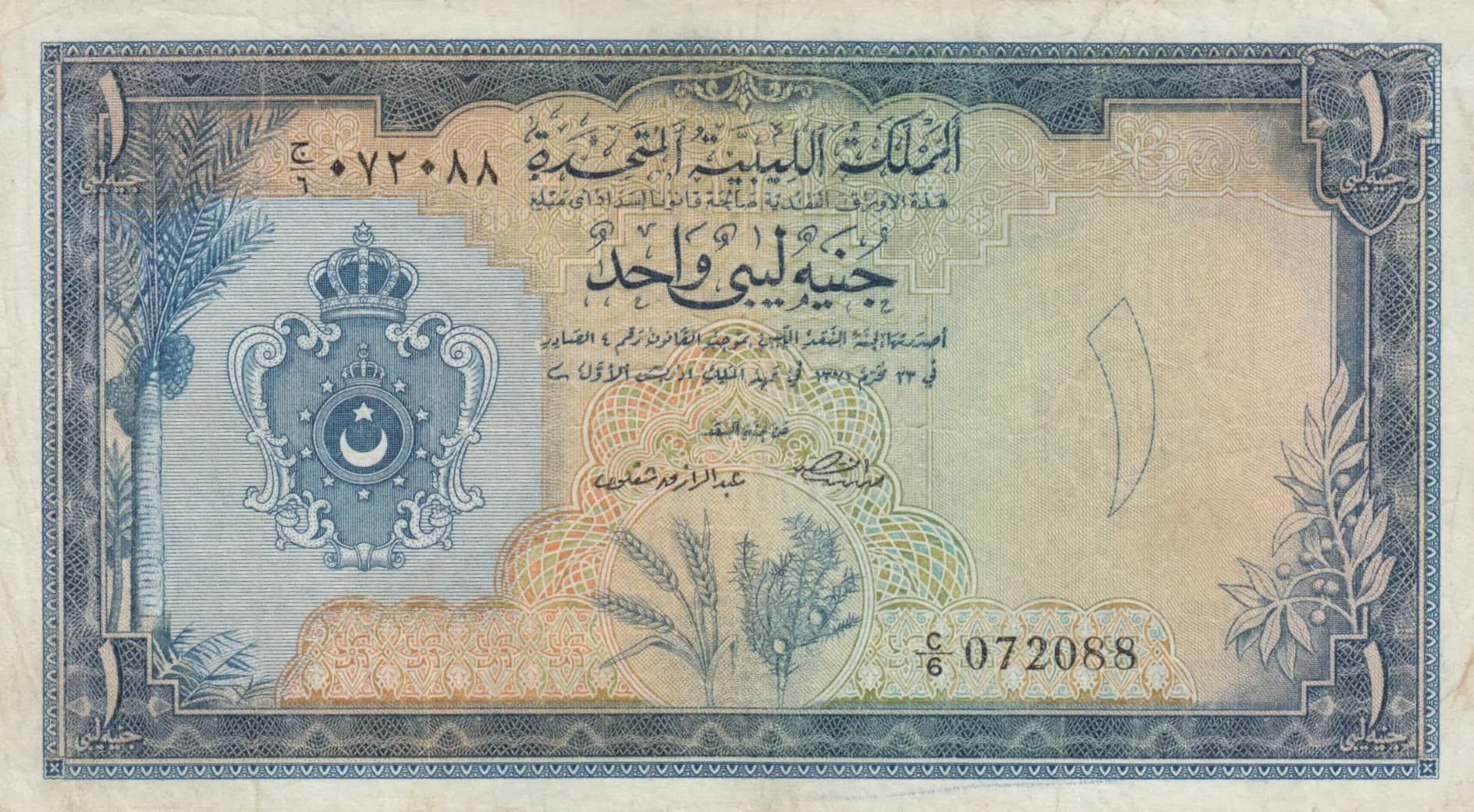
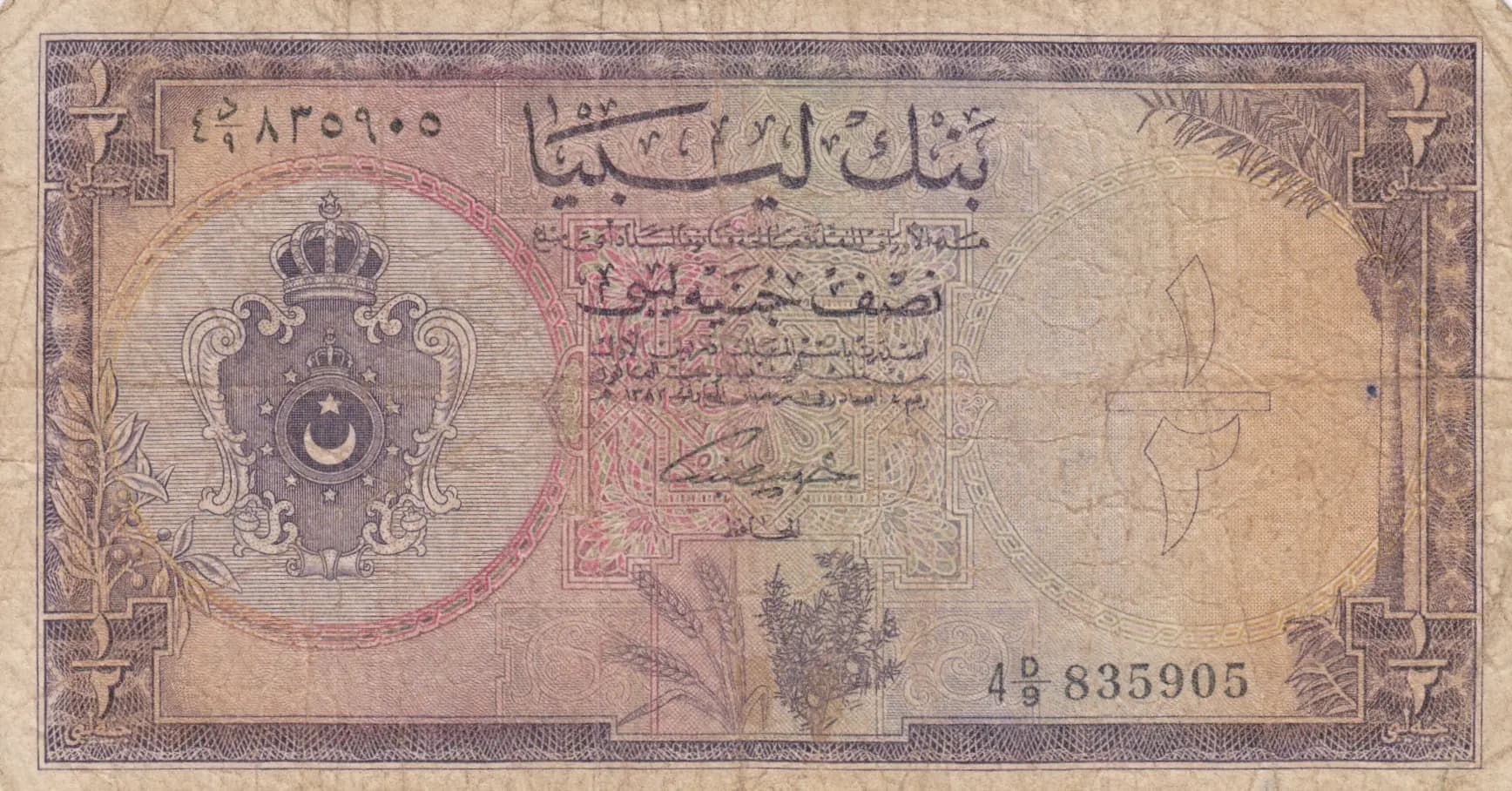
This is a Half Libyan Pound note from 1963, issued by the Bank of Libya under King Idris I's reign. The note displays the characteristic purple and multicolored design of the early Libyan currency series, featuring an ornate crowned arms with crescent and star at left on the obverse. In VG condition, this note shows expected wear from circulation including multiple creases, foxing, and discoloration, yet maintains structural integrity—a desirable example of Libya's first independent currency issue.
Common. eBay historical sales data shows consistent circulation at modest prices ($14–$37 for VG-VF specimens), with only exceptional grades (early 2010s VF examples) commanding premium prices above $100. The 1963 series had substantial print runs as regular circulation currency for an independent nation. Current catalog value for VF grade is $37.50, consistent with common-grade pricing. The VG condition grade of this specific note aligns with typical collector market expectations for this widely-produced issue.
Issued on February 5, 1963, this note commemorates Libya's transition to independence and the establishment of its own central banking authority under the constitutional monarchy of King Idris I. The crowned arms depicted on the obverse, featuring the crescent moon and star, reflect Libya's Islamic heritage and sovereignty, while the bilingual English-Arabic design represents the nation's international standing during the early post-colonial period. This series was short-lived, being replaced after the 1969 Revolutionary Command Council coup.
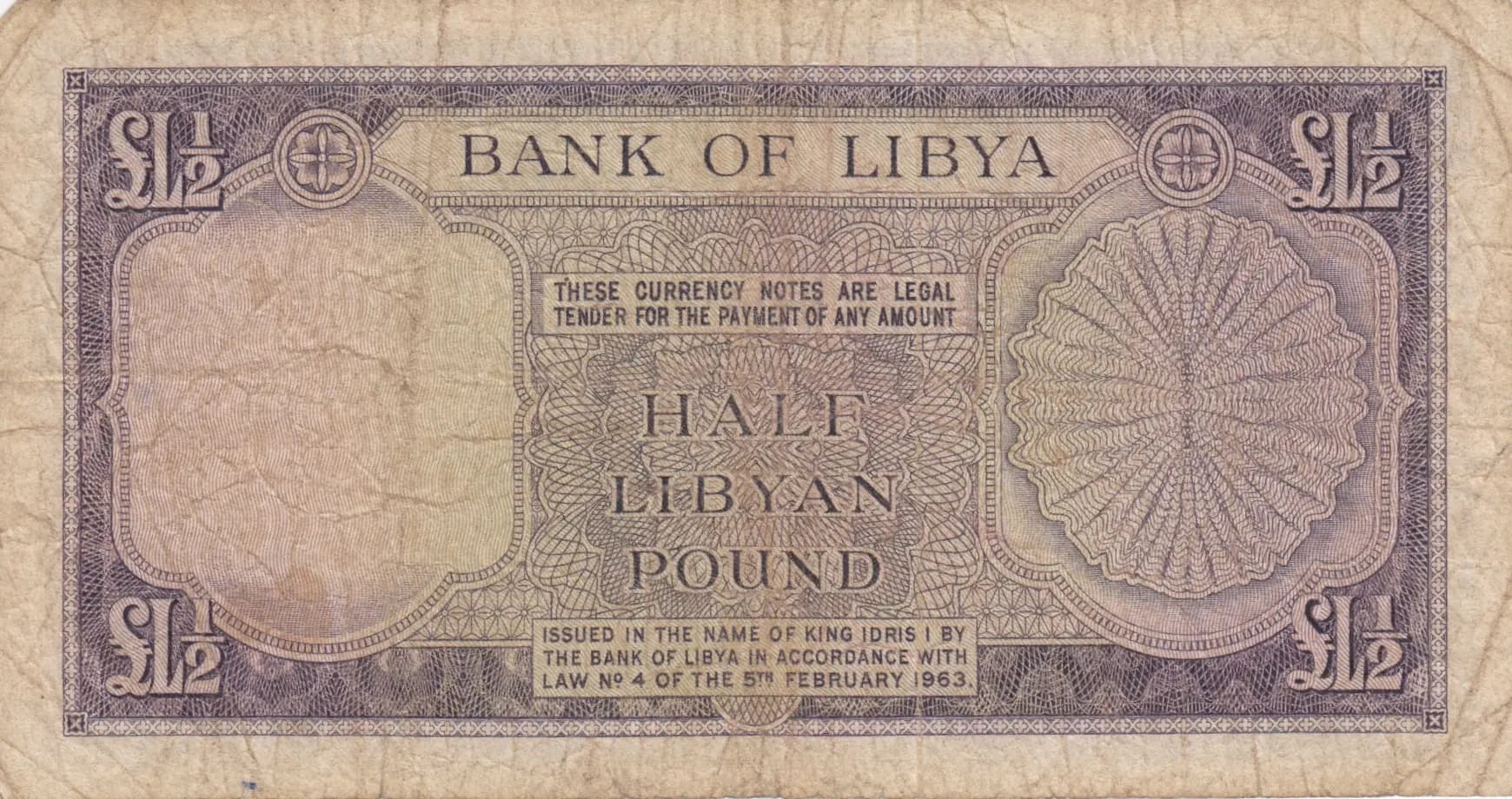
The obverse features the official crowned coat of arms of Libya centered within a circular red border at left, incorporating a crescent moon and star—the nation's primary heraldic symbols. The design employs ornate decorative borders with floral and geometric patterns throughout, reflecting Islamic artistic tradition. The reverse is bilingual, with English text dominating and providing legal tender information and issuance authority. The note incorporates elaborate guilloché patterning and fine engraved corner ornaments in tan, brown, and purple tones, typical of 1960s Commonwealth-influenced currency design. No portraits appear on this denomination, following Islamic convention observed by Libya's central bank.
FRONT: Arabic text 'كتاب الليبية' (Bank of Libya); serial number '4D 835905' in Latin numerals. BACK: English inscription 'BANK OF LIBYA' at top; legal tender declaration 'THESE CURRENCY NOTES ARE LEGAL TENDER FOR THE PAYMENT OF ANY AMOUNT'; denomination text 'HALF LIBYAN POUND'; official issuance statement 'ISSUED IN THE NAME OF KING IDRIS I BY THE BANK OF LIBYA IN ACCORDANCE WITH LAW No 4 OF THE 5TH FEBRUARY 1963.'
Intaglio engraving (steel plate), evidenced by the crisp, deeply detailed guilloché patterns, fine line work in decorative borders, and the sharp definition of the heraldic arms and ornamental elements visible throughout both sides. The precision of the geometric patterns and the fine parallel lines characteristic of hand-engraved security printing indicate production by a specialized banknote security printer, likely a British or European firm given the design aesthetic and Commonwealth-era production standards.
This note is cataloged as Pick P-24, the standard 1/2 Libyan Pound of 1963. The PMG population report identifies three cataloged variants (P-24, P-24cts, and P-24s with arms watermark). The observed serial number prefix '4D' and watermark type (arms, visible as circular outline on obverse right) should be noted for variety documentation. The bilingual design (English/Arabic) is standard for this issue; no overprints or special markings are visible on this specimen.