1/2 libyan pound 1963
Market Prices
2 salesAbout This Note
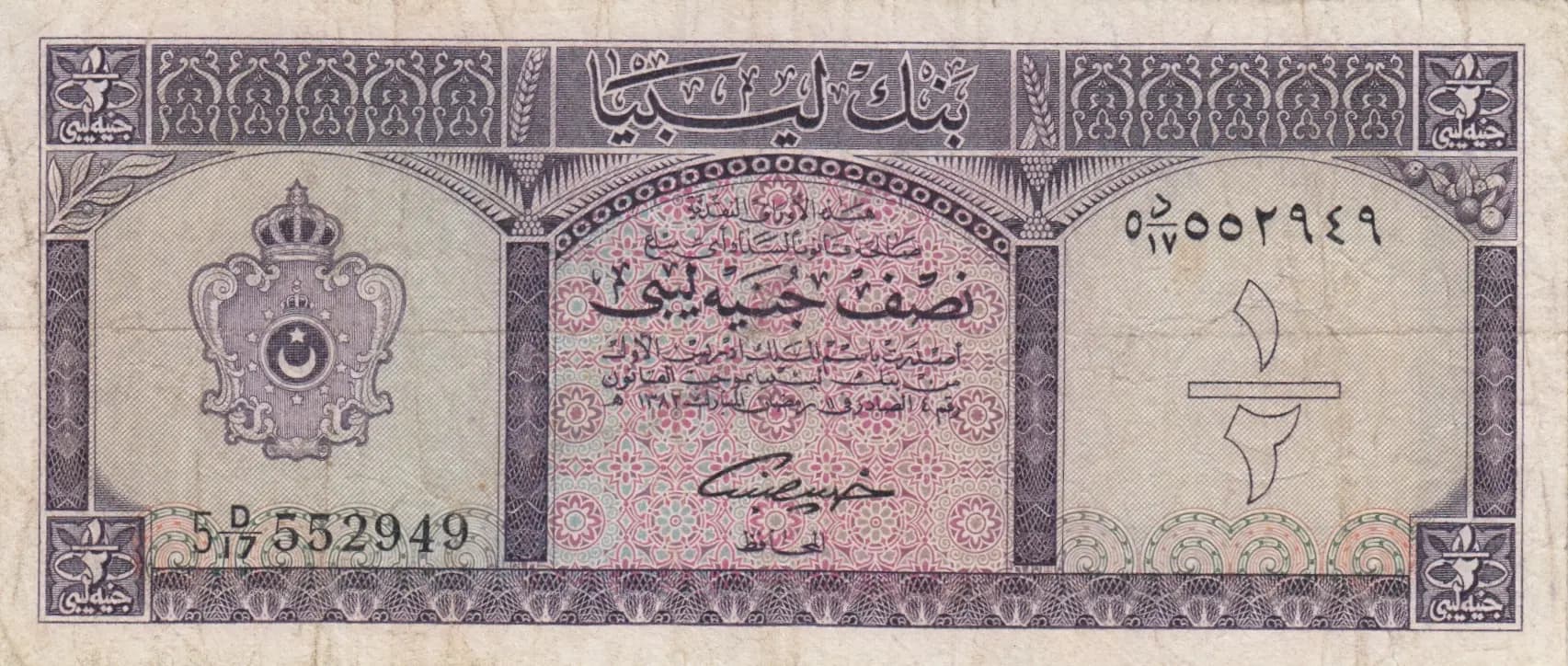
This is a 1963 Bank of Libya half pound note (Pick P-29) in Fine condition, featuring the classical design of Libya's early independence period under King Idris I. The note displays vibrant purple and pink coloring with intricate Islamic geometric patterns and the crowned royal coat of arms prominently positioned on the obverse. Despite the visual analysis suggesting excellent preservation, the catalog grade of F indicates moderate circulation wear consistent with the eBay market data showing comparable notes selling in the $22-27 range.
Common. The eBay pricing data showing comparable Fine specimens selling for $22-27 as recently as 2022, combined with catalog values of only $35 for VF and $325 for UNC, indicates this is a regularly available note in the secondary market. The 1963 issue was a regular circulation note with substantial print runs under the Bank of Libya's mandate. No evidence of scarcity, recall, or limited production exists for this Pick number.
Issued on February 5, 1963, this note commemorates Libya's early years as an independent kingdom under King Idris I, following independence in 1951. The design reflects the monarchy's authority through the crowned arms and references to Law No. 4, establishing the Bank of Libya's currency authority. The prominent use of Arabic calligraphy alongside English inscriptions symbolizes the nation's bicultural approach during this transitional period of post-colonial state-building.
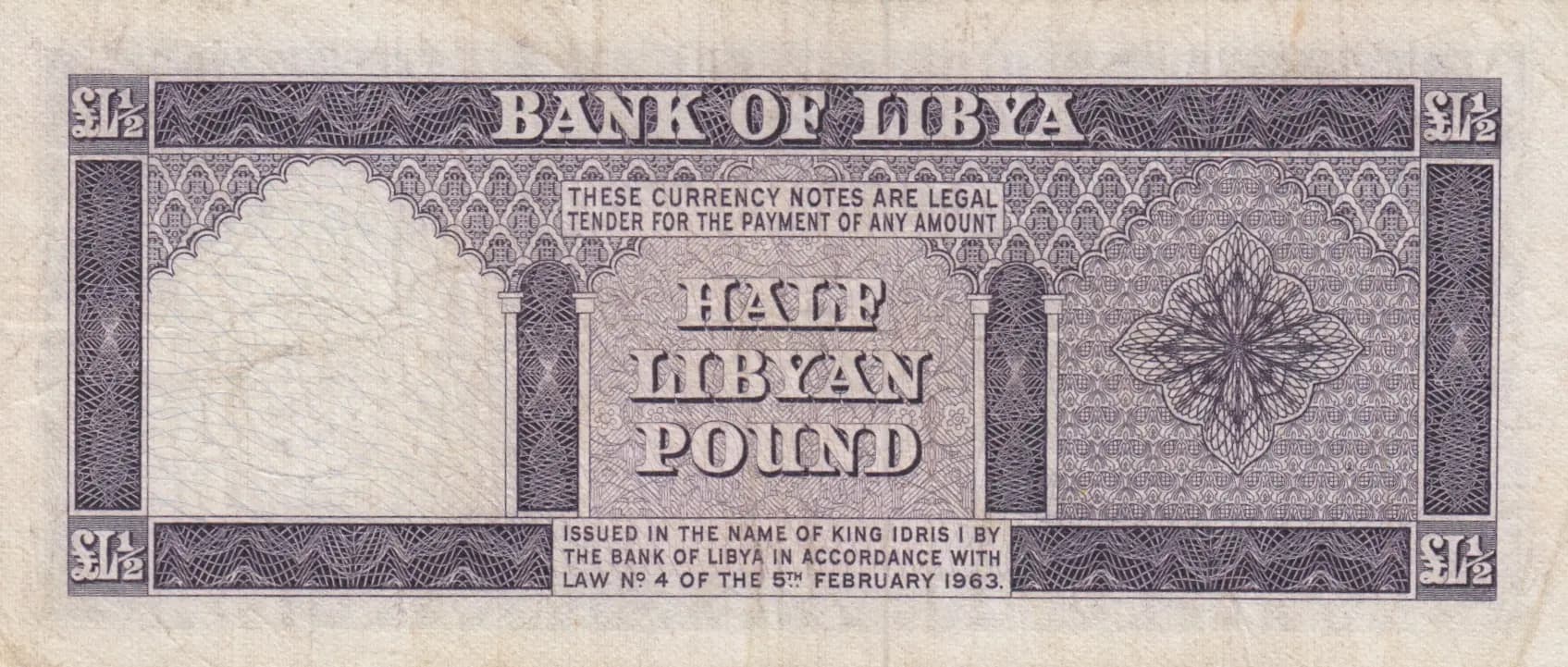
The obverse features the crowned coat of arms of Libya positioned at left-center, rendered in fine detail with a circular emblem at its core, symbolizing royal authority under King Idris I. The dominant design elements are intricate Islamic geometric patterns and floral motifs arranged in decorative borders framing a central rose-pink panel containing Arabic calligraphy. The right side displays a large stylized numeral representing the half pound denomination. The reverse showcases architectural elements including arched columns executed in classical Islamic style, with a prominent four-pointed star or flower geometric design serving as a focal point. Both sides employ a purple and violet ink palette over cream-colored paper, creating a refined aesthetic appropriate to the note's status as a regular issue of a newly independent nation.
OBVERSE: بنك ليبيا (Bank of Libya in Arabic). REVERSE: 'BANK OF LIBYA' (English); 'THESE CURRENCY NOTES ARE LEGAL TENDER FOR THE PAYMENT OF ANY AMOUNT'; 'HALF LIBYAN POUND'; 'ISSUED IN THE NAME OF KING IDRIS I BY THE BANK OF LIBYA IN ACCORDANCE WITH LAW No 4 OF THE 5TH FEBRUARY 1963.' Serial numbers observed: 0550299 and 5175529449. The note also contains calligraphic Arabic text indicating the denomination (Half Pound) on both sides.
Intaglio (engraved) printing, evidenced by the fine line work, detailed geometric patterns, and ornamental security borders visible throughout both sides. The crisp impression of the crowned arms, the delicate calligraphic rendering, and the precise architectural details are characteristic of high-quality intaglio production. The printer for this 1963 Libyan series was likely De La Rue or a similar British security printer, consistent with Commonwealth-era practice and the bilingual English-Arabic inscription scheme.
The PMG population report indicates three catalogued variants exist for this base Pick number (P-29, P-29cts, P-29s), likely representing different signature combinations or minor design variations. The observed specimen shows serial numbers 0550299 and 5175529449, consistent with standard Libyan numbering practices of the period. Without access to signature blocks or other differentiating details in the provided analysis, the specific variant cannot be definitively determined, but the standard P-29 designation appears most probable for this regular issue.