500 won 1966
About This Note
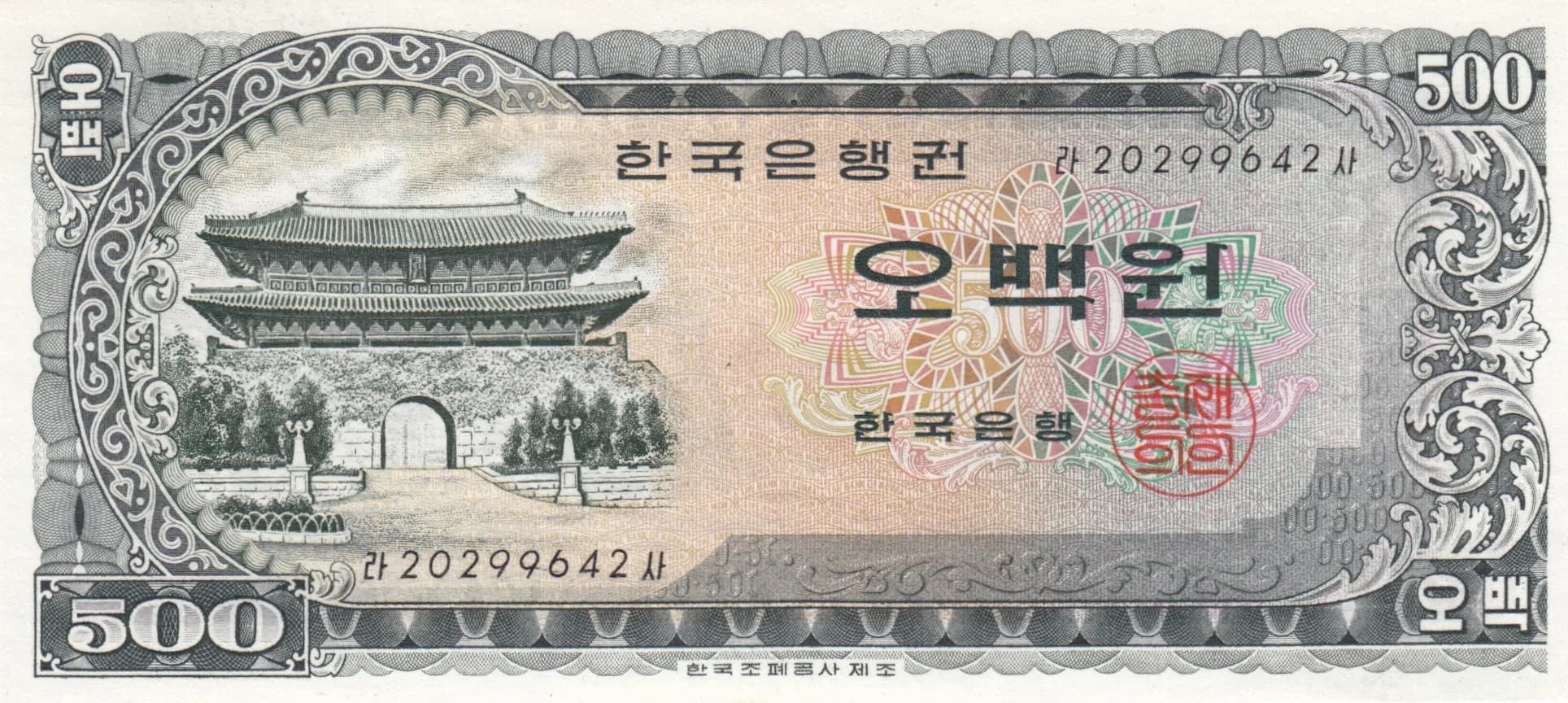
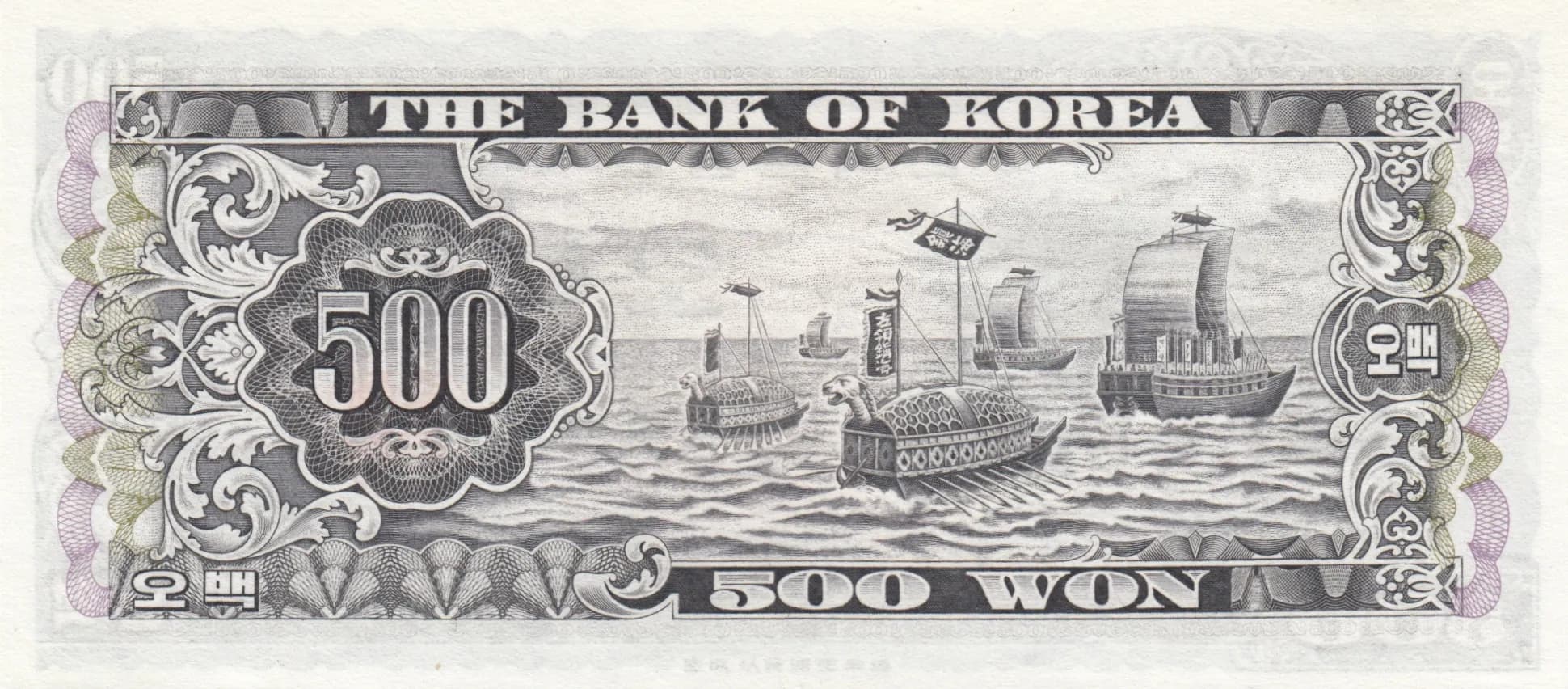
This is a stunning example of the 1966 South Korean 500 Won note (Pick-39) in uncirculated condition, featuring an elegant design that showcases Korea's architectural and maritime heritage. The front presents an intricately engraved traditional Korean gate or fortress tower with tiered roofs, complemented by ornate floral patterns in pink, orange, and green, while the back depicts a historically significant maritime scene with traditional Korean sailing vessels. The pristine condition, combined with the refined engraving work and multi-color security printing, makes this an excellent example of post-war Korean numismatic design.
Common. The 500 Won denomination from 1966 (Pick-39) was part of a standard circulation series issued in substantial quantities by the Bank of Korea. While the UNC condition grade represents a well-preserved example, the note itself is not scarce. These notes were produced in multiple series with varying serial number prefixes, and substantial quantities remain in numismatic circulation and private collections. The lack of limited print run documentation, absence of recall status, and the note's general availability in the secondary market all indicate this is a common date and denomination for collectors of Korean currency.
The 1966 500 Won note was issued during a period of significant economic development in South Korea following the Korean War, when the Bank of Korea was establishing modern currency designs to reflect the nation's recovery and cultural identity. The depicted architectural structure likely represents an important Korean historical fortification or gate, symbolizing national heritage and resilience, while the maritime scene on the reverse commemorates Korea's traditional seafaring traditions and importance of trade during the nation's modernization period. The bilingual English and Korean inscriptions reflect South Korea's international economic engagement during the 1960s post-war reconstruction era.
The front features a detailed engraving of what appears to be Namhansanseong (South Han Mountain Fortress) or a similar significant Korean historical fortification, rendered with fine linework showing the distinctive tiered pavilion roof architecture characteristic of Korean defensive structures. The fortress gate is positioned in the center-left with surrounding landscape including vegetation and stone fortification walls with archways. The right side displays elaborate decorative circular floral medallions with intricate geometric and botanical patterns in pink, orange, and green tones, bordered by elaborate scrollwork and shell-like motifs in gray and blue. The reverse depicts a maritime scene with traditional Korean sailing vessels (likely geobukseon or similar historical ships) on waters, emphasizing Korea's naval heritage. Both sides feature ornamental frames with scrollwork borders containing shell and spiral patterns characteristic of 1960s Korean banknote design aesthetics.
Front Side: '한국은행권' (Bank of Korea Note), '한국은행' (Bank of Korea), '오백' (Five Hundred), '원' (Won), '500' (500 in numerals), Serial Number: 'ㄹ2029964211'. Back Side: 'THE BANK OF KOREA' (English issuer name), '500 WON' (Denomination in English), '오백' (Five Hundred in Korean), '원' (Won in Korean), '500' (Denomination in numerals). The front and back both prominently display the denomination in both Korean Hangul characters and English/numerals, reflecting the bilingual nature of official Bank of Korea currency at this time.
This note was produced using traditional intaglio (engraved) printing combined with multi-color lithographic elements, a common technique for Bank of Korea notes of this era. The detailed line work visible in the fortress structure, maritime scene, borders, and decorative patterns indicates engraved steel plate printing, while the colored decorative elements (pink, orange, green floral patterns) suggest color lithography or simultaneous multi-color printing. The security features include intricate engraved detail work and complex border patterns designed to prevent counterfeiting. The note was likely produced by the Bank of Korea's printing facilities or under contract with an established currency printer such as De La Rue or American Bank Note Company.
The observed serial number prefix 'ㄹ' (Rieul in Korean Hangul) indicates this belongs to a specific printing series. The 1966 500 Won (Pick-39) is known to exist with various serial number prefixes corresponding to different print batches. The serial number format 'ㄹ2029964211' suggests this is from a middle-to-later production run of the series. Collectors should note that different serial number prefixes may indicate different security features or printing sessions. No other major varieties (overprints, color variants, or signature variations) are documented for this Pick number based on standard catalogs, though serial number prefix collections remain a recognized collecting interest.