15 chon 1947
About This Note
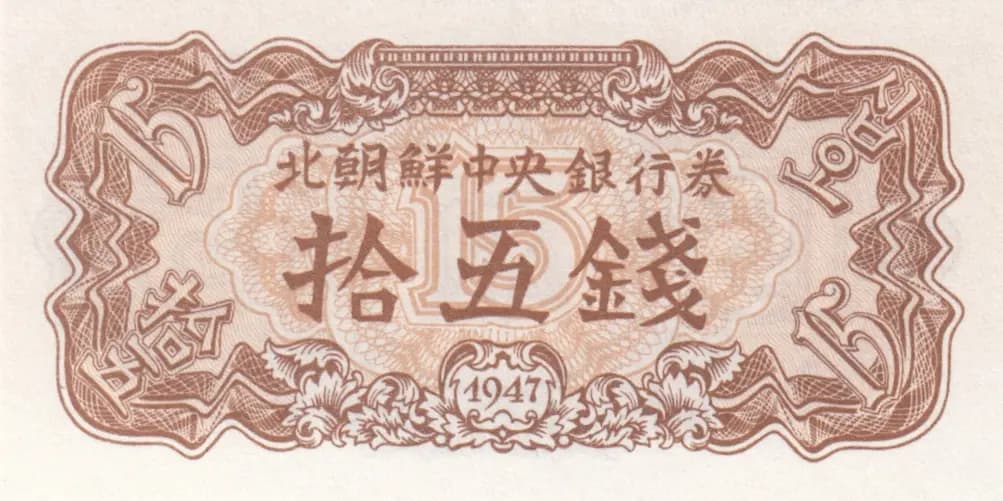
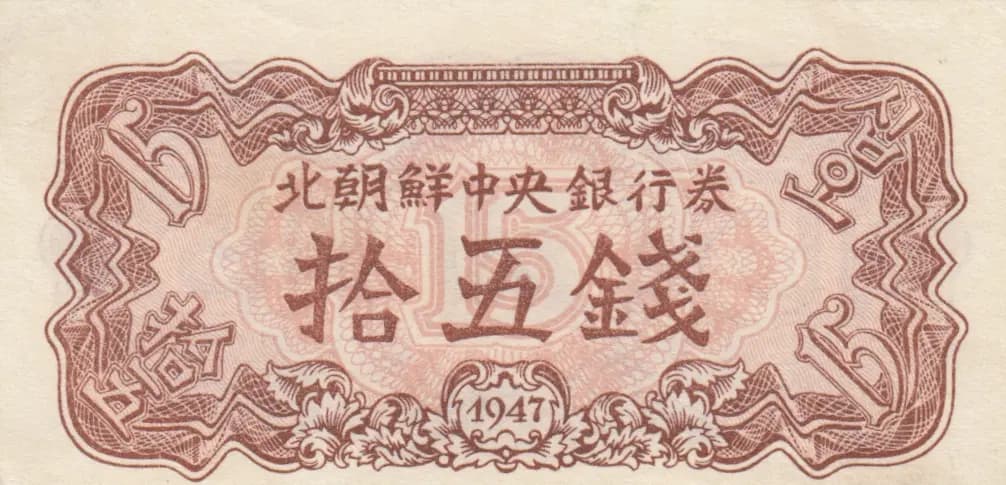
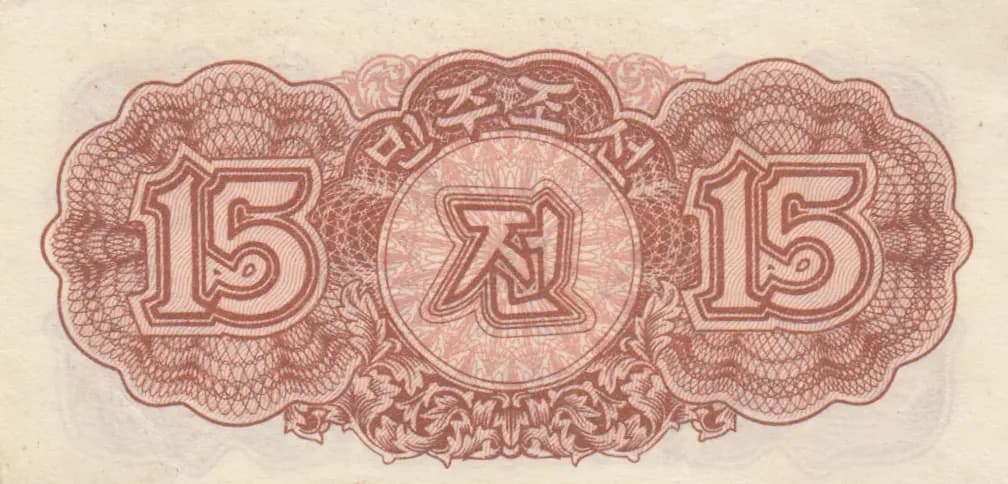
A North Korean 15 Chon banknote from 1947, issued by the North Korea Central Bank in the early post-liberation period. The note exhibits exceptional condition consistent with AU grading, featuring pristine cream-colored paper with rich reddish-brown printing, no visible wear, creasing, or circulation marks. This historically significant early North Korean currency displays elaborate engraved borders with floral scrollwork and fine line security work typical of mid-20th century Central Asian banknote production.
Common. While early North Korean currency from 1947 has historical significance and the note is scarce in high grades, the 15 Chon denomination appears to have been produced in substantial quantities as a fractional currency unit. The Pick P-5a series does not show evidence of extremely limited mintage or early recall. Uncirculated examples exist in reasonable supply for this series, keeping it in the 'common' category despite its age and historical importance. The AU condition grade observed is desirable but not extraordinarily rare for surviving examples of this denomination.
Issued in 1947, this 15 Chon note represents the earliest phase of North Korean currency following the country's establishment and Soviet occupation zone administration (1945-1948). The decorative design language—with its ornate borders, floral motifs, and centralized numeral emphasis—reflects the aesthetic standards of Soviet-influenced currency production during the immediate post-WWII period when North Korea was establishing its independent monetary authority and transitioning from Japanese colonial currency.
The note features a classically ornate design typical of 1947-era Central Asian banknote production. The front presents a symmetrical layout with the Korean Hangul inscription '북조선중앙은행권' (North Korea Central Bank Note) in the upper portion, denomination '십오전' (15 Chon) prominently displayed in the center, and '1947' marking the year of issue. The design is framed by an elaborate border composed of repeating wavy geometric patterns and acanthus leaf scrollwork in all four corners, with architectural molding at the top center. The back is dominated by large ornamental Arabic numerals '15' positioned on the left and right sides, flanking a central circular medallion containing a Hanja character (元 - won/yuan) with radiating decorative lines creating depth. The entire composition is enclosed by a scalloped-edge border with elaborate floral and scrollwork elements at top and bottom. No portraits or landmarks are depicted; instead, the design emphasizes geometric ornamentation and denomination clarity through repeated numeral presentation and fine engraved detailing throughout.
Front: '북조선중앙은행권' (North Korean Central Bank Note), '십오전' (15 Chon), '1947' (year). Back: '15' (left and right sides, Arabic numerals), '元' (Won/Yuan, currency denomination marker in Hanja). The dual-language presentation using both Hangul (Korean script) and Hanja (Chinese characters) reflects the writing conventions of the Korean peninsula in the 1940s.
Intaglio (engraved) printing process, evidenced by the fine line work visible in the borders, the complex geometric pattern work in background areas, the intricate mesh or scale pattern filling the large numerals on the reverse, and the detailed radiating lines of the central medallion. This high-security printing method was standard for early North Korean Central Bank notes. The printer for P-5a is not definitively documented in standard catalogs, but early North Korean currency of this period was likely produced domestically or under Soviet technical supervision.
Pick catalog identifies this as P-5a, indicating the existence of at least one variant (P-5b or other sub-varieties). Early North Korean notes of this period may show minor variations in printing quality, paper tone, or border details across production runs. Without serial number analysis or comparative specimens in the provided images, specific sub-variety identification beyond the P-5a designation is not possible from the visual analysis alone. The 1947 date and '15 Chon' denomination are consistent with the listed Pick catalog entry.