1 won 1947
About This Note
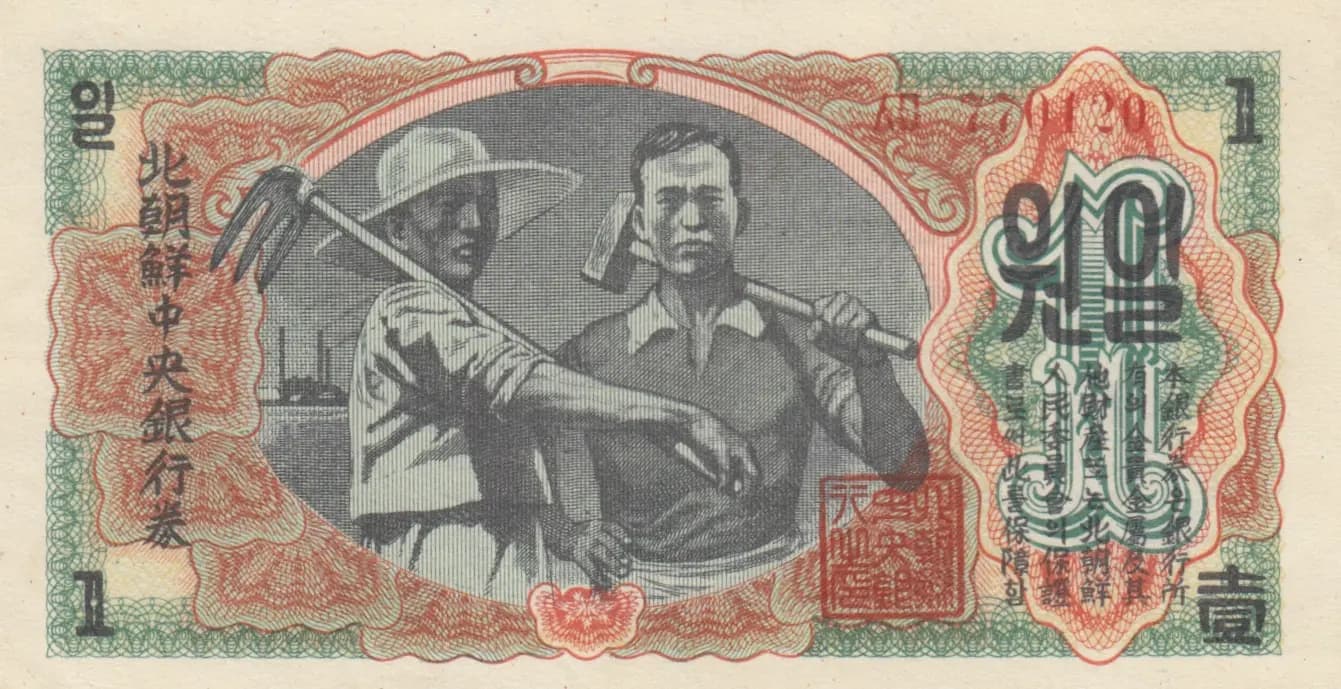
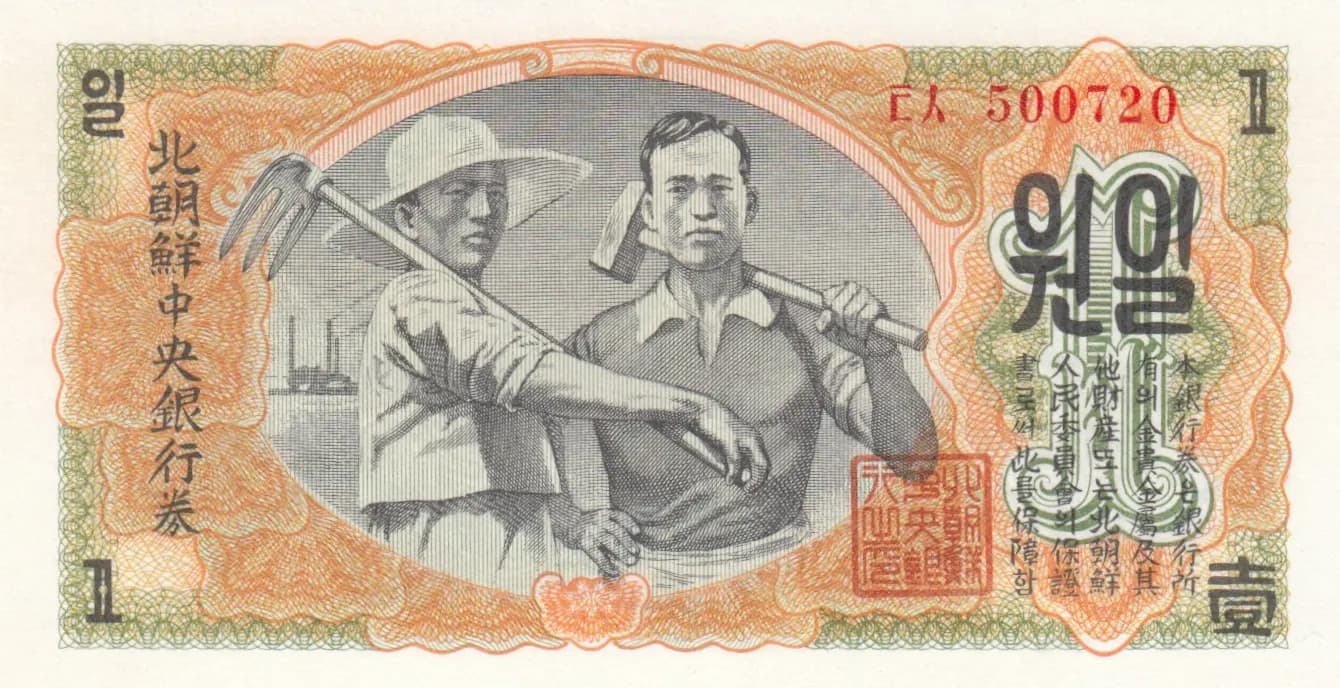
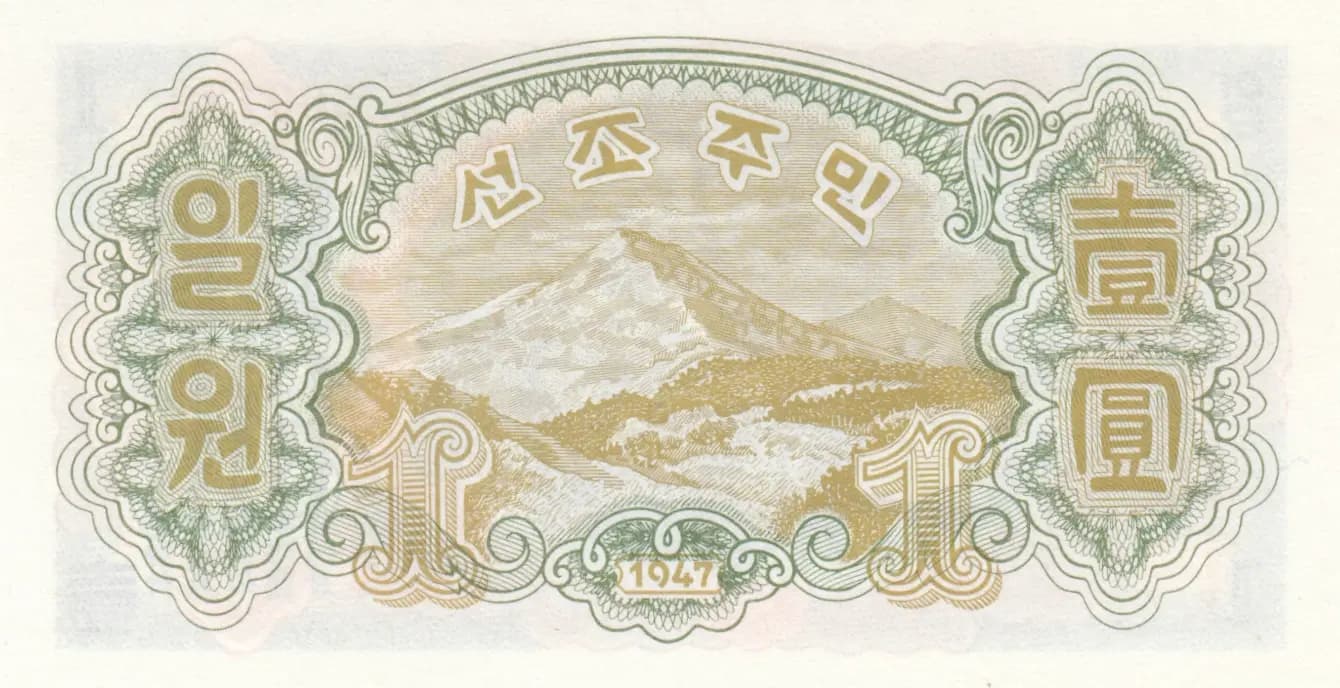
This is an outstanding example of North Korea's first currency issue, the 1 Won note of 1947 (Pick P-8b), presented in uncirculated condition. The note features striking socialist realist imagery on the obverse depicting two workers—one with a pickaxe and one with a hammer—rendered in orange and green tones with intricate decorative borders, while the reverse showcases the iconic snow-capped Mount Paektu in a mountainous landscape. The crisp printing, clean margins, and absence of any wear or damage make this an exceptionally well-preserved example of this historically significant early North Korean banknote.
Common. This is one of the earliest and most iconic notes in the DPRK series, and examples in uncirculated condition are readily available to collectors. While historically significant, the 1 Won denomination from 1947 was produced in substantial quantities and has survived in reasonable numbers. No evidence of limited print runs, recalls, or extreme scarcity exists for this Pick number. Market availability indicates widespread collector awareness and reasonable supply.
Issued in 1947 by the North Korea Central Bank during the initial period of the Democratic People's Republic of Korea's establishment, this note represents the early monetary system following the division of Korea and Soviet occupation of the north. The heroic socialist realism imagery of workers with tools reflects the communist ideology and emphasis on labor that would come to define North Korea's political culture. Mount Paektu, featured prominently on the reverse, holds deep symbolic significance in Korean nationalist mythology and communist historiography as the spiritual center of the Korean nation.
The obverse features two heroically depicted workers in socialist realist style positioned centrally—the left figure holds a pickaxe while the right figure holds a hammer, both wearing work clothes and hats characteristic of industrial labor imagery. Both figures are rendered in the monumental, idealized style typical of early communist propaganda art. A red seal or official stamp appears to the right of the central vignette. The reverse depicts Mount Paektu (Paektu San), the highest peak on the Korean peninsula, rendered as a snow-capped mountain with forested slopes and valleys in a naturalistic landscape style. Both sides are framed with ornate decorative borders featuring traditional Korean floral and scrollwork motifs, with stylized corner designs in circular frames. The color palette of orange, green, tan/gold, and cream creates a distinctive and visually striking appearance characteristic of early DPRK currency.
Front side: '일' (Hangul: 'Il'/One); '北朝鮮中央銀行券' (Chinese/Hanja: 'Bank of North Korea Note'); '원' (Hangul: 'Won', the currency denomination); '朝鮮' (Hanja: 'Chosŏn'/Korea); Serial number 'EX 500720'. Back side: '조선민주주의인민공화국' (Hangul: 'Democratic People's Republic of Korea'); '원' (Hangul: 'Won'); '1947' (Arabic numerals: Year of issue).
Intaglio engraving (line engraving) combined with multi-color letterpress or offset lithography. The fine line work visible in the borders, landscape details, and decorative elements is characteristic of traditional banknote engraving. The precise registration and sharp definition of multiple color layers indicate high-quality security printing typical of central bank note production in the mid-20th century, likely executed by Japanese or Soviet printers given the geopolitical context of 1947.
This example is cataloged as Pick P-8b, indicating it represents a identified variety within the 1947 1 Won issue. The serial number prefix 'EX' and numbering '500720' should be noted. Varieties of early DPRK notes may include different serial number prefixes, minor design variations, or printing plant differences. Without access to comprehensive Pick catalog variety specifications for this series, the 'b' designation likely indicates a secondary variety distinguished by serial numbering, printing differences, or security features compared to the P-8a variety.