2 dollars 1970
Market Prices
19 salesAbout This Note
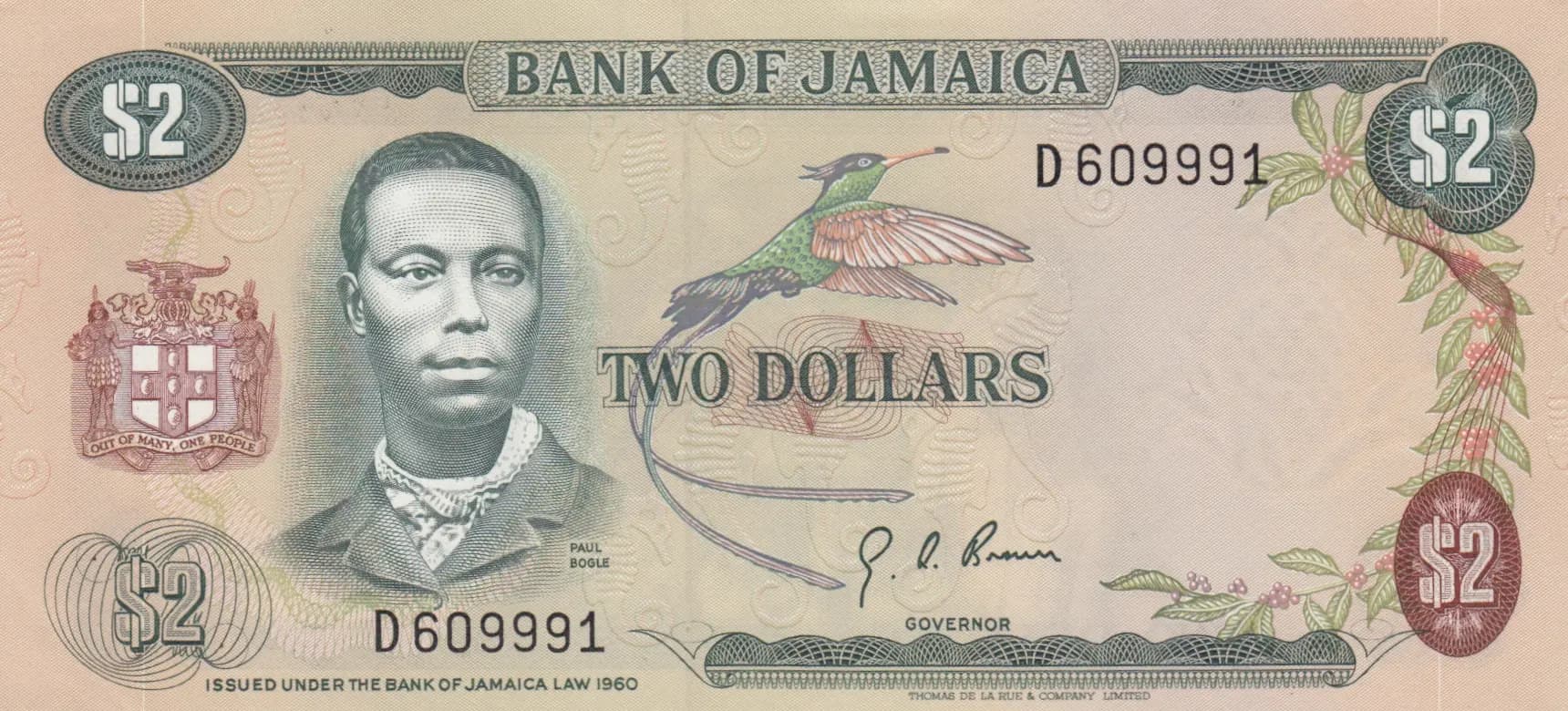
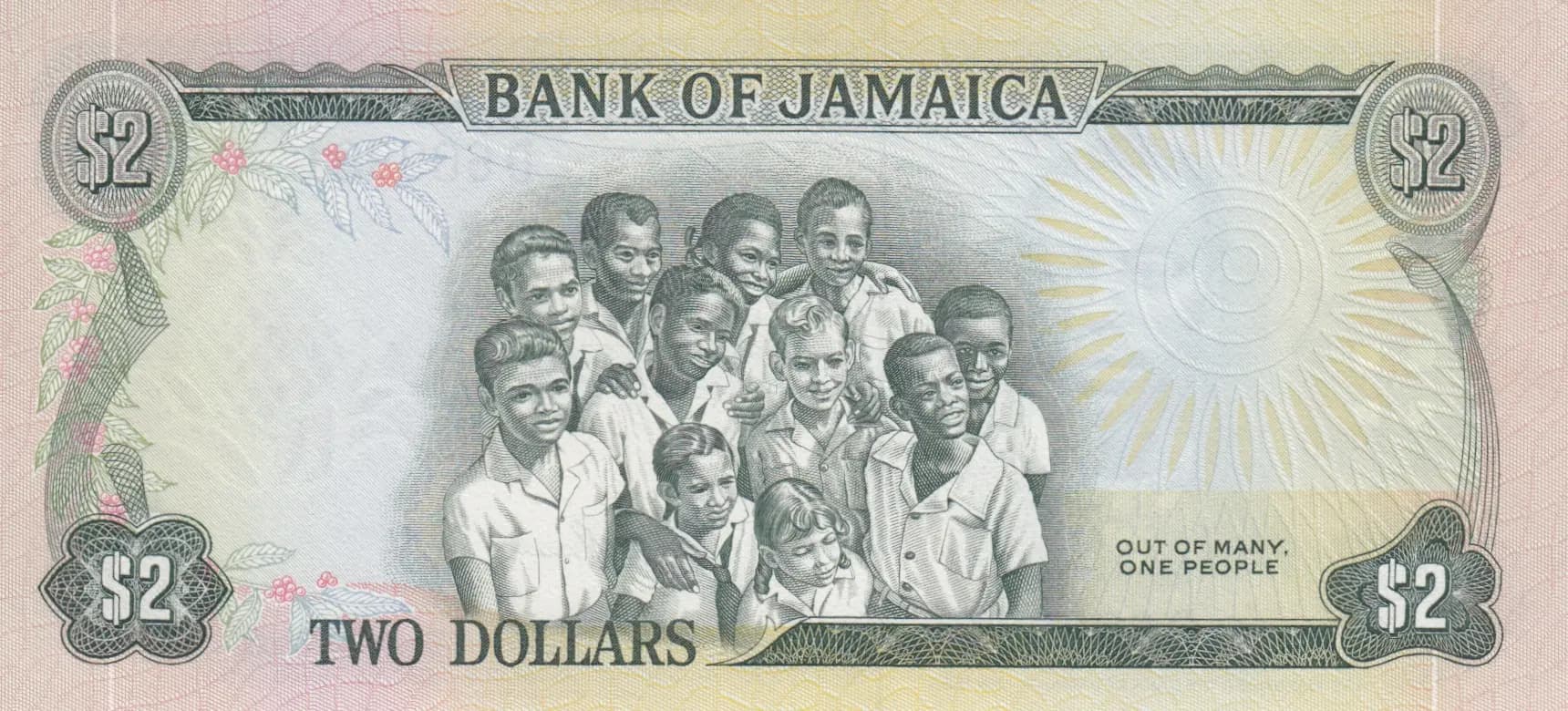
This is an uncirculated 1970 Jamaica 2 Dollar note (Pick 55) issued by the Bank of Jamaica, printed by Thomas de la Rue. The note features Paul Bogle on the obverse with a distinctive hummingbird design and the Jamaican coat of arms, while the reverse depicts students from Central Branch Primary School in Kingston representing Jamaica's multiracial population. In UNC condition with crisp paper, sharp impressions, and no visible wear, this example exemplifies the high quality of de la Rue's engraving work and represents an important piece of Jamaica's early post-independence currency.
Common. Market data from eBay transactions spanning 2014-2020 shows consistent sales in the $1-18 range, with UNC examples selling for $10-15. The 2019 catalogue value of $15 for UNC is modest and aligns with general circulation patterns for mid-20th century Commonwealth banknotes. This denomination and issuing period was produced in substantial quantities by the Bank of Jamaica. PMG population data shows minimal grading activity (1 variant recorded), which is typical for common notes that rarely warrant professional certification. No evidence of short print runs, recalls, or limited circulation that would elevate rarity status.
Issued in 1970 under the Bank of Jamaica Law of 1960, this note was produced during Jamaica's early years as an independent nation (since 1962). The deliberate inclusion of Paul Bogle, a national hero of the 1865 Morant Bay Rebellion, on the obverse reinforced national identity, while the reverse's depiction of schoolchildren of different races embodied the national motto 'Out of Many, One People,' reflecting Jamaica's commitment to unity among its diverse population during the post-colonial era.
The obverse features a formal black and white engraved portrait of Paul Bogle (1822-1865), the Jamaican national hero and leader of the Morant Bay Rebellion, positioned at the left in formal attire with collared shirt. The Jamaican coat of arms appears at lower left in red/maroon. A red-billed streamer hummingbird is depicted in the center-right area of the note, rendered in naturalistic style against the beige-tan background. Ornamental dollar sign symbols appear in circular frames in all four corners, with decorative floral border elements (leaves and flowers) on the right side. The reverse depicts approximately twelve schoolchildren of varying ages, all wearing white school uniforms, arranged in casual group formation representing the diverse racial composition of Jamaica's population. The background features radiating sun ray designs suggesting growth and optimism. Decorative floral border motifs frame both sides. The color scheme of dark green and red-brown on multicolored underprint creates visual distinction while maintaining the formal appearance appropriate to currency of the period.
Front: 'BANK OF JAMAICA' (issuing authority), '$2' and 'TWO DOLLARS' (denomination in numerals and words), 'PAUL BOGLE' (portrait identification), 'ISSUED UNDER THE BANK OF JAMAICA LAW 1960' (legal basis), 'OUT OF MANY, ONE PEOPLE' (national motto), 'GOVERNOR' (official title), serial number 'D609991'. Back: 'BANK OF JAMAICA' (issuing authority), '$2' and 'TWO DOLLARS' (denomination), 'OUT OF MANY, ONE PEOPLE' (national motto repeated). All inscriptions are in English.
Intaglio engraving (line engraving), characteristic of Thomas de la Rue's security printing methods. The note exhibits fine line work, intricate engraved patterns, complex background designs, and ornamental geometric elements typical of high-security banknote production. The precision of the portrait work, detailed rendering of clothing and facial features, and fine hatching patterns throughout indicate traditional steel plate engraving. Serial number and denomination printing appear to use standard banknote typography.
This specimen represents Pick-55a (standard variety). The note is identified as 'Law of 1960 (1970)' in catalog data, indicating it was issued under the 1960 banking legislation but printed in 1970. The 'shaded' value presentation (with values appearing in both shaded and white forms) distinguishes this from the related Pick-60 variety, which displays all values in white. No commemorative overprint is present, distinguishing it from Pick-58. Serial number prefix 'D' is consistent with standard printing from this period. The visual analysis confirms the expected design elements for this Pick number with no noted printing variations or errors.