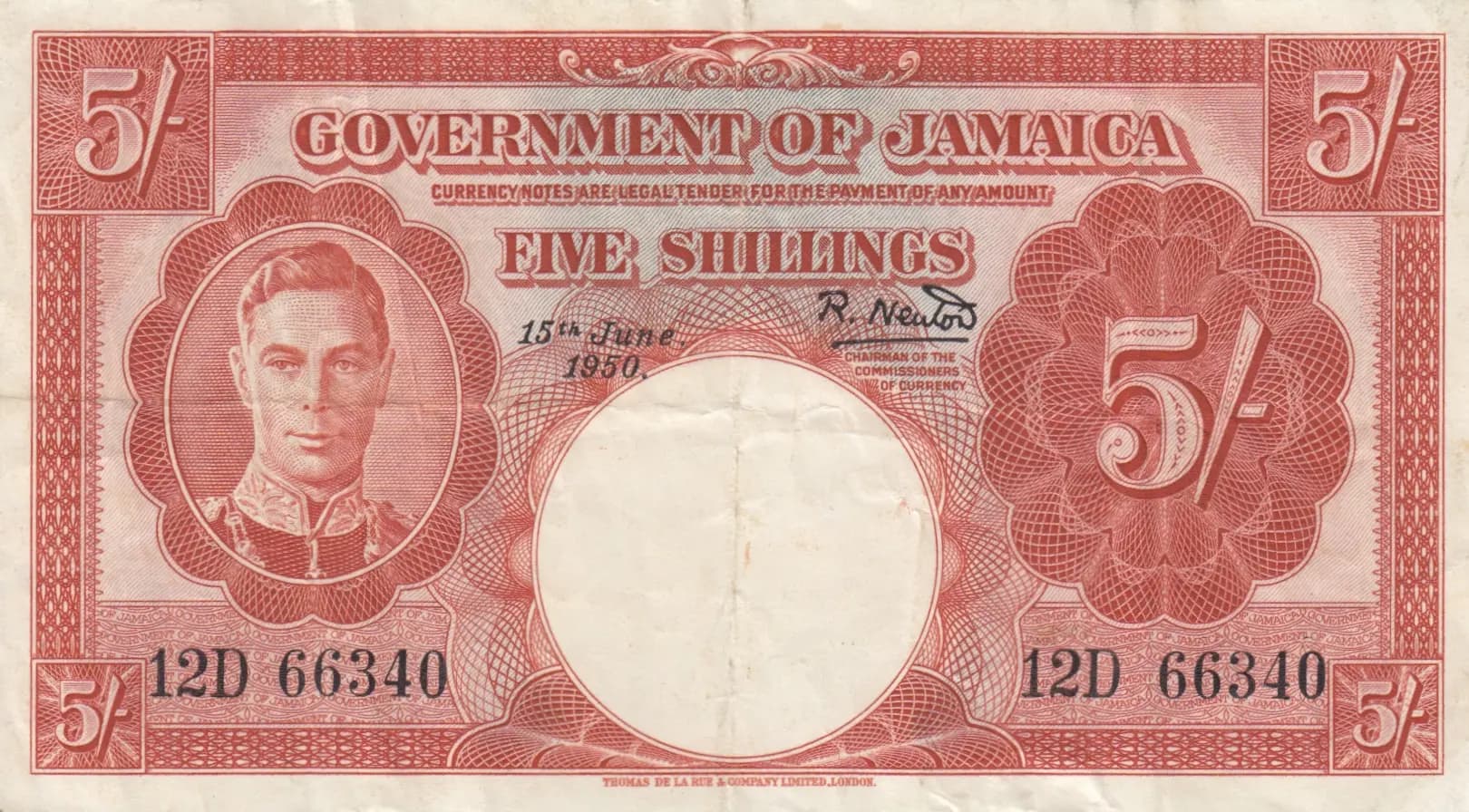
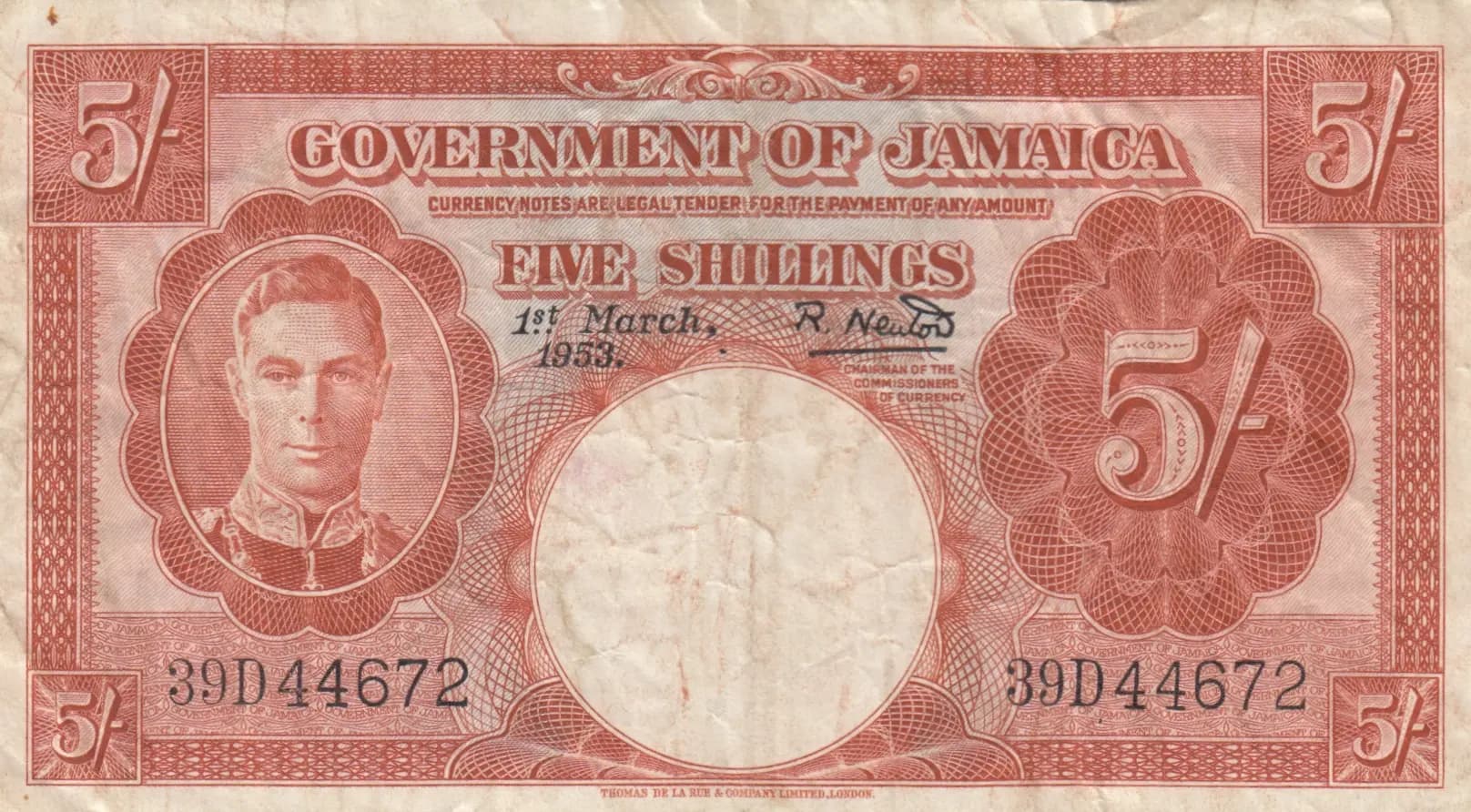
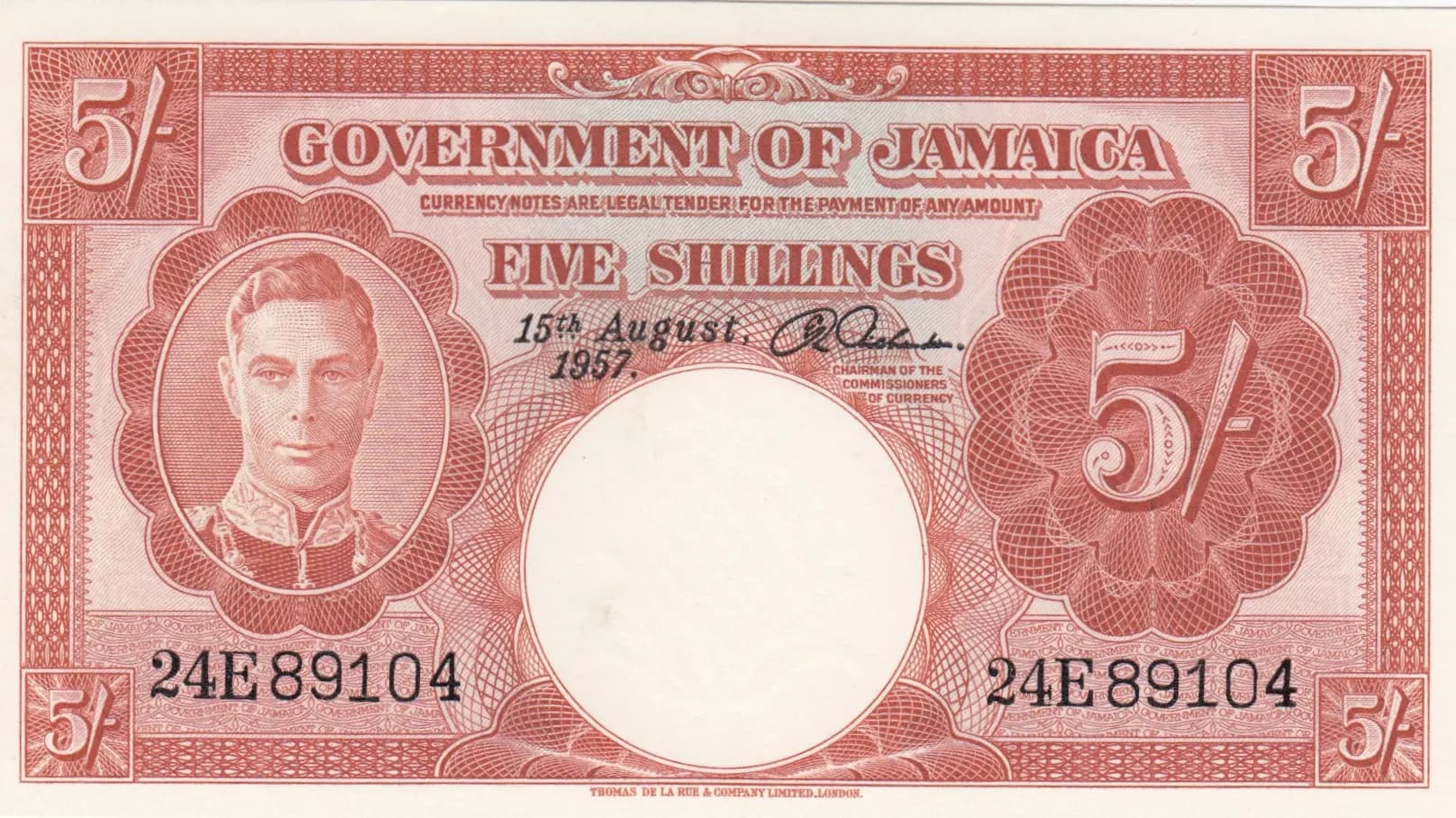
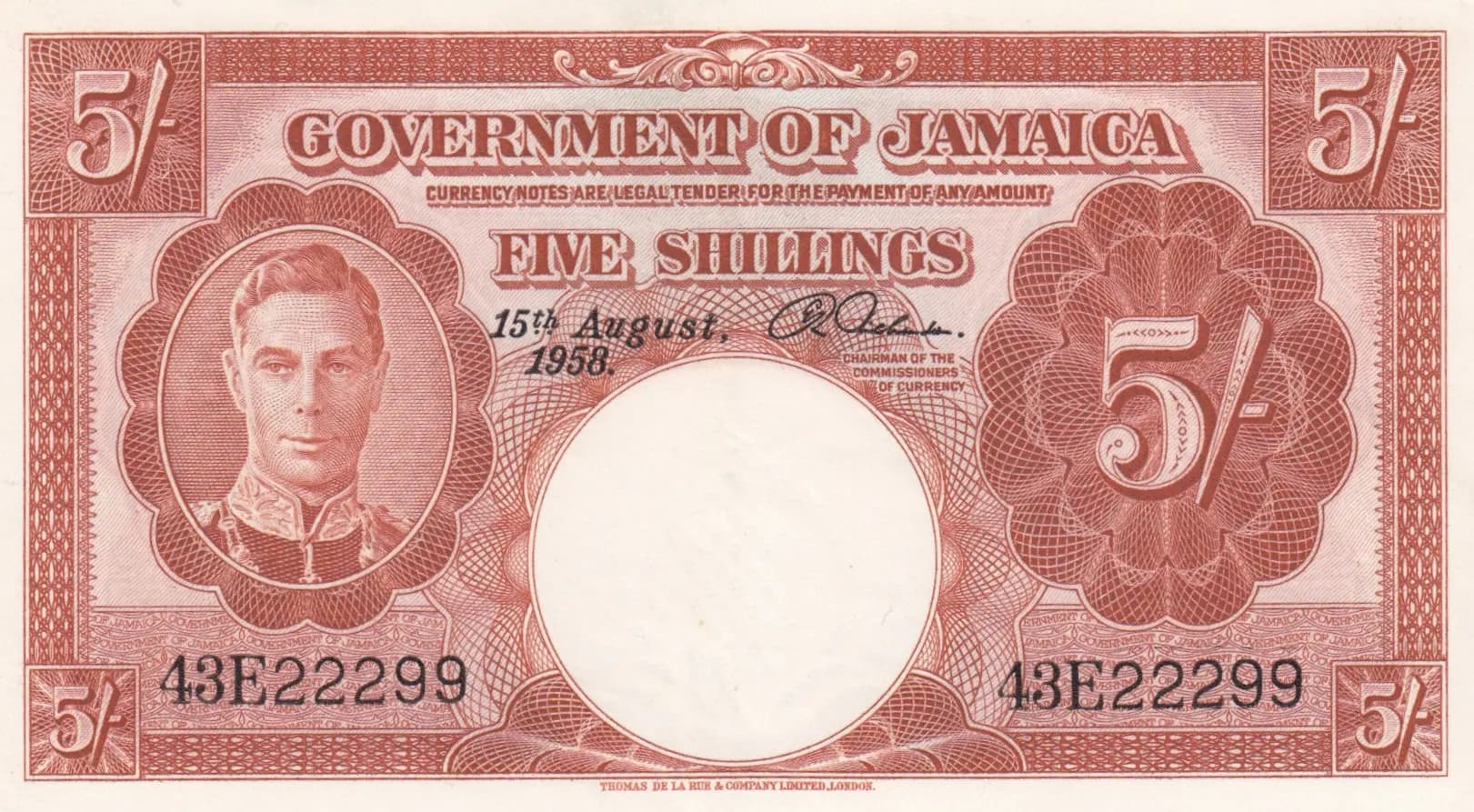
10 shillings 1958
Market Prices
16 salesAbout This Note
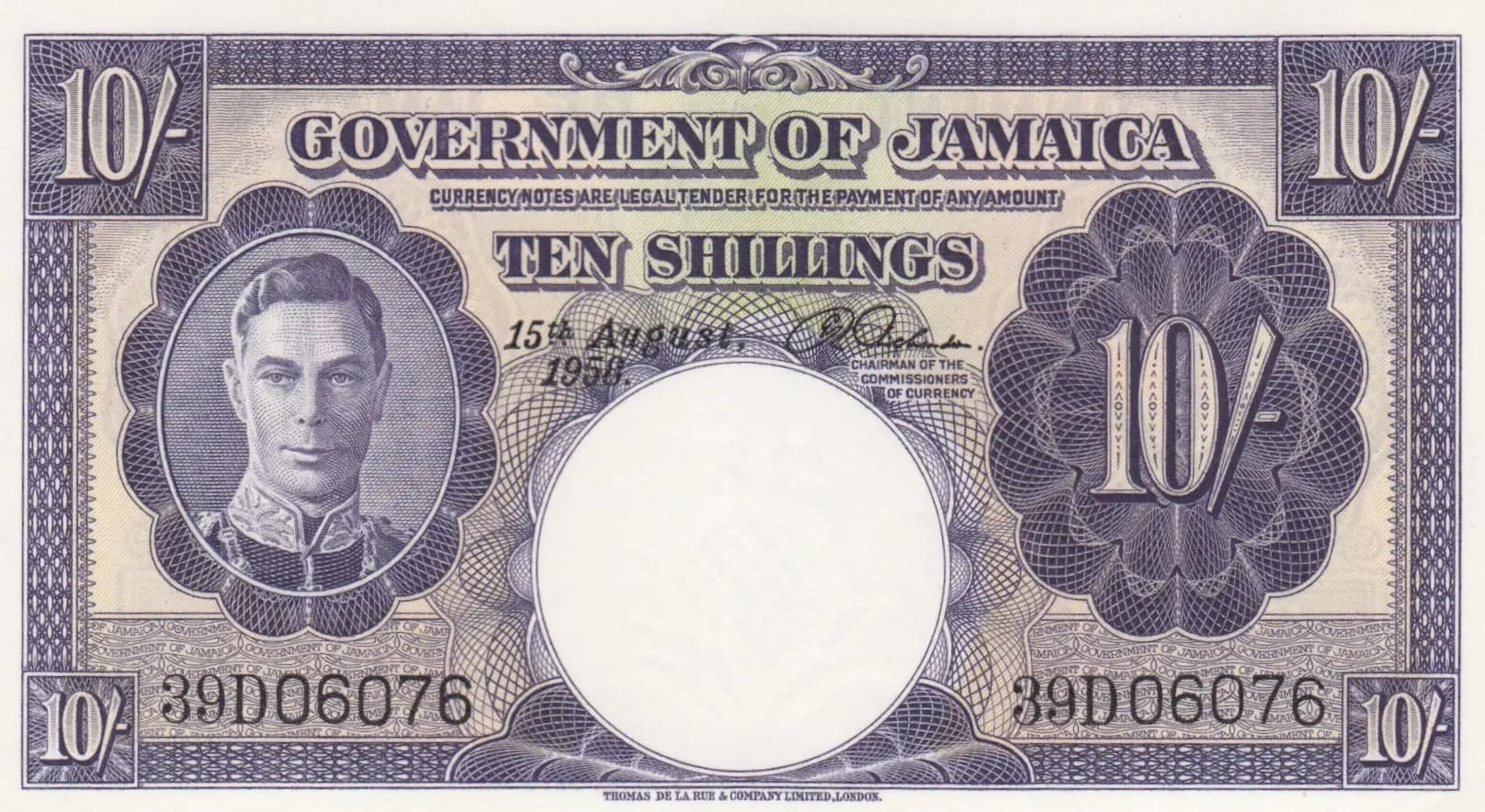
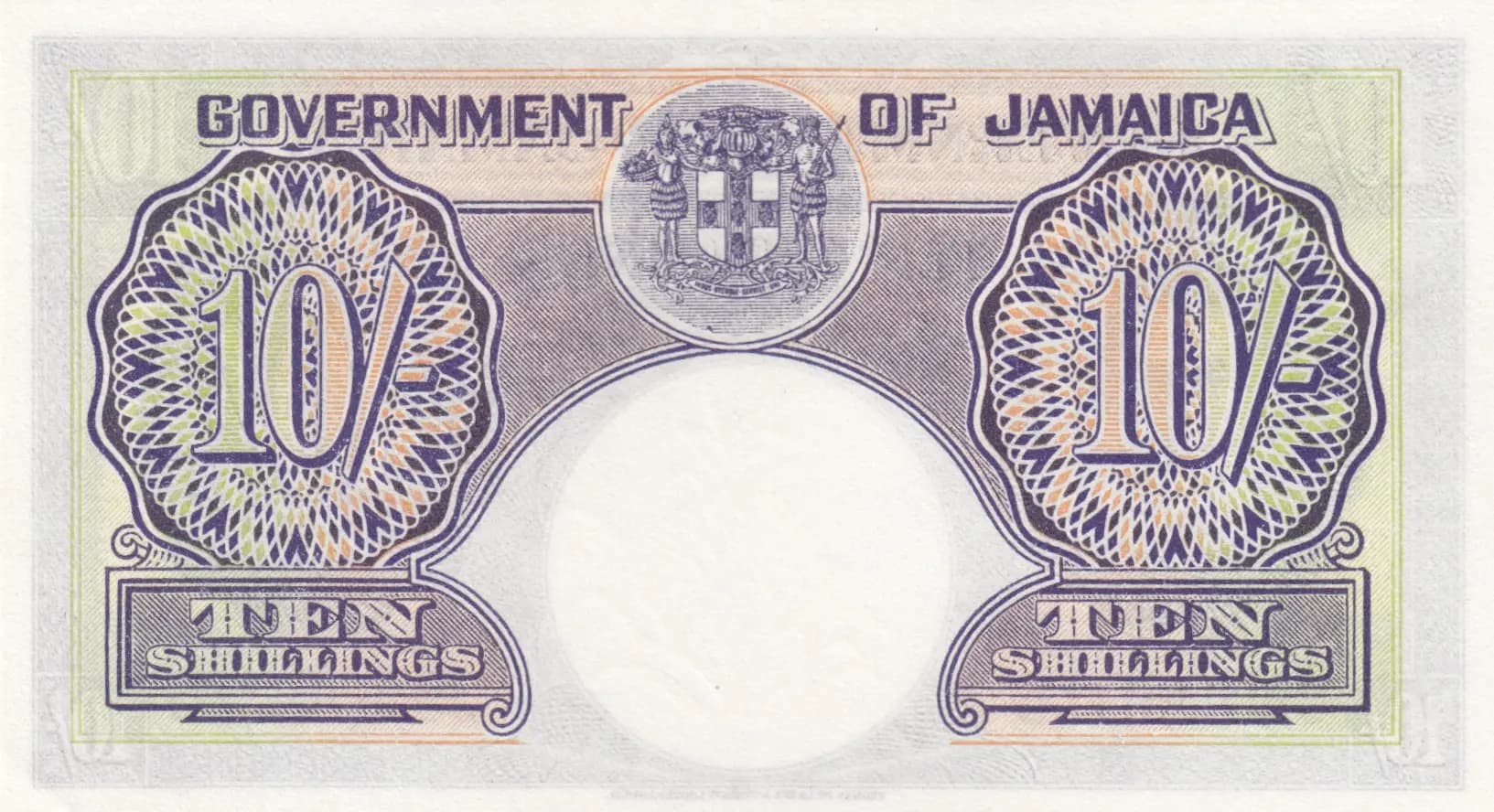
This Jamaican 10 Shillings note from 1958 (Pick P-39) is presented in uncirculated condition with pristine appearance and vibrant coloring. The note features a striking purple and multicolor design with a portrait of King George VI on the obverse and the Jamaican coat of arms on the reverse, flanked by elaborate security cartouches in green, orange, yellow, and blue. The sharp printing quality and absence of any wear, folds, or creases indicate careful preservation since issue, making this an attractive example of mid-20th century Commonwealth currency design.
Common. eBay pricing data shows this note in lower grades (F, VF) consistently selling for $11-$50, with even exceptional examples (EF, PMG 65) achieving $29-$302, indicating a healthy market supply at all condition levels. The note was issued across a 10-year period (1950-1960) with no indication of limited print runs or recall. While UNC examples command higher prices (catalog value $125 in 2016), the consistent appearance of this variety in the secondary market and the absence of any rarity designations in numismatic literature confirm this as a commonly encountered note.
Issued by the Government of Jamaica between 1950 and 1960, this note reflects Jamaica's period as a British Crown Colony, as evidenced by the prominent portrait of King George VI (who reigned until 1952) and the heraldic imagery of the colonial coat of arms. The note's circulation dates span the critical transition period leading to Jamaica's independence in 1962, making this 1958-dated variant a tangible artifact of the final years of British colonial rule in the Caribbean. The 'Commissioners of Currency' issuing authority represents the formal monetary structure maintained during this colonial administration.
The obverse features a formal portrait of King George VI positioned within an ornate scalloped oval frame on the left side, depicted in military dress with ceremonial collar insignia, reflecting his status as the reigning monarch and head of state for Jamaica during this period. The center of the note contains a large white circular space reserved for additional security elements or vignettes. Denomination indicators '10/-' are positioned in all four corners in a classical banknote layout. The reverse showcases the Jamaican coat of arms at the top center, presented within a circular heraldic frame and featuring the shield with supporting figures characteristic of the colonial-era arms. Two elaborate multicolored decorative cartouches with radiating fan-like or shell-like geometric patterns flank the central space—these serve both aesthetic and security purposes, rendered in vibrant greens, oranges, yellows, and blues. The overall design employs fine mesh crosshatch engraving patterns and baroque-inspired ornamental scrollwork throughout, typical of high-security banknote production of the era.
Front side: 'GOVERNMENT OF JAMAICA' (issuing authority), 'CURRENCY NOTES ARE LEGAL TENDER FOR THE PAYMENT OF ANY AMOUNT' (legal tender declaration), 'TEN SHILLINGS' (denomination in words), '10/-' (denomination in numeric form, appears in all four corners), '39D06076' (serial number), '1958' (year of design), 'CHAIRMAN OF THE COMMISSIONERS OF CURRENCY' (official signature line), 'THOMAS DE LA RUE & COMPANY LIMITED, LONDON' (printer identification), '15th August 1962' (note: this date appears to be a commemorative or printing date). Back side: 'GOVERNMENT OF JAMAICA' (repeated), 'TEN SHILLINGS' (denomination, appears twice flanking the coat of arms), '10' (numeric denomination within decorative cartouches, appears twice).
Intaglio engraving (line engraving), the standard security printing method for banknotes of this period. The printer is identified as Thomas de la Rue & Company Limited of London, one of the world's premier security printers, as clearly stated in the printer credit line. The multicolor security cartouches on the reverse employ sophisticated color-shifted or multi-color intaglio engraving, demonstrating the advanced security capabilities of de la Rue's production facilities. The intricate mesh patterns, fine linework, and precise registration of multiple color layers visible throughout the note exemplify the technical excellence of mid-20th century intaglio banknote production.
This specific example carries the serial number 39D06076, with the '39' prefix and 'D' letter designation identifying it within the broader P-39 issue. The catalog notes reference Pick P-38 as a similar earlier note and P-46 as a similar later variant with 'TEN SHILLINGS' rendered in a single line on the reverse (compared to the two-line format visible in this example). The 1958 date printed on the obverse represents the design date rather than the actual issue date; this note was part of the longer 1950-1960 circulation series. PMG has catalogued one primary variant for the P-39 base number, with no recognized sub-varieties distinguished by printer marks, signature variations, or serial number ranges documented in standard catalogs.