500 lire 1947
Market Prices
39 salesAbout This Note
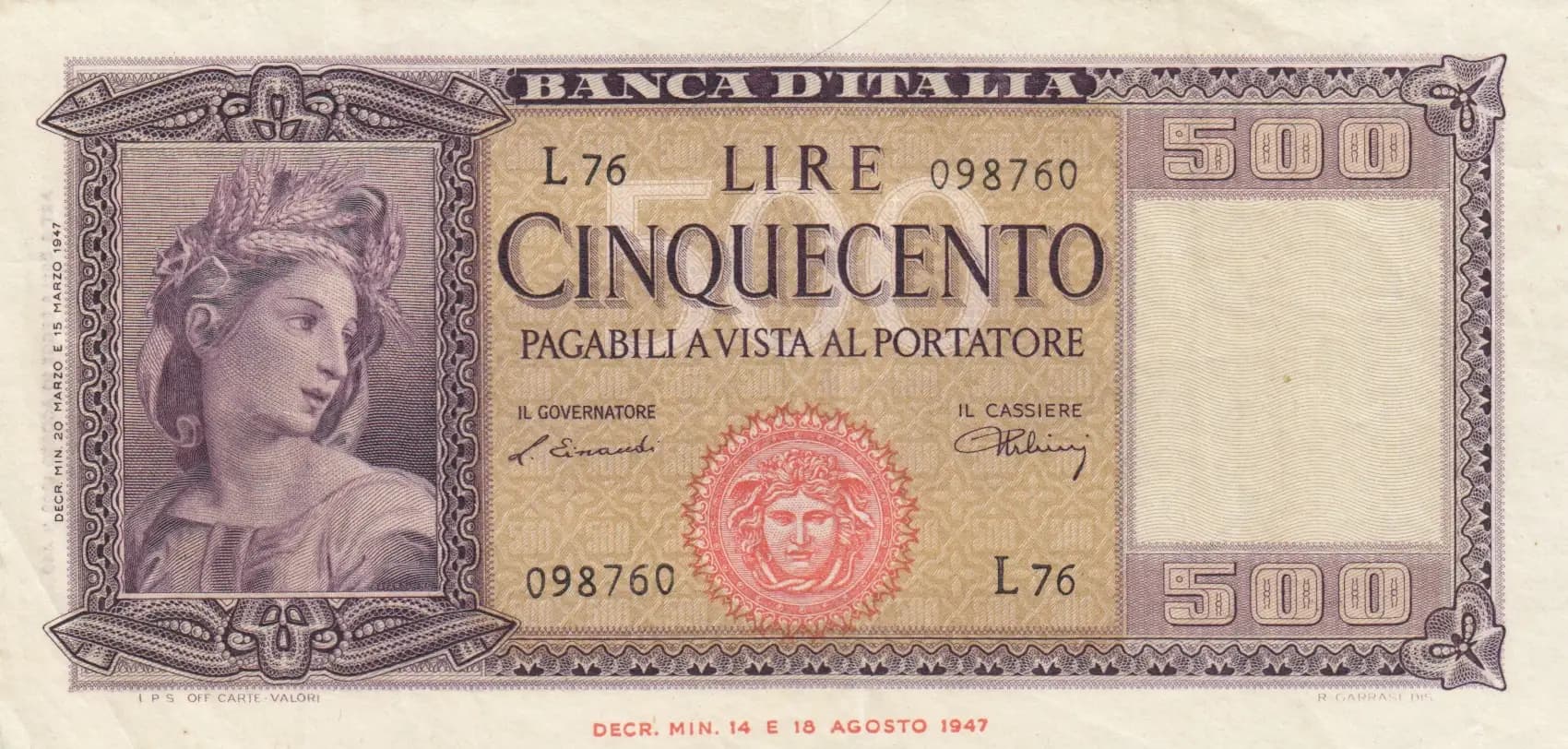
This 500 Lire note from 1947 is an excellent example of early post-war Italian currency design, featuring the iconic portrait of the Goddess Ceres in classical profile on the obverse. The VF condition specimen displays crisp, sharp printing with minimal wear, vibrant purple and cream coloring, and well-preserved ornamental borders throughout. The note exemplifies the high-quality engraving standards of Banca d'Italia during the immediate post-WWII period and remains a popular collector item due to its classical artistic design and historical significance as part of Italy's post-war monetary reconstruction.
Common. Despite the catalog value of $30 in VF condition (2016), eBay market data shows consistent availability with multiple VF examples selling for $9-$20 in recent years, indicating robust supply. The note experienced significant print runs across multiple years (1947, 1948, 1961), and examples survive in quantity in the collector market. Current prices well below catalog values suggest collector interest is moderate and supply is adequate for the demand level.
Issued in 1947 under Ministerial Decrees dated March 20 and August 14-18 of that year, this 500 Lire note was part of Banca d'Italia's post-war currency stabilization following the fall of Mussolini's regime and the return to democratic governance. The choice of Ceres, the Roman goddess of grain and agriculture, reflected Italy's post-war focus on economic recovery and agricultural renewal. The prominent 'Medusa' seal on the obverse served as an anti-counterfeiting device and became iconic among Italian collectors, with this series colloquially known as 'Ornata di Spighe' (Crowned with Wheat Ears) due to its agricultural and classical motifs.
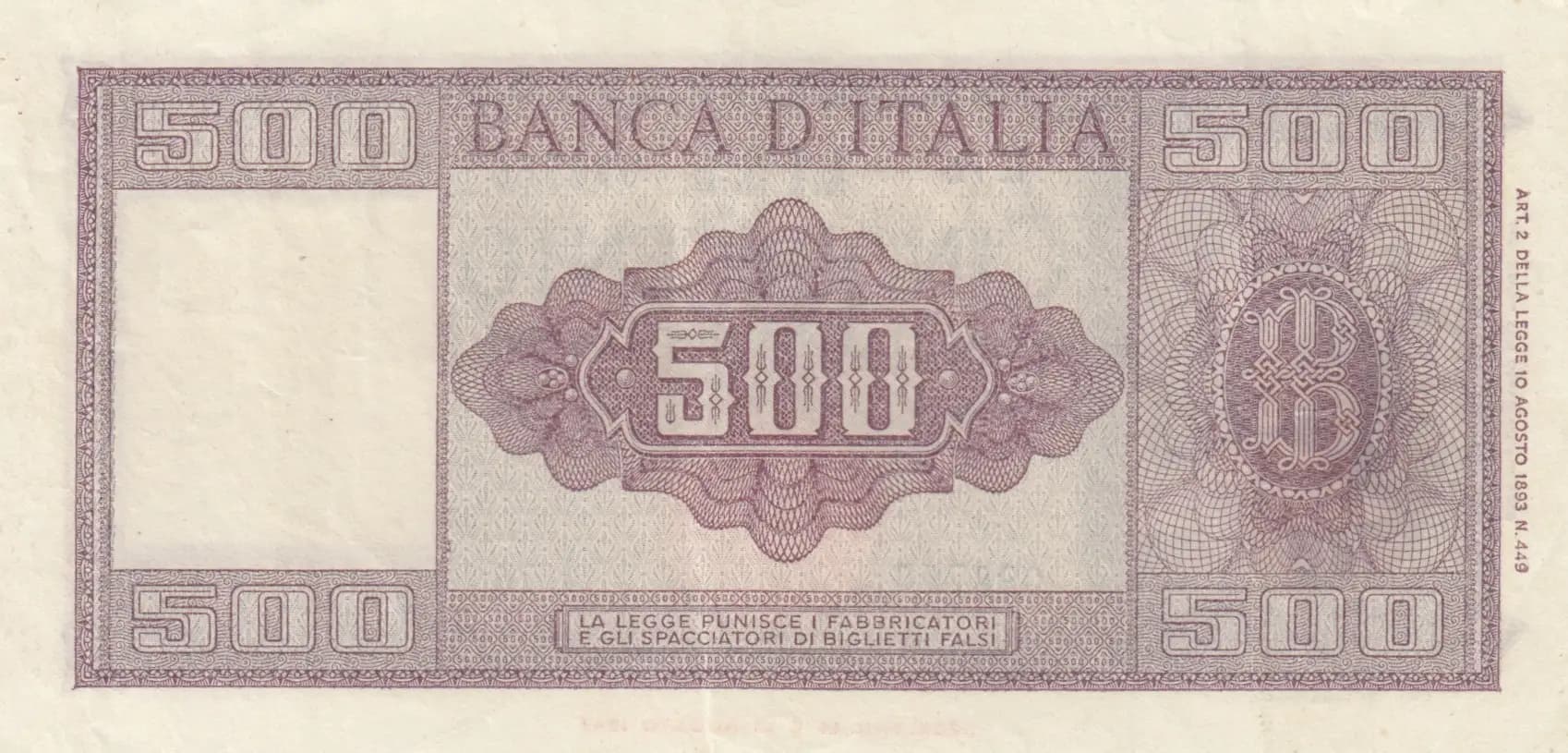
The obverse features a classical portrait of Ceres (Goddess of Agriculture) rendered in profile facing left, executed in the neoclassical tradition common to mid-20th century Italian currency design. The portrait is framed by intricate ornamental borders incorporating wheat ear motifs and floral patterns, reinforcing the agricultural symbolism. A distinctive red circular seal containing a classical Medusa motif is positioned centrally, serving both as a security feature and thematic element. The reverse displays a large ornate rosette or laurel-wreathed frame containing the denomination '500', with symmetric geometric borders, mesh patterns, and repeated corner numerals. The color scheme of purple/mauve on cream underprint was chosen for both aesthetic appeal and security purposes. Fine line engraving and detailed cross-hatching throughout the design create visual complexity intended to deter counterfeiting.
FRONT: 'Banca d'Italia' (Bank of Italy) — issuing authority. 'L 76' — series designation. '500 Cinquecento' — denomination in numerals and words. 'PAGABILI A VISTA AL PORTATORE' (Payable on demand to bearer) — legal tender declaration. 'IL GOVERNATORE' (The Governor) and 'IL CASSIERE' (The Cashier) — signature lines. 'DECR. MIN. 14 E 18 AGOSTO 1947' and 'DECR. MIN. 20 MARZO 1947' (Ministerial Decrees of 14-18 August 1947 and 20 March 1947) — legal authorization dates. Serial number '098760' and series 'L 76' appear in multiple locations. BACK: '500' — denomination repeated in all four corners and center within ornate frame. 'Banca d'Italia' — issuer identification. 'LA LEGGE PUNISCE I FABBRICATORI E GLI SPACCIATORI DI BIGLIETTI' (The law punishes the manufacturers and dealers of counterfeit notes) — anti-counterfeiting warning. 'ART 2 DELLA LEGGE 4 AGOSTO 1948 14-49' (Article 2 of the Law of 4 August 1948) — legal reference.
Intaglio (engraved) printing, produced by I.P.S. - Officina Carte-Valori, Rome. The visual characteristics—fine parallel line work, detailed cross-hatching, sharp definition of portraits and ornamental elements, and the precise color registration visible between the purple primary design and cream underprint—are all hallmarks of classic intaglio production. Security features incorporate color separation printing and intricate engraved patterns designed to be difficult to replicate with period counterfeiting methods.
This is the Pick 80a variety, identified by the 'Type B' seal (Medusa seal) and 1947 issue date. The note displays signatures of Einaudi (Governor) and appears to have 'Athling' or similar Cashier signature, which places it within the early 1947-1948 signature variant. Series marking 'L 76' visible on the specimen. The 1947 date, combined with the Medusa seal type and this signature combination, distinguishes it from later 1961 issues (which would typically show different signatures). No major known varieties are recorded for this Pick number beyond signature and date variations across the three-year issuance period.