5 lire 1904
Market Prices
21 salesAbout This Note
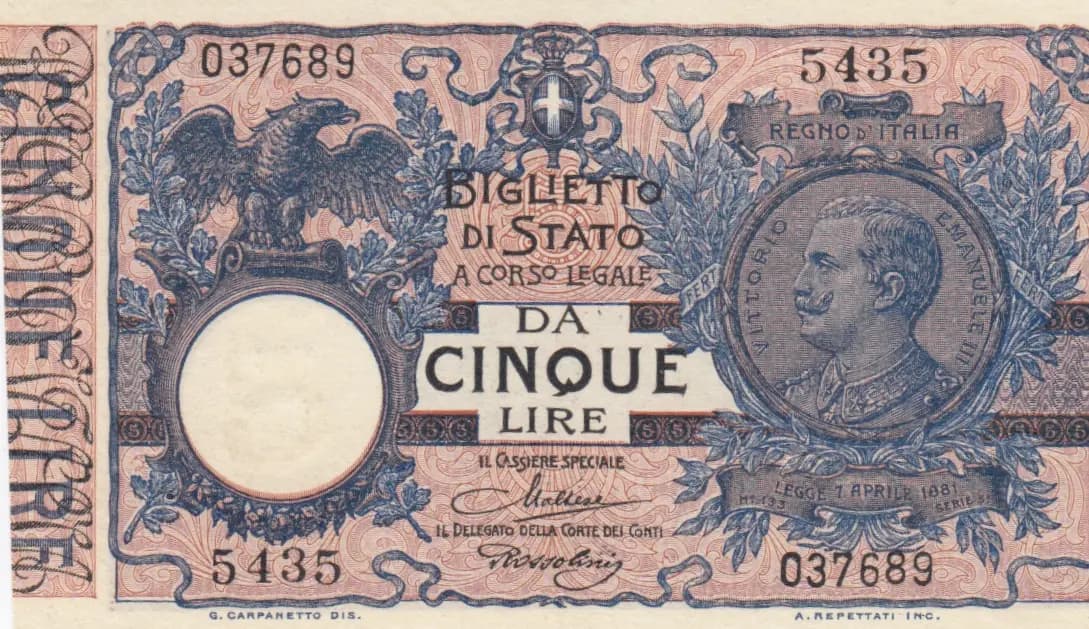
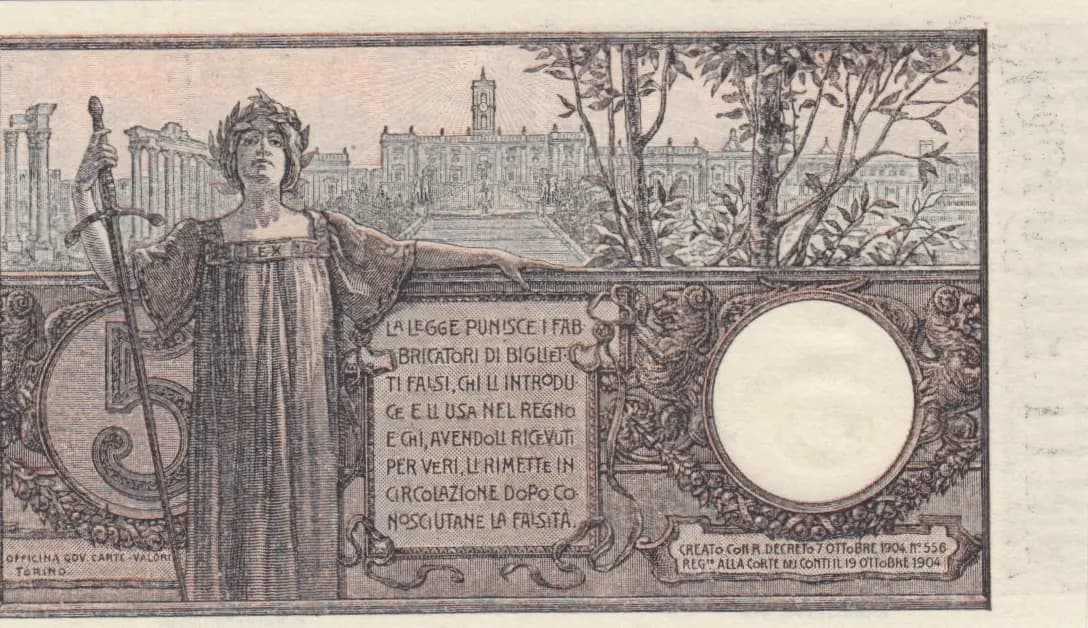
This 1904 Italian 5 Lire Biglietto di Stato (Pick P-23f) presents a stunning example of early 20th-century numismatic artistry in About Uncirculated condition. The note features elaborate Art Nouveau design with pink and blue coloring on the obverse, showcasing a portrait medallion of King Vittorio Emanuele III alongside ornate scrollwork and an imperial eagle emblem, while the reverse displays an allegorical female figure (Italia) in classical style before a cityscape backdrop. The intricate engraved detail work, minimal handling wear, and exceptional preservation make this an attractive example of this foundational Italian state banknote issue.
Common. The eBay price data provided shows consistent sales in the $4–$21 range for F-VF grades over more than a decade of transaction history, with UNC examples cataloged at approximately $90 according to 2016 values. This indicates substantial circulation in the collector market and no artificial scarcity. The note was issued as a regular circulation banknote under government authority and was produced in quantities sufficient to support regular monetary circulation. The AU grade specimen observed here, while well-preserved, remains within normal supply parameters for this foundational Italian issue.
Issued under Royal Decree of October 7, 1904, and registered with the Corte dei Conti (Court of Accounts) on October 19, 1904, this note represents the Kingdom of Italy's assertion of monetary sovereignty during the reign of Vittorio Emanuele III. The allegorical imagery of Italia holding sword and shield, depicted against an identifiable Italian cityscape (Piazza del Campidoglio, Rome), reflects nationalist sentiment and classical themes prevalent in early 20th-century European state design. The legal disclaimer on the reverse regarding counterfeiting penalties underscores the government's commitment to protecting the nascent state banknote currency system under the 1881 Law.
The obverse presents King Vittorio Emanuele III in right-facing circular portrait medallion, characteristic of Italian state banknotes of this era. The composition is dominated by Art Nouveau ornamental elements: elaborate scrollwork, floral motifs rendered in fine engraved line work, spiral corner decorative patterns, and a crowned imperial eagle emblem positioned centrally above a shield bearing the House of Savoy cross. The color scheme employs pink/salmon undertones with blue and black ink overlay, creating a visually sophisticated palette typical of 1904 Italian banknote design. The reverse features the allegorical personification of Italia as a classical female figure in flowing robes, wielding a sword and shield, positioned before an identifiable cityscape featuring the Piazza del Campidoglio in Rome with its distinctive architecture and tower. The elaborate decorative border frames the central motif, reinforcing the institutional prestige of the issuing authority.
FRONT: 'Regno d'Italia' (Kingdom of Italy); 'Biglietto di Stato' (State Banknote); 'A Corso Legale' (Legal Tender); 'Da Cinque Lire' (Five Lire); 'Il Cassiere Speciale' (The Special Cashier); 'Legge 1 Aprile 1881' (Law of April 1, 1881); Designer credit 'G. Carparetti dis.' (G. Carparetti designed) and 'A. Repettati inc.' (A. Repettati engraved); Serial numbers visible. BACK: 'La legge punisce i fabbricatori di biglietti falsi che li introducono e li usano nel Regno e chi avendoli ricevuti per veri, li rimette in circolazione dopo conosciutane la falsità.' (The law punishes manufacturers of counterfeit banknotes who introduce and use them in the Kingdom and anyone who, having received them as genuine, puts them back in circulation after discovering their falsity); 'Creato con Decreto 7 Ottobre 1904 N° 556' (Created by Decree October 7, 1904 No. 556); 'Registrato alla Corte dei Conti 19 Ottobre 1904' (Registered to the Court of Accounts October 19, 1904); 'Officina Gov. Carte Valori Roma' (Government Office Security Papers Rome).
Intaglio engraving (line engraving), executed by the Officina Governativa Carte-Valori (Government Security Printing Office) located in Turin (noted on back as Rome in some variants, reflecting administrative designation). The fine detail work, intricate line cross-hatching visible throughout both obverse and reverse, and the precise portrait rendering are characteristic of high-security intaglio production. The incorporation of multiple circular watermark areas (visible as blank white spaces in the images) indicates the use of specialized security paper with integral watermark design. This represents the pinnacle of early 20th-century anti-counterfeiting security printing technology employed by the Kingdom of Italy.
This specimen is identified as Pick P-23f with watermark type '5'. The PMG population report identifies three distinct catalog variants for this base Pick number: P-23e, P-23f, and P-23g, each differentiated by watermark specifications. The P-23f variant specifically carries a '5' watermark, distinguishing it from other contemporary printings. Serial numbers visible in the image (0376889 and 5435) suggest this note is from the standard production run. No overprints, signature variations, or other distinguishing markings suggesting a limited or exceptional sub-variety are apparent in the visual analysis.