5 lire 1943A
Market Prices
9 salesAbout This Note
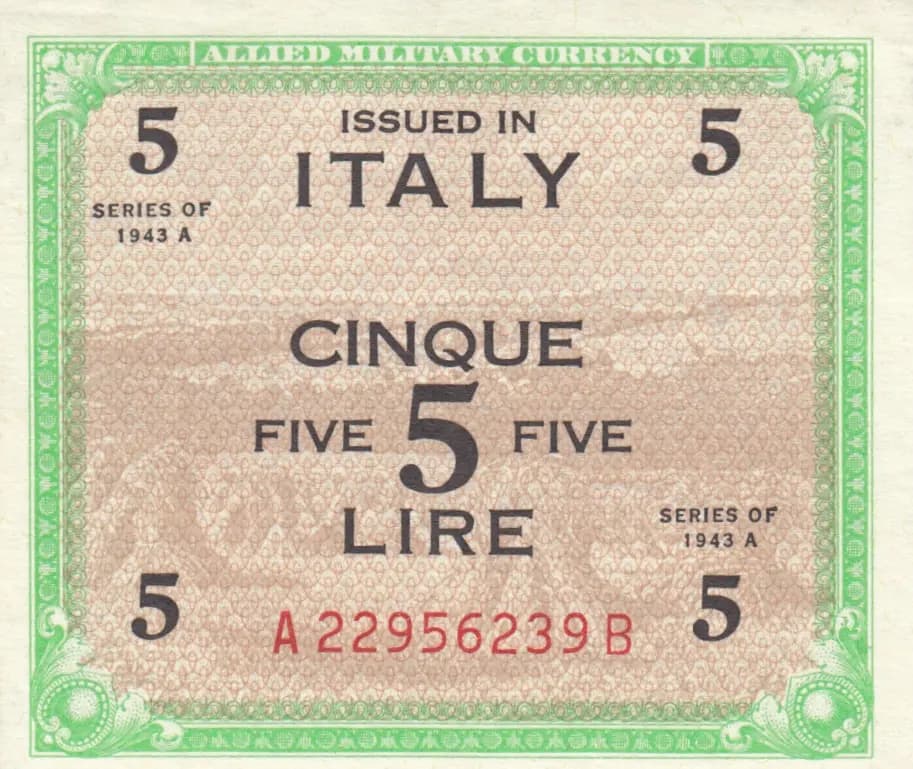
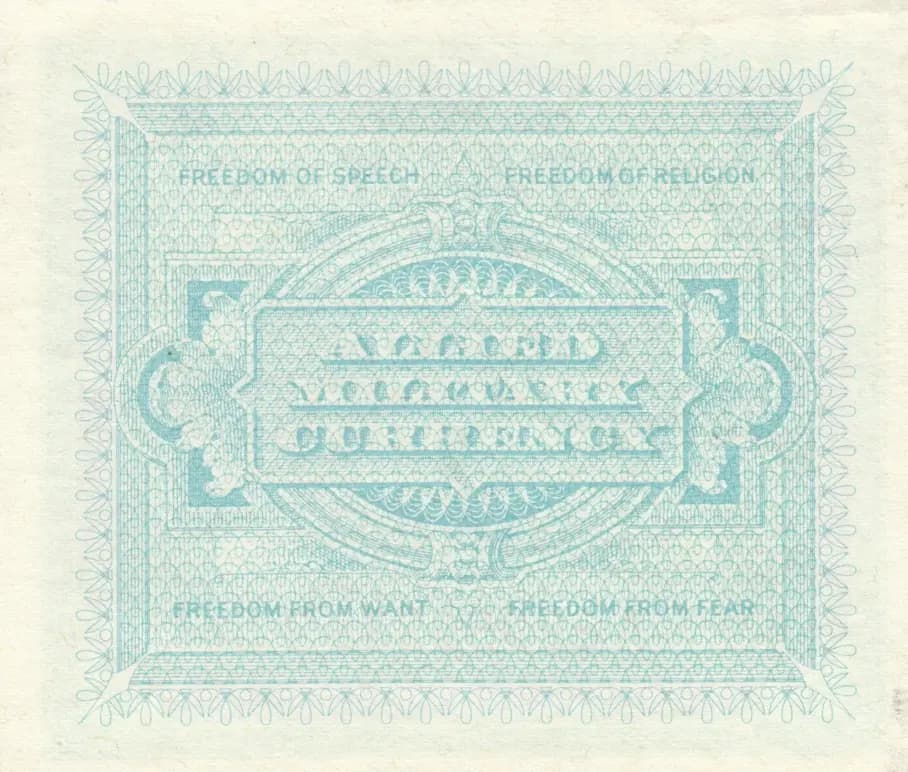
This is an exceptional example of the 1943A Italian Allied Military Currency 5 lire note, graded AU by the catalog, displaying crisp uncirculated condition with no visible wear, creases, or damage. The note features distinctive green and turquoise coloration with ornamental borders and a repeated decorative pattern field, along with the Four Freedoms (Freedom of Speech, Religion, from Want, and from Fear) prominently displayed on the reverse. As a military payment note issued during the Allied occupation of Italy, this piece represents an important transitional currency and remains highly collectible despite being relatively common in the marketplace.
Common. The eBay transaction history shows consistent sales ranging from $1.54 to $27.03 depending on condition, with most AU/AUNC examples selling in the $8-$14 range. The catalog 2008 valuation of $7.50 for UNC further confirms this is a readily available note. The Allied Military Currency program produced millions of notes across multiple denominations and series, and the 5 lire denomination appears to have been issued in substantial quantities. While PMG has graded variants of this note, the absence of documented scarcity indicators (no recall history, no restricted printing run, stable market availability) establishes this as common even in AU condition.
This note was issued in 1943 during the Allied invasion and occupation of Italy in World War II, serving as military payment currency for occupying American forces and Italian civilian commerce. The reverse prominently features Franklin D. Roosevelt's Four Freedoms—foundational principles of American democratic ideals—which were used extensively in Allied wartime messaging to legitimize the occupation and promote democratic values to the Italian population. The bilingual English-Italian inscriptions and the deliberate omission of any fascist symbolism reflect the broader effort to establish a post-Mussolini civic order under Allied military administration.
The front features a utilitarian but elegant design with a green-framed border containing ornamental corner flourishes and a centered beige field with a repeating geometric security pattern. Large black corner numerals '5' appear in all four corners. The center contains straightforward English text identifying the currency type and issue series. The reverse displays a more elaborate classical design in turquoise and cream, dominated by a symmetrical central cartouche with ornamental scrollwork and floral motifs in the classical style. The Four Freedoms are distributed around the decorative border—one per side—creating a balanced, propaganda-like composition. No portraits or historical landmarks are depicted; instead, the design emphasizes abstract democratic symbolism through decorative restraint and textual messaging. The overall aesthetic reflects mid-20th-century American military design standards combined with classical European ornamental traditions.
FRONT: 'ALLIED MILITARY CURRENCY / ISSUED IN / ITALY / SERIES OF 1943 A' (English); 'CINQUE LIRE' (Italian: Five Lire); 'FIVE' (corner denominations); Serial number: A22956239B. BACK: 'FREEDOM OF SPEECH' / 'FREEDOM OF RELIGION' / 'FREEDOM FROM WANT' / 'FREEDOM FROM FEAR' (The Four Freedoms, English). All inscriptions appear in English on the front with Italian denomination text, while the reverse exclusively features English-language statements of democratic principles.
Intaglio (engraved) printing on both sides, typical of United States government currency production during the WWII era. The sharp definition of corner ornaments, fine line work in the security pattern background, and precise registration of multi-color overprinting (green on front, turquoise on reverse) are characteristic of the Bureau of Engraving and Printing (BEP) methods used for AMC notes. The even ink distribution and absence of printing imperfections visible in the visual analysis confirm professional security printing standards.
This is cataloged as Pick P-M18b (5 Lire, 1943A series, Italy). The catalog data indicates a variant P-M18a exists; this specimen appears to be the P-M18b variant based on the specific serial number format (A22956239B) and design characteristics. The 'A' designation in 'SERIES OF 1943 A' indicates this is from the first series issued in 1943. Serial numbers with this prefix and format are consistent with early production runs of the Italy AMC program.