30 lire 1880
About This Note
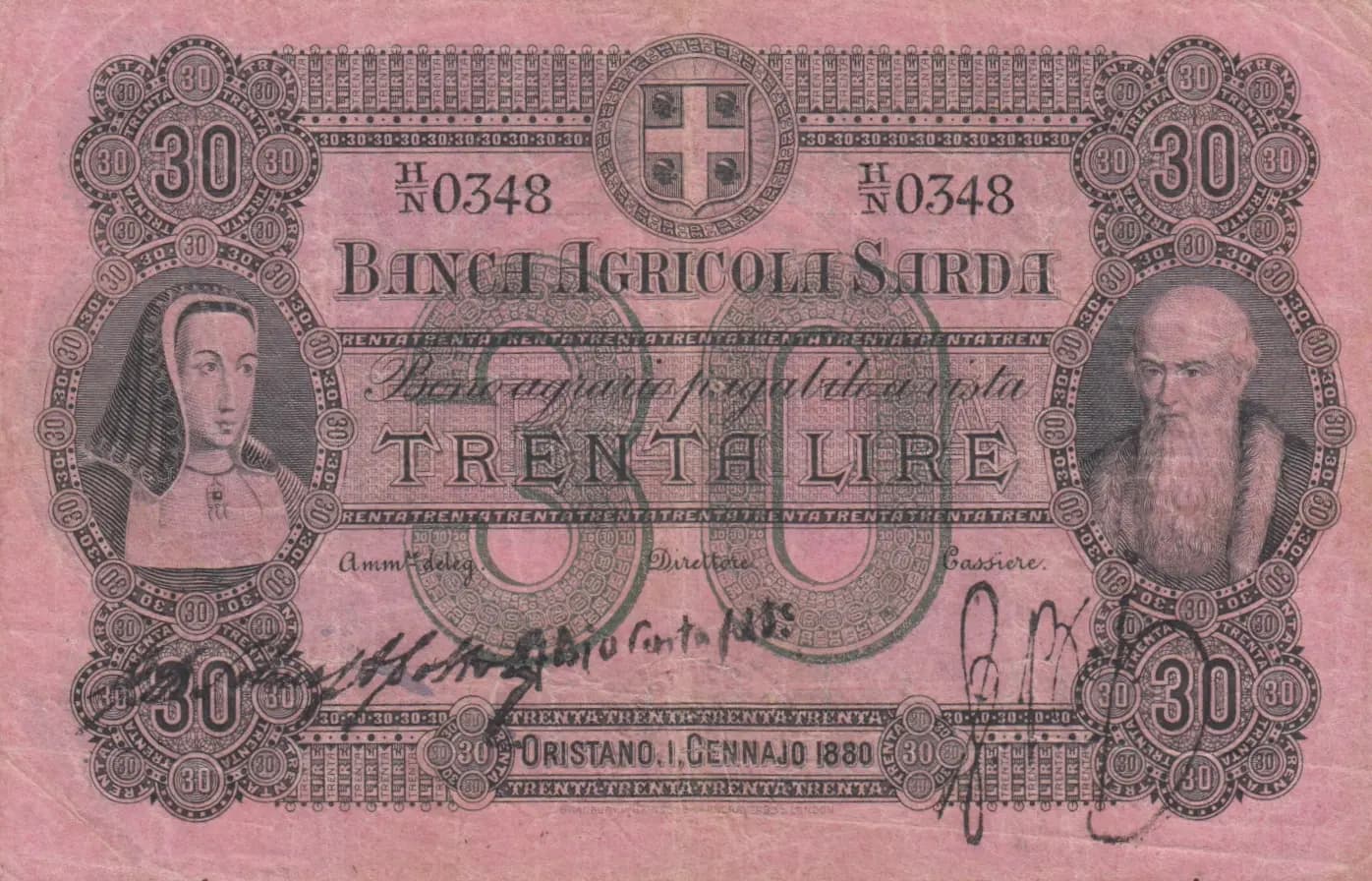
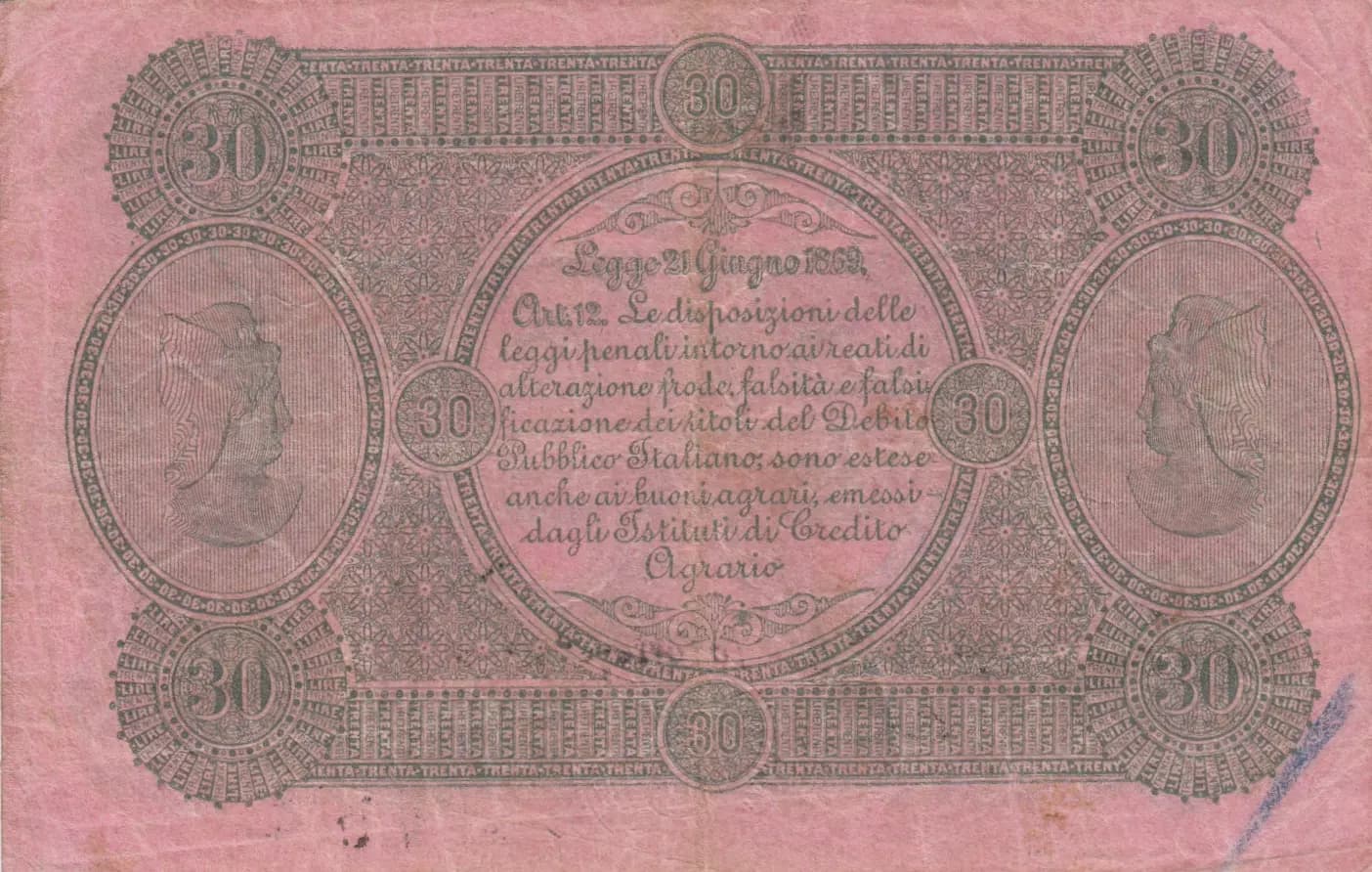
This is a VF-graded 30 lire banknote issued by the Banca Agricola Sarda on January 1, 1880, from Oristano. The note displays the characteristic ornate design typical of 19th-century Italian regional bank issues, with two male portrait medallions on the front and female portrait medallions on the reverse, framed by intricate geometric borders featuring repeating circular denominational elements. Despite showing expected signs of age including foxing, discoloration, and muted pink coloration, the note retains excellent legibility and structural integrity, with handwritten administrative signatures still clearly visible.
common. Regional Italian agricultural bank notes from the 1880s, while not in everyday circulation today, were issued in substantial quantities by the Banca Agricola Sarda. The VF condition grade indicates this is a well-preserved example of a note type that, while attractive to collectors of Italian regional currency, does not command premium pricing typical of rare or scarce issues. The survival of multiple examples in various collections and the moderate denominational value (30 lire) suggest adequate original print runs. Pricing in specialized markets for similar Pick-numbered notes typically ranges from $25-$60 USD, consistent with common status rather than rarity.
The Banca Agricola Sarda (Agricultural Bank of Sardinia) was a regional credit institution established to support Sardinian agricultural development during the post-unification period. This 1880 issue reflects the broader Italian system of regional agricultural credit institutions, which were granted authority to issue their own banknotes under the Law of June 21, 1863—specifically referenced on the note's reverse, which emphasizes the legal framework protecting such securities against fraud and falsification. The Oristano dating and Sardinian issuer represent the decentralized financial structure of late 19th-century Italy before the centralization of note issuance under the Banca d'Italia.
The note features a symmetrical design typical of 1880s Italian regional bank issues. The front displays two male portrait medallions in oval frames positioned on the left and right margins—the left figure appears younger with dark hair and facial hair, while the right figure is an older man with a fuller beard. The center of the note features a coat of arms displaying a shield with a cross design, likely representing Sardinia or the bank's heraldic authority, positioned above the prominent 'TRENTA LIRE' denomination text. The reverse mirrors this symmetrical layout with female portrait medallions in the same positions, though their specific identities are not definitively established from the visual evidence. Both sides employ ornate decorative borders composed of repeating geometric patterns and circular medallions containing the numeral '30'. The central cartouche on the reverse contains the legal text regarding fraud provisions. The entire design emphasizes security through elaborate ornamentation and fine detail work.
FRONT SIDE: 'BANCA AGRICOLA SARDA' (Agricultural Bank of Sardinia); 'TRENTA LIRE' (Thirty Lire); 'ORISTANO, I GENNAIO 1880' (Oristano, January 1, 1880); Serial number 'HN0348'; Administrative titles 'Amministratore' (Administrator), 'Direttore' (Director), and 'Cassiere' (Cashier). BACK SIDE: 'Legge 21 Giugno 1863' (Law of June 21, 1863); 'Art. 12. Le disposizioni delle leggi penali intorno ai reati di alterazione frode, falsità e falsificazione dei titoli del Debito Pubblico Italiano; sono estese anche ai buoni variari emessi dagli Istituti di Credito Agrario' (Art. 12. The provisions of the penal laws concerning crimes of alteration, fraud, falsity and falsification of titles of Italian Public Debt are extended also to the securities issued by Agricultural Credit Institutions).
This banknote was produced using intaglio (engraved) printing, as evidenced by the deep, precise geometric patterns, fine line work in the borders, and the sharp detail visible in the portrait medallions and coat of arms. The intricate repeating circular patterns and the quality of the decorative elements are characteristic of high-security intaglio printing employed for banknotes of this era. The printer for this specific Pick number is not definitively documented in standard references, but Banca Agricola Sarda notes of this period are believed to have been produced by Italian security printers operating under contract to regional agricultural credit institutions.
The observed variety is identified by the serial number prefix 'HN0348' and the specific date of issue 'I GENNAIO 1880' (January 1, 1880). The Pick catalog designation P-S921c indicates this is part of the cataloged variety series for 30 lire issues by this issuer. The handwritten signatures and administrative notations visible on this example are consistent with standard administrative practice for 1880 and do not indicate a distinct cataloged variety. No overprints or significant printing variations are apparent from the visual analysis, suggesting this represents the standard first-issue variety of this denomination.