1000 lire 1965
Market Prices
18 salesAbout This Note
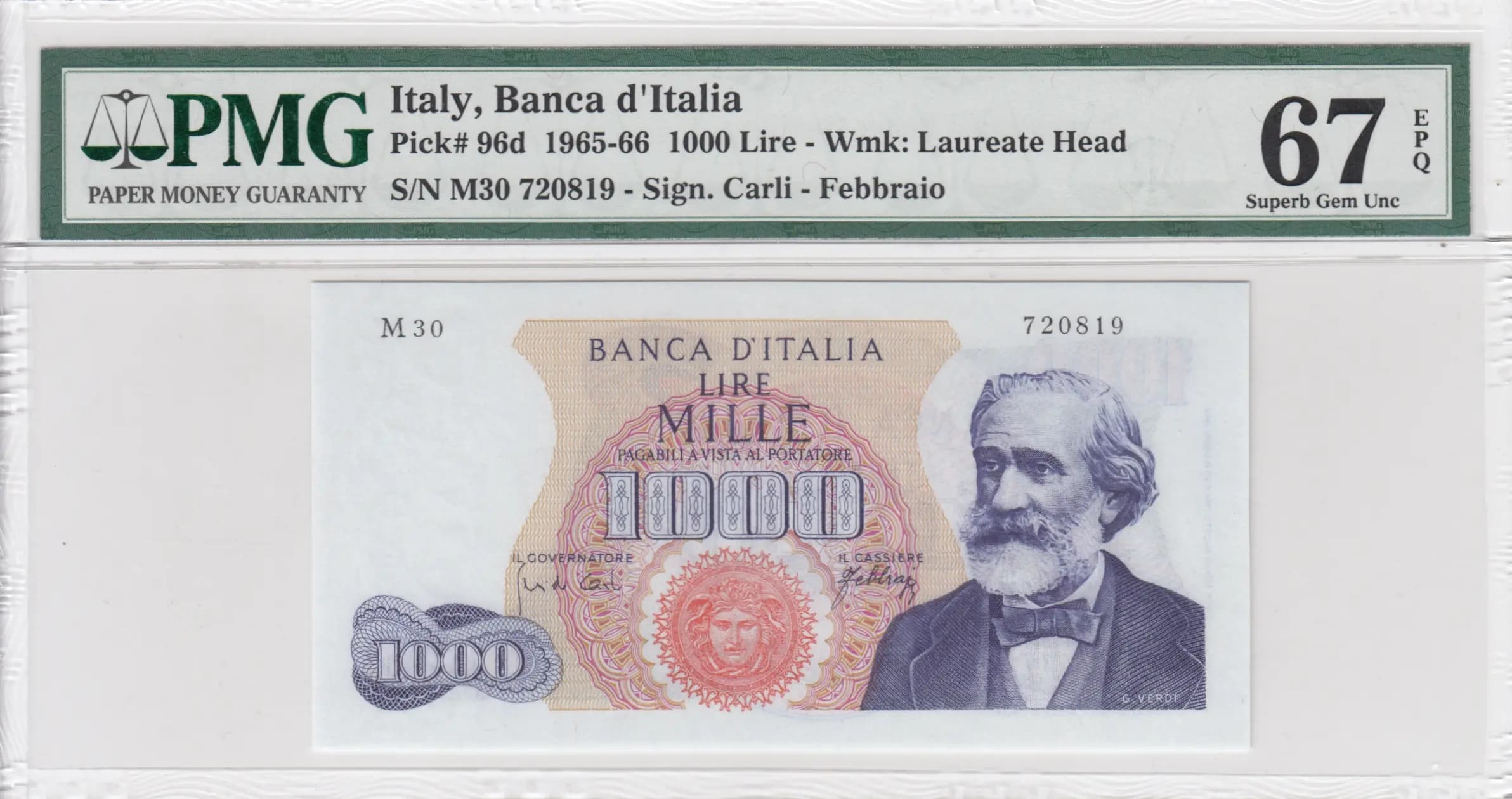
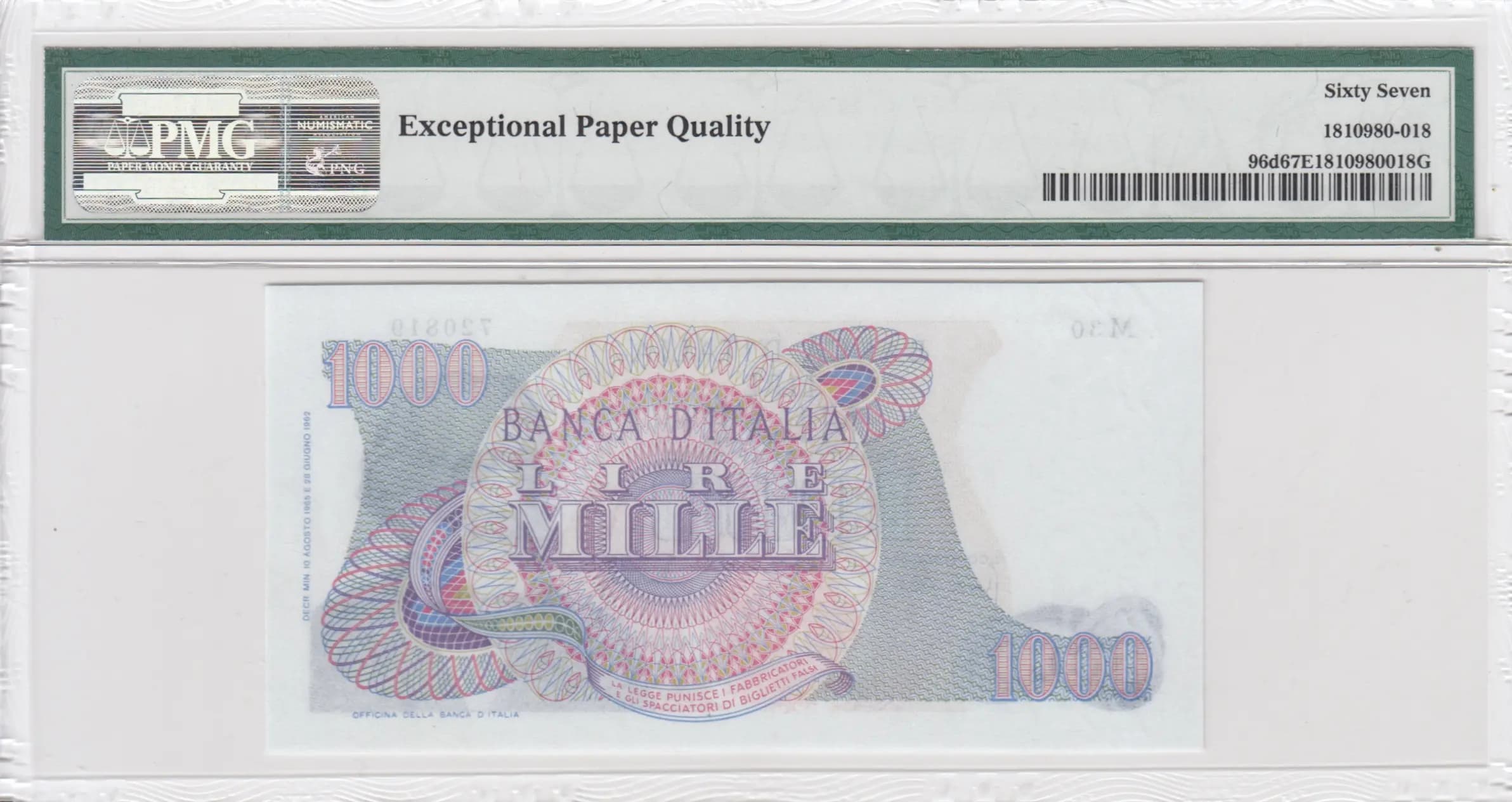
This 1000 Lire note from Banca d'Italia represents the classic 1965 issue featuring composer Giuseppe Verdi in formal bow-tie attire on the obverse. The note exhibits exceptional condition graded PMG 67 EPQ (Superb Gem Uncirculated), with pristine paper quality, sharp printing, and no visible wear or handling—making it an outstanding example of Italian mid-century currency design. The intricate guilloche patterns and ornate rosette medallions on both sides demonstrate the sophisticated security printing employed by Banca d'Italia during this period.
Common. Secondary market eBay data shows consistent sales across a wide range of grades (F to AUNC) from 2014-2022, with VF-grade notes regularly bringing $4.96-$17.50 and lower grades selling for $1-$7. Even professionally graded examples (PMG 63 sold for $52 in 2018) indicate a reasonable population of graded specimens. The high catalog values for UNC ($115) versus circulated grades, combined with the note's accessibility in most conditions, confirm this is a standard issue with substantial print runs. The PMG 67 EPQ grade represents the upper end of available specimens but does not indicate rarity—merely exceptional preservation of a common note type.
This note was issued during Italy's post-war economic stabilization period (1962-1968 production run), when the Italian lira remained a major European currency. The choice of Giuseppe Verdi—Italy's most celebrated operatic composer—reflects national pride in cultural achievement during the 1960s economic expansion. The classical male head in profile within the central medallion and the ornamental design language evoke Renaissance artistic traditions, connecting contemporary Italian currency to the country's historical legacy.
The obverse features a dignified three-quarter portrait of Giuseppe Verdi (1813-1901), the renowned Italian composer, positioned on the right side in formal Victorian-era attire with bow tie and jacket. At the center is an ornate circular medallion containing a classical male head in profile (likely representing a historical or allegorical figure), surrounded by elaborate rosette and wreath patterns rendered in fine guilloche linework. The reverse displays a dominant ornamental design centered on an elaborate nested circular rosette medallion containing 'LIRE MILLE' text, with geometric and floral security patterns filling the composition. The color palette—light blue-green base with beige, tan, red, purple, and navy accents—creates strong contrast while maintaining the elegant aesthetic appropriate to a high-denomination note.
FRONT SIDE: 'BANCA D'ITALIA' (Bank of Italy), 'MILLE LIRE' (One Thousand Lire), '1000' (denomination), 'G. VERDI' (Giuseppe Verdi, artist signature), 'PAGABILE A VISTA AL PORTATORE' (Payable on demand to bearer), 'IL GOVERNATORE' (The Governor). Serial number prefix 'M 30' with number '720819'. BACK SIDE: 'BANCA D'ITALIA' (Bank of Italy), 'LIRE MILLE' (One Thousand Lire), '1000' (denomination in upper left and lower right), 'UFFICI DELLA BANCA D'ITALIA' (Offices of the Bank of Italy), 'BANCHE PUNISCE I FALSIFICATORI DI BIGLIETTI E SPACCIATORI DI BIGLETTI FALSI' (Bank punishes counterfeiters and distributors of false notes).
Intaglio (recess) printing, the standard security printing method for Banca d'Italia notes of this era. The exceptional detail visible in the guilloche patterns, the precise line work in the rosette medallions, and the sharp registration of multiple color layers are characteristic of intaglio production. The fine security patterns and complex decorative elements throughout both sides reflect the anti-counterfeiting sophistication typical of Italian Central Bank currency printing during the 1960s.
This note corresponds to Pick P-96d (the final variant listed in the Pick catalog), though the exact variant distinction between P-96a, P-96b, P-96c, and P-96d is not explicitly defined in available references. The serial number prefix 'M 30' represents a standard allocation block. The visual characteristics (Laureate Head watermark, blue on red and light brown underprint, Verdi portrait, face seal with Medusa's head) match the standard 1965-issue specifications. No significant overprints, date variations, or signature varieties are apparent; this represents a standard circulation-issue example of the 1000 Lire type.