10 centesimi 1918
Market Prices
31 salesAbout This Note
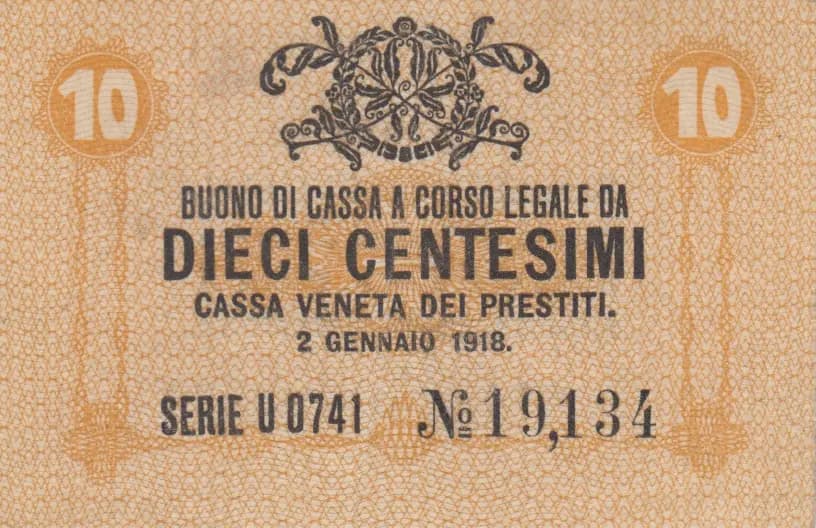
This is a 10 Centesimi military payment note issued by the Cassa Veneta dei Prestiti on January 2, 1918, during World War I. The note displays elegant ornamental design work in black on a light tan/beige background with orange denomination numerals, and is presented in VF (Very Fine) condition with minimal wear and clear, legible printing throughout. This particular example (Series U, No. 19,134) represents an important Italian financial instrument from the final year of the First World War, when regional banks issued emergency currency to support military operations.
Common. The eBay market history demonstrates consistent availability with numerous sales spanning from 2013 to 2025, with VF examples regularly selling in the $2.25-$6.50 range. Current market values in VF condition average $3-$4, well below the $10 threshold that would indicate scarcity. The 2008 catalog values ($1 VF) have appreciated modestly but predictably with inflation. Print runs for Cassa Veneta dei Prestiti emergency notes were substantial, and survival rates remain adequate for the grade. This is a standard collectible military currency note without significant rarity factors.
The Cassa Veneta dei Prestiti (Venetian Loan Bank) issued this note during the desperate final months of World War I, when Italy's financial system required emergency liquidity measures. As a 'Buono di Cassa' (cash voucher), this instrument served as legal tender to facilitate military procurement and personnel payments. The January 1918 date places this note during the critical period following the Italian defeat at Caporetto (October 1917) and preceding the final Italian victory at Vittorio Veneto (November 1918), reflecting the urgent financial needs of the military campaign.
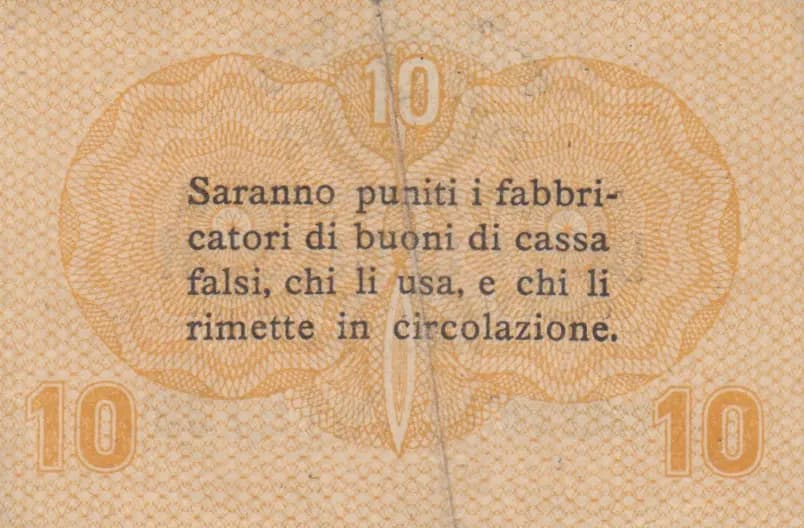
This is a typographically-focused military payment certificate rather than a traditional banknote with portraits or landmarks. The front features an elaborate ornamental coat of arms or institutional seal with scrollwork and floral elements surrounding a central medallion design, positioned prominently at the top center. Large orange/tan denomination numerals '10' appear in both upper corners. The reverse displays the same denomination numerals in all four corners with an ornamental double-lobed frame design centered on the note containing warning text about counterfeiting. A fine geometric crosshatch background pattern appears throughout both sides, serving as a rudimentary anti-counterfeiting measure typical of emergency wartime currency. The tan/beige color, serif typeface, and overall layout emphasize the official, government-backed nature of this emergency tender.
Front Side: 'BUONO DI CASSA A CORSO LEGALE DA' (Legal Tender Cash Voucher For) / 'DIECI CENTESIMI' (Ten Centesimi) / 'CASSA VENETA DEI PRESTITI.' (Venetian Loan Bank) / '2 GENNAIO 1918.' (2 January 1918) / 'SERIE U 0741' (Series U 0741) / 'N° 19,134' (Number 19,134). Back Side: 'Saranno puniti i fabbricatori di buoni di cassa falsi, chi li usa, e chi li rimette in circolazione.' (Counterfeiters of false cash vouchers, those who use them, and those who put them back into circulation will be punished.)
Letterpress (typographic) printing on colored paper stock, with the ornamental designs, numerals, and text all produced through relief printing. The fine geometric crosshatch background pattern was likely applied through either letterpress with a patterned forme or possibly a supplementary printing pass. No intaglio or advanced security printing techniques are evident, consistent with emergency military currency standards of the WWI period. The printer is not identified on the note itself.
This note is catalogued as Pick P-M2 (10 Centesimi denomination). The visual analysis identifies this as Series U, Number 19,134, dated 2 January 1918. The PMG Population Report indicates multiple varieties exist for the broader Cassa Veneta dei Prestiti series (P-M20 through P-M25), covering denominations from 50 Lire to 1000 Lire, though the specific variety designation (whether this is P-M2a, P-M2b, etc.) cannot be conclusively determined from the provided data. No overprints, signatures, or other distinguishing features are noted that would indicate a rare variety within the P-M2 classification.