1 lira 1872
About This Note
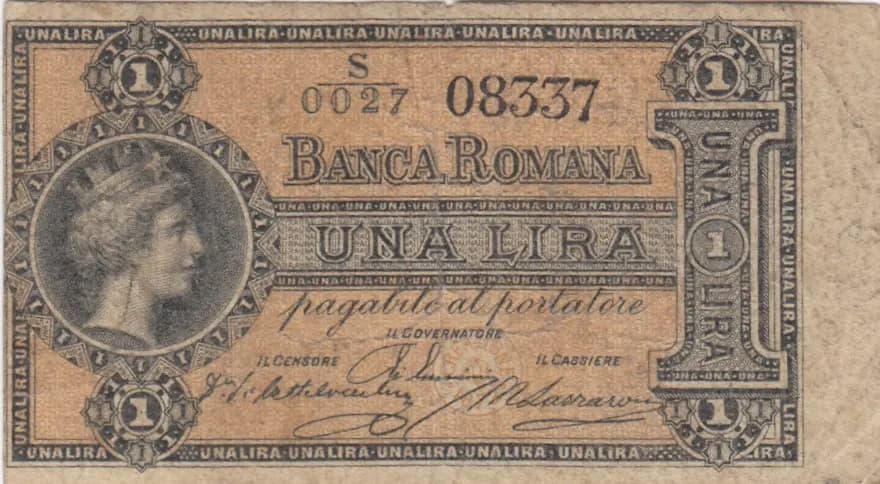
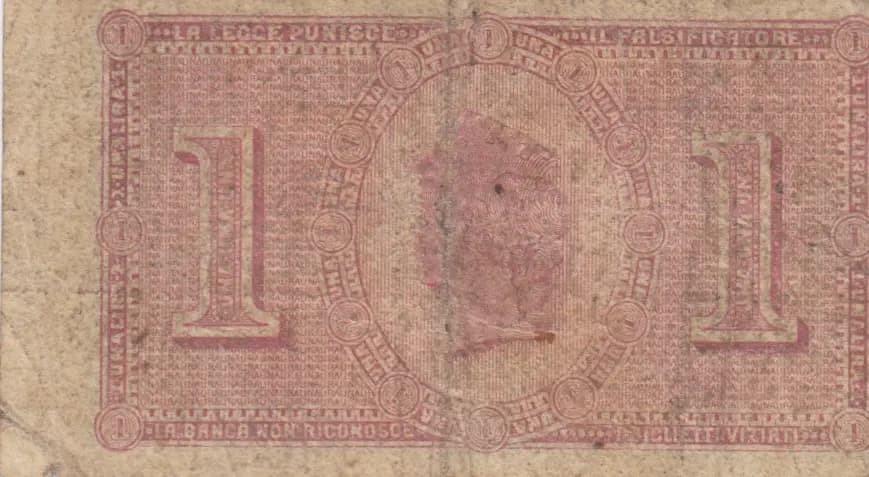
This 1872 Banca Romana 1 lira banknote presents a well-preserved example of early Italian currency from the first decade following national unification. The note features classical allegorical portraits on both obverse and reverse, rendered in fine engraving with ornate corner medallions and decorative borders typical of 19th-century security printing. Despite significant age-related wear including foxing, discoloration, and creasing consistent with over 150 years of circulation, the engraved details remain clearly visible, and the note retains its original tan/sepia and mauve/rose coloring, making it a notable artifact of the Banca Romana's early issuances.
Common. The 1 lira denomination from Banca Romana's 1872 issuance represents a standard circulating denomination from a major Italian bank. The print run for this issue was substantial, given its role as a foundational currency note during early Italian banking consolidation. While the note is now 150+ years old and shows significant age-related deterioration, the VG condition grade indicates it was modestly circulated rather than exceptionally rare or preserved. Early Italian lire in this denomination and from this period remain relatively available in the collector market, particularly in worn grades.
The Banca Romana, established in 1866, was one of Italy's primary note-issuing banks during the critical period of national consolidation following unification in 1861. This 1872 issue reflects the bank's role as a foundational financial institution during the early Kingdom of Italy, when establishing stable currency was essential to national development. The classical allegorical imagery—female and male profiles—reflects 19th-century conventions of portraying national virtues and historical authority rather than contemporary political figures, a common practice in European banking during this era.
The obverse features a classical female allegorical figure (likely representing Italia or a banking virtue) in profile facing right, housed within an ornate circular medallion on the left side of the note. The reverse presents a male classical profile facing left in a central medallion, possibly representing a historical figure or another national allegory. Both sides employ repeating decorative text border patterns and circular corner emblems containing the numeral '1', which also appears as large numerals flanking the reverse design. The denominations are integrated throughout the design rather than prominently displayed, reflecting security printing practices of the era wherein the entire note surface served as an anti-counterfeiting measure. Three signature lines at the bottom of the obverse—Governatore, Censore, and Cassiere—represent the tripartite authority structure of the bank's management.
Front Side: 'UNA LIRA' / 'UN A LIRA' (One Lira - denomination in Italian); 'BANCA ROMANA' (Roman Bank - issuing authority); 'pagabile al portatore' (Payable to Bearer - redeemability clause); 'IL GOVERNATORE' (The Governor - signature line); 'IL CENSORE' (The Censor - signature line); 'IL CASSIERE' (The Cashier - signature line); Serial number: 'S 0027 08337' (security identification). Back Side: '1' (Denomination numeral, repeated in decorative corner emblems).
Intaglio engraving (copperplate or steel plate), evidenced by the fine line work, precise detail in portrait rendering, and complex decorative border patterns visible throughout both sides. The security features—repeating text patterns, ornate medallion frames, and multiple signature areas—are characteristic of high-security banknote production from this era. The Banca Romana's early notes were typically produced by established European security printers, though specific printer attribution for this particular Pick number would require additional archival documentation.
Serial number S 0027 08337 is present on the obverse. The 'S' prefix and specific serial structure may indicate a particular printing batch or series within the Banca Romana's 1872 issuance. Without access to comprehensive cataloging of Banca Romana serial numbering systems, definitive variety classification cannot be confirmed, but the presence of the 'S' designation should be noted for comparative research with other examples of this Pick number. The three signature lines (Governatore, Censore, Cassiere) represent the standard authorized signatories for this issue, with potential minor variations possible due to changes in bank officials during the issuance period.